National News
Cooper will seek U.S. Senate seat being vacated by Tillis

Roy Cooper will lead the North Carolina Democrats’ effort to win a U.S. Senate election for the first time since 2008.
The 68-year-old former two-term governor, four-term attorney general and 14-year state lawmaker indicated Saturday night he will file in December to succeed Republican Sen. Thom Tillis. The state’s senior senator on June 29 said he would not seek a third term.
His comments gave confirmation he had decided to the first report by Politico on Thursday morning. As he took the stage at the party’s state convention, he asked for those running in 2026 to stand, and after they did to be seated.
He said, “Hey, I’m not sitting down am I?” To roars and a standing ovation from the audience.
Cooper went on to laud his accomplishments. He introduced the keynote speaker, Illinois Gov. J.B. Pritzker, who in turn said, “Let’s hear it for Sen. Cooper.”
Cooper is expected to make a more formal announcement on Monday.
Former U.S. Rep. Wiley Nickel since April had been the leading name for Democrats, even as Tillis was not showing intent to exit. Nickel on Friday suspended his campaign, endorsed Cooper and said he was considering a run for district attorney in Wake County.
Sen. Kay Hagan in 2008 was the last Democrat to win a Senate seat in the state. The last Democrats to win midterms were John Edwards in 1998 and Terry Sanford in 1986. Republicans are 5-0 in Senate elections since Hagan’s triumph.
Cooper’s intent was no surprise, and it is likely to mean no competitive primary threats for Democrats in March.
Republicans could be the same. Michael Whatley, the Republican National Committee chairman, is expected to announce his candidacy within days. President Donald Trump has already given his endorsement.
Even before Tillis’ retirement announcement, the seat was one of two for Republicans considered most vulnerable to change in the midterms either within party or to flip blue. Rep. Susan Collins, R-Maine, is in the other.
Cooper, born and raised in the Nash County community of Nashville, claimed gubernatorial wins of Medicaid expansion, cumulative raises of 19% for teachers, and dismantling of the infamous bathroom bill, also known as House Bill 2, that now appears about eight years ahead of its time. The legislation didn’t allow boys and men to enter private spaces of the opposite sex by saying they were girls or women.
His losses are led by universal school choice, photo identification for voting, deregulation and abortion. The national move on the protection of women’s spaces is poised to erode a similar battle he won on HB2.
A lawyer by trade, his “sue until it’s blue” approach put many decisions in courtrooms rather than the Capitol or Legislative Building. The tactic garnered success when the state Supreme Court grew to 6-1 majority Democrats, but lost steam during and after the COVID-19 era as it pivoted to 5-2 Republicans.
Cooper is 13-0 in elections for the state Senate, House of Representatives, attorney general and governor. It’s a far different time for his party than when he won a state House seat in 1986, joining Democratic majorities of 40-10 in the Senate and 84-36 in the House.
Today, it’s Republicans 30-20 in the upper chamber and 71-49 in the lower. Democrats that 21 years ago held 47.6% of voter registrations now (30.6%) trail the unaffiliated (38.3%) and are barely ahead of the Grand Old Party (30.4%).
At a time when elected authority has become questioned as kingship, Cooper holds a state record with 104 vetoes – 52 were overridden – and also doled out 328 executive orders over eight years as governor.
Of four state budgets, he vetoed two, signed one, and allowed one to become law without his signature. He long advocated for big pay raises for teachers and state employees and instead wound up with more veto stamps than signatures and adversary Republicans able to claim giving teachers raises more times than he did.
Cooper left the governor’s office with eight years of promises for 17,708 jobs, along with investments of $31.78 billion. There were collective announcements by Toyota, Apple, FujiFilm Diosynth, Novo Nordisk, Eli Lilly, Wolfspeed, Boom Supersonic, Natron Energy and Boviet Solar. Not all made it.
There was also VinFast, the $1.2 billion taxpayer subsidy recipient with one-time plans for a $4 billion plant in Moncure sporting 7,500 jobs. Reports say VinFast is still coming but didn’t start production as intended last summer.
Analysts: Ending digital service taxes, strict regulations must be part of EU trade deal

President Donald Trump is set to meet Sunday with European Commission President Ursula von der Leyen to continue talks on a trade deal.
Ahead of that meeting, policy analysts say that any agreement on trade must include the removal of non-tariff regulations and digital service taxes that largely target U.S. tech and communications companies.
Joe Grogan, president of Public Policy Solutions and former Domestic Policy Council chief in the first Trump administration, told The Center Square in a statement that, “For decades, the European Union has attacked the United States with unfair regulations, taxes and fees. Given America’s tech leadership, our digital policy is trade policy, and any trade deal should address non-tariff barriers like digital services taxes to end the protectionist approach to these American innovators. To pay more than lip service to freedom and free markets, the EU must remove its burdensome bans and regulations on American companies.”
Digital service taxes (DSTs) are taxes levied by countries on gross revenues of international companies rather than on the companies’ profits, according to the Tax Foundation. They are meant to force large U.S.-based companies such as Google, Amazon, Meta, streaming services and others to contribute to a country’s tax base even if they don’t have physical operations in those countries.
In a report released last month, Public Policy Solutions said European countries target U.S. technology and telecommunications companies in three primary ways: they promote “purchases with European digital companies instead of facilitating a free market;” they force U.S. digital companies to pay high fees and taxes; and they place “burdensome regulations and restrictions” on them.
Canada last month considered a digital services tax on U.S. companies but quickly backed off, realizing it would escalate the ongoing trade dispute between the two border nations.
Michael Toth, a research fellow at the Civitas Institute at the University of Texas at Austin, similarly told The Center Square that eliminating Europe’s digital services taxes and regulatory burdens must be a part of any U.S.-Europe trade deal.
“They’re looking at these American companies like an ATM,” Toth said. “‘So why not tax these businesses in other countries instead of our own.’ It impacts [American companies’] bottom line. It means they have these additional costs just for the privilege of doing business there” in Europe.
Toth said the Trump administration is using the threat of tariffs on European goods imported into the U.S. to help level the playing field.
“What the administration is saying, ‘hey wait a second. Everyone wants to do business with American companies.’ So we have a lot of leverage,” Toth said. “That’s not something our companies should have to pay for. It should be a big part of any deal that comes together.”
Toth also told The Center Square that European countries penalize American companies for not following Europe’s excessively burdensome environmental and other regulations.
“When EU regulators hit Apple and Meta with $800 million in fines last month, a Meta spokesperson called out the European money grab for what it is – ‘a multi-billion-dollar tariff’ on American companies,” Toth wrote in The Hill in June.
“These fines do not take into account the enormous day-to-day compliance costs that U.S. firms must pay for the privilege of doing business in the Eurozone. Staying on top of EU digital rules runs Alphabet, Apple, Meta, Amazon and Microsoft $2.2 billion annually. American companies are forecasted to forgo more than $2 trillion of revenue due to Europe’s massive regulatory burden.”
Toth told The Center Square that these regulations also need to be addressed in any trade deal.
“The administration is smart to hit the reset button,” he said. “The EU markets will then be much more open to American products.”
As Texas becomes 7th state to ban lab-grown meat, Trump’s FDA, USDA advance it

Texas will become the seventh state to ban the production and sale of lab-grown meat in September.
Florida was the first, followed by Alabama last year. This year, five more states, including Texas, followed.
They did so after the Trump administration took the opposite approach. In 2019, the first Trump administration was the first in U.S. history to begin the process to authorize lab-grown chicken, seafood and beef in the U.S.
In 2023, under former President Joe Biden, the U.S. became the second country in the world to approve the production and sale of lab-grown meat.
Recognizing the importance of the Texas cattle industry and health concerns expressed by Texans, state Sen. Charles Perry, R-Lubbock, filed SB 261 to ban the sale of lab-grown meat in Texas. The bill, which includes civil and criminal penalties, received bipartisan support and was signed into law by Gov. Greg Abbott last month. It becomes effective Sept. 1.
“The introduction of lab-grown meat could disrupt traditional livestock markets, affecting rural economies and family farms,” Perry’s bill analysis states. “There are concerns over transparency in labeling, risk of contamination, and the long-term health impacts of consuming cell-cultured products.” The measure prohibits the production and sale of cell-cultured protein products in Texas “to protect consumers and support traditional agriculture.”
“Cell-cultured protein is made by harvesting animal cells and growing them in a bioreactor to produce tissue-based food products,” the analysis explains.
Earlier this year, the Texas legislature passed a resolution officially recognizing a “State Steak of Texas,” highlighting Texas as “the birthplace of many iconic culinary traditions, including those tied to cattle drives, chuck wagons, and steak houses, all of which have cemented steak as an integral part of the state’s culture and cuisine,” The Center Square reported.
Texas remains the undisputable leader with the most beef cattle in the U.S., representing nearly 15% of the national beef market, The Center Square reported. Texas cattle, including beef and dairy, are Texas’ top agricultural commodity, representing $15.5 billion in market value in 2022, according to state agriculture data.
Florida Gov. Ron DeSantis was the first governor in the country to sign a lab-grown meat ban last year in an effort to protect the state’s cattle and agricultural industry. Alabama wasn’t far behind.
This year, five more states followed. In February, South Dakota’s governor signed its ban into law. In March, Mississippi’s ban was approved. In May, Nebraska’s ban was signed into law. In July, Indiana implemented a two-year ban on lab-grown meat.
Georgia attempted to implement a ban this year, HB 201, which went nowhere this legislative session. Arizona passed a bill this year, HB 2739, requiring labeling on all cell-grown products.
State legislative action was taken after the first Trump administration’s departments of Agriculture’s Food Safety and Inspection Service and Health and Human Services’ Food and Drug Administration announced a formal agreement to jointly oversee the production of human food products derived from the cells of livestock and poultry. The regulatory framework directed the FDA to oversee “cell collection, cell banks, and cell growth and differentiation.”
By 2023, the Biden administration continued the Trump administration’s work. Its FDA and USDA approved California-based Upside Foods and Good Meat to sell cell-based chicken products, which are currently being sold in restaurants nationwide.
Upside Foods sued Florida last year arguing its ban is unconstitutional. A federal judge allowed the lawsuit to go forward this April. It remains unclear if the California company or others like it will sue the seven states that have so far implemented bans.
Last month, the second Trump administration continued the efforts it began in 2019 when the FDA and USDA approved a San Francisco-based cell-based seafood company Wildtype to market its products that are currently being served in restaurants. It was approved after agri-giant Cargill and partners invested more than $100 million to launch an “alternative to salmon,” Just Food reported.
Although the U.S. began its process in 2019, Singapore was the first country in the world to officially authorize the production of lab-grown meat in 2020. The U.S. was the second in 2023.
Last year, Israel became the third after an Israeli company, Aleph Farms, received approval to sell lab-grown meat in Israel and the Middle East. Several European countries are also moving toward approving lab grown meat, according to several news reports.
Report: Feds allowed 1,000s of juvenile gang members, criminals to become citizens
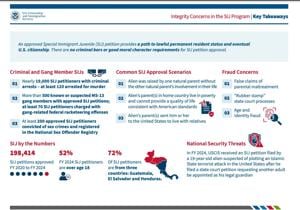
Congress has created several programs to allow illegal border crossers claiming to be minors to remain in the U.S. Despite years of documented abuse of the programs, Congress continues to fund them to the tune of billions of dollars.
One is the failed unaccompanied minor program, with decades of documented reports of abuse and neglect of children, The Center Square has reported. Another is the Special Immigrant Juvenile Petition (SIJP) program that allows illegal foreign national minors already involved in the juvenile court system to remain in the U.S. and obtain a pathway to citizenship.
For decades, the SIJP has been exploited by criminal actors to enable thousands of violent gang members and suspected terrorists to obtain lawful permanent resident (LPR) status and become U.S. citizens, the U.S. Citizenship and Immigration Services (USCIS) says in a new report, “Criminality, Gangs, and Program Integrity Concerns in Special Immigrant Juvenile Petitions.”
Instead of requiring that illegal foreign national minors be vetted, including conducting criminal background checks, locating and verifying family members, and implementing a repatriation process, Congress in 1990 established the SIJP process without any prohibitions. The primary requirement for a SIJP is for a state juvenile court to determine that the minor could not reunify with one or both parents due to abuse, neglect or abandonment.
Congress never included a prohibition for juveniles with criminal records or a moral character standard requirement.
Under current law, nearly all SIJP applicants are approved, allowing them to obtain lawful permanent resident (LPR) status and eventually U.S. citizenship.
The USCIS evaluated more than 300,000 SIJP applications filed between fiscal year 2013 through February 2025 and found that nearly 19,000 applicants had criminal arrests, including 120 for murder.
More than 500 were identified as known or suspected MS-13 gang members whose applications were approved; at least 70 had been charged with gang-related federal racketeering offenses.
At least 200 had been convicted of sex crimes and were registered in the National Sex Offender Registry.
From fiscal 2020 through 2024, 198,414 SIJP applications were approved. Among them, 52% weren’t even eligible because they were over age 18 and legally adults.
The overwhelming majority, 72%, were from Guatemala, El Salvador and Honduras, where cartels and gangs recruit young boys into a life of crime.
The USCIS report also found that many SIJP applicants were gotaways – those who illegally entered the U.S. to evade detection and didn’t file immigration claims. A record more than two million gotaways were reported under the Biden administration, The Center Square exclusively reported.
The USCIS also found that 853 SIJP applicants were known or suspected gang members. Instead of being processed for deportation, their SIJP applications were approved. More than 600 were identified as MS-13 gang members; more than 500 of their applications were approved.
More than 100 known or suspected members of the 18th Street gang, at least three Tren de Aragua members, and dozens of Sureños and Norteños gang members applied for SIJP and were approved.
Of the MS-13 gang member SIJP applicants, at least 70 had already been charged with federal racketeering offenses; many others were charged with having already committed violent crimes in the U.S., the report found.
Common claims made by SIJP applicants were they were sent to the U.S. to live with a relative, they lived a life of poverty in their home country, they didn’t know one of their parents, their parents mistreated them with no corroborating evidence, their applications were “rubber stamped” by state juvenile courts, and USCIS found a repeated pattern of age and identity fraud, including falsifying names, birth dates and citizenship.
In June, the Trump administration implemented a new policy, eliminating automatically considering deferred action (and related employment authorization) for SIJP applicants who were ineligible to apply for LPR status, among other measures.
The administration and Congress have not terminated the SIJP and continue to fund it.
WATCH: Newsom accuses Trump of gerrymandering in Texas

Warning of a “five-alarm fire for democracy,” Gov. Gavin Newsom Friday suggested the possibility of California redrawing its congressional districts in response to actions in Texas.
“We’re looking at different pathways. There are no maps drawn,” Newsom told reporters as he stood outside the Capitol in Sacramento with Democratic members of the Texas House of Representatives.
The Republican-dominated Texas Legislature is holding redistricting hearings in response to Republican President Donald Trump’s call for new congressional districts. Trump, who discussed the matter with Republican Texas Gov. Greg Abbott, told reporters the GOP could gain five more seats in the U.S. House.
Republicans currently have a narrow majority in the House with 219 seats. Democrats could take control by flipping a few seats. Republicans also face the historic pattern of the party in control of the White House losing control of one chamber of Congress during the first midterm.
In determining the number of congressional seats, all states should play by the same rules, Newsom, a Democrat, said.
“That’s no longer the case, not with Donald Trump, not when he makes a call to the governor of Texas and talks about finding five additional seats so he can hold the line and control the majority of the House of Representatives,” Newsom said.
“The people of California realize what’s at stake if we don’t put a stake into the heart of this administration,” Newsom said. “There may not be an election in 2028.”
In a post on X, Newsom warned of Trump trying to redistrict the GOP to victory in 2026.
Opponents of the administration’s policies can’t afford not to act, Newsom said at the news conference. “We have to fight fire with fire.”
Later at the outdoor press conference, as a fire engine coincidentally rushed by with its siren blaring, the governor added, “It’s a five-alarm fire for democracy.”
Texans are experiencing an assault on their democracy, Newsom said.
If Texas redraws congressional district lines, California has the option of bringing a ballot measure to ask voters to do likewise, Newsom said, but added various pathways are being considered. What might go on the ballot hasn’t been determined, he said.
“This is a fluid conversation that came in reaction to the phone call from Donald Trump to Greg Abbott,” Newsom said.
The governor also criticized the administration for what he called illegal tariffs, threats of conditioning disaster aid on the basis of politics and what he called the “warrantless raids” across California by U.S Immigration and Customs Enforcement agents.
Before Newsom spoke, Texas state Rep. Rafael Anchía accused Trump of trying to dismantle congressional districts that historically consists of African-American and Latino communities.
“It will create great harm, not only to Texas, but all Americans,” Anchía said.
Before Newsom’s press conference, state Sen. Tony Strickland, R-Huntington Beach, said states shouldn’t consider redistricting at any point other than the traditional 10 years between censuses.
“I think it’s a long, slippery slope for a state to do it,” Strickland told The Center Square Friday. He noted it should only be done when there’s a voting rights issue.
“What will happen is every two years, you’re going to have a power grab from all the states within the union, and I don’t think that’s good for democracy,” Strickland said.
When asked if a redistricting attempt in Texas would amount to gerrymandering, Strickland said, “I think gerrymandering happens all the time. The difference between Texas and California is Texas doesn’t have an independent citizens’ commission.”
Since 2010 in California, redistricting has been handled by an independent commission.
“By the way, I think our lines are gerrymandered,” Strickland said. “Republicans get 40 to 42% of the vote, yet we have 20% of legislative seats.
“I think he (Newsom) will have egg on his face” if California is redistricted, Strickland said. He predicted that if Newsom got California four more seats in Congress, those seats would be held by Republicans.
While noting Texas and California shouldn’t do redistricting, Strickland was critical of Newsom for focusing on national issues instead of matters related to the state.
Strickland said he believes Newsom’s attention is on running for president in 2028. The governor hasn’t announced his candidacy, but is widely believed to be eyeing the White House.
“He’s not addressing the issues that the people of California expect us to address: gas prices, affordability,” Strickland said. “Our crime is on the rise.”
Republicans target China as security threat to U.S. real estate, schools, farmland

With the southern border crisis largely eliminated, Republicans and the Trump administration are setting their sights on China as the next major threat to U.S. domestic security.
Long considered a foreign adversary, China has been making inroads in nearly all sectors of American society, including real estate, universities, agriculture, and even the legal system. Reports released just over the past month show the spread of China’s influence.
One report showed that Chinese nationals made up the top percentage – 15% – of foreign buyers of U.S. homes from April 2024 to March 2025. That amounts to $13.7 billion worth of existing homes in the U.S. getting sold to Chinese nationals, some still residing abroad, as The Center Square reported.
Higher education institutions like the University of Michigan have had multiple Chinese foreign exchange students arrested for activities including spying on U.S. military bases, smuggling dangerous biological pathogens, and illegally voting in the 2024 presidential election.
An even greater source of concern for Republicans is the amount of U.S. farmland that Chinese entities – some of whom are connected to the Chinese Community Party – now own. According to a federal report released earlier this month, Chinese investors own at least 277,335 acres of agricultural land across 30 states, as The Center Square reported.
U.S. Department of Agriculture Secretary Brooke Rollins has pledged the Trump administration will “restore farm security and expose the extent to which our adversaries have targeted American agriculture.” She also recently launched a National Security Farm Action Plan to protect American agriculture.
Two Republican lawmakers plan to help with that effort. U.S. Sen. Josh Hawley, R-Mo., and U.S. Rep. Mary Miller, R-Ill., introduced the Protecting Our Farms and Homes from China Act in their respective chambers this week.
The legislation would ban Chinese companies and individuals affiliated with the CCP from buying agricultural land in the U.S. and require such parties who already own U.S. agricultural land to divest of it within one year.
Those parties would also have to divest of any U.S. residential real estate currently owned, and any residential real estate in the U.S. would be off-limits to CCP-affiliated buyers for the next two years. The president could renew that prohibition biennially.
“China’s goal is simple: control our food production, control our land, and weaken America from within,” Miller stated Friday on X. “We are not going to let that happen.”
Hamadeh introduces bill addressing VA health care staffing

Editor’s note: This story was updated Friday afternoon.
U.S. Rep. Abe Hamadeh, R-Arizona, is sponsoring a bipartisan bill to address staffing shortages at the Veterans Health Administration.
The Health Professionals Scholarship Program Improvement Act of 2025 would amend Section 7616 of Title 38 and “enhance the educational occupational program to address staffing shortages” within the VHA. The bill was approved Wednesday by the House Veterans’ Affairs Committee.
“From what I am told, staffing shortages in the Veterans Health Administration are driven by two main factors: high demand for veteran healthcare and persistent challenges in recruiting and retaining qualified staff, especially medical officers and nurses,” Hamadeh told The Center Square, answering questions by email. “In fact, according to Inspector General reports, well over 80% of VA facilities have severe medical officer and nursing shortages.”
Hamadeh added that “part of this gap is the result of bureaucratic red tape” in the onboarding process for healthcare workers.
“Healthcare providers are unable to fill open positions in a timely manner so veterans must wait longer for care,” said Hamadeh, a former U.S. Army Reserve captain and intelligence officer. “That is unacceptable.”
When asked how long veterans are waiting for health care, Hamadeh described it in two words: too long.
“And I want to be crystal clear about this: For far too long, timely access to care has been the VA’s Achilles’ heel,” Hamadeh continued.
The representative applauded what he called “major progress under Secretary Doug Collins’ leadership,” but said the truth is that “the VA was set back so much under the Biden Administration” that there is still work to be done.
“And because of the constant shortage of physicians and nurses, far too many veterans can’t get care when they need it,” said Hamadeh. “That is exactly why I introduced the HPSP Improvement Act. We have to cut the red tape and get qualified healthcare professionals into VA clinics, so our veterans never have to wait too long for the care they have earned.”
If the government does nothing, Hamadeh said wait times will grow, quality of care will decrease, and the health of U.S. veterans will be sacrificed. That, said Hamadeh, is not something the government should do to those who have served their country.
“The Congressional Budget Office (CBO) has reviewed my Health Professionals Scholarship Program Improvement Act, as amended, and determined it would have ‘insignificant budgetary effects’ for taxpayers,” said Hamadeh. “My bill is designed to make the system work better without adding new costs to federal spending or burdens on taxpayers.”
Also known as H.R. 3767, the HPSP Improvement Act of 2025 is co-sponsored by U.S. Rep. Nikki Budzinski, D-Illinois.
“The bipartisan Health Professionals Scholarship Program Improvement Act would streamline the path for HPSP participants to start working full-time and make it easier for veterans to get the care they need,” said Budzinski in her own press release.
When asked whether he’s had discussions with the other Arizonans representing the state on Capitol Hill, Hamadeh said he has spent most of his time listening to his fellow veterans’ stories, concerns and hopes about what Congress should do for them.
“When it comes to veterans’ issues, I don’t care about party lines,” Hamadeh told The Center Square. “Every veterans’ bill I have introduced has been bipartisan, and it is not by mistake. I believe in results, and I will work with anyone — Democrat or Republican — to ensure we keep our promise to America’s veterans and turn positive changes into real improvements.”
Trump administration to release all $6.8B in education funds

The Trump administration announced Friday it will release all previously withheld $6.8 billion in education funds back to the states.
Since July 1, education departments across the country have been urging the administration to unfreeze the funds.
Twenty-four states and the District of Columbia sued the administration, calling this freeze unconstitutional, unlawful and an arbitrary decision.
Though the administration released some of the education funds, after 25 days of relentless bipartisan pushback, the administration is now announcing it will release the remaining $5.5B.
The Office of Management and Budget “has directed the Department to release all formula funds,” according to Madi Biedermann, deputy assistant secretary for communications at the Education Department. “The agency will begin dispersing funds to states next week.”
After this announcement, education organizations are still speaking out against what they call administration’s reckless actions in delaying crucial education funding.
“Playing games with students’ futures has real-world consequences. School districts in every state have been scrambling to figure out how they will continue to meet student needs without this vital federal funding, and many students in parts of the country have already headed back to school,” said National Education Association President Becky Pringle. “These reckless funding delays have undermined planning, staffing and support services at a time when schools should be focused on preparing students for success.”
Colorado sues sheriff’s deputy for allegedly working with ICE

Colorado Attorney General Phil Weiser has filed a lawsuit against a Colorado sheriff’s deputy, holding him liable for allegedly cooperating with federal immigration officials.
Weiser made the announcement on Tuesday.
“Colorado Law is clear: it is illegal for local law enforcement to carry out federal civil immigration enforcement,” he posted to social media. “And in Colorado, we do not allow the federal government to commandeer local resources for their own agenda.”
Weiser is suing Deputy Alexander Zwinck of Mesa County for allegedly working with federal immigration officials to detain a 19-year-old illegal immigrant with an expired visa.
The lawsuit, which was filed in Mesa County District Court, states Zwinck had no right to share, or inquire into, the driver’s personal identifying information for the purpose of assisting with federal civil immigration enforcement.
It asks that the court issue an order to prevent Zwinck from “similar unlawful conduct” moving forward.
The incident first started on June 5, when Zwinck pulled over the woman for following too close to a semitruck. She then provided him with her driver’s license, vehicle registration and insurance information, which Zwinck then allegedly uploaded to a Signal group chat, which included federal immigration officers.
“Instead of ending communications with officials on the group chat since there were no criminal matters to follow up on, Deputy Zwinck proceeded to assist the federal immigration officers in detaining the driver,” Weiser’s office said in a press release. “According to the state investigation, Deputy Zwinck provided his location to the federal immigration officers on the chat who indicated that they were on the way.”
Zwinck allegedly stalled the driver, before messaging federal immigration officers with a description of her car, her vehicle’s license plate number and the direction she was traveling once she left. She was later picked up by U.S. Immigration and Customs Enforcement officials.
“In this case, the driver was detained by immigration authorities because of actions by Colorado law enforcement despite the absence of any criminal activity on her part,” Weiser said. “Her detention for over two weeks is directly due to this violation of Colorado’s laws.”
The Mesa County Sheriff’s Office has also begun an administrative investigation into the incident.
The state alleges this was not the only instance of Zwinck assisting ICE officials and that it is investigating the other law enforcement officers who might have been involved in the Signal chat.
“Because of this action, we are making clear that Colorado law enforcement’s role is to advance public safety, not take on the responsibility of doing the work of federal immigration enforcement,” Weiser said.
This comes as Colorado and its capital city Denver have been under scrutiny for their so-called sanctuary city policies, which limits their cooperation with federal immigration authorities.
Notably, Denver Mayor Mike Johnston joined four other sanctuary city mayors in testifying before a U.S. House Oversight and Government Reform committee in March on the issue, as previously reported by The Center Square.
“Mike Johnston had every opportunity to condemn and change his city’s sanctuary policies,” U.S. Rep. Lauren Boebert, R-Colorado, said on social media on Wednesday. “He refused. Denver is a SANCTUARY CITY that makes all Coloradans less safe.”
USDA to relocate thousands of employees, consolidate agency functions

In the coming months, the U.S. Department of Agriculture will relocate more than half of its Washington D.C.-based employees to five different regional hubs across the country.
The move is part of USDA’s larger plan “to achieve improved effectiveness and accountability, enhanced services, reduced bureaucracy and cost savings for the American people,” according to the announcement memo.
Approximately 4,600 USDA employees currently reside in D.C., a growth of 8% over the past four years. With a nearly 15% salary increase during that time as well, the Trump administration says the USDA Department Reorganization plan will ensure that the agency can afford its workforce.
USDA Secretary Brooke Rollins estimates that roughly 2,000 employees will be left in D.C. after the relocations are complete. The other 2,600 will disperse to one of USDA’s five regional hub locations, located in Raleigh, North Carolina; Kansas City, Missouri; Indianapolis, Indiana; Fort Collins, Colorado; and Salt Lake City, Utah.
The agency also will end some leases and vacate some buildings in the D.C. area, as well as reduce regional office management layers. Core administrative support locations in Albuquerque, New Mexico and Minneapolis, Minnesota will remain operational.
Additionally, management of civil rights functions, legislative affairs, Freedom of Information Act responses, human resources, and leases will each be consolidated under different offices.
Rollins said the reorganization will bring the USDA “closer to the people it serves.” She intends to ensure that the transition works “as smooth and as minimally disruptive as possible” for affected USDA staff and their families.
“We will carry out this reorganization through a transparent, common-sense process that preserves USDA’s critical health and safety services that the American public relies on,” Rollins said. “We are embarking on a new chapter that will improve our service to the great patriotic farmers, ranchers, and producers that we are mandated to support.”
While most Republicans view the move as a fiscally responsible way to efficiently manage resources, Democrats have blasted it as reckless.
“The planned reorganization announced by the Agriculture Secretary without notice or input from Congress or key stakeholders and constituencies demonstrates that this administration … is willfully risking the effectiveness of the agencies and programs that support America’s family farmers,” House Agriculture Committee Ranking Member Angie Craig, D-Minn., said.
Since the second Trump administration took office, 15,364 USDA employees have voluntarily chosen deferred resignation. In 2024, the agency’s workforce numbered nearly 100,000 individuals.