National News
Person of interest in custody in deadly Brown University shooting

A “person of interest” is in custody in connection to Saturday’s shooting at Brown University that left two people dead and nine others injured, authorities said Sunday morning.
The person of interest was apprehended at a hotel in Coventry, Rhode Island, just southwest of the Providence-based campus, multiple news outlets reported. Few other details were released as of mid-morning.
Saturday night, local law enforcement described the suspect as a male wearing all black who opened fire in Barus & Holley Building during final exams in the afternoon.
The campus and Providence had been placed on lockdown, but that ended Sunday morning when the person of interest was taken into custody.
“We are able to report that we have detained a person of interest involved in yesterday’s shooting,” Providence Mayor Brett Smiley said at a Sunday morning news conference. “I want to let the Providence community know we are lifting the shelter-in-place.”
Of the nine people injured in the mass shooting, seven are in stable condition, Smiley said, one is in critical condition, and one was released from the hospital. Authorities were not yet ready to release information about the victims, Smiley said.
Colonel Oscar L. Perez, Jr. of the Providence Police Department said authorities could not release many details as the investigation is ongoing. Perez said as of the Sunday morning news conference, police are not looking for any other suspects.
Roughly 11,000 students attend the Ivy League university established in 1764. Brown University said it would be issuing a series of announcements regarding this week’s campus schedule.
President Donald Trump told Fox News from the White House that he’d been “fully briefed” on the situation. Rhode Island Gov. Dan McKee confirmed he’d been in touch with the president, as well, and the FBI is assisting with the investigation.
“What a terrible thing it is,” he said. “And all we can do right now is pray for the victims.”
Economists question necessity of farm bailout, say tariffs don’t help

The Trump administration last week announced it would be giving about $12 billion in direct cash assistance to American farmers, similar to how it assisted farmers in 2018 – only, its stated reasons for doing so are different.
At a roundtable, Secretary of Agriculture Brooke Rollins said Biden-era policies had plunged farmers into “one crisis after another” and the new Farmer Bridge Assistance program was meant to transport them from a tumultuous present to a more prosperous future.
“This bridge is absolutely necessary, based on where we are right now,” Rollins said. “[This is] the bridge that is needed to get from the last administration and what basically happened under the last president… to this new golden age for farmers.”
The first Trump administration also provided American farmers with a bailout of $12 billion in taxpayer dollars, only that time, it said the disbursement was needed as a temporary buffer while the administration worked out better trade deals. The bailout was described as “a short-term relief strategy to protect agricultural producers while the Administration works on free, fair, and reciprocal trade deals to open more markets,” according to a Department of Agriculture press release at the time.
Even though President Donald Trump has brought a renewed intensity to tariff and trade policy in 2025, the farm economy is in a different place, according to senior research fellow at the International Food Policy Research Institute, Joseph Glauber – which could account for the difference in messaging.
In 2018, when the first supplemental aid package was announced, the farm economy had endured more sustained losses.
“Back in 2018 you really did see some big trade losses… and they were sustained, right? They lasted a year and a half, or almost two years,” Glauber said.
But American farmers have received a lot of supplemental aid since 2018, in addition to that first payout.
Farmers received additional financial assistance during the COVID-19 pandemic, as did most segments of the American economy, amounting to about $57.7 billion in 2020 alone, according to a USDA working paper.
“We find $57.7 billion in total financial assistance was provided to farm operations and households in calendar year 2020,” the paper reads. “Programs specifically designed to address the economic impacts of COVID-19 in 2020 delivered an estimated $35.2 billion, the assistance provided under non-COVID-19 related programs (other than net indemnity payments) delivered an estimated $16.8 billion, and the net indemnity payments provided the remaining $5.7 billion.”
The Agriculture Department is also given broad authority under the Commodity Credit Corporation Charter Act to issue discretionary agricultural support payments of up to $30 billion per year, in addition to the regular funding, insurance and disaster assistance provided by the Farm Bill. (Congress can also authorize more if needed.) The Act was passed in 1933 as an emergency relief measure to help farmers during the Great Depression. Like many other New Deal programs such as Social Security, it remains in effect today.
As a result of these additional disbursements in recent years and shifts in global food markets, the American farm economy overall is in a better position, according to Glauber.
“If you concentrate on farm income, which is the big, big number that includes both livestock and crop producers, that’s pretty good and is higher than the 10-year average,” Glauber told The Center Square. “By a lot of measures like that, it’s pretty good.”
Glauber said land values, too, would likely reflect signs of a crisis if the farm sector was, in fact, facing a crisis that most American farmers “haven’t seen in their lifetime,” as Rollins described it.
“If the farm sector were in a serious downturn, you would think that land values would be falling. They haven’t been. They’ve actually been holding fairly firm,” Glauber said.
Crop farmers have been hurt by recent government policy, but because of the infusion of supplemental assistance the sector has seen since 2018, they likely suffered worse during the recession in 2009 or in the 1980s when they didn’t have that kind of assistance, according to Glauber.
Ryan Young, senior economist with the Competitive Enterprise Institute, said much of the damage that has been done to the farm sector comes from tariffs both from Trump’s first and second terms – and former President Joe Biden could have improved things for farmers if he had undone some of them.
“Two wrongs don’t make a right. That’s the main point. President Trump’s tariffs got farmers in this mess in the first place. The solution is to remove the tariffs, not to try covering up that mistake with a taxpayer-funded bailout,” Young told The Center Square.
Tad DeHaven, policy analyst with the Cato Institute, called attributing farmers’ current challenges to the Biden administration “laughable” due to the fact that the Trump administration’s choice mirrors the bailout in the president’s first term, before Biden had been president.
“Certainly the Biden administration was responsible for a good part of the inflation that we went through,” DeHaven told The Center Square. “The first Trump administration initiated a trade war and they lost. Farmers lost market access. They got a bailout.”
Congress drags on full year funding bills, risking second govt shutdown
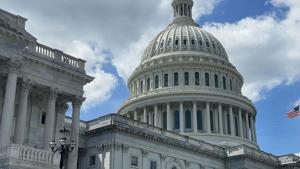
Despite only having until the end of January to pass the remaining nine annual government funding bills, Congress has so far made minimal progress.
The U.S. House is not planning on advancing anything before its Christmas recess, with all of leadership’s focus currently on a healthcare policy plan.
Republicans unveiled the text of the plan – the Lower Health Care Premiums for All Americans Act – Friday night, a counterproposal to Democrats’ failed bill to extend the Obamacare Premium Tax Credits.
The Senate, meanwhile, is currently stuck on a proposed five-bill minibus due to a couple of recalcitrant Republicans fighting over earmarks within some of the appropriations bills.
Congress has only seven weeks to find a solution before the government runs out of money, and it can take two to three weeks to pass appropriations bills through both chambers even after the text is agreed to.
The minibus, which hasn’t been publicly released yet, purportedly has $5 billion in earmarks.
The package includes fiscal year 2026 funding for federal agencies that handle Transportation and Housing and Urban Development; Defense; Labor and Health and Human Services; Commerce, and Justice, Science; and Interior.
Most federal government agencies are still running off of appropriations levels from fiscal year 2024. Congress never passed a real budget in fiscal year 2025, instead punting forward the shutdown deadline via three consecutive Continuing Resolutions.
The government then shut down Oct. 1, when Democrats refused to vote for a fourth CR due to Republicans’ refusal to extend the expiring enhanced Obamacare subsidies.
After a record long 43-day shutdown, enough Democrats voted to reopen the government by passing a CR. Congress also passed a three-bill minibus that same day, which knocked out three of the twelve fiscal year 2026 appropriations bills.
It authorized full-year funds for Military Construction and Veterans Affairs; the Food and Drug Administration, Agriculture and Rural Development; and the Legislative Branch. Agencies covered under the remaining nine bills – including those in the five-bill minibus currently under consideration – are covered by the CR.
This means that if Congress does not pass those bills in some form by Feb. 1, the end date of the CR, they risk a partial government shutdown.
Exclusive: First Nation reservation grappling with transnational crime

A First Nation reservation located in upstate New York and extends into Canada says it is grappling with transnational and illegal border crosser crime. One of its law enforcement chiefs came to Texas seeking help.
Ranatiiostha Swamp, chief of police of the Akwesasne Mohawk Territory, spoke with The Center Square in an exclusive interview about the challenges his community faces while joining an Operation Lone Star Task Force operation in south Texas.
His territory, which straddles the international border, has been a target of human, drug and weapons smuggling, as well as other crimes, The Center Square reported.
The territory borders the Canadian Cornwall Port of Entry, includes Cornwall Island and smaller islands on the St. Lawrence River, and a coastal region of Quebec. In the U.S., it borders the Massena POE in upstate New York, and the northernmost parts of Franklin and St. Lawrence counties. Cornwall, Ontario, is roughly a 20-minute drive to Massena; Ottawa to Messena is roughly a 1.5-hour drive. To reach either city, travelers, including residents, must go through the reservation.
Chief Swamp has jurisdiction in the province of Quebec and Ontario and transits through New York State. The reservation also has a chief of police on the New York side who receives grants to work with U.S. Homeland Security and Border Patrol. Swamp’s jurisdiction includes the St. Lawrence River; the vast amount of his region is divided by water. Because of the vast region and lack of resources, despite their best efforts, they are limited in law enforcement efforts, he says.
Each side of the reservation falls under different laws, Canadian and American, including a political, judicial and currency system. The international border divides the reservation. “The only thing that we share is our culture,” he said. Every morning, they say a prayer of unity and thanksgiving, “Ohen:ton Karihwatehkwen,” to bring their mind together as one, he said. “That is what we’re doing today,” he said, when coming to Texas to seek solutions.
Their community is facing increasing criminal threats, he said.
“Mexican cartels are buying up property along the border, that’s primarily what we’re seeing from where I’m from. It’s all on the U.S. side where they’re buying up all the farmlands connected into different farms,” Swamp said. “We’re working with U.S. Border Patrol and state police in our area.” The properties being purchased are in strategic locations where open farmland provides easy access to cross the river, he said.
He’s working to create memorandum of understandings with law enforcement agencies “to have some border law enforcement patrol on land. We have had a shiprider [maritime law enforcement cooperation] come through on the moving area on the water. I’d like to incorporate that same concept and bring it to” law enforcement cooperation on land in Canada, he said.
Dwayne Zacharie, president of First Nations Chiefs of Police Association and Chief Peacekeeper of the Kahnawake Peacekeepers, oversees law enforcement operations on a reservation roughly an hour from Montreal. “Where we are located, all of the land around us is farmland where many of the workers are migrants from Guatemala, Mexico, India and other countries. They’re coming to Canada and into our community,” also connected to an illicit tobacco trade, he said where organized criminal organizations have seized on an opportunity.
“More and more and more, our community is being inundated by immigrant traffic,” Zacharie said. “We’ve had a number of contacts from a Homeland Security office in Montreal about what they’re seeing in Montreal. The immigrants are illegal, so we see this influx in our community and all of these impacts lead to other statistics: theft, fraud, vehicle theft, all of these things are starting to rise.”
The reservations’ designations have existed since the 1700s but all of a sudden these communities are experiencing a wave of crime from illegal immigration, he said. “We’re not big, but we are in the middle of all of this. We see what the impacts are, and we see where the hole is. We see that there’s a lack of understanding at the federal and provincial level about how to combat the issue that we’re all facing.” After meeting with OLS Task Force sheriffs in Texas, he’s hoping to develop solutions and form new partnerships.
The police chiefs face legal and prosecutorial constraints stemming from the Indian Act and Immigration and Protection Act, they argue, which contribute to lack of border enforcement. Another is not receiving funding from Public Safety Canada, which is expected to cut funding for First Nation policing organizations next March, Zacharie said. Another struggle they face stems from the Canadian government refusing to designate them as essential services, The Center Square reported.
While Swamp’s community on the New York side has benefitted from U.S. federal funding, there is nothing comparable in place locally on the Canadian side, which is a goal of his, he said. “I continue to spearhead that and that’s part of the reason why I’m here [in Texas] so I can learn from what’s going on here and bring it back home. Because of the border that goes straight through the Akwesasne reservation, it divides our community despite us saying that we are one community,” he said.
As a result of their trip, Texas policy makers and OLS Task Force members are working on border security solutions with First Nation police chiefs.
Los Angeles mayor urges hiring of over 400 police officers

Los Angeles Mayor Karen Bass sent a letter this week to city council members, urging them to pass a budget that would allow the Los Angeles Police Department to hire 410 new officers.
In the Dec. 10 letter, Bass implored the council to approve $4.4 million in funding, without which the police department will no longer be able to hire incoming recruits.
“It will mean no new cadets in the police academy in January of 2026,” Bass wrote in the letter. “It will mean increasing overtime hours and costs as fewer officers will have greater workloads. It will mean that we strain officers’ health with longer shifts and more responsibility.”
Bass and the president of the Los Angeles City Council, Marqueece Harris-Dawson, did not respond to The Center Square for comment this week. The Los Angeles Police Department deferred questions to the city council and mayor’s office on Thursday and did not return calls and emails from The Center Square on Friday.
In her letter, Bass noted the nation’s second-largest city can’t have a police force that staffs at the same levels as 1995. She also noted Los Angeles doesn’t have enough police officers per 1,000 residents the way other large cities throughout the country do. The demands of the police department with the upcoming 2028 Olympics and 2026 FIFA World Cup, she wrote, would strain the LAPD.
“Mayor Bass sees the handwriting on the wall,” Assemblymember Tom Lackey, R-Palmdale and a member of the Assembly Public Safety Committee, told The Center Square on Friday. “We’ve got some worldwide, high-profile events coming with the World Cup and the Olympics coming. They would be one of the most understaffed police departments in the country per capita.”
Some groups outside of the electorate of the city support the funding package, telling The Center Square on Friday that a robust police presence is crucial in keeping the city safe.
“Without this very paltry amount of money in the scheme of things, there would be no hiring for a period of time,” Tom Saggau, a spokesman for the Los Angeles Police Protective League, a police union in Los Angeles, told The Center Square on Friday. “That would have devastating impacts to the safety of not just our police officers who need backup, but also the residents of Los Angeles.”
However, a local anti-police group, Stop LAPD Spying, told The Center Square on Friday that the organization did not support the $4.4 million package deal.
“We absolutely reject it,” organizer Hamid Khan said. “They [the LAPD] are constantly bleeding the city of its resources. This goes to show the completely sick priorities in that it is more about policing the youth, criminalizing unhoused people and giving more money to the LAPD rather than investing in communities and their health and wellness.”
Another group, the Anti-Police Terror Project, did not respond to The Center Square on Friday.
The National Police Association, a nationwide industry group for local law enforcement, was unreachable on Thursday. Another pro-police group, the Los Angeles County Professional Peace Officers Association, did not respond to The Center Square on Friday.
Hilda Solis, the chair of the Los Angeles County Board of Supervisors, also did not return calls.
Bill designed to protect school kids from sexual misconduct
A new bill protecting children was introduced this week by U.S. Rep. Wesley Hunt, R-Texas, called the National Educator Safety and Accountability Act of 2025.
It aims to protect, prevent and respond to educator sexual misconduct in schools.
The legislation would establish a National Educator Misconduct and Discipline Registry to track offenders and create a federal task force on educator sexual misconduct. Hunt presented the bill Tuesday to the House of Representatives.
Studies state 10% of children experience sexual misconduct or grooming by a school employee before graduation. That’s around 5.2 million and 9.4 million U.S. public school students. This misconduct can result in lifelong consequences, negative physical, psychological and academic outcomes.
There are no systems that exist to prevent employees dismissed for misconduct from moving to new districts undetected, according to Hunt.
“Under no circumstances should a child fear the adults who are supposed to provide a supportive, educational environment,” Hunt told The Center Square in an email. “This situation is unacceptable, and it is the responsibility of leadership to ensure that our children have safe communities. This bill will establish the National Educator Misconduct and Discipline Registry, which will give school districts the proper background checks on school employees. This incentive is crucial for ensuring our children’s safety.”
Arizona state Sen. Janae Shamp, R‑Surprise, praised Hunt’s proposal, as she has long supported stronger protections for children against sexual predators.
“This bill will finally end the shameful practice of ‘passing the trash’ by creating the mandatory National Educator Misconduct Registry for every federally funded school employee, volunteer and contractor, banning secret settlements that hide sexual deviants, and withholding federal funds from non-compliant districts,” Shamp told The Center Square. “Our kids deserve to learn in safe environments, and good teachers deserve a profession free of sexual predators hiding in plain sight.”
Shamp emphasized the legislation is a critical step toward ensuring schools are safe and accountable. She noted offenders cannot continue moving from district to district without consequence.
The Texas Education Agency did not respond to The Center Square’s request for comment on this bill.
WATCH: California co-leads suit over $100,000 H-1B visa fee
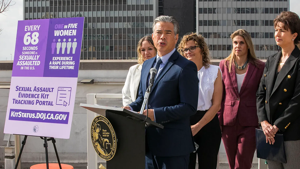
Democratic attorneys general from California and 18 other states sued the Trump administration Friday over its new $100,000 fee on H-1B visas.
President Donald Trump imposed the rule Sept. 19 for new petitions for the nonimmigrant visas, which allow U.S. employers to hire temporary, foreign workers in response to labor shortages among physicians, surgeons, researchers, educators, nurses and other vital workers.
The new fee will make it more difficult for health care centers, schools, universities and others to hire workers, California Attorney General Rob Bonta said during a news conference Friday morning in San Francisco. He said it will make current labor shortages worse.
Bonta and Massachusetts Attorney General Andrea Joy Campbell are co-leading the coalition of states in the suit, which is California’s 49th one this year against the Trump administration.
Bonta said the new fee violates the U.S. Constitution and the Administrative Procedure Act’s notice-and-comment process.
The Center Square Friday reached out to the White House, which commented on the lawsuit.
“President Trump promised to put American workers first, and his commonsense action on H-1B visas does just that by discouraging companies from spamming the system and driving down American wages, while providing certainty to employers who need to bring the best talent from overseas,” White House spokeswoman Taylor Rogers told The Center Square in an email. “The Administration’s actions are lawful and are a necessary, initial, incremental step towards necessary reforms to the H-1B program.”
The Center Square also reached out to the U.S. departments of Homeland Security and Labor, but did not hear back before press time.
Bonta noted the visas allow employers such as schools, hospitals, universities and research institutions to hire highly skilled workers.
“California, like every other state, needs more teachers, more nurses, more doctors,” the California attorney general said. “There is a shortage of supply in those professions.”
Bonta’s office said employers filing H-1B petitions typically pay between $960 and $7,595 in regulatory and statutory fees.
Bonta said the $100,000 far exceeds processing costs and call the new fee an “unnecessary obstacle” to hiring the workers America needs.
“The consequences for California would be devastating,” Bonta said. “We’re already facing a nationwide teacher shortage. Last year 74% of U.S. school districts struggled to fill open positions, especially in areas such as special education, foreign language and STEM [science, technology, engineering and math] fields. Nearly 30,000 educators nationwide hold H-1B visas.
“And hundreds of colleges and universities rely on them to support instruction and support research,” he said.
“Public schools, many of which operate on very tight budgets, can’t absorb an extra $100,000 for hire,” Bonta said.
“The health care sector is equally at risk,” he said, noting rural communities would be especially hit by the loss of workers. He said patients would see “longer wait times, reduced access to care, growing health disparities.”
Bonta said Congress didn’t authorize Trump to impose the new $100,000 fee.
“No presidential administration can rewrite immigration law,” the attorney general said. “No president can destabilize our schools, our hospitals, our universities on a whim. And no president can ignore the co-equal branch of government, the Congress; the Constitution or ignore the law.”
Besides California, states filing the lawsuit are Arizona, Colorado, Connecticut, Delaware, Hawaii, Illinois, Maryland, Michigan, Minnesota, North Carolina, New Jersey, New York, Oregon, Rhode Island, Vermont, Washington and Wisconsin.
In other litigation news, Democratic attorneys general praised this week’s federal ruling that blocked the Trump administration’s attempt to close a Federal Emergency Management Agency program designed to protect communities from natural disasters before they strike.
Democrats won their suit to protect FEMA’s Building Resilient Infrastructure and Communities program. Those filing the suit included attorneys general from Arizona and California.
“We’re winning case after case as we protect Arizonans from harm and rising prices that the Trump administration continues to illegally pursue,” Arizona Attorney General Kris Mayes said in a news release. “Arizonans will notice this victory the next time a wildfire or flood hits – thanks to the work of those in my office, our state will be prepared.”
Entrepreneur’s supporters say case law may result in release

Arizonans think a situation involving Kilmar Armando Abrego Garcia should result in the release of a Phoenix area business owner facing deportation.
Garcia is the Maryland man who the Trump administration has argued is in the U.S. illegally and needs to be deported.
A federal judge Thursday ordered Garcia to be released for reasons including Zadvydas v. Davis, a 2001 U.S. Supreme Court case that established limits on indefinite immigration detention.
It is that same case that Democrat Brent Peak of Arizona has pointed to in his efforts to have Kelly Yu, a restaurateur in the Phoenix suburb of Peoria, released after being in detention for months. Yu is an illegal immigrant but has received bipartisan support from Arizonans who say she’s a responsible business owner and a respected member of the community.
Yu is being detained at the U.S. Immigration and Customs Enforcement detention center in Eloy, Arizona.
“The court determined that if someone is being held, but there is no record and their deportation is not foreseeable, like, there’s no foreseeable resolution to completing the deportation, then they must be released,” Peak told The Center Square. “She has no record. She has 20 years of upstanding conduct and residency in the U.S, so, at this point, from what I understand it would simply take a filing, filing a habeas petition, and a judge would order her release awaiting deportation.”
A habeas petition is a legal request that someone in custody files to ask a court to rule their imprisonment is unlawful.
Yu has been in detention for six months.
Republican Lisa Everett has been partnering with Peak to try to help Yu. Like Peak, Everett is optimistic that the Garcia situation will benefit Yu.
“Kelly Yu should be released because she has not violated any laws,” Everett told The Center Square. “She pays her taxes. She is a business owner and employs Americans. She is who we want in an immigrant.”
In August, when The Center Square first reported about Peak and Everett’s efforts to keep Yu from being deported, the U.S. Department of Homeland Security said Kelly Yu, aka Lai Kuen Yu, is “an illegal alien from Hong Kong, one that has had a final deportation order from a judge since 2005.” U.S. Homeland Security Assistant Secretary Tricia McLaughlin also told The Center Square in an email that Yu “was arrested illegally crossing the border by U.S. Border Patrol in Arizona on February 4, 2004.”
Yu was released into the country days later.
“On November 14, 2013, the Board of Immigration Appeals dismissed her appeal and upheld her final order of removal,” McLaughlin told The Center Square. “On August 23, 2016, the U.S. Court of Appeals for the Ninth Circuit denied her appeal. On June 12, the Board of Immigration Appeals granted her a temporary stay of removal while they consider her motion to reopen. She will remain in ICE custody pending her removal proceedings.”
According to Peak, the reason Yu has not been deported is because China has not responded to the U.S. to finalize the passport.
“That normally is done in a few weeks,” said Peak. “That’s why we thought all along that deportation was imminent because we were just waiting on the China side of whatever needs to be done for the passport, and I don’t know the details of that, of how that works.”
China isn’t doing anything, which leaves Yu stuck in prison, Peak said.
Yu’s husband, Aldo Urquiza, is an American citizen. He runs the two restaurants he has with his wife. Meanwhile, Yu’s daughter, Zita Yu, is in college and works at the restaurants.
Peak and Everett have been in touch with Urquiza on a regular basis.
“At this point, the family has given up,” said Peak. “My hope is that some other organization or perhaps even I would love to see Kris Mayes, our attorney general [in Arizona], file on her behalf to get a judge to order her released as she awaits deportation.”
Pointing again to Zadvydas v. Davis, Peak said “it is illegal to continue to imprison her for an indefinite time frame when the U.S. cannot determine how long they need to hold her” in custody.
“They do not know when her deportation will happen because they cannot get the answers that they need and the follow up that they need from China,” said Peak.
The Center Square has tried multiple times since August to get interviews from Arizonans in the U.S. House of Representatives and the U.S. Senate.
No one has responded.
“Sadly, I have not gotten a response from any of these officials with the exception of one returned phone call from Mark Kelly‘s office back in August I believe,” said Everett. “I have reached out to most of these offices repeatedly.”
The Center Square also reported on Yu’s situation in October and November.
GOP lawmakers silent on Trump’s EO punishing state AI guardrails

Frustrated with Congress failing to enact national artificial intelligence regulations, President Donald Trump took matters into his own hands Thursday night and signed an executive order strong-arming states into setting industry-friendly regulations only.
Republicans have spoken out against Big Tech and the potential dangers of uncontrolled AI expansion. Yet as of Friday afternoon, not a single AI-cautious Republican member of Congress has condemned the order, with only one commenting on the action at all.
“President Trump is right: we need federal standards to protect kids, creators, consumers, and conservatives across the entire country,” Sen. Marsha Blackburn, R-Tenn., posted on X on Friday. “I look forward to continuing to work with the President to draft the federal framework he has called on Congress to pass.”
While not a moratorium on state-level AI regulations – something U.S. lawmakers voted overwhelmingly to strip out of two major bills this year – the executive order cracks down on states with more restrictive laws.
Under the order, states with AI laws that the Trump administration says “harm innovation” would lose access to crucial broadband funds and could even face lawsuits from the U.S. Attorney General’s newly established AI Litigation Task Force.
The order also directs Congress to “ensure that there is a minimally burdensome national standard” for AI and requires that whatever congressional framework emerges “forbid State laws that conflict with the policy set forth in this order.”
The ultimate goal, the White House says, is to “protect American AI innovation from an inconsistent and costly compliance regime resulting from varying State laws.”
David Sacks, who advises the White House on AI and Cryptocurrency policy, said the executive order “is not that framework itself, or an amnesty or moratorium, but rather a statement of principles and a set of tools for the Administration to push back on the most onerous and excessive State AI laws.”
He added that the order “does not mean the Administration will challenge every State AI law.”
“The focus is on excessive and onerous State laws,” Sacks said. “We look forward to working with Congress to enact a stable and enduring framework that reduces unnecessary regulation, enables innovation, protects core values, and helps America win the AI race.”
Democrats quickly condemned the order, with Sen. Amy Klobuchar, D-Minn., calling it “dangerous, and most likely illegal” and Sen. Ed Markey, D-Mass., dubbing it “an irresponsible power grab.”
Conspicuously silent on the order are the Republicans who spoke out the most against an AI moratorium, including Sens. Josh Hawley, R-Mo., and Ron Johnson, R-Wis., as well as Reps. Chip Roy, R-Texas, and Thomas Massie, R-Ky.
Rep. Majorie Taylor Greene, R-Ga., who previously argued that states “must retain the right to regulate and make laws on AI and anything else for the benefit of their state,” also remained mum as of Friday afternoon.
According to Co-Chair of Congressional Artificial Intelligence Caucus Don Beyer, D-Va., however, “members in both chambers and both parties” are “actively exploring legislative options” in response to the order, which he says violates the 10th amendment.
“This is a terrible idea,” Beyer said in a statement. “Congress has been slow to respond to the AI revolution and in the absence of a strong federal response, states are wisely taking the lead to create guardrails and protect the public. Trump’s attempt to undo this progress without providing any federal regulatory protections would be extremely harmful.”
The executive order will likely draw lawsuits from both Republican and Democrat-led states.
Gabbard: 2,000 Afghan refugees in U.S. have ties to terrorism

An estimated 2,000 Afghan nationals admitted to the United States following the deadly 2021 pullout of American forces from Afghanistan have ties to terrorism, according to the Director of National Intelligence Tulsi Gabbard.
Gabbard made the astonishing revelation during an interview on Fox News Friday morning, following a tense House Homeland Security Committee hearing Thursday, when Homeland Security Secretary Kristi Noem highlighted national security risks to the homeland.
The Center Square previously reported that the U.S. Department of Defense Inspector General released a report in January 2022 that admitted thousands of Afghan evacuees who entered the U.S. following the American military evacuation in August 2021 were not properly vetted.
“[The DoD] found that Afghan evacuees were not vetted by the National Counter-Terrorism Center (NCTC) using all DoD data prior to arriving in CONUS,” the report said.
The report also noted, during an “analytic review, NGIC personnel identified Afghans with derogatory information in the DoD ABIS database who were believed to be in the United States.”
The 2022 report affirms Gabbard’s concerns that some individuals admitted to the U.S. under the Biden administration may pose a national security risk.
“The vast majority of them were not properly vetted. They certainly were not vetted at anywhere near the standard that we require under this administration of allowing people into our country. And of that number, we know that there are at least 2,000 who are here who have ties to or are known or suspected terrorists,” Gabbard told Fox News.
During the Biden administration, nearly 200,000 Afghan nationals were admitted to the U.S., including Rahmanullah Lakanwal, who is accused of shooting two National Guard members, killing one just blocks from the White House on the eve of Thanksgiving.
While there have been no formal terrorism charges brought against Lakanwal as of yet, the attack is being investigated for alleged terrorism. It has been described as a terror attack by high-ranking officials such as Gabbard and Noem.
During the interview, Gabbard stated that, through the National Counterterrorism Center, in partnership with the Department of Homeland Security and the FBI, the agencies will work together to re-vet “every single” Afghan individual admitted during the Biden administration, underscoring the threat to national security.
“We’ve got to realize what’s happening here within the context of the greater threat that we face. We know that al Qaeda and ISIS continue to actively plot attacks against our homeland. And so when you look at the spread of the radical Islamist ideology and the propagation of it, you look at active plots, and they’re looking for people who can carry out those plots,” said Gabbard.
In July, The Center Square asked border czar Tom Homan about the report and whether the Trump administration would investigate the individuals who had not been vetted.
Homan vowed the Trump administration would thoroughly vet Afghan refugees and would be doing things the “right way” by revisiting the vetting process.
“We’re going to re-vet them because we don’t think the last administration properly vetted them…This administration will do things the right way, we’ll make sure everyone is vetted properly,” said Homan.
After last month’s shooting in Washington, D.C., President Donald Trump vowed to pause migration from certain countries, including Afghanistan.