National News
Pronoun policy in schools violates First Amendment, court finds

A federal appeals court reversed a lower court’s decision holding that an Ohio school district’s policy on student pronouns did not violate First Amendment rights.
Olentangy Local School District maintains a policy that bans individuals from referring to transgender and nonbinary students using pronouns that match their biological sex.
Mathew Hoffman, legal counsel for Alliance Defending Freedom, said this policy was put to the test by a parent who questioned whether their student could be punished for not obeying this rule.
“What the counsel for the school district said was that purposely referring to another student by using gendered language that that student knows is contrary to the other students identity would be an example of discrimination under board policy,” Hoffman said.
Defending Education appealed an initial ruling, which upheld the school district’s policy. A 17-judge panel struck down the lower court’s opinion 10-7 in November, holding that the school policies violated the First Amendment rights of affected students.
“[The school district] introduced no evidence that the use of biological pronouns would disrupt school functions or qualify as harassment under Ohio law,” the Sixth Circuit Court of Appeals opinion reads. “Our society continues to debate whether biological pronouns are appropriate or offensive – just as it continues to debate many other issues surrounding transgender rights.”
While the majority opinion held that the school’s policies violated First Amendment rights, a large coalition of judges dissented.
“The law delegates to our teachers and administrators the difficult work of defining, addressing, and, when possible, preventing bullying and severe harassment in public schools,” Judge Jane Stanch wrote in dissent of the majority opinion.
Stanch argued that there is a difference in expressing views on a subject and directly addressing or confronting an individual issue.
“Expressing views on immigration is different from telling a particular immigrant, ‘You don’t belong here,’ Stanch wrote. “By the same token, discussing sex and gender identity is different from using non-preferred pronouns to target or confront a particular student.”
Hoffman said schools can still regulate harassment and bullying while not forcing students to comply with an individual’s preferred pronouns. He also said governments are not allowed to censor an individual for certain speech in a particular area.
“The First Amendment leaves the choice of how we want to speak to the individual,” Hoffman said.
While the court’s majority found the school policy violated some students First Amendment rights, it affirmed the need to continue protecting transgender students from harassment and discrimination.
“Nothing we say here forecloses the district from enforcing its anti-harassment policies against the abuse of transgender students just as it enforces those policies against the abuse of all other students,” the majority opinion reads.
WATCH: J.D. Vance says he ‘believes in the wisdom of the American people’

Vice President J.D. Vance returned to Pennsylvania on Tuesday to discuss the Trump administration’s economic policies to lower prices for everyday Americans.
The rhetoric comes six days after his boss, President Donald Trump, visited Allentown, where he touted tariffs and his support for the energy industry, of which Pennsylvania is a hub.
Vance didn’t miss the opportunity to remind the crowd gathered at a warehouse the Lehigh County town of Alburtis.
“So if we lower the price of energy, we lower the price of groceries, we lower the price of gasoline, and importantly, we bring good jobs back into this country so that wages go up, that’s how you give people a shot at the American dream again,” he said. “That is our job. That is what we ran on.”
DOJ Epstein files to be made public on Friday; Democrats say there are more

The Justice Department is required to make all of the Epstein files public by Friday, after months of back-and-forth between Congress and the Trump administration.
On Nov. 18, with almost unanimous support, Congress passed the Epstein Files Transparency Act. President Donald Trump signed the bill into law the next day. The law demands the department’s full release of the files into a downloadable, searchable PDF format within 30 days of its signing.
The files include thousands of pages from two criminal investigations into the deceased financier and sex trafficker, Jeffrey Epstein. In December, two judges also unsealed grand jury records from sex trafficking cases against Epstein and his associate, Ghislaine Maxwell.
Congress and the administration have been at odds for months, after Attorney General Pam Bondi signaled that large quantities of files were going to be made public and then a Justice Department memo in July abruptly ended their release. The memo said that investigators had found “no incriminating ‘client list’ and “no credible evidence…. that could predicate an investigation against uncharged third parties.”
Congress launched its own oversight inquiry into the handling of the Epstein files, through which a handful of news-making files have come to light – like an alleged bawdy 50th birthday letter from Trump to Epstein, which Trump denies sending; Epstein emails calling Trump “the dog that hasn’t barked,” and some photos of the president and other public figures at events with Epstein or multiple women.
One of those public figures was former President Bill Clinton. The House Oversight Committee subpoenaed Clinton and former Secretary of State Hillary Clinton to testify before the committee on Dec. 17 and 18, but those depositions were pushed back Tuesday to mid-January.
Democrats held a press conference Tuesday saying they expect the administration to only partially comply with the law on Friday, but that there would be consequences for anything less than full compliance.
“We fully expect Trump, Bondi and their minions to dodge, delay or partially release these files,” said Senate Minority Leader Chuck Schumer, D-NY. “Stop hiding, stop delaying. Come clean with the American people. And if you don’t, the question will only get louder and louder and louder.”
“If they abuse narrow exemptions to hide the truth, we will know and there will be serious legal and political consequences,” Schumer warned.
Sen. Ron Wyden, D-Ore., also said the Treasury Department has numerous files on Epstein transactions and financial operations that could hold important information, but that the Trump administration won’t release those. The Nov. 19 law only requires that the Department of Justice hand over its files.
“My investigators saw a large, large portion of these records in 2024, under the Biden administration, but the Trump administration is denying us the file today. It’s important for the American people to find out how all of this was financed, and that means getting our hands on the file to investigate further,” Wyden said.
Though called to release all of its files by Friday, the Justice Department can withhold or redact records that needlessly expose victims’ identity, show the sexual abuse of children or pertain to an active federal investigation.
Testimony: At least 18,000 suspected terrorists released into U.S. during Biden admin

At least 18,000 known or suspected terrorists (KSTs) were released into the U.S. during the Biden administration, Director of the National Counterterrorism Center Joe Kent told the U.S. House Committee on Homeland Security at a hearing in Washington, D.C.
The NCTC has also added roughly 35,000 narco-terrorists to the federal Terrorist Screening Dataset (TSDS) since he’s been the NCTC director. President Donald Trump appointed Kent to the position after he deployed 11 times overseas to fight Islamic terrorists while serving in the U.S. Army Special Forces.
The additional KSTs added to the TSDS include members of newly designated foreign terrorist organizations(FTOs), including multiple Mexican cartels and transnational criminal organizations like MS-13 and Tren de Aragua. The Trump administration made the FTO designations in February, The Center Square reported.
The unprecedented 18,000 KSTs excludes the 6,525 KSTs the NCTC helped prevent from entering the country as of October, The Center Square reported.
It’s a huge jump from the nearly 1,200 KSTs NCTC identified illegally in the U.S. within the first 100 days of the Trump administration, The Center Square reported.
“We have a persistent threat from the individuals that were allowed into this country by the previous administration. The number one threat that we have right now is the fact that we don’t know who came into our country in the last four years,” Kent said.
So far, the NCTC has identified 18,000 KSTs released into the country by the Biden administration “who, under normal circumstances, would never be allowed to enter our country because of their ties to Jihadist groups like ISIS and Al-Qaeda,” Kent said. “Yet, the Biden administration not only let them into the country, in many cases, facilitated their entry.”
They include the Afghan men who committed terrorist attacks and attempted terrorist attacks in Washington, D.C., Texas and Virginia in a one-week period, as well as others being arrested by U.S. Immigration and Customs Enforcement, The Center Square reported.
None of the 18,000 were properly vetted, Kent said. “The Biden Administration essentially used his tactical level vetting as a ruse to bring him here and to bring him into our communities, and we’ve seen the tragic results of that,” Kent said.
Of 88,000 Afghans released into the U.S., the NCTC has identified 2,000 who “have ties to terrorist organizations,” Kent testified.
Kent also said that it was impossible for the Biden administration to have vetted the Afghans released into the country.
“Prior to the Biden administration, these individuals, even ones who wanted to claim asylum, they had to go to the first safe third country,” he explained. “And it would take 18 months to two years to properly vet them. Biden threw all of that out the window.”
Now, the NCTC is working hand in hand with the Department of Homeland Security and the FBI “to run down this 2,000 — the Afghans who came here under Allies Welcome who have ties to terrorist organizations — and additionally, the other 16,000 individuals of ties to terrorist organizations that Biden let into our country,” to find and deport them, he said.
The 18,000 people with ties to terrorism present “the top terrorist threat that we face right now, and that doesn’t include the individuals who came here illegally through the open border,” he said, referring to millions of people released through parole programs as well as at least two million gotaways, those who illegally entered and evaded capture. “That number alarmingly remains unknown at this time. We’re trying to figure out who those individuals are as well,” he said.
The NCTC also issued a warning about heightened terrorism threats presented by ISIS and al-Queda.
The warning was issued as U.S. Customs and Border Protection updated the number of KSTs CBP and Border Patrol agents have apprehended at the northern and southwest borders. Due to the new FTO designations, KST apprehensions reached a record high under the Trump administration.
In fiscal 2025, a record 4,011 KSTs were apprehended, according to CBP data. So far in just the first 45 days of fiscal 2026, 1,949 KSTs have been apprehended, according to the data. The fiscal year goes from Oct. 1 through Sept. 30.
The greatest number of KSTs that CBP and Border Patrol agents ever apprehended in U.S. history was 1,903 during the Biden administration, according to CBP data.
The majority, 64%, totaling 1,216, were apprehended at the northern border coming from Canada between fiscal years 2021-2024, according to CBP data, The Center Square first reported.
Americans don’t trust feds in K-12 decisions, survey shows
While Americans continue to support expanding education freedom, a new national survey shows declining trust in the federal government’s role in K-12 education.
The poll, conducted by Yes. Every Kid. Foundation, asked voters nationwide about their thoughts on trusting the federal government to make the right decisions for K-12 education.
Since taking office in 2025, President Donald Trump has made efforts to dismantle the U.S. Department of Education. While education officials have pushed back, for concerns over potential federal funding cuts, the administration has continued taking steps to return more authority to the states.
According to the survey, 76% of respondents agree that K-12 schools should be held accountable to parents, with 89% of Republicans and 67% of Democrats in agreement.
Matt Fendeway, vice president of strategy at Yes. Every Kid. Foundation, said many Americans lack a clear understanding of the U.S. Department of Education’s role, which can lead to misconceptions.
The report indicates that 56% of respondents do not trust the federal government to make K-12 decisions for their communities. While 59% trust their state government, an overwhelming 87% said parents and families should have the primary role in education decision-making.
Once you explain to voters what dismantling the department would look like, the opposition shifts in support, pointing to low federal trust and a desire to shift power back to parents and states, according to the foundation.
Support stands at 56% when voters are informed that federal education protections would remain in place and funding would continue to flow directly to states, according to the foundation. Many respondents cited bureaucracy as a major concern.
“The more folks understand there is a plan in place to dismantle it and do so in a responsible manner, I suspect that you’ll see much more American support returning power to the states,” Fendeway told The Center Square during the briefing.
Voters described the Department of Education as bureaucratic and disconnected from classrooms, expressing a preference for a system that places greater control in the hands of families and local communities.
Republican health care plan would reduce premiums by 11%, CBO says

U.S. House Republicans’ five-point health care plan could reduce premiums by 11%, but could also increase the number of people without health insurance by 300,000 annually, according to a new Congressional Budget Office analysis.
House lawmakers will vote on the Lower Health Care Premiums for All Americans Act on Wednesday, which Republican leaders have been touting as an alternative to renewing the pandemic-era enhancements to the Obamacare Premium Tax Credit.
Congress temporarily expanded the PTC during the COVID-19 pandemic, and its reversion to original pre-pandemic levels after Dec. 31 will partially contribute to premium hikes for millions of Americans in 2026.
Extending the tax credit, a subsidy which goes directly to insurance companies, for the next 10 years would cost an estimated $350 billion. Republicans’ bill, by contrast, would reduce the federal deficit by $35.6 billion by 2035, per CBO’s report.
Key reforms in the bill include increasing oversight and transparency requirements for pharmacy benefit managers, reforming health reimbursement arrangements, and excluding stop-loss policies from the definition of health insurance coverage.
Most notably, the bill would finally appropriate funding for cost-sharing reduction payments, as well as loosen restrictions on which employers can form association health plans.
CBO projects that unlocking CSR payments would lower gross benchmark premiums for all Americans by 11%, though 300,000 people annually could lose their existing health insurance between 2027 and 2035.
The new rules for health association plans, however, would provide insurance to 200,000 people who currently have none. Allowing small business owners and independent workers to band together across industries to form association health plans would increase the total number of people on those plans by an estimated 700,000.
The Lower Health Care Premiums for All Americans Act will likely pass the House, given Republicans’ majority. But it will likely die in the Senate, given that 60 votes are needed for it to pass and Democrats staunchly oppose it.
“Over the next two weeks, millions will see skyrocketing premium amounts deducted from their bank account,” Senate Majority Leader Chuck Schumer, D-N.Y., posted on social media Tuesday. “All thanks to Donald Trump and Republicans who are refusing to extend the ACA tax credits.”
Trump to address nation Wednesday night

Closing in on his first year in office, President Donald Trump will address the nation Wednesday night.
The president announced the address via his Truth Social account Tuesday afternoon. White House Press Secretary Karoline Leavitt briefed reporters after the announcement, indicating that the president would be highlighting his “accomplishments” over the past year.
Trump will mark one year in office since he was inaugurated for a second term on Jan. 20.
The president and Vice President JD Vance have embarked on a rallying campaign to promote Trump’s economic agenda, touting lower gas prices, inflation and tariff revenue.
In recent days, the president has also highlighted immigration and the border, which he claims has dropped to zero illegal border crossings at the southern border during an event in the Oval Office Monday afternoon.
Trump could use the address as a springboard for the 2026 midterm elections, which his Chief of Staff, Susie Wiles, is vowing he will be active on the campaign trail, as Republicans hope to maintain their slim majority in Congress.
The address will come as the president prepares to depart Washington for the Christmas holiday.
Thune says ‘path forward’ on healthcare; Schumer says no alternative to Dems’ plan
With health care premiums for millions of Americans set to spike in 2026, congressional leaders say they have exhausted all options to cushion the blow.
Republicans tanked Democrat’s bill that would have prevented the pandemic-era enhancements to the Obamacare Premium Tax Credit from expiring. Senate Democrats have voted down any health care plan that does not include an extension of the enhanced subsidies, and are set to do so again if House Republicans’ health bill reaches the upper chamber.
As Congress prepares to leave for Christmas, Senate Majority Leader John Thune, R-S.D., expressed some optimism that the parties could reach a compromise when they return in January.
“Our views on healthcare and the Democrat views on healthcare are very different. And I think that’s a difficult challenge that we have to figure out how to overcome,” Thune told reporters Tuesday. “But if they’re willing to accept changes that actually would put more power and control and resources in the hands of the American people and less of that in the pockets of insurance companies, I think there’s a path forward.”
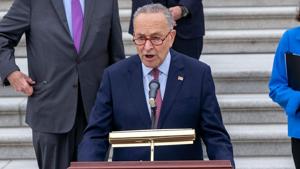
Senate Minority Leader Chuck Schumer, D-N.Y., however, said “the damage has been done,” indicating opposition to any bill other than Democrats’ $83 billion three-year extension of the subsidies that doesn’t include changes to reduce fraud.
“We always want to work with people who will lower health care costs, but if the Republicans want to do something, they have until January 1st to pass the one bill that can get it done: our bill,” Schumer said Tuesday.
A recent Government Accountability Office report uncovered systemic fraud risk and confirmed fraud in the enhanced subsidies. More than 90% of office’s fake applicants received coverage, with GAO noting that “agents and brokers have a financial incentive to maximize enrollments” under the existing tax credit system.
Many rank-and-file lawmakers in both chambers have put forward compromise legislation as negotiations among leadership have failed. A bipartisan group of 35 lawmakers in the House are pushing for a vote this week on legislation that would extend the subsidies but include targeted reforms.
Schumer declined to say whether Democrats would again shut down the government when funding runs out on Jan. 31 if their health care demands are not met.
Trump calls Colorado governor ‘weak’ over Tina Peters case, seeks pardon

President Donald Trump is once again calling for the release of former Mesa County Clerk Tina Peters, who is in a Colorado prison for her role in tampering with election equipment following the 2020 election.
On Monday, Trump briefly addressed the issue during a press conference on illegal immigrants and drug trafficking.
“The governor of Colorado is a weak and pathetic man who was run by Tren de Aragua,” Trump said. “The criminals from Venezuela took over sections of Colorado. And he was afraid to do anything, but he puts Tina in jail for nine years because she caught people cheating.”
Additionally, Trump said Polis would not “allow our wonderful Tina to come out of a jail – and a high-intensity jail.”
Peters, a 70-year-old former Republican clerk in western Colorado, was found guilty last fall by a jury trial on seven charges related to election integrity, including three counts of attempting to influence a public official. Four of those counts were felonies, three were misdemeanors, and Peters was acquitted on three other charges.
According to the charges, in the months after the 2020 election, Peters allowed an unauthorized person access to the county’s electronic voting machines and take images of server hard drives.
Trump has long called out Colorado officials for the charges against Peters, who is now one year into a nine year sentence. In May, he directed the U.S. Department of Justice “to help secure the release” of Peters, who he said was prosecuted “for political reasons.”
“Colorado must end this unjust incarceration of an innocent American,” Trump said, as previously reported by The Center Square. “FREE TINA PETERS, NOW!”
Democrats have expressed concern with this sentiment from the president.
“Nobody is above the law,” said the Colorado Democratic Party. “Not even Trump’s friends.”
Last week, the president said he would grant Peters a “full pardon.” This is an unprecedented announcement as Peters was convicted of state crimes, not federal.
Colorado Attorney General Phil Weiser called this a pardon “attempt.”
“One of the most basic principles of our constitution is that states have independent sovereignty and manage our own criminal justice systems without interference from the federal government,” Weiser said. “The idea that a president could pardon someone tried and convicted in state court has no precedent in American law, would be an outrageous departure from what our constitution requires, and will not hold up.”
Peters remains in Colorado custody.
Data centers face growing resistance from Michigan communities

A growing coalition of Michiganders is forming against more than a dozen proposed data centers throughout the state.
While the push for data centers is a national phenomenon, advocates for the facilities argue that Michigan’s climate and resources make it an ideal location.
Opponents have labeled themselves “Michigan’s Data Center Resistance” and argue that environmental and taxpayer concerns should lead Michigan communities to say no data centers.
This issue will come to a head on Thursday as the Michigan Public Service Commission considers approving one of the biggest projects yet.
Growing industry
Though data centers have been around since the 1950s, even before the internet age, the initiative for more has only grown in recent years with the emergence of artificial intelligence and an ever-growing need for more cloud storage.
These large industrial facilities house thousands of computer servers used to store, process and transmit digital information for services such as cloud computing, streaming and artificial intelligence. They typically require significant amounts of electricity and water to operate and cool the equipment, making their local environmental and infrastructure impacts a central point of debate.
Michigan has 59 data centers, according to the Data Center Map. Many more are either officially in the process of approval, construction, or are being considered.
Michigan’s expansion
As recently as September, Michigan-based internet company 123Net completed an expansion of one of its data centers located in Detroit. It said in a statement that the expansion will cut network costs while “creating the ultimate environment for AI, machine learning and data intensive applications.”
Yet, this 80,000-square-foot facility is minuscule compared to the data centers of Michigan’s proposed future. One of those that has faced significant backlash is set to be located in Saline Township – a small rural community in southeast Michigan.
The $7 billion, 2.2-million-square-foot data center, is an initiative of DTE Energy for OpenAI, the company behind ChatGPT, and Oracle. If built, the “Project Stargate” center would help service artificial intelligence programs via OpenAI’s Stargate.
Yet, many are calling for the Michigan Public Service Commission to not approve the project.
“Private developers and DTE Energy need to prove that everyday Michiganders won’t be forced to subsidize corporate investments in their energy bills, and projects like this won’t hinder or block our transition to the clean energy future that we’ve set together as a state,” said Nick Occhipinti, senior policy director for the Michigan League of Conservation Voters.
The commission will meet again on Thursday to consider DTE’s proposal to fast-track approval for the center, despite opponents claiming there is a lack of transparency around the proposed contracts – which include hundreds of redacted lines.
“Michigan residents are showing up, speaking out, and demanding a public process,” said the Michigan Department of Attorney General.
Other states, like Wisconsin, are facing similar issues with transparency around these data centers – which can have substantial impacts on consumers’ energy bills.
In the next 10 years, data centers are expected to increase the average American’s energy bill from 25% to 70%, according to the Jack Kemp Foundation. Another analysis from Bloomberg News found a 267% increase in energy prices in communities located near data centers.
In Michigan, controversy is also swirling around a proposed 300,000 square-foot data center in Ypsilanti Township set to break ground in 2026. This project, also located in southeast Michigan, is a collaboration of the University of Michigan and Los Alamos National Laboratory.
Gov. Gretchen Whitmer has applauded the project, saying it will bring jobs and economic development to Michigan.
“I’m grateful to these cutting-edge companies for betting on Michigan, building on our work to compete for and win big projects in next-generation industries from cars and clean energy to semiconductors and batteries,” Whitmer said following the October announcement of the multi-billion-dollar facility. “We will continue working together at the state level to win more projects so we can create even more good-paying, local jobs for Michiganders and grow our economy.”
Corporate subsidies
Taxpayer funding is another significant draw, pulling many companies to consider Michigan as homes for their data centers due to state grants and tax breaks. In the case of the Ypsilanti data center, it is set to receive a $100 million state grant.
That funding could be in jeopardy though, as state Rep. Jimmie Wilson Jr., D-Ypsilanti, proposed a bill last week to pull that grant. So far, House Bill 5362 has received widespread bipartisan support with 17 state representatives signing on as cosponsors.
It has not yet been taken up by its assigned committee in the state House of Representatives.
Many are flagging this funding, either direct or via tax breaks, as just another form of “corporate welfare.”
“Michigan’s businesses built this state with blood, sweat, and tears,” said Tom Leonard, a former member of the Michigan House and a Republican candidate for governor. “They shouldn’t be forced to fund out-of-state corporations, especially data centers. Simply put – corporate welfare doesn’t work.”
Differing opinions
Michigan Attorney General Dana Nessel said she plans to take a stand against these centers, especially the one in Saline Township.
“My office has statutory authority to intervene on behalf of ratepayers and I’m sounding the alarm about DTE’s questionable proposal for a 1.4 gigawatt data center,” Nessel said. “Michiganders shouldn’t be left wondering if our energy bills will go up to pay for this. We deserve transparency.”
Consumers Energy, Michigan’s largest energy provider, has responded to some of the efforts from Nessel and her office. It labeled her position “anti-investment.”
“When businesses grow, families have more choices – better jobs, stronger schools, and thriving communities where people want to live and stay,” said Lauren Snyder, Consumers Energy’s senior vice president and chief customer and growth officer.
While many in Michigan’s small communities are up in arms about the data centers, leading to viral social media clips from city meetings statewide, not everyone is expressing the same concern. Some see this instead as an opportunity for Michigan to be at the forefront of technology’s newest frontier.
“AI, digitization, automation, are all run on data center-based platforms,” said Brian J. Shoaf, the vice president of public policy at the Detroit Regional Chamber. “If Michigan doesn’t land data centers, those other projects … that can come with them, won’t be here.”