Posts by Newspaper Staff
Thune says ‘path forward’ on healthcare; Schumer says no alternative to Dems’ plan
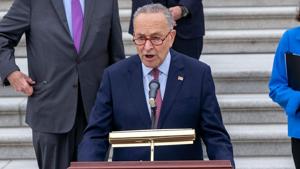
With health care premiums for millions of Americans set to spike in 2026, congressional leaders say they have exhausted all options to cushion the blow.
Republicans tanked Democrat’s bill that would have prevented the pandemic-era enhancements to the Obamacare Premium Tax Credit from expiring. Senate Democrats have voted down any health care plan that does not include an extension of the enhanced subsidies, and are set to do so again if House Republicans’ health bill reaches the upper chamber.
As Congress prepares to leave for Christmas, Senate Majority Leader John Thune, R-S.D., expressed some optimism that the parties could reach a compromise when they return in January.
“Our views on healthcare and the Democrat views on healthcare are very different. And I think that’s a difficult challenge that we have to figure out how to overcome,” Thune told reporters Tuesday. “But if they’re willing to accept changes that actually would put more power and control and resources in the hands of the American people and less of that in the pockets of insurance companies, I think there’s a path forward.”
Senate Minority Leader Chuck Schumer, D-N.Y., however, said “the damage has been done,” indicating opposition to any bill other than Democrats’ $83 billion three-year extension of the subsidies that doesn’t include changes to reduce fraud.
“We always want to work with people who will lower health care costs, but if the Republicans want to do something, they have until January 1st to pass the one bill that can get it done: our bill,” Schumer said Tuesday.
A recent Government Accountability Office report uncovered systemic fraud risk and confirmed fraud in the enhanced subsidies. More than 90% of office’s fake applicants received coverage, with GAO noting that “agents and brokers have a financial incentive to maximize enrollments” under the existing tax credit system.
Many rank-and-file lawmakers in both chambers have put forward compromise legislation as negotiations among leadership have failed. A bipartisan group of 35 lawmakers in the House are pushing for a vote this week on legislation that would extend the subsidies but include targeted reforms.
Schumer declined to say whether Democrats would again shut down the government when funding runs out on Jan. 31 if their health care demands are not met.
Pritzker signs $1.5B plan to overhaul public transportation, avoid service cuts

New transit reform law is designed to improve public transportation services after Chicago area faced funding shortfall.
Read MoreTrump calls Colorado governor ‘weak’ over Tina Peters case, seeks pardon

President Donald Trump is once again calling for the release of former Mesa County Clerk Tina Peters, who is in a Colorado prison for her role in tampering with election equipment following the 2020 election.
On Monday, Trump briefly addressed the issue during a press conference on illegal immigrants and drug trafficking.
“The governor of Colorado is a weak and pathetic man who was run by Tren de Aragua,” Trump said. “The criminals from Venezuela took over sections of Colorado. And he was afraid to do anything, but he puts Tina in jail for nine years because she caught people cheating.”
Additionally, Trump said Polis would not “allow our wonderful Tina to come out of a jail – and a high-intensity jail.”
Peters, a 70-year-old former Republican clerk in western Colorado, was found guilty last fall by a jury trial on seven charges related to election integrity, including three counts of attempting to influence a public official. Four of those counts were felonies, three were misdemeanors, and Peters was acquitted on three other charges.
According to the charges, in the months after the 2020 election, Peters allowed an unauthorized person access to the county’s electronic voting machines and take images of server hard drives.
Trump has long called out Colorado officials for the charges against Peters, who is now one year into a nine year sentence. In May, he directed the U.S. Department of Justice “to help secure the release” of Peters, who he said was prosecuted “for political reasons.”
“Colorado must end this unjust incarceration of an innocent American,” Trump said, as previously reported by The Center Square. “FREE TINA PETERS, NOW!”
Democrats have expressed concern with this sentiment from the president.
“Nobody is above the law,” said the Colorado Democratic Party. “Not even Trump’s friends.”
Last week, the president said he would grant Peters a “full pardon.” This is an unprecedented announcement as Peters was convicted of state crimes, not federal.
Colorado Attorney General Phil Weiser called this a pardon “attempt.”
“One of the most basic principles of our constitution is that states have independent sovereignty and manage our own criminal justice systems without interference from the federal government,” Weiser said. “The idea that a president could pardon someone tried and convicted in state court has no precedent in American law, would be an outrageous departure from what our constitution requires, and will not hold up.”
Peters remains in Colorado custody.
Illinois extends open enrollment deadline for health care plans starting Jan. 1

The deadline was extended from Dec. 15 to Dec. 31.
Read MoreData centers face growing resistance from Michigan communities

A growing coalition of Michiganders is forming against more than a dozen proposed data centers throughout the state.
While the push for data centers is a national phenomenon, advocates for the facilities argue that Michigan’s climate and resources make it an ideal location.
Opponents have labeled themselves “Michigan’s Data Center Resistance” and argue that environmental and taxpayer concerns should lead Michigan communities to say no data centers.
This issue will come to a head on Thursday as the Michigan Public Service Commission considers approving one of the biggest projects yet.
Growing industry
Though data centers have been around since the 1950s, even before the internet age, the initiative for more has only grown in recent years with the emergence of artificial intelligence and an ever-growing need for more cloud storage.
These large industrial facilities house thousands of computer servers used to store, process and transmit digital information for services such as cloud computing, streaming and artificial intelligence. They typically require significant amounts of electricity and water to operate and cool the equipment, making their local environmental and infrastructure impacts a central point of debate.
Michigan has 59 data centers, according to the Data Center Map. Many more are either officially in the process of approval, construction, or are being considered.
Michigan’s expansion
As recently as September, Michigan-based internet company 123Net completed an expansion of one of its data centers located in Detroit. It said in a statement that the expansion will cut network costs while “creating the ultimate environment for AI, machine learning and data intensive applications.”
Yet, this 80,000-square-foot facility is minuscule compared to the data centers of Michigan’s proposed future. One of those that has faced significant backlash is set to be located in Saline Township – a small rural community in southeast Michigan.
The $7 billion, 2.2-million-square-foot data center, is an initiative of DTE Energy for OpenAI, the company behind ChatGPT, and Oracle. If built, the “Project Stargate” center would help service artificial intelligence programs via OpenAI’s Stargate.
Yet, many are calling for the Michigan Public Service Commission to not approve the project.
“Private developers and DTE Energy need to prove that everyday Michiganders won’t be forced to subsidize corporate investments in their energy bills, and projects like this won’t hinder or block our transition to the clean energy future that we’ve set together as a state,” said Nick Occhipinti, senior policy director for the Michigan League of Conservation Voters.
The commission will meet again on Thursday to consider DTE’s proposal to fast-track approval for the center, despite opponents claiming there is a lack of transparency around the proposed contracts – which include hundreds of redacted lines.
“Michigan residents are showing up, speaking out, and demanding a public process,” said the Michigan Department of Attorney General.
Other states, like Wisconsin, are facing similar issues with transparency around these data centers – which can have substantial impacts on consumers’ energy bills.
In the next 10 years, data centers are expected to increase the average American’s energy bill from 25% to 70%, according to the Jack Kemp Foundation. Another analysis from Bloomberg News found a 267% increase in energy prices in communities located near data centers.
In Michigan, controversy is also swirling around a proposed 300,000 square-foot data center in Ypsilanti Township set to break ground in 2026. This project, also located in southeast Michigan, is a collaboration of the University of Michigan and Los Alamos National Laboratory.
Gov. Gretchen Whitmer has applauded the project, saying it will bring jobs and economic development to Michigan.
“I’m grateful to these cutting-edge companies for betting on Michigan, building on our work to compete for and win big projects in next-generation industries from cars and clean energy to semiconductors and batteries,” Whitmer said following the October announcement of the multi-billion-dollar facility. “We will continue working together at the state level to win more projects so we can create even more good-paying, local jobs for Michiganders and grow our economy.”
Corporate subsidies
Taxpayer funding is another significant draw, pulling many companies to consider Michigan as homes for their data centers due to state grants and tax breaks. In the case of the Ypsilanti data center, it is set to receive a $100 million state grant.
That funding could be in jeopardy though, as state Rep. Jimmie Wilson Jr., D-Ypsilanti, proposed a bill last week to pull that grant. So far, House Bill 5362 has received widespread bipartisan support with 17 state representatives signing on as cosponsors.
It has not yet been taken up by its assigned committee in the state House of Representatives.
Many are flagging this funding, either direct or via tax breaks, as just another form of “corporate welfare.”
“Michigan’s businesses built this state with blood, sweat, and tears,” said Tom Leonard, a former member of the Michigan House and a Republican candidate for governor. “They shouldn’t be forced to fund out-of-state corporations, especially data centers. Simply put – corporate welfare doesn’t work.”
Differing opinions
Michigan Attorney General Dana Nessel said she plans to take a stand against these centers, especially the one in Saline Township.
“My office has statutory authority to intervene on behalf of ratepayers and I’m sounding the alarm about DTE’s questionable proposal for a 1.4 gigawatt data center,” Nessel said. “Michiganders shouldn’t be left wondering if our energy bills will go up to pay for this. We deserve transparency.”
Consumers Energy, Michigan’s largest energy provider, has responded to some of the efforts from Nessel and her office. It labeled her position “anti-investment.”
“When businesses grow, families have more choices – better jobs, stronger schools, and thriving communities where people want to live and stay,” said Lauren Snyder, Consumers Energy’s senior vice president and chief customer and growth officer.
While many in Michigan’s small communities are up in arms about the data centers, leading to viral social media clips from city meetings statewide, not everyone is expressing the same concern. Some see this instead as an opportunity for Michigan to be at the forefront of technology’s newest frontier.
“AI, digitization, automation, are all run on data center-based platforms,” said Brian J. Shoaf, the vice president of public policy at the Detroit Regional Chamber. “If Michigan doesn’t land data centers, those other projects … that can come with them, won’t be here.”
Johnson calls drug smugglers ‘clear and present danger’

Republican House Speaker Mike Johnson said Tuesday drug smugglers off the coast of Venezuela pose a “clear and present danger” to the U.S. after a confidential briefing on Capitol Hill.
Johnson, R-La., defended the military strikes against suspected drug traffickers. He said drug overdoses were responsible for more deaths than all recent wars.
“Over the last four years alone, America has lost more lives to drug overdoses and other drug related deaths than we did to the enemy actions in World War II, Korea, Vietnam, Afghanistan and Iraq combined,” Johnson said. “This is a serious problem that a serious administration is addressing.”
Johnson spoke to reporters Tuesday after a confidential briefing from U.S. Secretary of State Marco Rubio and Secretary of War Pete Hegseth.
The House Speaker’s remarks came after U.S. Southern Command reported three additional military strikes on suspected drug boats on Monday. The three strikes killed eight people. Since June, the military has reported 25 strikes that have killed at least 94 people.
Johnson compared Trump’s military actions to President Barrack Obama’s strikes against overseas terrorists during his time in the White House. He said that Obama carried out more than 500 drone strikes that killed more than 3,700 people, including American citizens, from 2009 to 2015.
Democrats, a few Republicans, and human rights groups have criticized the strikes.
Trump says the strategy is working and saving lives. The U.S. president said each sunken boat has saved 25,000 American lives from overdoses.
The strikes come amid a pressure campaign against Venezuelan leader Nicolás Maduro, who has controlled the South American nation since 2013.
International election observers have accused Maduo of consolidating power through fraudulent elections. In 2024, his reelection was widely condemned as illegitimate, with allegations of vote tampering and intimidation of opposition leaders. Maduro is also facing allegations of human rights abuses, corruption, and involvement in illegal drug trafficking. U.S. prosecutors have charged Maduro with running a drug cartel using cocaine trafficking as a tool to run the regime and put a $50 million bounty on information leading to his arrest. Almost eight million people, more than a quarter of the population, have left Venezuela in recent years.
While U.S. officials have not publicly released detailed reports about the strikes, the boats appear to be smuggling cocaine.
Trump has focused his war on drugs against fentanyl, a powerful and deadly synthetic opioid. U.S. health officials have reported that synthetic opioids are the leading cause of overdose deaths in the U.S.
The U.S. Centers for Disease Control and Prevention reported provisional data found about 87,000 drug overdose deaths from October 2023 to September 2024. That’s down from about 114,000 the previous year and the lowest since 2020.
On Monday, Trump issued an executive order designating illicit fentanyl a weapon of mass destruction.
VA plans to overhaul nation’s largest integrated health care system

The Department of Veterans Affairs plans to reorganize the management structure of the Veterans Health Administration, the nation’s largest health system, to improve care.
The goal is to empower local hospital directors and eliminate duplicative layers of bureaucracy across all the administration’s 1,380 medical facilities. VA officials plan to announce details in early 2026, including organizational and personnel changes. Those changes are expected to take place over the next two years.
“The current VHA leadership structure is riddled with redundancies that slow decision making, sow confusion and create competing priorities,” VA Secretary Doug Collins said in a statement. “In other words, when everyone’s in charge of everything, no one’s in charge of anything.”
Staffing and operations at medical facilities won’t change, but the reorganization will include giving the VHA Central Office the responsibility to set policy goals and conduct financial management, oversight and compliance. Operations Centers and Veterans Integrated Service Networks, or VISNs, will take policy direction from VHA’s Central Office to develop operational, quality and performance standards.
“Under a reorganized VHA, policymakers will set policy, regional leaders will focus on implementing those policies, and clinical leaders will focus on what they do best: taking great care of Veterans,” Collins said.
House Committee on Veterans’ Affairs Chairman Mike Bost, R-Ill., said he supports the undertaking.
“I support the intent of Secretary Collins’ plan to break new ground and restructure the agency to meet the needs of today and tomorrow’s veterans, their families, and their survivors. Change can be a good thing. Veterans and their families gave us a clear mandate last November that business as usual is not cutting it and we must cut through the bureaucracy, remove the red tape, and push VA forward,” Bost said in a statement. “Congress looks forward to working with my friend, Secretary Collins, and the entire Trump administration in the coming weeks and months to learn more about the implementation of this plan to ensure it does one thing: benefit veterans.”
Reviews from VA’s Inspector General, the Government Accountability Office and others have underscored the need for reorganizing VHA.
“This initiative is not a reduction in force or an attempt to reduce staffing levels at VHA, and VA does not expect a significant change in overall staff levels once it’s complete,” according to the agency.
‘Grinch’ UPS sued over holiday pay for workers

One of the nation’s largest delivery companies is accused of being a “Grinch” by chiseling its seasonal workers out of holiday pay.
In a lawsuit filed Monday in U.S. District Court, New York Attorney General Letitia James alleges that Atlanta-based United Parcel Service “stole” wages from seasonal workers last year, including “Driver Helpers” and “Seasonal Support Drivers” who assist full-time staff with package delivery around the holidays. The democratic AG said the company practices have “repeatedly” violated state and federal labor laws on seasonal pay.
“Each year, UPS commits wage theft against these workers in myriad ways,” James wrote in the 21-page complaint. “Seasonal Delivery Workers have worked off-the-clock before the beginning of the shift, after the ending of the shift, and at various other times, including at the beginning and end of employment, between shifts, and during meal breaks.’
“Additionally, UPS’s timekeeping practices and edits to records have introduced and compounded timekeeping errors,” the complaint reads.
The lawsuit claims that during its peak season, which runs from October to January, UPS hires thousands of temporary workers at at least 55 facilities in New York state. But the companies practices deprived those workers of millions of dollars in pay, according to the legal challenge.
James said she is seeking back pay for UPS workers in New York and a court order requiring the company to end off-the-clock work and to overhaul its timekeeping and payroll practices.
“UPS built its holiday business on the backs of workers who were not paid for their time and labor,” James said in a statement. “UPS’s seasonal employees work brutal hours in the cold to deliver the holiday packages families across the country count on. Instead of compensating these workers fairly for their labor, UPS has played the Grinch.”
The company, which employs nearly 500,000 people worldwide and reported more than $90 billion in revenue last year, issued a statement dismissing the claims in the lawsuit and saying it doesn’t underpay its seasonal workers.
“UPS takes all accusations of wrongdoing seriously and denies the unfounded allegation of intentionally underpaying UPS employees,” the company said. “We offer industry-leading pay and benefits to our more than 26,000 employees in New York, and we remain committed to following all applicable laws.”
Labor Department fines California grower for violations

The U.S. Department of Labor recovered $171,400 from a California agricultural employer for employment violations.
Lucky Growers Inc., based in San Marcos, Calif., charged 30 workers rent in unsafe housing conditions that did not comply with federal law, according to the Labor Department.
While investigating housing conditions, federal officials found that agricultural workers were living in housing with structural damage, mold, insect and rodent infestation and missing lighting. The investigation also found the housing did not have fire extinguishers, first aid kits or working smoke detectors.
The Labor Department’s wage and hour division recovered $171,400 that it will use to reimburse workers for the rent charged.
“Farmworkers provide essential labor that helps feed millions of Americans, and they have rights that are federally protected,” said Wage and Hour Division Assistant District Director Emily Eckstein in San Diego.
Lucky Growers Inc. has locations in San Marcos, Calif., and Portland, Ore. The grower employers 79 workers and operates 180 acres of land.
According to data from the U.S. Department of Agriculture, 42% of farmworkers in the United States do not have U.S. work authorization.
Jessica Vaughan, policy director at the Center for Immigration Studies, said a lack of legal status causes agricultural workers to face rights violations and poor housing conditions across the country.
In 2023, the Department of Labor debarred a farm labor contract agency in North Carolina for wage violations. The Department of Justice has also litigated numerous cases against migrant worker recruitment agencies.
Vaughn said states can take a more active role in policing these issues to protect migrant workers.
“I would like to see states,’” Vaughn said, “Setting standards, setting expectations.”
Rosemary Jenks, policy director of the immigration accountability project, said employers are required to follow strict regulations to provide housing and transportation to agricultural workers. She said growers should be more focused on using technological modernization instead.
“We should be, as a country, incentivizing growers to invest in capital, to invest in the machines that can pick the crops rather than relying on an imported slave class to pick them,” Jenks said.
The Department of Labor said it would continue to investigate other agricultural employers for workplace violations and safety concerns.
“Lucky Growers failed to meet its legal requirements for employing agricultural workers,” Eckstein said. “The Wage and Hour Division remains committed to protecting farmworkers and holding accountable employers who violate the law.”
In 45 years, nearly 70,000 Islamic terrorist attacks committed worldwide

Twenty-four years after 9/11, and after multiple wars and U.S. military interventions overseas, the U.S. hasn’t stopped Islamic terrorist attacks from occurring at home or abroad.
While 9/11 was the greatest attack on U.S. soil since Pearl Harbor, Islamic terrorist attacks have been occurring worldwide since the seventh century.
Nearly 70,000 Islamic terrorist attacks occurred worldwide in the last 45 years, according to an analysis by the French think tank Fondation Pour L’Innovation Politique (Fondapol), which focuses on European integration and a free economy.
Fondapol’s data covers the timeframe after the Iranian Revolution ended in February 1979 through April 2024. It found that at least 66,872 Islamic terrorist attacks occurred during this period, killing at least 249,941 people.
The majority of attacks, 35.2%, occurred in Sub-Saharan Africa, causing 30% of deaths from Islamic terrorism worldwide, according to the analysis.
Nearly one-third of the attacks occurred in South Asia and the Middle East and North Africa, causing 33.7% and 33% of worldwide terrorism related deaths, respectively.
A fraction of the number of attacks occurred in North America of 0.1%, causing 1.3% of terrorism-related deaths worldwide. The remainder occurred in Sub-Saharan Africa, followed by Southeast Asia, Europe and Russia, Oceania and South America, according to the analysis.
The majority of Islamic terrorist attacks, 86%, occurred in Muslim countries, according to the data. The data isn’t exhaustive; not all countries compile Islamic terrorist attack data or allow access to it if they do. Likewise, not all who are murdered are reported. Fonapol evaluated accessible data from roughly 40 Muslim majority countries noting that Mozambique prohibited it from identifying attack targets.
The majority of attacks in Muslim majority countries occurred where U.S. military forces were involved in various conflicts.
Afghanistan has suffered the most from Islamic terrorist attacks, according to the data. More than 17,000 have been killed there, followed by nearly 11,000 killed in Somalia and more than 8,200 killed in Iraq.
Islamic terrorist attacks are ongoing in Muslim countries with U.S. troops who are stationed there continuing to be targeted. Two U.S. soldiers from Iowa were just killed in Syria.
After the U.S. fought the Taliban for 20 years, the Biden administration withdrew troops from Afghanistan in August 2021, leaving billions of dollars worth of weapons, equipment and cash with the Islamic terrorist organization. The Taliban not only controls Afghanistan but is the deadliest Islamic terrorist group in the world, killing at least 71,965 people, according to the analysis.
ISIS is identified as the second deadliest, killing at least 69,641, followed by Boko Haram killing more than 26,000, Al Shabaab killing nearly 22,000 and al Queda killing nearly 15,000, according to the analysis.
U.S. and Russian wars in Afghanistan directly led to Islamic terrorists targeting Americans and Russians on their own soil: 86 attacks in Russia killed 988, 60 attacks in the U.S. killed 3,121, including on 9/11, according to the data.
Since April 2024, total terrorist attacks and death totals have only gone up worldwide and in the U.S.
Between April 2021 and June 2025, there were more than 50 jihadist cases in 30 U.S. states, including dozens of attempts to provide material support to ISIS, Hizballah and al Queda, according to a U.S. House Committee on Homeland Security terror threat assessment report. According to Georgetown University’s Project on Extremism, 170 individuals have been charged in the U.S. since 2014 for offenses related to ISIS.
According to a Center for Strategic & International Studies analysis, there were “740 terrorist attacks and plots in the United States between January 1, 1994, and January 1, 2025, 140 of which were jihadist attacks and plots.”
U.S. military intervention in multiple countries hasn’t ended Islamic terrorism abroad or in the U.S.
Twenty-four years after 9/11, Republican committee members argue foreign jihadist networks and homegrown violent Islamic extremism cause a persistent terrorism threat to Americans.
“From the resurgence of foreign jihadist networks across the Middle East, North Africa, and Southeast Asia to the rise of homegrown extremists and online radicalization, the West is facing a dynamic and volatile terror threat landscape. This landscape has only intensified in the aftermath of the October 7 attacks, with a disturbing rise in antisemitic and anti-Israel violence on U.S. soil, as well as the reckless anti-enforcement, open-border policies of the Biden-Harris administration,” U.S. Rep. August Pfluger, R-Texas, argues.
Pfluger, who chairs the committee’s Subcommittee on Counterterrorism and Intelligence, fought ISIS as a U.S. Air Force fighter pilot in Iraq and Syria nearly 10 years ago.
He and other committee members have raised concerns about how many known or suspected terrorists were released into the country or illegally entered undetected during the Biden administration, The Center Square reported.