Posts by Newspaper Staff
Illinois criminal justice advocates tout ‘Clean Slate’ legislation as ‘economic boon’
Capitol News Illinois
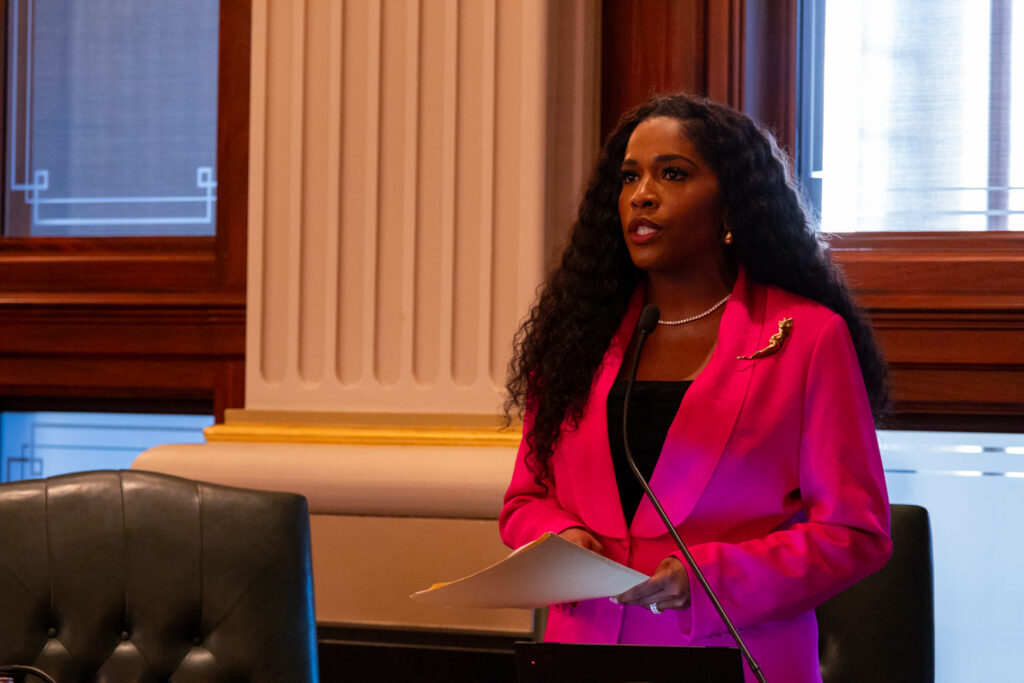
SPRINGFIELD — Criminal justice reform advocates say legislation to seal criminal records for certain nonviolent crimes, which passed Friday in the House, would unlock economic opportunity for thousands of Illinoisans.
The so-called Clean Slate Act has failed twice before, but activists see renewed fiscal messaging as the key to reinvigorating the campaign. This time, the bill’s sponsor points to a “diverse coalition of stakeholders” and backing from business groups as signs Illinois could become the 13th state to enact similar legislation.
“This is something I’ve worked on for six long years, and now we have law enforcement and the business community — folks like the Illinois Retail Merchants Association, the Illinois Manufacturers Association — all on board,” Rep. Jehan Gordon-Booth, D-Peoria, said in an interview. “Not as a neutral party, but they are proponents. They want to see this bill passed.”
Like earlier proposals, Senate Bill 1784 would require law enforcement agencies to automatically seal records for nonviolent criminal convictions twice a year — Jan. 1 and July 1. The records would no longer be public, although law enforcement and state’s attorneys would retain access.
Gordon-Booth has sponsored Clean Slate legislation twice before — once in 2021 and again in 2023 — but neither bill progressed past committee.
Just a few days before the 2025 legislative session concludes, she filed it again. Within two days, it passed the House mostly along partisan lines, and is headed for debate on the Senate floor.
The session ends at midnight Saturday, although the bill could still pass after that deadline.
People convicted of certain violent offenses — including sex crimes against minors, DUI, reckless driving and violent offenses that require sex offender registration — would be ineligible to have their records sealed.
“I want to make this very, very clear: Serious criminal records are not eligible for automated sealing,” Gordon-Booth said during floor debate.
Gordon-Booth argued that conviction records trap formerly incarcerated individuals in a state of perpetual punishment, eclipsing access to employment, housing and educational opportunities. She said Clean Slate would remove these barriers, helping system-impacted people reintegrate into society instead of recidivating.
Paul Rothschild, managing director of operations for the Illinois Coalition to End Permanent Punishment — a group that advocates for the rights of people with criminal records — said he agrees. He said the justice system fails to follow through on its own promise: Once someone has served their time, they are entitled to a second chance.
“We believe that people should be accountable for the crimes that they commit. But we also believe there is an implied covenant that when they finish, they’re supposed to be returned to the world made whole, and that covenant is not being kept by society. They’re being forever subjugated in that lower caste, that lower class,” Rothschild said.
More than 3 million Illinoisans have arrest or conviction records, and an estimated 921,000 people are eligible for “sealing relief” — but only about 10% actually petition to have their records cleared, according to statistics from Live Free Illinois, a grassroots organization aimed at reforming the state criminal justice system and part of the Clean Slate Illinois steering committee, which coordinates the campaign’s messaging and advocacy efforts.
The bill would automate the process for individuals with nonviolent convictions to have their records sealed, once they have served their sentences, completed probation, and remained crime-free.
Many eligible individuals are deterred by steep fines, complex paperwork and long waiting periods, Gordon-Booth said. The “burdensome” process has contributed to massive court backlogs, according to Clean Slate Illinois.
“It’s going to automate the process, so this way we don’t have to go through that whole trying to get the paperwork, trying to go through all the rigmarole,” said Chauncy Stockdale, who was formerly incarcerated and is now a member of the Live Free Illinois Fellowship, a reentry program that supports returning citizens.
The measure passed the House 81-28, with five Republicans joining Democrats in support of the measure. No Democrats voted against the bill.
During debate on the House floor, Minority Floor Leader Rep. Patrick Windhorst, R-Metropolis, voiced concerns about the tentative $18 million price tag, and whether the state is capable of fully funding the policy in the years ahead, leaving counties to cover the cost.
“If this isn’t funded, we’re either going to be sending a large unfunded mandate to our counties, or we’re making a promise to 2.1 million people that will not be fulfilled without any funding,” he said.
Gordon-Booth detailed a three year “implementation ramp,” which would give the state time to identify funding sources for the local circuit clerks. She also said the Illinois State Police would absorb the initial costs and emphasized the state’s commitment to supporting circuit clerks in the rollout phase.
“It is our full intention to provide clerks with all that they need to implement this,” she said. “We are not going to send an unfunded mandate to our local governments.”
‘Workforce and economic policy’
On April 10, nearly 300 members, supporters and advocates from Live Free Illinois chapters gathered in front of the Abraham Lincoln monument in Springfield for Advocacy Day, calling on lawmakers to introduce the Clean Slate Act.
Live Free Illinois — a faith-based nonprofit focused on ending gun violence and mass incarceration — organizes Black congregations to push for systemic change. The organization is involved in the broad-based Clean Slate steering committee, which also includes the Fully Free Campaign, the Illinois Coalition to End Permanent Punishments, and Impact for Equity.
The day before, Muslim leaders also advocated for Clean Slate legislation at Illinois Muslim Action Day.
Beyond criminal justice reform, advocates pushed a new messaging angle this year to usher the legislation across the finish line: Clean Slate could boost Illinois’ economy.
As of April, Illinois has one of the highest unemployment rates in the country, at 4.8% — above the national average of 4.2%, according to the data from the U.S. Bureau of Labor Statistics.
Jerika Richardson, senior vice president for equitable justice and strategic initiatives at the National Urban League, said the act would open doors for thousands of people who have been barred from work because of background checks.
“There are so many employers and businesses across this country who are struggling to find the workers that they need, and part of the reason is because these records are barriers,” Richardson said. “If Illinois passes the Clean Slate Act, you won’t have to worry about businesses going to another state or leaving the country.”
An amendment to the Illinois Human Rights Act, signed by Gov. JB Pritzker in 2021, expanded legal protections for state workers by prohibiting discrimination based on criminal convictions, in addition to arrest records. Yet many say they continue to face employment hurdles despite the law.
People with conviction histories earn an average of 25% less than those with clean records — a gap the National Urban League says costs the state billions of dollars in lost wages. According to a news release from the National Urban League, the Clean Slate Act could generate more than $4.7 billion in lost wages for Illinois, easing economic disparities and addressing labor shortages.
Gordon-Booth echoed Richardson’s point, adding that her office frequently hears from constituents who are missing out on life-changing chances.
“I get calls from people saying, ‘I had an opportunity to get my dream job, and it fell through because of something that I did when I was 18 or 19.’ And we’re talking about folks that are in their 30s,” Gordon-Booth said. “They have not gone through the process of hiring a lawyer, going through the court-mandated process, and folks are losing out.”
Reilly Cook is a graduate student in journalism with Northwestern University’s Medill School of Journalism, Media, Integrated Marketing Communications, and a fellow in its Medill Illinois News Bureau working in partnership with Capitol News Illinois.
Capitol News Illinois is a nonprofit, nonpartisan news service that distributes state government coverage to hundreds of news outlets statewide. It is funded primarily by the Illinois Press Foundation and the Robert R. McCormick Foundation.
The post Illinois criminal justice advocates tout ‘Clean Slate’ legislation as ‘economic boon’ appeared first on Capitol News Illinois.
CA legislators reject bill closing loophole on violent offenders

A legislative committee has rejected a bipartisan bill to end a loophole in California’s mental health diversion program that allows mentally ill individuals charged with domestic violence, human trafficking or assault of a child under age 8 resulting in the child’s death, to seek mental health treatment instead of facing criminal charges and prison time.
Assembly Bill 433, a bipartisan bill authored by Assemblywoman Maggy Krell, D-Sacramento, failed the Assembly Public Safety Committee when only Assemblymen Juan Alanis, R-Modesto, and Tom Lackey, R-Palmdale, voted to advance the bill.
Sacramento County Sheriff Jim Cooper, a former Democratic Assemblyman, testified in support of the bill. He shared a real-world situation in which the current diversion system resulted in no criminal record and no prison time for the killer of a child.
“Mark was taking care of his 1-year-old daughter, and at the same time, he got blackout drunk. He admitted to drinking a pint of vodka and several beers. Under his care, his baby girl suffered a fractured skull, broken ribs and a brain hemorrhage,” said Cooper. “She died of the horrific injuries inflicted by her father.”
“After he was arrested, Mark claimed he was too drunk to remember what he did, and prosecutors couldn’t prove his intent to kill. So, instead of murder, he faced only felony child abuse charges,” continued Cooper. “This made Mark eligible for mental health diversion instead of prison, which he was granted.”
As a result, Mark’s punishment was to “take a few virtual classes,” after which he “walked away with a clean slate,” Cooper said.
“The judge congratulated him, and the courtroom clapped for him,” the sheriff said. “Today, Mark has no criminal record. Mark is considered the victim for not remembering how he brutally killed his baby girl.”
Krell, while sympathetic to the apparent need for mental health diversions for some criminals, explained the current exemptions allow some more serious crimes to go unpunished.
“While there are certain cases where pretrial mental health diversion would be an appropriate alternative to criminal sentencing, this law fails to provide justice for victims who have been trafficked, abused as children, and individuals who have sustained great bodily injury,” wrote Krell in support of her bill to close the law’s loophole. “As applied to offenders who are dangerous and seek to continue to abuse their victims, this law creates a major public safety gap.”
The Assembly Public Safety Committee’s analysis of the bill noted the results of a 2019 study finding “more than 30% of the state’s prison and 23% of the jail populations have a mental illness,” and stated that “Promoting treatment over incarceration has shown positive results in reducing recidivism.”
While the bill was backed by law enforcement groups and anti-child-abuse advocates, the bill was opposed by a broad coalition including the American Civil Liberties Union and Smart Justice California — a project of George Soros-backed Tides Advocacy.
“AB 443 seeks to limit the discretion of judges to apply mental health diversion to candidates that are currently eligible,” wrote Smart Justice California in opposition. “Current law never requires courts to grant diversion, it merely gives the court the ability, where appropriate, to use its informed discretion to divert mentally disordered people out of the criminal system and into the mental health treatment system.”
After the bill’s failure, Cooper announced he is hosting an event June 4 in Sacramento to discuss the state’s mental health diversion program and its impact on the state.
Immigration experts: Tech workforce will not hurt from Trump immigration policies

A law firm specializing in injury and immigration matters is concerned about the effect of unspecified “Trump immigration laws” on innovation in technology, but immigration experts say the main workers that will be affected are in the U.S. illegally or brought in to be paid less than citizens – these workers don’t “drive innovation.”
In a study by Brooks Law Firm that details Trump immigration laws’ effect on various U.S. industries, it is stated that the information industry will be the most affected as it employs 416,000 “immigrant workers.”
For perspective, immigrants make up 1.4% of the information industry, according to the study.
Brooks Law Firm is based out of Massachusetts and focuses on injury and immigration matters.
The firm’s study additionally states that education and health services comes in at second most impacted and professional business services at third with 183,500 and 157,600 immigrant workers respectively potentially leaving.
In a statement obtained by The Center Square, founding attorney of Brooks Law Firm Arinda Brooks said of the study, “the rapid reshaping of America’s tech workforce through immigration policy changes threatens to undermine decades of competitive advantage in global innovation markets.”
“Silicon Valley’s success has been built on its ability to attract world-class talent, with immigrants representing more than 57% of STEM workers in the Bay Area and contributing disproportionately to patent filings and venture formation,” Brooks said.
“Without thoughtful policy recalibration that balances security concerns with talent acquisition, the U.S. risks ceding technological leadership to competing innovation hubs in Canada, Europe, and Asia,” Brooks said.
Those in immigration studies disagree with Brooks’ statements, however.
To start with, some of those the Brooks Law Firm’s report calls immigrants are actually illegal aliens, director of policy studies at the Center for Immigration Studies Jessica Vaughan told The Center Square.
“No one is talking about eliminating or reducing access to global talent in any field,” Vaughan told The Center Square. “What the Trump administration is doing is addressing illegal immigration, and addressing flaws in our guestworker programs that allow companies to replace U.S. workers with lower-paid foreign guest workers.”
“According to government data, these visa workers are not the cream of the crop or especially talented; most are ordinary, often entry-level or trainee workers who are brought in by staffing companies to reduce labor costs – not to drive innovation,” Vaughan said.
In a similar vein, director of research at the Center for Immigration Studies Steven Camarota told the Center Square that “Silicon Valley was created largely with a US-born workforce in the 1960s to the early 80s, which…was a period of relatively low immigration in American history.”
Camarota said that “allowing a huge number of such workers [into the nation] certainly reduces the incentives for business to pressure policy makers and the education system to produce more workers with these skills.”
Vaughan said she has not “observed any proposed changes to US immigration policy that would put American leadership in technology innovation at risk.”
“U.S. companies have access to top global talent, and these individuals are attracted to our country by its innovative and entrepreneurial culture and opportunities,” Vaughan said.
Brooks Law Firm does not specify which new Trump immigration laws it refers to in its report other than citing in its data – “potential Trump-era immigration enforcement policies” – and did not respond to a request for comment from The Center Square.
Vaughan sees Trump’s immigration policies as for the benefit and improvement of the nation.
“The first improvement is to make sure that the rules are followed and that the public can have confidence that our legal immigration system has integrity,” Vaughan said.
“In addition, Trump is ensuring that our visa programs serve American interests, do not disadvantage American citizens, and bring in immigrants who will be self-sufficient and hopefully become contributing Americans,” Vaughan said.
“That approach ensures that immigration will not be a drag on our economy or a threat to our security,” Vaughan said.
Vaughan also told The Center Square that “Americans should be skeptical of claims that we have a labor shortage or a dearth of talent in technology fields.”
“If we did, then salaries would be increasing and workers could be very mobile,” Vaughan said. “There is no evidence of this.”
“Instead we have witnessed the dumbing down of certain aspects of tech work, as employers have been able to substitute visa workers brought in by staffing companies for American workers,” Vaughan said.
Trump announces 50% tariff on imported steel

President Donald Trump announced higher tariffs on imported steel Friday.
The president made the announcement during a visit to Pittsburgh.
“That means no one is going to be able to steal your industry,” Trump said. “At 25%, they can sort of get over that fence. At 50%, they can no longer get over the fence.”
In February, Trump announced 25% tariffs on steel and aluminum imports. He doubled that on Friday to 50%.
Ruling awaited in South Carolina climate lawsuit

No ruling from a South Carolina judge was rendered Friday at the end of a two-day hearing in a climate change lawsuit brought by the city of Charleston against 24 oil and gas companies.
The oil companies want a dismissal.
In the lawsuit, Charleston seeks unspecified monetary damages from the oil and gas companies, claiming that they knew their products contributed to climate change but didn’t disclose that to the public.
Judge Roger Young asked lawyers in the case to submit draft orders to him by July 1.
“I hear a lot of arguments,” the judge said. “Sometimes I don’t find oral arguments to be helpful but this was extraordinarily helpful.”
Attorneys for Charleston argued Thursday that the oil and gas companies knew that their products contributed to climate change but kept that from the public in order to continue reaping profits from the sales.
“When I get into a car, or a train or a bus or a plane, we don’t really care what the energy source is that leads to the transportation,” one of the attorneys for Charleston, Matt Edling, told the judge. “We just care that it gets us from point A to point B and that if we’re paying for it, that’s it’s the most economic choice that is available to us.”
The oil companies intentionally created a market where energy choices were artificially limited to fossil fuels, he added.
“That’s the problem,” he said. “You guys, together, you knew all of this and you made herculean efforts to convince the world that it wasn’t a problem. You saw that it could be a calamitous problem, have benefit from it economically to extraordinary disadvantage of cities like Charleston.”
However, attorneys for the oil companies pointed out that the city of Charleston still uses fossil fuels today and that there are few affordable alternatives yet on the market.
They also pointed out that the oil companies have invested heavily in renewable energy and that one, BP, adopted a slogan, “Beyond Petroleum,” and began using the color green in its corporate logo.
“The city’s theory is that these actions are part of an effort to mislead consumers into believing that BP is becoming a sustainable energy company and that this effort is somehow to convince consumers to want to buy BP’s fossil fuel products,” BP attorney Merritt Abney told the judge. “That theory obviously makes no sense.”
A similar case in Bucks County, Pennsylvania, was dismissed earlier this month
WATCH: Trump, Musk hold press conference amid DOGE exit

President Donald Trump was joined in the Oval Office Friday by top advisor Elon Musk, just two days after Musk announced his formal departure from the administration.
With Musk at his shoulder, Trump announced that the Tesla CEO is “really not leaving” and that he will likely “be back and forth.”
As the top staffer in the Department of Government Efficiency, Musk has been a powerful force in implementing Trump’s vow to reduce waste, fraud, and abuse in the federal government.
“Elon’s service to America has been without comparison in modern history,” Trump said.
However, as a special government employee, Musk’s limited 130-day tenure came to an end this week.
“I expect to remain a friend and an advisor and certainly, if there’s anything the president wants me to do, I’m at the president’s service,” Musk said.
Under Musk’s ambitious leadership, DOGE committed to finding $1 trillion in cuts to the federal budget. While DOGE’s cuts currently measure much lower than this goal, Musk reiterated that he still plans to meet the targeted $1 trillion “over time.”
“It’s just a lot of work going through the vast expenses of the federal government and just really asking questions,” Musk said.
Musk’s departure from the Trump administration has been marked by disagreements between himself and the president over the “One Big Beautiful Bill Act.” But the tone of the news conference gave the air of an amicable parting.
Trump presented Musk with a large gold key as a symbolic farewell gift. “As a presentation from our country. Thank you, Elon. Take care of yourself,” Trump said.
Trump was also asked about the debt ceiling and expressed interest in eliminating it, departing from his position during the Biden administration. Trump said that Sen. Elizabeth Warren, D-Mass., “happened to be right” about the need to cancel the debt limit, noting his differing viewpoint from most Republicans on the matter.
‘Medical aid in dying’ bill moves forward in Illinois
Capitol News Illinois
SPRINGFIELD — Terminally ill Illinoisans may have the legal option to end their own life with the help of a physician next year under a bill approved by lawmakers Thursday.
The procedure, which advocates and the bill call “medical aid in dying,” would give people in a sound mental state with severe health issues the option to end their life with the help of a doctor.
Under Senate Bill 1950, doctors would be allowed to prescribe terminally ill patients a lethal dose of medication that they could self-administer at a time of their choice.
Advocates for the procedure, which is legal in 10 states and the District of Columbia, say it provides agency to people at the end of their life.
“I want to enjoy the time I have left with my family and friends,” Deb Robertson, a terminally ill woman, told lawmakers via Zoom on Wednesday. “I don’t want to worry about how my death will happen. It’s really the only bit of control left for me.”
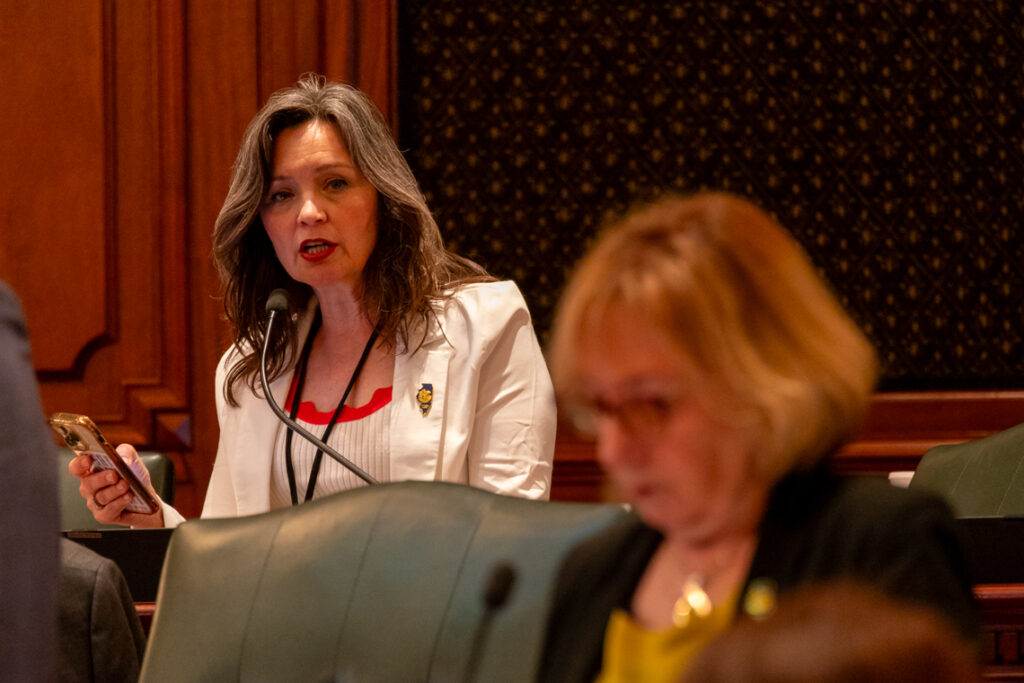
The measure passed in the House 63-42 after more than an hour of intense, sometimes tear-filled debate. It now awaits action in the Senate. Senators have a matter of hours to pass the bill before their scheduled adjournment Saturday.
The bill outlines a process that includes two doctors recommending the procedure, sometimes referred to as medically assisted suicide, and limits the people who are eligible. People must be of sound mind and have a prognosis of less than six months.
Death certificates of those who use the procedure would also list their underlying diseases, not “suicide,” reflecting the common belief among advocates that the procedure should not be called suicide. Bill sponsor Rep. Robyn Gabel, D-Evanston, noted in debate Thursday that the provision would also “prevent inappropriate suicide investigations.”
But even with these protections, some oppose allowing the procedure.
Medical associations are divided on the issue. The American Medical Association, the largest and most influential medical association, notes an “irreducible moral tension” inherent in the practice.
The AMA’s Code of Ethics, for many years, said the procedure is “fundamentally incompatible with the physician’s role as healer.” The association has recently softened its stance, opening the door for physicians to act on their own conscience on the matter.
Rep. Bill Hauter, R-Morton, a practicing physician, opposed the bill and told his colleagues during debate Thursday that it “changes forever the soul of medicine.”
During the House debate, the division among the health care industry reared its head. Rep. Nicolle Grasse, D-Arlington Heights, is a hospice chaplain and was supportive of the bill.
“I’ve seen hospice ease pain and suffering and offer dignity and quality of life as people are dying, but I’ve also seen the rare moments when even the best care cannot relieve suffering and pain, when patients ask us with clarity and peace for the ability to choose how their life ends,” she said.
Outside of health care, religious groups and disability rights advocates are also divided. Members of both parties invoked their faith during floor debate, including Rep. Maurice West, D-Rockford, an ordained Christian minister.
“Life is sacred. Death is sacred, too,” West said. “The sanctity of life includes the sanctity of death. This bill allows, if one chooses by themselves, for someone with a terminal diagnosis to have a dignified death.”
Republicans, who are generally more aligned with pro-life religious groups, opposed the bill. Catholic groups say procedures like medically assisted suicide violate the church’s teachings and many conservative protestant groups oppose the practice as well.
Rep. Adam Niemerg, R-Dietrich, said the procedure does not “uphold the dignity of every human life.”
“This does not respect the Gospel,” Niemerg, who is Catholic, said during debate. “This does not respect the teachings of Jesus Christ or uphold the values of God.”
Disability rights activists are also split on the issue. Sebastian Nalls, a policy analyst at the disability rights organization Access Living, said that if the procedure is legalized, insurers may pressure some sick people into it instead of expensive treatment.
“This bill carries far too many loopholes and lacks oversight to be safe and equitable, but the bottom line for Access Living is this: The existence of assisted suicide is a threat, to not just the kind of health care we deserve, but a threat to our ability to live and die with dignity,” Nalls said in a committee hearing Wednesday.
Other disability rights advocates, like Beth Langen, note that “disability is not terminal.”
“Death, like life, is easier to navigate when you know you will have options to choose from, even if you never need to,” Langen said at Wednesay’s hearing.
Capitol News Illinois is a nonprofit, nonpartisan news service that distributes state government coverage to hundreds of news outlets statewide. It is funded primarily by the Illinois Press Foundation and the Robert R. McCormick Foundation.
The post ‘Medical aid in dying’ bill moves forward in Illinois appeared first on Capitol News Illinois.
Watchdogs: New Montana law restricting foreign money in elections insufficient

Montana recently became the sixth state this year to pass a ban on foreign spending on ballot measures. Watchdog organizations, however, say the state’s new law is inadequate.
Montana’s new law bars non-U.S. citizens, foreign governments, foreign political parties and foreign-owned entities from contributing to campaigns surrounding ballot measures. The legislation passed mostly along party lines, with near-unanimous Republican support and limited Democratic backing.
The new law, however, carves out an exemption for U.S.-based companies with foreign ownership if they pay state taxes and use only domestically generated funds from citizens or permanent residents.
Additionally, the measure doesn’t stop American political advocacy groups that receive money from foreigners from taking sides in ballot questions, watchdogs say.
“The problem that Montana failed to address is that you can have these intermediary groups that act as essentially money launderers, like the Sixteen Thirty Fund, raising enormous sums from foreign nationals, while simultaneously spending money on ballot measures,” Honest Elections Project executive director Jason Snead told The Center Square in a Zoom interview. “That’s why some of the measures we’ve seen passed this year, like in Missouri, for instance, require groups that spend in support of or against ballot measures have to certify that they have not taken above a certain threshold of foreign money over a four-year period. And the reason for that is to avoid this money laundering type of activity. That’s what’s missing from the Montana law.”
The Sixteen Thirty Fund, an American progressive political advocacy organization, has received at least $280 million from Swiss billionaire Hansjörg Wyss since 2016, according to the New York Post.
The organization, for example, has actively participated in Montana’s politics. It spent over $3 million supporting a ballot initiative in Montana last year that made abortion a constitutionally protected right, according to Ballotpedia.
The Sixteen Thirty Fund has spent over $130 million on ballot questions in 25 U.S. states in the past decade, according to RealClearPolicy.
Since the Sixteen Thirty Fund is an American-based company that Wyss donates to – and doesn’t tell the organization how to spend its money – Montana’s new law won’t prevent it from spending on the state’s ballot questions.
Americans for Public Trust executive director Caitlin Sutherland said Montana should look to other states for model legislation.
“Yes, absolutely,” she told The Center Square in a Zoom interview. “Starting with Ohio last year, we have seen that foreign funding bans have really swept state houses across the country. They’re all slightly similar with the goal of banning foreign money – direct and indirect – on ballot issues. We saw that Wyoming passed a very strong ban, as did Kansas, Arkansas, Kentucky and Indiana all this year.”
Once Ohio’s ban on foreign funding of ballot initiatives took effect last year, the Sixteen Thirty Fund stopped spending on The Buckeye State’s ballot questions and turned its attention elsewhere, as RealClearPolitics reports.
Heritage Action for America Montana State Director Kristen Christensen said her group wanted Gov. Greg Gianforte to veto the measure
“Montana HB 818 was intended to safeguard Montana elections but unfortunately stopped short in protecting the integrity of elections in the Treasure State,” Christensen said. “Heritage Action urged Governor Gianforte to veto this weak legislation. It leaves loopholes open for foreign actors to pour millions of dollars into Montana’s electoral process, and leaves Montanans’ voices vulnerable to being drowned out by illegitimate and foreign influence.”
Snead also worries that foreign adversaries, like Russia and China, may one day capitalize on this campaign finance loophole and fund American ballot initiatives.
“Any loopholes that exist in our current laws or that we create with new laws can and probably will be exploited by adversarial foreign powers, like China, like Russia, that clearly mean the U.S. ill,” he said. “That’s why we should never risk playing with fire by allowing foreign powers to meddle in our politics. We need to build the protections now and make sure that money’s out of our state politics forever.”
Exclusive: Former USAID executive disputes reported impact of foreign aid cuts

A former executive at the U.S. Agency for International Development is disputing claims by an international human rights organization that the Trump administration’s foreign aid cuts have caused mass suffering.
The administration’s cutting of 90% of USAID foreign aid contracts has sparked debate over whether American tax dollars have funded global humanitarian policies, or a giant organization rife with corruption and wasteful spending. A new report from Amnesty International suggests the cuts have threatened, stalled or shuttered life-saving programs across the world.
However, Max Primorac, who worked in the foreign aid sector for over 30 years, told The Center Square that “there’s a lot of problems” in the foreign aid sector and said claims that thousands are dying “have no credibility.” Primorac launched the Bureau for Humanitarian Assistance while at USAID and later served as its acting COO.
“It’s incredible to blame America for millions of people dying. Number one, they [Amnesty International] don’t have any documentation, any proof. And second, the primary responsibility of providing for citizens overseas are their own governments, not the American taxpayer,” Primorac said.
According to the report, dozens of impoverished and conflict-ridden countries have seen multiple aid services cut, creating “a life-threatening vacuum” that other governments and aid organizations “are not realistically able to fill in the immediate term,” according to Amanda Klasing of Amnesty International USA.
Anonymous sources interviewed by the organization said programs and clinics in Guatemala, Haiti, Afghanistan and Yemen that support sexual and gender-based violence survivors have been impacted by the cuts.
The cuts have also purportedly interrupted emergency nutritional support in Syria, Yemen, Haiti and South Sudan, as well as HIV prevention and treatment programs in Haiti and across east and southern Africa.
Refugee and migrant services in Thailand, Myanmar, Costa Rica, Mexico and other countries have also been partially suspended or scaled back.
“It is a false choice that the U.S. government has to choose between addressing the economic needs of Americans or the rising cost of living here in the U.S. and development and humanitarian assistance abroad,” Klasing said, noting how foreign aid represented about 1% of the total U.S. budget before the aid cuts.
“The U.S. has a global responsibility and interest in providing support to the most marginalized,” she added.
But Primorac dubbed the Amnesty International report “a progressive political hit job” on the Trump administration.
“The fundamental problem that we have is that the aid sector, number one, is politically very radical. Many of these organizations were supporting Hamas. And in terms of humanitarian assistance in the countries that they talk about, I know these countries very well — Afghanistan, Yemen, Syria, Gaza — and we have a very big problem in terms of diversion of aid to bad actors,” he said.
As The Center Square previously reported, Primorac has testified before Congress regarding corruption, waste and mismanagement he witnessed in the foreign aid system, including lobbying efforts to tank legislation that would have increased transparency in USAID spending.
USAID has come under fire for its involvement in coronavirus research in Wuhan, China, in 2019, its alleged funding of gender ideology initiatives in dozens of countries, and its sponsoring of armed terrorist groups, among other things.
“It is a self-interested foreign aid industrial complex that has no credibility,” Primorac told The Center Square. “Instead of using taxpayer money to help alleviate poverty, what they have done instead is create a permanent global welfare program that doesn’t help these people, that keeps them poor, keeps them hungry. This aid dependency has destroyed the ability of these countries to get off aid.”
Primorac called the report a “missed opportunity” to discuss how the U.S. can better administer aid to needy countries given the increasing amounts of foreign aid and “no progress.”
“These are the true ways in which to generate wealth and fight poverty in these countries, not welfare programs,” he said. “Under the leadership of Secretary Rubio, the United States has a unique opportunity to move away from these traditional welfare-based programs to promoting more trade and investments.”
Trump says no more ‘Mr. Nice Guy’ after short-term trade deal with China

President Donald Trump accused China on Friday of breaking a short-term trade deal with the U.S.
Earlier this month, the two countries reached a 90-day deal to reduce high tariffs on trade between the world’s two largest economies. The global superpowers agreed to slash tariffs that had been so high that nearly all trade between the two nations stopped. The U.S. reduced its tariffs on China from 145% to 30% while the two nations continued to talk. China cut its levies on U.S. imports from 125% to 10%.
“China, perhaps not surprisingly to some, HAS TOTALLY VIOLATED ITS AGREEMENT WITH US. So much for being Mr. NICE GUY!” Trump wrote on Truth Social.
U.S. markets retreated on the news in what has been a challenging month for investors.
Trump also lashed out at the three judges on the U.S. Court of International Trade who unanimously ruled on Wednesday that Congress did not give tariff authority to the president under the International Emergency Economic Powers Act of 1977. That court voided most of Trump’s tariffs, but the administration appealed the decision to a higher court, which paused the Court of International Trade ruling for now.
“Where do these initial three Judges come from? How is it possible for them to have potentially done such damage to the United States of America?” Trump wrote on Truth Social. “Is it purely a hatred of ‘TRUMP?’ What other reason could it be?”
The Court of International Trade said the International Emergency Economic Powers Act of 1977 didn’t give Trump “unbounded” authority to set tariffs. The ruling was a setback for Trump’s foreign and domestic policy agenda, which is underpinned by tariffs.
“Worldwide and Retaliatory Tariffs do not comply with the limitations Congress imposed upon the President’s power to respond to balance-of-payments deficits,” the Court of International Trade judges wrote. “The President’s assertion of tariff-making authority in the instant case, unbounded as it is by any limitation in duration or scope, exceeds any tariff authority delegated to the President under IEEPA.”
On Thursday, the Trump administration filed an emergency motion asking for a stay.
“The injunction threatens to unwind months of foreign policy decision-making and sensitive diplomatic negotiations, at the expense of the Nation’s economic well-being and national security,” DOJ attorneys wrote.
The appeals court granted the stay Thursday afternoon.
“The ruling by the U.S. Court of International Trade is so wrong, and so political!” Trump wrote. “Hopefully, the Supreme Court will reverse this horrible, Country threatening decision, QUICKLY and DECISIVELY. Backroom ‘hustlers’ must not be allowed to destroy our Nation!”
Trump made it clear he didn’t want to work with Congress on tariffs.
“The horrific decision stated that I would have to get the approval of Congress for these Tariffs. In other words, hundreds of politicians would sit around D.C. for weeks, and even months, trying to come to a conclusion as to what to charge other Countries that are treating us unfairly,” Trump wrote. “If allowed to stand, this would completely destroy Presidential Power – The Presidency would never be the same!”