National News
Attacker targets pro-Israel demonstration in Boulder, Colo.
Local and federal authorities are investigating what FBI Director Kash Patel said was a “targeted terror attack” in Boulder, Colo., Sunday in which multiple people were set on fire during an event hosted by a group that seeks the release of Israeli hostages held by the anti-Israel terrorist group Hamas.
The suspect in the attacks was arrested at the scene, authorities said. He was identified as Mohamed Sabry Soliman, 45. FBI Denver’s field office said he was heard yelling “Free Palestine.”
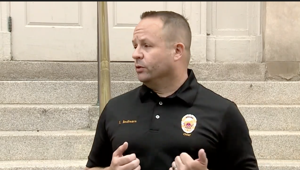
“The initial callers indicated that there was a man with a weapon and that people were being set on fire,” Boulder Police Chief Steve Redfearn said during a Sunday afternnoon news conference. There were at least six victims, all aged 67 or older.
Redfearn said authorities do not think there was a second attacker but he could not say definitively without further investigation.
Redfearn said the attack occurred during a pro-Israel demonstration on Pearl Street near the county courthouse but authorities were still investigating if it was antisemitic in nature.
Witnesses told police that the suspect threw Molotov-style cocktails.
Colorado Gov. Jared Polis called the attack a “heinous act of terror” in a post on X.
“I am closely monitoring the situation in Boulder, and my thoughts go out to the people who have been injured and impacted by this heinous act of terror,” Polis wrote. “Hate-filled acts of any kind are unacceptable. While details emerge, the state works with local and federal law enforcement to support this investigation.”
This is a developing story.
PHOTOS: Trump celebrates U.S. Steel merger in Pennsylvania

President Donald Trump visited West Mifflin, Pa. on May 30 to celebrate U.S. Steel’s merger with Nippon Steel.
Read MoreUnpacking the baseline battle: Trump’s ‘big, beautiful bill’ and the national debt
Top U.S. Senate Republicans are eyeing a controversial accounting method to theoretically slash the multi trillion-dollar price tag of President Donald Trump’s “big, beautiful bill.”
However, tax policy experts remain strongly divided over whether the tactic would constitute legitimate policy or a recipe for fiscal disaster.
The current version of the budget reconciliation package, entitled the One Big Beautiful Bill Act, passed the U.S. House on a razor-thin margin. The bill would give a 10-year extension to key portions of the expiring 2017 Tax Cuts and Jobs Act, raise the debt ceiling by $4 trillion, and fulfill Trump’s energy, border security and defense agenda.
Using the traditional current law baseline, House leaders calculated that the tax cut extensions would lead to an estimated $4.3 trillion in lost revenue over the next decade.
To help offset the cost, House committees included more than $1.7 trillion in savings in the package. They assumed that economic growth from the tax cut extension would cover the rest, though the Committee for a Responsible Federal Budget estimates the bill would still add at least $3.1 trillion to the national debt by 2034.
But Senate leaders want to make the tax cuts permanent, which, under the traditional current law baseline understanding, would increase the federal debt and deficit.
As a result, lawmakers are planning to use the current policy baseline to score their portion of the bill instead, which would treat the tax cut extension as a continuation of current law rather than new policy, theoretically zeroing out the cost.
In a recent statement, CRFB President Maya MacGuineas called the plan “nothing short of a fiscal failure.”
“The problem with the use of a current policy baseline in this bill is that they are using it to extend provisions originally scored under current law back in 2017 to bring down their score,” MacGuineas said. “This two-step would allow policymakers to avoid ever acknowledging the deficit impact of the TCJA for 2026 and beyond.”
The unprecedented move would not only pave the way for tax cut permanence but also allow the Senate to tack on an additional $1.5 trillion in spending to the bill for other wishlist items.
The White House fully endorsed the method Thursday, with White House Deputy Chief of Staff Stephen Miller calling the dire estimates from the Congressional Budget Office and others a “ludicrous theory” in multiple social media posts.
“Private money yet to be earned does not ‘belong’ to the government,” Miller said. “CBO says maintaining *current* rates adds to the deficit, but by definition leaving these income tax rates unchanged cannot add one penny to the deficit.”
Multiple Republicans in both the House and Senate have pledged to oppose a final bill that operates under current policy baseline or lacks additional spending cuts. Under the budget reconciliation process, Senate Majority Leader John Thune, R-S.D., needs only a majority vote for the One Big Beautiful Bill Act to pass.
In just a few months, ICE makes 1,000+ worksite enforcement actions

In just a few months, U.S. Immigration and Customs Enforcement agents have arrested more than 1,000 “illegal alien workers without employment authorization.”
It’s “the highest rate of arrest in HSI’s history,” HSI acting Executive Associate Director Robert Hammer said in April. “We’ve subpoenaed the business records of about 1,200 businesses, and as part of our review, we’ve proposed close to $1 million in fines.”
Fast forward into the end of May and hundreds more have been arrested through targeted worksite multiagency enforcement actions nationwide, with more than $8 million in fines levied in Denver alone.
On May 29, more than 100 citizens of Colombia, El Salvador, Honduras, Guatemala, Mexico, Nicaragua and Venezuela were arrested at construction sites in Tallahassee. One was “taken into state custody for resisting arrest and is being charged with four counts of assault on law enforcement officers. Another attempted to pull a weapon on officers,” ICE said.
In Tampa, 33 citizens of Guatemala, Honduras and Mexico were arrested at construction sites “in one of the fastest growing communities in the nation located 20 miles south of Ocala,” ICE said. Four were charged with felony reentry; more than 30 “could be seen fleeing from the construction sites,” ICE said.
In Atlanta, ICE agents found two unaccompanied minors (UACs) and five adults from Guatemala and Mexico during a worksite enforcement operation at a subdivision in Theodore. One of the adults was previously twice deported.
The minors illegally entered the U.S. in 2023, were apprehended by Border Patrol agents and transferred into the custody of U.S. Department of Health and Human Services’ Office of Refugee Resettlement. ORR has a long history of documented abuse of minors within facilities it manages, paid for by taxpayers. Allegations and criminal charges include sex abuse, trafficking and forced labor, The Center Square has reported.
This case was no different. ICE agents learned that “neither UAC was enrolled in school nor had any relatives in the area.” The children were sent back to ORR, ICE said.
In Denver, three businesses received more than $8 million in fines after ICE worksite audits “uncovered widespread employment eligibility violations.” CCS Denver, Inc. was fined $6.18 million “after a 100% substantive violation rate and evidence of knowingly hiring and employing at least 87 unauthorized workers.” PBC Commercial Cleaning Systems, Inc., was fined nearly $1.6 million “for a 74% violation rate and a pattern of knowingly employing at least 12 unauthorized workers;” Green Management Denver was fined $270,195 “after a 100% violation rate and identification of 44 unauthorized employees.”
In Detroit, ICE filed a civil complaint against a Chinese money laundering organization and seized 14 properties, seven bank accounts and 15 vehicles worth millions of dollars. It was charged with operating “a staffing company to supply illegal workers to a factory in Ohio and harbored that illegal workforce.”
In Louisiana, 15 citizens of El Salvador, Guatemala, Honduras and Nicaragua were arrested at construction sites in the New Orleans area. In another operation, 11 citizens of Ecuador, Mexico and Nicaragua were arrested as part of an investigation “into the illegal hiring of unauthorized employees by commercial and industrial general contractors currently engaged in a construction project within the Port of Lake Charles.”
In Lowell, Mass., ICE agents arrested 11 Ecuadorians working for a roofing business; in Philadelphia they arrested four Brazilian nationals at a meat market; at the Port of New York/New Jersey, they arrested 16 illegal foreign nationals.
In Laredo, Texas, ICE agents arrested 31 citizens of El Salvador, Honduras and Mexico at business and construction sites with prior convictions, including “aggravated criminal sexual assault, bodily harm, possession of a controlled substance, evading arrest, transporting noncitizens, domestic violence/strangulation, terroristic threats,” weapons charges and others.
“Businesses that exploit and hire illegal workers are harming the American public,” Hammer said. “ICE’s statutory duties include protecting Americans and enforcing more than 400 laws that relate to immigration, so there are two aspects to our worksite enforcement operations.”
Investigators conduct I-9 inspections and audits in accordance with federal law, which requires employers to verify the identity and employment eligibility of everyone they hire using the Employment Eligibility Verification Form I-9. “These inspections are among the federal government’s most effective tools to enforce U.S. employment laws,” ICE says.
ICE imposes civil fines, makes criminal referrals, makes criminal arrests of employers and administrative arrests of unauthorized workers after uncovering “multiple forms of criminal activity,” including human trafficking, document fraud, and human rights abuses, including forced labor.
In fiscal 2024, the Department of Labor investigated 736 cases of child labor violations impacting more than 4,000 children. It fined employers more than $15 million, an 89% increase from the previous year.
Texas legislature advances ‘Mayorkas model’ providing limited border cooperation
The Texas legislature on Saturday advanced a bill that authorizes limited support for Trump administration border security enforcement.
After SB 8, filed by state Sen. Charles Schwertner, R-Georgetown, passed the Senate, a substitute bill passed the House filed by Rep. David Spiller, R-Jacksboro, which the Senate rejected. A conference committee released a revised bill on Saturday.
It only applies to “certain sheriffs” that operate jails or enter into contracts with vendors that operate jails, according to the bill language. It doesn’t apply to state agencies or police departments. It doesn’t respond to a Trump administration request for all law enforcement officials in all counties nationwide to participate in a federal immigration program referred to as 287(g). Named after a section of the 1996 Immigration and Nationality Act, it authorizes U.S. Immigration and Customs Enforcement to delegate to state and local law enforcement officers specified immigration functions under ICE supervision.
Under the Biden administration, former Homeland Security Secretary Alejandro Mayorkas limited 287(g) participation to a jail model, which the Texas bill follows.
The Trump administration expanded 287(g) to three models, a Jail Enforcement Model (JEM), Task Force Model (TFM) and Warrant Service Officer (WSO) model, The Center Square reported. Additional models may be rolled out in the future. ICE provides free training, saying it “bears the cost of 287(g) training for law enforcement agencies.”
As of May 29, law enforcement agencies in 40 states were participating in 287(g), with the greatest number of agreements signed in Florida, The Center Square reported.
Florida agencies are participating in all three models, including Florida’s 67 sheriff’s offices; roughly 90 police departments; multiple university police departments, including boards of trustees; county commissioners; airport police; multiple departments of corrections, among others. No other state has the level of participation that Florida does.
By comparison, 64 Texas sheriffs have signed at least one 287(g) agreement with ICE, as well as the Nixon Police Department, Texas National Guard and Texas Office of Attorney General. Applications are pending from four additional sheriffs, as of May 29 data.
Current sheriff participation represents roughly 27% of Texas’ 254 counties. The majority are counties with small populations with limited funds. Notably absent are the Texas Department of Public Safety, Texas Department of Criminal Justice, and other state agencies. By contrast, Democratic-led Arizona Department of Corrections and Massachusetts Department of Corrections are participating in the JEM.
Just because President Donald Trump has largely shut down illegal border crossings doesn’t mean law enforcement efforts are finished, ICE says. State and local law enforcement have “four years to eliminate cartel activities in our communities,” Goliad Sheriff Roy Boyd, who leads an Operation Lone Star Task Force in multiple counties, told The Center Square.
“The reason we need everybody to participate in 287(g) is pretty simple. The people that are in this country illegally are beholden to the cartels and their contractors. The only way to get rid of the cartel presence in the United States is to apprehend illegal aliens in our counties and state,” he said. “As long as those people are here, the cartels have the logistical means they need to conduct their business, whether that is their slave trade, moving drugs, moving money, stealing oil in the Permian Basin.”
Cartel operatives also adapting and changing their methods, he and others in the OLS Task Force told The Center Square. “The reason we formed the task force was to deny the cartels the ability to operate freely within the jurisdictions of task force members,” he said. Their efforts have so far proved successful, with cartel operatives going around task force counties to avoid being apprehended, The Center Square first reported.
In nearby Lavaca County, where the previous sheriff wouldn’t participate in task force operations, drug trafficking went unchecked until a new sheriff was elected and is now participating in the task force, The Center Square exclusively reported.
Law enforcement at the state and local levels need to prepare for the future expecting a Biden administration 2.0 to reverse Trump administration policies, task force members say.
Now that Trump’s in office, “We need to keep the momentum going,” founding task force member Brooks County Sheriff Benny Martinez told The Center Square. “Trump’s term is only four years, 48 months and it’s gone. We need to think ahead for the next term already. We’ve got to do it now because [border security] has to be sustained. We just can’t give that up.”
“When President Trump is out of office, if the next administration does not take the same strong stance against the cartels, the cartels will be right back up at full production across the United States, bringing their product over. This is our opportunity to defund the cartels’ operations in our counties and state, and eventually nationwide,” Boyd said.
The current bill “is a continuation of the Mayorkas model,” task force members said, excluding the field enforcement component. Without field enforcement, the Trump administration won’t have the support it needs, they argue.
Without weighing in on the specifics of the bill, Trump border czar Tom Homan advocates for a whole of government approach targeting criminal illegal foreign nationals.
“Law enforcement at the local, state and federal levels should all work together seamlessly to protect our communities from illegal alien public safety threats. It’s plain common sense,” he told The Center Square.
Law enforcement agencies in 40 states are partnering with ICE 287(g) program
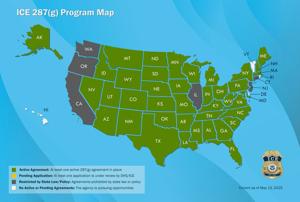
U.S. Immigration and Customs Enforcement is calling on law enforcement officials in all U.S. counties to participate in a federal program, 287(g). Those who do receive free training and resources, potentially federal grant money, and a partnership with the Trump administration to identify violent criminals illegally in the country, many of whom are already booked in their local and state jails.
The program is named after the Immigration and Nationality Act of 1996, 8 USC 1357, Section 287(g)(1), which authorizes ICE to delegate to state and local law enforcement officers the authority to perform specified immigration functions only under ICE’s direction and supervision. Local law enforcement officers can apply to participate in the Jail Enforcement Model (JEM), Task Force Model (TFM) and Warrant Service Officer (WSO) model, The Center Square reported.
As of May 29, a record 635 memorandum of agreements (MOAs) for 287(g) have been signed with ICE in 40 states, with the number growing every day, according to ICE.
They include JEM agreements with 100 law enforcement agencies in 25 states, WSO agreements with 228 law enforcement agencies in 31 states, and TFM agreements with 307 agencies in 30 states.
Another 68 pending 287(g) applications have been filed with ICE, including seven JEMs, 18 WSOs and 43 TFMs, according to the data.
Florida leads all states with the number of agencies that have signed 287(g) MOAs. It is the only state to have every county sheriff’s office (67) participating in at least one 287(g) program; many counties are participating in all three.
Florida also has the greatest number of state agencies participating: Florida Department of Highway Safety and Motor Vehicles; Florida Division of Highway Patrol; Florida Department of Law Enforcement; Florida National Guard; Florida State Guard; departments of Environmental Protection, Financial Services, Lottery Services, Division of Alcohol, Beverages and Tobacco, Fish and Wildlife Conservation Commission and Gaming Control Commission.
Florida has the greatest number of police departments (roughly 90) that have signed MOAs with ICE, including Indian River Shores and Jupiter Island departments of public safety.
Florida’s the only state to have universities participating, including: the board of trustees from Florida A&M University and University of Central Florida; and the police departments of Florida Gulf Coast University, Florida Polytechnic University, Florida Southwestern State College, New College of Florida, Northwest Florida State College, Tallahassee State College, University of Florida, and University of West Florida.
Florida is the only state to have a county board of commissioners participating, the first do to so in the country is from Pasco County.
Florida is the only state to have airport police departments participating: Melbourne International Airport and Sanford Airport were the first to do so in the country.
In addition to the Florida Department of Corrections, correctional facilities in Jackson, Miami Dade, Orange, Osceola and Volusia counties are also participating.
Florida also has the greatest number of pending applications, including 22 police departments, another airport, two more universities and the Florida Department of Agriculture, as of May 29, according to the data.
Americans who want their sheriffs, local and state law enforcement agencies to participate in 287(g) can provide them with an ICE 287g fact sheet, 287g brochure, or participant map, ICE says. They can also contact their state legislators and governors to encourage state agencies, university police, airports and others to participate.
‘Big, Beautiful Bill’ includes billions for government AI programs

Congress’s gigantic reconciliation bill, which passed the U.S. House last month, includes billions of dollars for artificial intelligence and machine learning program investments.
The bill sets landmark goals for implementation of AI in government agencies, defense preparation and social services tracking.
The legislation allocates more than $1 billion in available funds until 2029 for procurement of artificial intelligence technology to combat drug trafficking at the United States’ northern, southern and maritime borders.
The government will allocate $500 million to replace legacy technology systems at the Commerce Department with AI. The investment will continue until 2034.
The aim for the investment is to “improve the cybersecurity posture of Federal information technology systems through modernized architecture, automated threat detection, and integrated artificial intelligence solutions,” according to the bill.
Several defense projects are expected to get upgrades through the increased AI investment. These investments include $450 million to use AI for naval shipbuilding, $150 million for AI-powered drones and $124 million to the Department of Defense’s test resource management center to further develop AI capabilities.
AI is also set to receive a $200 million investment boost until 2029 to expedite the audits of its financial statements. This investment comes after the Pentagon failed its seventh audit in a row in 2024.
Additionally, AI is expected to help reduce and recoup improper payments made through Medicare.
The Department of Health and Human Services reported an estimated $100 billion in improper payments in the Medicare and Medicaid programs in fiscal year 2023. That accounts for 43% of the government-wide total improper payments for that year, according to a report from U.S. Government Accountability Office.
The bill also imposes a 10-year ban on state and local governments from enforcing laws that would regulate the development of data centers powering artificial intelligence.
The bill said this effort is to “streamline licensing, permitting, routing, zoning, procurement, or reporting procedures in a manner that facilitates the adoption of artificial intelligence models” across the country.
U.S. Rep. James Comer, R.Ky., announced a hearing set for June 5 to further examine ways the government can invest in AI. The hearing is planned in response to President Trump’s Jan. 23 executive order on AI.
The hearing will examine the global landscape of artificial intelligence, focusing on the federal government deploying the technology to improve efficiency, reduce fraud and provide better customer services to the taxpayers.
“As AI adoption accelerates, the federal government needs to be prepared to deploy this transformative technology efficiently and effectively,” Comer said in a statement. “I look forward to working alongside my colleagues to unleash AI responsibly and ensure the federal government leads innovation while protecting the interests and rights of all Americans.”
While the bill has passed the House, revisions are expected in the Senate which could change amounts of federal investments in AI.
Poll: College not preparing students for workforce, managers avoid hiring them

American colleges are not preparing students for the workforce, according to a recent poll, with hiring managers saying many graduates are entitled, easily offended, and on their phones too much.
A May release on the Resume.org poll said that “the class of 2025 college graduates [are] entering a difficult job market. Not only is there economic uncertainty, but hiring managers also express skepticism about the capabilities and professionalism of young workers joining the workforce.”
The poll was conducted in April by Resume.org – a website that helps with resume writing – and surveyed 1,000 hiring managers.
According to the poll, “8 in 10 hiring managers say a recent college graduate didn’t work out at their company in the past year, and 65% say they had to fire one.”
“Most companies (90%) say they hired recent college graduates in the past year,” the release said. “However, only 17% of those companies say all of these hires were successful.”
“The majority, 70%, say that only some of the hires worked out, and 13% say that only a few of their recent grad hires worked out,” while “1% say that none of them were successful,” the release said.
At 48%, the top issue for graduates at companies where it didn’t work out is a lack of motivation or initiative.
Other issues include a lack of professionalism at 39%, excessive phone use at 39%, poor time management at 38%, and an indifferent attitude at 37%.
“Poor communication skills, difficulty handling feedback, and an inability to adapt to company culture” are also issues for the young adults.
Workplace professionalism appears to be a problem in general for recent college graduates, according to managers.
The poll shows that 61% of managers say recent graduates are entitled or too easily offended, over half say they are unprepared for the workforce, and 87% say they are “often or sometimes on their phones during work days.”
“Tardiness is also a concern,” the release said. “66% say recent grads are late to start work often or sometimes, and 55% say they are late to meetings,” while “60% say they turn in assignments late.”
Additionally, the poll shows that “more than half (58%) of managers report that recent grads often or sometimes fail to dress appropriately, and 56% say they don’t always use proper workplace language.”
One in six of the managers polled “are reluctant to hire this cohort.”
“Only 58% of companies say they plan to hire from the graduating class of 2025, reflecting growing hesitation among employers,” the release said.
Resume.org career coach Irina Pichura said in the release: “Colleges don’t teach students how to behave in the workplace, and there is a lack of transitional support from both universities and employers.”
“Most students graduate with little exposure to professional environments, so when they arrive at their first job, they’re often learning basic workplace norms for the first time,” Pichura said.
“Colleges should have a workplace training program to support graduates’ transition to the workplace,” Pichura said.
Resume.org has not yet responded to The Center Square’s request for comment via an online contact form.
Truth in Accounting explains what the Moody’s downgrade really means for taxpayers
When the U.S. lost its last AAA credit rating earlier this month, a nonprofit group that tracks government spending wasn’t surprised.
Truth in Accounting, which pushes for financial transparency across all levels of government, had already given the federal government its own grade: F.
The group uses a proprietary methodology that it says cuts through “politicization and accounting tricks” to give taxpayers a complete picture of government financial management.
According to the U.S. Department of Treasury, the nation’s debt stands at $36.2 trillion. Truth in Accounting, however, uses tougher standards. It pegs the nation’s true debt at $158.6 trillion, or about $974,000 for each federal taxpayer.
Most of the debt is from obligations, including $67.1 trillion in Medicare benefits and $51.6 trillion in Social Security benefits.
Sheila Weinberg, founder and CEO of Truth in Accounting, said Moody’s was late to the game.
“We always think those ratings are very generous,” she told The Center Square. “So obviously, we thought it was overdue.”
Moody’s downgraded the U.S. credit rating to AA1 earlier this month, projecting Congress won’t be able to reduce the nation’s growing debt. It was the last credit-rating agency to keep the U.S. at a top AAA rating. Fitch Ratings downgraded the U.S. in 2023, and S&P Global Ratings did so in 2011.
“Successive U.S. administrations and Congress have failed to agree on measures to reverse the trend of large annual fiscal deficits and growing interest costs,” Moody’s wrote in a statement. “We do not believe that material multi-year reductions in mandatory spending and deficits will result from current fiscal proposals under consideration. Over the next decade, we expect larger deficits as entitlement spending rises while government revenue remains broadly flat.”
Moody’s evaluates risk for bondholders. Weinberg said Truth in Accounting evaluates financial management for taxpayers. Weinberg noted that credit rating agencies often take into account a government’s ability to raise taxes because those taxes can be used to pay back bondholders.
Weinberg said the federal government’s “financial condition has been horrible for decades, and it is just getting worse and worse and worse.” Without changing major cost drivers such as Medicare and Social Security, Congress can do little to fix the debt situation, Weinberg said.
“If you’re not going to touch [Social Security and Medicare], then you’re just playing with the deck chairs on the Titanic,” she said.
Weinberg said the only good thing to come from Moody’s rating decision was that more people might pay attention to the federal debt problem.
GOP members of the U.S. Senate have already raised concerns about the debt levels in the House-approved budget. Congress has run a budget deficit every year since 2001, which contributes to the nation’s overall debt profile.
In January, the federal government reported net costs of $7.4 trillion in fiscal year 2024, but it couldn’t fully account for its spending. The U.S. Government Accountability Office, which is Congress’s research arm, said that the federal government must address “serious deficiencies” in federal financial management and correct course on its “unsustainable” long-term fiscal path.
WATCH: No ‘shoddy steel from Shanghai’ says Trump

From a crowded mill in West Mifflin, Pa., on Friday, President Donald Trump said a $14 billion merger will shore up the American steel market and bolster national security.
He made the comments at a rally to celebrate the deal between U.S. Steel and Japanese-owned Nippon Steel, nearly 18 months after the foreign competitor first proposed the idea.
The development is an about-face for both the president and the former Biden administration, who both worried that unfair Chinese trade practices had made the domestic steel market unstable.