National News
Treasury hits 3 banks with sanctions over alleged cartel money laundering

The U.S. Treasury Department on Wednesday slapped sanctions on three Mexican-based banks that it said were used to launder millions of dollars for cartels.
The move, officials said, would cut the banks off from the U.S. financial system.
Treasury’s Financial Crimes Enforcement Network identified three Mexico-based financial institutions – CIBanco S.A., Institution de Banca Multiple (CIBanco), Intercam Banco S.A., Institución de Banca Multiple (Intercam), and Vector Casa de Bolsa, S.A. de C.V. (Vector) – laundering money in connection with illicit opioid trafficking.
The orders are the first actions by FinCEN under the Fentanyl Sanctions Act and the FEND Off Fentanyl Act, which gives Treasury additional authorities to target money laundering associated with the trafficking of fentanyl and other synthetic opioids, including by cartels. The moves comes as Trump looks to crack down on fentanyl trafficking, especially by Mexican cartels.
CIBanco is a commercial bank with more than $7 billion in total assets. Intercam holds more than $4 billion in total assets. Vector, a brokerage firm, manages nearly $11 billion in assets.
FinCEN alleges all three “played a longstanding and vital role in laundering millions of dollars on behalf of Mexico-based cartels and facilitating payments for the procurement of precursor chemicals needed to produce fentanyl.”
“Financial facilitators like CIBanco, Intercam, and Vector are enabling the poisoning of countless Americans by moving money on behalf of cartels, making them vital cogs in the fentanyl supply chain,” Treasury Secretary Scott Bessent said. “Through the first use of this powerful authority, today’s actions affirm Treasury’s commitment to using all tools at our disposal to counter the threat posed by criminal and terrorist organizations trafficking fentanyl and other narcotics.”
The move away from plant-based drugs to synthetics has helped the cartels rake in even more cash. Cartels maintain steady supply chains for precursor chemicals, primarily from China and India, needed to produce these synthetic drugs.
In the 12 months ending in October 2024, the United States recorded 52,385 overdose deaths from synthetic opioids – a 33% decline – while overall overdose deaths, from any drug, declined about 26%, according to the most recent available CDC provisional data. Provisional data from the CDC showed that 74,702 of the 107,543 total drug overdose deaths in 2023 involved synthetic opioids, primarily fentanyl. That’s about 69% of all overdose deaths in the U.S.
The DEA seized about 29% less fentanyl in 2024 compared to the prior year. In 2024, the DEA seized 21,936 pounds of fentanyl. The agency also seized 61.1 million fake pills in 2024, a 24% decrease from the previous year. Data from the El Paso Intelligence Center’s National Seizure System – which consolidates drug seizure data from federal, state, and local agencies throughout the United States – indicated a similar trend, with 23,256 total kilograms seized in 2024, down from the previous year.
Fentanyl purity also fell last year, according to DEA testing. In 2024, the average fentanyl pill contained 1.94 milligrams of fentanyl, ranging from a low of 1.58 mg to a high of 2.18 mg. Based on these analyses, DEA forensic laboratory results found that about 5 out of 10 fake pills contain 2mg or more of fentanyl. The average purity of fentanyl powder samples was 11.36%, ranging from exhibits that contained almost no fentanyl (0.07%) to 82% purity.
Trump plans to take tariff case to Supreme Court if needed

President Donald Trump’s team of Department of Justice attorneys plans to take their tariff case to the U.S. Supreme Court if a federal appeals court doesn’t rule in their favor.
DOJ attorneys argued in a new brief that the Court of International Trade erred in ruling that the president doesn’t have unilateral authority to impose tariffs on U.S. trading partners around the world. They argued that if the CIT decision was upheld, it would disadvantage the U.S. as Trump seeks to reorder global trade through tariffs to put America at the center.
“The CIT’s injunction would, if affirmed, disrupt the Executive Branch’s ongoing, sensitive diplomatic negotiations with virtually every major trading partner,” attorneys for the administration wrote. “And it would unilaterally deprive the United States of a powerful tool for combating systemic distortions in the global trading system, thus allowing other nations to continue to hold American exporters hostage to their unreasonable, discriminatory, and sometimes retaliatory trade policies.”
They added: “If the Court affirms the judgment, we respectfully ask that the Court extend its stay … to allow the government to seek relief from the Supreme Court.”
Trump has turned to the nation’s highest court multiple times this term after federal judges blocked large parts of his domestic agenda.
The administration appealed after a three-judge panel of the U.S. Court of International Trade unanimously ruled in May that Congress did not give the president tariff authority under the International Emergency Economic Powers Act of 1977. The Court of International Trade gave Trump 10 days to unwind all the tariffs he issued under IEEPA. The federal appeals court granted the administration’s request for a stay, putting the Court of International Trade ruling on hold while the appeal continues.
Trump’s attorneys said presidents have used IEEPA authorities multiple times over the years. They pointed to President Jimmy Carter, who invoked the IEEPA to seize Iranian assets in response to the hostage crisis at the American Embassy in Tehran. President Ronald Reagan issued executive orders “banning commerce with Libya and freezing all U.S. assets of the Libyan government and its agents.” President Bill Clinton “blocked Russian assets related to the implementation of an agreement for the disposition of highly enriched uranium extracted from nuclear weapons.” President George W. Bush used IEEPA to “maintain the export control system previously established under a different statute. Biden also used the IEEPA. But none of those presidents used the IEEPA they way Trump has: To issue worldwide tariffs on nearly every U.S. trading partner.
The administration’s attorneys said the tariffs have been good for the U.S.
“And the tariffs have already achieved successes,” they wrote “They have spurred ongoing negotiations on trade agreements with major trading partners and have already produced the general terms of a historic trade deal with the United Kingdom.”
Small businesses and some states disagree. States and small businesses challenged the “Liberation Day” tariffs in two separate cases that are on appeal before the Federal Circuit Court of Appeals.
The businesses, represented by the Liberty Justice Center, said their livelihood is on the line. The businesses included VOS Selections, a New York-based wine and spirit importer, along with others business owners, including one who expects to go out of business before the case reaches a conclusion.
On Wednesday, Liberty Justice Center added to its roster of attorneys in the high-profile case. LJC added constitutional scholars Michael McConnell and Neal Katyal and their law firms to the suit.
“More than any other case challenging executive action, the tariff cases combine fundamental principles of structural constitutional law with immense consequences for the economy,” McConnell said.
The plaintiffs argue that the IEEPA does not authorize the president to impose tariffs at all. And even if it did, it would still require an economic emergency and an unusual, extraordinary threat to be invoked. Existing circumstances don’t meet those requirements, LJC attorneys have argued.
The U.S Court of Appeals for the Federal Circuit will hold a hearing in the case on July 31, which will be available via livestream.
Economists, businesses and some publicly traded companies have warned that tariffs could raise prices on a wide range of consumer products.
Trump has said he wants to use tariffs to restore manufacturing jobs lost to lower-wage countries in decades past, shift the tax burden away from U.S. families, and pay down the national debt.
States file amicus brief against proposed NPR, PBS cuts

Colorado Attorney General Phil Weiser joined 22 other states in filing an amicus brief in support of two lawsuits brought by National Public Radio and Public Broadcasting Service against the Trump administration.
Those lawsuits seek to block proposed funding cuts to public media, which would affect their organizations and local affiliates or “member stations.”
Weiser is co-leading the coalition of Democratic states supporting the lawsuits.
“Public radio and television connect millions of people in Colorado and across the country to critical information they might not otherwise be able to access,” Weiser said in a statement. “Cuts to public broadcasting won’t just rob us of programming many of us cherish, they will create real danger by reducing our ability to get critical emergency notifications to the public, especially to people in rural and tribal communities.”
On May 1, President Donald Trump signed an executive order directing the board of the Corporation for Public Broadcasting and executive branch agencies to end federal funding for NPR and PBS.
The order argued public media is “biased.”
“Today the media landscape is filled with abundant, diverse, and innovative news options. Government funding of news media in this environment is not only outdated and unnecessary but corrosive to the appearance of journalistic independence,” the order stated. “At the very least, Americans have the right to expect that if their tax dollars fund public broadcasting at all, they fund only fair, accurate, unbiased, and nonpartisan news coverage. No media outlet has a constitutional right to taxpayer subsidies.”
On May 27, NPR and three Colorado public radio stations sued to block the proposed cuts. PBS and a Minnesota-based affiliate filed a separate lawsuit on May 30.
The states’ brief was filed concurrently in both lawsuits. It argues that “public media is a public good” and cutting its funding will harm the American people, especially those in rural or tribal areas.
It specifically highlights how public media is currently used to disseminate emergency information and notifications.
“Many states, including Colorado, rely on public broadcast stations to serve as primary or secondary stations to deliver EAS messages to the public during emergencies,” Weiser’s office said in a statement.
The brief also argued for the role of public media as a “vital supplement to early childhood education.”
Colorado, Minnesota, Arizona and Rhode Island all co-led the brief. They were joined on it by leaders from California, Connecticut, Delaware, District of Columbia, Hawaii, Illinois, Maine, Maryland, Massachusetts, Michigan, Nevada, New Jersey, New Mexico, New York, North Carolina, Oregon, Vermont, Washington and Wisconsin.
Colorado has been a critical player in the coalition of Democratic states fighting against the many cuts pushed by the Republican president’s administration, cuts that are motivated by efforts to cut waste and save money. So far, Colorado has joined or filed over 20 lawsuits against the Trump administration, while supporting many others.
“I am proud to stand with my fellow attorneys general to urge the courts to block yet another reckless, illegal action by the Trump administration,” said Weiser, who is running in Colorado’s 2026 governor’s race.
In a separate threat to public media funding, the federal Recissions Package would cut $1.1 billion from public broadcasting. That package narrowly passed the House 214-212 a few weeks ago and has received backlash from Democrats and even a few Republicans. Nevada’s U.S. Rep. Rep. Mark Amodei of Carson City was one of only four Republican members of the House who voted against the Recissions Package, as previously reported by The Center Square.
All four of Colorado’s Republican representatives voted in favor of the package, while the state’s four Democratic representatives voted against it.
Most Republicans applauded the funding cuts in that package.
“The federal government has no business funding media companies,” said U.S. Sen. John Kennedy, R-Louisiana. “It’s time to stop picking winners and losers and defund public broadcasting for good.”
Nation’s sole transuranic nuclear waste disposal plant in ‘degraded condition’

The U.S.’s only nuclear waste disposal site equipped to handle transuranic materials is facing up to $14.2 million in maintenance and repair costs, with more than half of its core infrastructure in “substandard condition.”
Transuranic waste consists of soil, clothing, or other materials containing man-made elements heavier than uranium on the periodic table – such as plutonium – which have longer half-lives.
The New Mexico facility, an underground depository expected to operate until the 2080s, processes radioactive byproducts of weapons production, nuclear research, and power production by the U.S. Department of Defense.
The Department of Energy hires contractors to run onsite operations and is supposed to annually evaluate contractor performance. But according to a new Government Accountability Office analysis, the DOE has not ensured that WIPP contractors establish timelines for long-term infrastructure planning or correct multiple data reliability issues.
More alarmingly, much of the plant’s decades-old critical infrastructure has needed repairs or replacements since 2016, when DOE found about $37 million in deferred maintenance, jeopardizing safety.
“The condition of site infrastructure at WIPP showed some improvements from fiscal year 2016 to fiscal year 2023,” GAO reported. “However, over half of mission critical assets remained in substandard or inadequate condition as of fiscal year 2023.”
Mission critical assets refer to infrastructure necessary to carry out the facility’s core functions.
Some of the degradation directly impacts plant worker and emergency safety. A recent letter from the Defense Nuclear Facilities Safety Board to DOE Secretary Chris Wright found that “all existing hoists relied on for underground worker evacuation at WIPP have been identified as obsolescent by site management.”
“Despite long-standing recognition of underlying problems, age-related degradation and technical obsolescence issues with the shafts and hoists used for emergency egress have not been addressed in a timely manner,” the authors added.
GAO called on the DOE to improve data collection and ensure site contractor accountability, noting at the end of its report that the agency has promised to do so.
CBO says Medicaid reforms in House-passed OBBBA won’t harm the vulnerable

As tensions flare over Republicans’ cost-saving reforms to Medicaid in the One Big Beautiful Bill Act, a new report from the Congressional Budget Office confirms that vulnerable populations currently on Medicaid would not lose health-care coverage.
Out of the 7.8 million current Medicaid recipients estimated to lose health-care coverage under the bill, approximately 4.8 million are able-bodied adults between the ages of 19 and 64 who have no dependents and work less than 20 hours a week.
Those recipients could still remain on Medicaid under the OBBBA if they decide to participate in work-related activities at least 80 hours per month.
The work requirements would not apply to pregnant women; minors and seniors; foster youth under 26; Tribal members; the medically frail; those already meeting TANF or SNAP work requirements; caregivers with young dependents; or the currently and recently incarcerated.
Another 1.4 million individuals estimated to lose subsidized healthcare under the OBBBA are noncitizens who do not meet immigration status requirements for Medicaid enrollment. Those noncitizens have nonetheless received coverage under taxpayer-funded, state-sponsored Medicaid programs.
Additionally, roughly 1.6 million out of the 7.8 million current Medicaid recipients who would be disenrolled would still have access to other types of subsidized health insurance, CBO said.
Other individuals impacted by the Medicaid reforms – but who would not ultimately lose healthcare coverage – are 1.3 million dual enrollees in Medicare and Medicaid and 1.6 who are erroneously enrolled in Medicaid in more than one state. The former group would lose Medicaid but retain Medicare, while the latter would retain their Medicaid coverage only in their state of residence.
House Budget Committee Chairman Jodey Arrington, R-Texas, who requested the CBO estimates, said in a statement that the CBO’s analysis “exposes Democrats’ phony claims that vulnerable Americans are being ‘kicked off’ of Medicaid.”
“My Democrat colleagues have resorted to false claims and fear mongering in order to protect benefits for illegals and healthy people who refuse to work at the expense of taxpayers and vulnerable Americans who depend on these programs,” Arrington added.
Overall federal spending on Medicaid would still grow by 30% over the next decade.
Rather than seeing cuts, which Democrats feared, the program would merely increase at a lower rate than previously projected. If the provisions in the House-passed OBBBA are passed, federal Medicaid spending will rise from $655.9 billion in 2025 to $860.5 billion in 2034.
The report also shows that states would save a net $13.1 billion in their Medicaid program costs over the 2025-2034 period, which they could reinvest in their own projects.
The Senate proposed revisions to the OBBBA may change that, however.
While the House-passed OBBBA froze the amount states tax Medicaid providers at 6%, GOP leaders in the Senate want to lower the cap to 3.5%. Some Republican lawmakers have pushed back, arguing that the change could force rural hospitals to cut back on services or even close.
If Republican leaders are unable to reach a compromise with holdouts, they may not get the bill to the president’s desk by their self-imposed July 4 deadline. The Senate can pass the OBBBA under budget reconciliation rules with a majority vote, but the House must approve whatever changes the upper chamber makes.
House Speaker Mike Johnson, R-La., said that he had advised House Republicans to “keep their schedules flexible” over the holiday.
GOP senator warns ‘big, beautiful bill’ could strip his party of majority
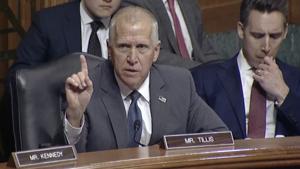
Sen. Thom Tillis, R-N.C., blasted his party’s sweeping budget bill Tuesday, cautioning Republican colleagues that cuts to Medicaid could lose them majorities in both chambers of Congress in the 2026 midterms.
Tillis equated the ‘One Big, Beautiful Bill’ to the Republicans’ version of Obamacare, which cost Democrats big losses in the 2010 and 2012 elections.
The North Carolina senator, who is up for reelection next year, said in a GOP luncheon Tuesday that his state would lose $39 billion in federal Medicaid funding if the Senate’s version of the bill is passed, risking coverage for 600,000 recipients in his state.
Tillis is part of a growing number of Republican senators to voice their opposition to the legislation. Sens. Josh Hawley, R-Mo., and Lisa Murkowski, R-Alaska, have also criticized the bill because of provisions proposed by the Senate Finance Committee last week which threaten deep cuts to Medicaid in their respective states.
The Senate Finance Committee’s text includes hundreds of billions of dollars’ worth of cuts to Medicaid, acting as a major cost cutter to fund key parts of President Donald Trump’s policy agenda. The Senate’s bill goes deeper than the House-passed version, tightening eligibility and work requirements for Medicaid recipients.
Tillis told colleagues Tuesday that working-class Trump voters will suffer the most from these proposed cuts. He argued that these voters will be consequential to Republicans keeping control of Congress in the midterms next year.
Senate Republicans are facing a time crunch to finalize their version of the bill and pass it back over to the House before their self-imposed deadline of July 4.
With Independence Day quickly approaching, Trump urged the Senate to continue working despite internal divisions, telling Republicans to “lock yourself in a room if you must.”
Speaker of the House Rep. Mike Johnson, R-La., signaled that the House might not break for their scheduled July 4 recess if necessary.
“If the Senate does its work on the timeline that we expect, we will do our work as well.” Johnson said Tuesday.
Senate Majority Leader Sen. John Thune, R-N.D., expressed optimism in his chamber’s schedule, saying the Senate is on track to begin voting on the budget package as early as Friday.
House GOP slams billions in DEI-based federal contracts
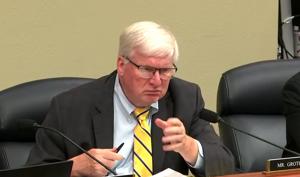
U.S. House Republicans criticized the Biden administration’s diversity, equity and inclusion practices for costing billions in tax dollars by awarding contracts to “minority owned companies.”
The House Oversight and Government Reform’s subcommittee on healthcare and financial services held a hearing on Wednesday discussing the effect of DEI policies on federal contracts and student admissions.
“You’re trying to just destroy America by doing to America what they do in other countries and trying to set one ethnic group against another ethnic group,” U.S. Rep. Glenn Grothman, R-Wis., said about DEI practices in federal contracts.
Judge Glock, a witness before the committee and director of research at the Manhattan Institute, said laws and regulations for federal grants have required portions of contracts to be awarded to customers based on race and sex, rather than the quality of the contract.
Glock pointed to a Biden administration goal of requiring up to 15% of federal contracts to go to “disadvantaged businesses.”
“These minority contracting programs cost taxpayers tens of billions of dollars, degrade our infrastructure and national defense, and do nothing to help the truly disadvantaged,” Glock said.
Glock called on members of Congress to challenge the 8(a) business program, and the business development program, which gives federal contract preferences to disadvantaged businesses, minority- and women-owned businesses.
Glock said DEI programs have allowed businesses to access federal funds by fraudulently claiming “disadvantaged” status and collecting tax revenue.
“Preferences for already successful businesses based on their owners’ race or sex are unconstitutional, expensive, and detrimental to the core functions of government,” Glock said.
House Democrats, alongside one witness before the committee, argued that America “owes” minority groups and women for years of “unpaid labor.”
“America owes the enslaved Africans who built the White House and the U.S. Capitol building,” Erec Smith, a professor at the university of Southern California, said.
“Neither they, nor family members of theirs and subsequent generations were rightly compensated for their magnificent contributions or for centuries of additional unpaid labor,” Smith added.
Rep. Wesley Bell, D-Mo., agreed with Smith that the history of racism in the United States necessitates protections for DEI initiatives.
“This country that we all love has a history of racism; racism towards the very individuals that make up our diversity, racism towards those striving for an equitable society and an inclusive America, [because] inclusion, that part of DEI, just means everybody,” Bell said.
WATCH: Trump leaves NATO touting multiple successes
President Donald Trump heads home from the NATO summit in the Netherlands touting a slew of international successes, including the member nations committing to more than doubling their defense spending.
In addition, Trump is taking a victory lap after Israeli officials supported Trump’s claim that the U.S. “obliterated” Iran’s key nuclear sites, following media reports disputing the overall success.
NATO partners, comprised of 32 member nations, agreed to Trump’s demands that the countries increase their defense spending to 5% of GDP. The proposal initially had been met with resistance, given that the current spending threshold is 2%.
However, in recognition of Russian aggression and terrorism threats on member nations, the leaders agreed to increase their spending by 2035 substantially.
“United in the face of profound security threats and challenges, in particular the long-term threat posed by Russia to Euro-Atlantic security and the persistent threat of terrorism, Allies commit to invest 5% of GDP annually on core defence requirements as well as defence-and security-related spending by 2035 to ensure our individual and collective obligations, in accordance with Article 3 of the Washington Treaty,” according to a statement signed by the member nations.
The member nations say the 5% spending “commitment will comprise two essential categories.”
“Allies will allocate at least 3.5% of GDP annually based on the agreed definition of NATO defence expenditure by 2035 to resource core defence requirements, and to meet the NATO Capability Targets. Allies agree to submit annual plans showing a credible, incremental path to reach this goal. And Allies will account for up to 1.5% of GDP annually to inter alia protect our critical infrastructure, defend our networks, ensure our civil preparedness and resilience, unleash innovation, and strengthen our defence industrial base,” the statement said. “The trajectory and balance of spending under this plan will be reviewed in 2029, in light of the strategic environment and updated Capability Targets.”
The member nations also underscored their commitment to supporting Ukraine, a non-member nation, from continued Russian aggression.
Trump met with Ukrainian President Volodymyr Zelenskyy during the summit. This was the second time the leaders had met since their publicly contentious meeting in the Oval Office in February.
The meeting was reported to be friendly, with the Ukrainian leader praising Trump for leading a “successful operation” in Iran.
Zelenskyy said the pair discussed the embattled Eastern European country’s plan to purchase military equipment from the U.S.
“We discussed the protection of our people with the President – first and foremost, the purchase of American air defense systems to shield our cities, our people, churches, and infrastructure. Ukraine is ready to buy this equipment and support American weapons manufacturers. Europe can help. We also discussed the potential co-production of drones. We can strengthen each other,” Zelenskyy posted to X Wednesday afternoon.
Trump characterized the meeting as “good,” adding that Zelenskyy “couldn’t have been nicer.”
The president stressed his commitment to ending the war between Ukraine and Russia, adding that he would be talking to Vladimir Putin.
“I think [Zelenskyy would] like to see an end to this… I think it’s a great time to end it. I’m going to speak to Vladmir Putin; see if we can get it ended,” Trump told reporters.
The president also addressed many questions concerning Iran, strongly disputing what he is characterizing as “fake news” reports that the U.S. airstrikes did minimal damage to the nuclear facilities.
“We’ve collected additional intelligence and we’ve also spoken to people who have seen this site – and the site is obliterated,” Trump told reporters.
The president shared a letter from the Atomic Energy Commission of Israel that described the strike as “devastating,” adding that strikes on Fordow “destroyed the site’s critical infrastructure and rendered the enrichment facility totally inoperable.”
Trump added that he would be speaking with Iranian officials next week on the next steps for the Islamic Republic.
Governors plead for congressional help on SNAP in reconciliation bill

Sicker residents, struggling rural grocery stores and loss of jobs are cited in a gubernatorial request to continue funding SNAP made to majority and minority leaders of the U.S. Senate and House of Representatives.
A letter authored by North Carolina first-term Democratic Gov. Josh Stein and signed by 22 other governors – all Democrats – says cuts to the Supplemental Nutrition Assistance Program in the hotly debated reconciliation bill will cause hunger and poverty to increase, “children and adults will get sicker, grocery stores in rural areas will struggle to stay open, people in agriculture and the food industry will lose jobs, and state and local economies will suffer.”
Tuesday’s letter was addressed to Sens. John Thune, R-S.D., and Chuck Schumer, D-N.Y., and Reps. Mike Johnson, R-La., and Hakeem Jeffries, D-N.Y. Stein is cochairman of President Donald Trump’s Council of Governors.
SNAP provides “eligible low-income households with electronic benefits redeemable for SNAP-eligible foods at SNAP-eligible retailers,” says a May 30 summary posted to Congress.gov. Federal spending on the program through 2034 would be reduced by $295 billion through 12 SNAP provisions estimated to reduce spending.
The changes proposed would shift costs to states and require more able-bodied recipients, by the millions, to work or lose their benefits. The Congressional Budget Office projects 3.2 million coming off the assistance.
“Congress,” Stein and colleagues write, “has proposed profoundly changing the relationship between the federal government and states – by shifting unprecedented costs to states for the first time in the 50 years of SNAP’s history. Under this plan, states will need to find millions or even billions of extra dollars in their budgets or be forced to leave the SNAP program entirely, potentially cutting off millions of Americans from this vital assistance.”
The governors say cuts will not only increase costs per state, but “make it nearly impossible for states to effectively plan for these long-term budget impacts.” They also point out congressional proposals “to slash Medicaid, disaster relief, and other federally funded safety net programs.”
For context, in Stein’s state and many others, a balanced budget is in the general statutes. Federally, the amount of outstanding borrowing by the federal government – also known as the national debt – is $36.2 trillion.
Republicans are not in agreement with all the criticisms. For example, U.S. Rep. Virginia Foxx, R-N.C., in a letter to constituents Friday said the bill will save 2 million “family-owned farms from the death tax.” And, she said the legislation “helps American farmers compete by increasing access to the global marketplace.”
In addition to Stein, the letter is also signed by governors from Arizona, California, Colorado, Connecticut, Delaware, Hawaii, Illinois, Kansas, Kentucky, Maine, Maryland, Massachusetts, Michigan, Minnesota, New Jersey, New Mexico, New York, Oregon, Pennsylvania, Rhode Island, Washington, Wisconsin. There were no Democratic governors not to sign the letter, and no Republican governors signed.
Trump admin expands LNG authorizations in Gulf of America states

Under the Trump administration, the Department of Energy has so far issued five liquified natural gas (LNG) authorizations in the Gulf of America states of Louisiana, Texas and Florida.
Under the first Trump administration, the U.S. became the largest LNG exporter in the world, led by the Gulf states of Louisiana and Texas. By 2023, Louisiana accounted for 61% of LNG exports, according to U.S. Energy Information Agency data.
The new authorizations reverse Biden administration orders, including banning issuing new LNG export permits, which disproportionately negatively impacted Gulf states.
“Exporting American LNG strengthens the U.S. economy and supports American jobs while bolstering energy security around the world, and I am proud to be working with President Trump to get American energy exports back on track,” Energy Secretary Chris Wright said.
The DOE’s first LNG export authorization was the Commonwealth LNG project in Cameron Parish, Louisiana. Owned by Kimmeridge Texas Gas, LLC, its exports to non-free trade agreement countries are expected to top 1.2 billion cubic feet per day (Bcf/d) of LNG.
The DOE said Commonwealth LNG exports “are likely to yield economic benefits to the United States, diversify global LNG supplies, and improve energy security for U.S. allies and trading partners over the course of the export term through 2050.” A final authorization is expected later this year.
The DOE’s second authorization was issuing an “Order on Rehearing,” reversing a Biden administration order that created greater regulatory burdens for using LNG as a marine fuel source, known as LNG bunkering.
The reversal will benefit JAX LNG, a small-scale coastal LNG facility located at Dames Point near Jacksonville, Florida, impacted by the Biden-era directive. It dispenses LNG fuel to ships, including cruise ships, car carriers, petroleum tankers and container ships.
The DOE withdrew exercise of its jurisdiction under the Natural Gas Act for ship-to-ship transfers of LNG for marine fuel use at a U.S. port, in U.S. waters, or in international waters, it said. It also left unchanged its authorization to JAX to export LNG via ISO container.
The demand for LNG as marine fuel has increased as emissions regulations for shipping have increased. The number of LNG-fueled ships is expected to nearly double, reaching more than 1,200 vessels by 2028, according to an EIA January 2025 Quarterly Gas Report.
The DOE’s third LNG authorization extends an LNG export permit for Golden Pass LNG Terminal LLC, currently under construction in Sabine Pass, Texas. The project was first approved under the first Trump administration.
Golden Pass, owned by QatarEnergy and ExxonMobil, is expected to begin exports this year. Once operational, it will be the ninth large-scale export terminal operating in the U.S., able to export up to 2.57 Bcf/d of LNG.
The DOE’s fourth authorization extended an LNG export permit for Delfin LNG LLC to construct a floating liquefied natural gas vessel off the coast of Louisiana after it was delayed by the Biden administration.
Delfin, majority-owned by Fairwood Peninsula, Talisman Global Alternative Master, L.P. and Talisman Global Capital Master, L.P., is expected to reach a final investment decision later this year. The order extends the authorization date to June 1, 2029, for Delfin to begin exporting up to 1.8 Bcf/d of LNG to non-free trade agreement countries.
The fifth and most recent authorization was for Port Arthur LNG Phase II in Jefferson County, Texas. Owned by Sempra Energy, it’s projected to export 1.91 billion Bcf/d of LNG once completed. Port Arthur Phase I is currently under construction and expected to begin exporting LNG in 2027.
Sempra also operates the Cameron LNG export terminal in Louisiana, which has been exporting LNG since 2019. It’s currently constructing the Energia Costa Azul terminal in Mexico, which is slated to begin commercial export operations of U.S.-sourced LNG next year.
All five authorizations bring the total volume of LNG exports to 11.45 Bcf/d, the DOE said.
According to EIA’s most recent Short-Term Energy Outlook, LNG exports are expected to reach record highs this year, averaging more than 15 Bcf/d, coinciding with record projected natural gas production of nearly 105 Bcf/d, led by Texas and Louisiana.