National News
CBP data: Trump admin has released thousands of inadmissibles into U.S.
The Trump administration has released more than 13,000 inadmissible noncitizens into the U.S. in the first four full months of his administration who arrived at ports of entries (POEs) nationwide, according to U.S. Customs and Border Protection data evaluated by the Transactional Records Access Clearinghouse (TRAC), a nonpartisan organization founded at Syracuse University.
The data includes case-by-case CBP Office of Field Operations data reported at POEs nationwide in records TRAC obtained through Freedom of Information Act requests.
It excludes illegal border crossers reported by Border Patrol who were apprehended or encountered between ports of entry. It also excludes gotaways, those who evaded capture and illegally entered the country, also deemed inadmissible.
The Immigration and Nationality Act defines “inadmissible aliens” as “An alien present in the United States without being admitted or paroled, or who arrives in the United States at any time or place other than as designated by the Attorney General …” The law includes multiple categories and definitions related to public health and a range of crimes and circumstances, including national security and terrorism designations and associations.
“Noncitizens arriving at the United States by land, air and sea continue to seek entry to this country without adequate papers,” the TRAC report states. Since President Donald Trump was sworn into office in January and through the end of May, 50,071 foreign nationals “arrived at ports of entry and were initially found ‘inadmissible,’” according to the data published by TRAC.
“The Trump administration has not stopped all noncitizens without papers from entry,” the TRAC report states. As of the end of May 2025, 10,673 inadmissibles were paroled into the U.S.; an additional 2,351 were issued Notices to Appear before an immigration judge and allowed entry by CBP Office of Field Operations officers, TRAC says, according to the data it obtained.
The greatest number of inadmissables were released into the country by CBP OFO officers in San Diego and San Francisco; CBP OFO officers who issued the greatest number of NTAs were at Laredo and New York POEs, TRAC found.
When evaluating data from February through May, the greatest number of foreign nationals reported by CBP OFO officers at POEs were citizens of Mexico, Cuba, Philippines, Haiti, Canada, Venezuela, Ukraine, India, China, Honduras, Russia, Nicaragua, Guatemala, Colombia and El Salvador, according to the TRAC analysis.
The data includes everyone OFO determined was inadmissible and categorizes the reasons OFO gave for each designation and how they were processed. CBP provided data for most periods, TRAC said, however “CBP recently refused to release” some data it requested, and is “contesting this unlawful withholding.”
The data is categorized by country of origin, month and year, OFO location/POE, inadmissible entry details, gender, age, and other categories and subcategories.
Parole data refers to humanitarian, public interest or parole programs specific to countries.
Each category is searchable using different drop-down menus.
For example, in March 2025, 20,860 inadmissables were reported by CBP OFO officers nationwide. Among them, the greatest number were Mexicans (4,137), followed by Philippinos (2,693), Canadians (2,662), Indians (1,933) and Chinese (1,875).
Among them, the greatest number of inadmissibles released into the country in March were Mexican nationals: 1,548 were paroled into the country; 88 were released given NTAs to appear before a federal immigration judge, according to the data.
The large numbers of inadmissible Philippine, Indian and Chinese nationals are attributed to crew members of ships who didn’t have proper papers. Only 44 Philippino, 71 Indian and 76 Chinese nationals were paroled into the U.S. that month.
Of the 2,662 inadmissible Canadians, 93 were paroled into the U.S.; five were given NTAs. The majority, 2,481, were withdrawals, according to the data.
CBP OFO officers work at more than 300 POEs nationwide at international airports, land and seaports.
TRAC data includes more than 6 million foreign nationals designated as inadmissible by CBP OFO officers at POEs nationwide, from October 2011 to May 2025.
‘Big, beautiful bill’ narrowly passes Senate, faces tough crowd in House
After more than 26 hours of debate and a record number of vote-a-rama amendments, the U.S. Senate narrowly passed President Donald Trump’s ‘big, beautiful bill’ Tuesday.
The massive budget reconciliation bill hikes the debt ceiling by $5 trillion and implements President Donald Trump’s tax, energy, border security and defense agenda. But the cost and complexity of the bill required Vice President J.D. Vance to break the chamber tie with Sens. Rand Paul, R-Ky., Thom Tillis, R-N.C., and Susan Collins, R-Maine, voting no.
By permanently extending the bulk of the 2017 tax cuts – rather than extending them for only 10 years, as the House originally did — the Senate-amended OBBBA would add roughly $4 trillion to the national debt when accounting for interest by fiscal year 2034.
Republican leaders have spent weeks trying to rally their constituents around the massive bill, formerly titled the One Big Beautiful Bill Act but stripped of its name via a last-minute procedural complaint by Senate Democrats. While fiscal hawks objected to the bill’s projected impact on the debt and deficit, other Republicans raised concerns about the $1.7 trillion in savings found by House and Senate committees.
The majority of the bill’s offsets came from Medicaid reforms, with the House imposing work requirements on able-bodied adults and the Senate lowering the Medicaid provider tax cap from 6% to 3.5%. Some GOP senators worried this could cause rural hospitals to close, so a provision creating a $50 billion hospital stabilization fund was included.
Another 11th-hour amendment, introduced by U.S. Sens. Marsha Blackburn, R-Tenn., and Maria Cantwell, D-Wash., passed in a 99-1 vote and stripped a provision that would have banned states from regulating AI for the next ten years or risk losing federal funds.
The Senate also changed the House’s plan to quickly phase out most Inflation Reduction Act subsidies and gave states with high SNAP payment error rates more time to fix their rates before incurring the penalties outlined in the bill.
Most notably, the Senate changed budget reconciliation precedent by operating under current policy baseline, an accounting method that treats tax cut extensions as if it costs nothing. As a result, the Senate waived the usual requirement to find additional budgetary offsets in order to codify the tax provisions of the bill.
Dozens of House Republicans had already warned they will reject the bill if it returns with drastic Senate revisions, especially the never-before use of current policy baseline to calculate revenue loss from tax cuts. House Speaker Mike Johnson, R-La., had personally promised holdouts that tax cuts would be paired dollar-for-dollar with spending reductions or economic growth.
Since the Senate’s final product upended that compromise, Johnson and House committees will likely have to revise the Senate’s revisions to get enough lower chamber votes, which in turn will require another Senate vote before the bill can reach Trump’s desk.
Sen. Ron Johnson, R-Wis., a deficit-concerned holdout who eventually voted in favor, called the bill “a step forward” after its Senate passage but reiterated that “there is still a long way to go.”
Everyday Economics: Personal income decline, student loan debt point to slowdown
Bottom line up front: The economic data this week tells a story of resilient consumers facing mounting headwinds. Inflation pressures remain somewhat contained – perhaps due to emerging cracks in consumer finances.
What’s Behind the Latest PCE Numbers
The PCE price index rose 0.14% for the month, putting inflation at a 1.7% annualized rate, with core PCE posting respective readings of 0.18% and 2.2%.
Energy prices fell 4.6% year-over-year but even without the decline, inflation is still running just slightly above the Fed’s 2% target.
The income and spending dynamics reveal an important story. Personal income declined 0.4% in May while spending fell 0.1%. Recent months saw elevated income growth thanks to policy changes – Social Security Fairness Act retroactive payments and Emergency Commodity Assistance Program payouts to farmers provided temporary support. But that support will soon wane. At the same time, private sector wage growth continues to slow.
The Student Debt Crisis Hits Hard
Another significant development for consumer spending power is the return of student loan delinquencies. After a 43-month payment pause, nearly one in four student loan borrowers (23.7%) were behind on their student loans in the first quarter of 2025.
The scale of this change is unprecedented. According to the Quarterly Report on Household Debt and Credit published by the New York Fed, more than 2.2 million newly delinquent borrowers have seen their credit plunge by over 100 points, while more than 1 million have experienced drops of at least 150 points.
This isn’t just about student loans – it’s about access to consumer credit going forward. An estimated 2.4 million delinquent borrowers previously had credit scores above 620, meaning they qualified for mortgages, auto loans and credit cards before these delinquencies hit their reports. Many no longer do.
The timing couldn’t be worse. These borrowers are predominantly millennials and Gen Z near or at peak home-buying age, facing an already brutal housing affordability crisis. When credit access tightens for millions of consumers simultaneously, spending patterns shift – and not in ways that support robust economic growth.
Labor Market Signals Point to Weakness Ahead
The frozen labor market adds another layer of concern for consumer spending. Private sector wage growth continues slowing as unemployment duration rises and job seekers give up. This creates a feedback loop: weaker labor market conditions reduce workers’ bargaining power, which slows wage growth and ultimately constrains spending.
Housing’s Negative Wealth Effect
The expected decline in home values represents another headwind for consumer spending going forward. For homeowners who’ve relied on housing wealth gains to borrow and spend, a negative wealth effect could cause them to curtail spending.
What’s Next?
Next week brings construction spending and auto sales data – both expected to show weakness. But the main event is the jobs report, where employment growth is expected to slow further and the unemployment rate could nudge higher.
Faith group provides tools for parents to opt out of LGBT curriculum after SCOTUS ruling
A nonprofit religious freedom organization is providing tools for parents to help them opt out of public-school LGBTQ+ instruction, curriculum and materials after the Supreme Court’s landmark ruling on Friday.
In Mahmoud v. Taylor, the Supreme Court ruled 6-3 that a Maryland school board’s introduction of “LGBTQ+-inclusive” books and curriculum “combined with its no-opt-out policy, burdens the parents’ right to the free exercise of religion.”
The school board previously allowed for an opt-out policy but reversed it, arguing it was too difficult to manage, The Center Square reported.
Because the school board refused to allow an opt-out option, the court held that if it didn’t issue an injunction to halt the school district’s policy, parents would be forced to keep making the same choice. They would be forced to “either risk their child’s exposure to burdensome instruction, or pay substantial sums for alternative educational services,” the ruling states. “As we have explained, that choice unconstitutionally burdens the parents’ religious exercise, and ‘[t]he loss of First Amendment freedoms, for even minimal periods of time, unquestionably constitutes irreparable injury.’”
The court majority said that “a government burdens the religious exercise of parents when it requires them to submit their children to instruction that poses ‘a very real threat of undermining’ the religious beliefs and practices that the parents wish to instill.”
It also emphasized that parental rights and religious freedom were protected by the Constitution, arguing, “The practice of educating one’s children in one’s religious beliefs, like all religious acts and practices, receives a generous measure of protection from the Constitution.”
In response, California-based Advocates for Faith & Freedom, which has been embroiled in lawsuits over parental rights and religious freedom for years, created a free, legal opt-out form for parents to use nationwide.
The form is customizable, allowing parents to “request that their child be exempt from exposure to any instruction or materials on gender identity, sexual orientation, or other related topics contrary to their faith,” it says. This includes opting out of “instruction, curriculum, or discussions related to gender identity, gender theory, sexual orientation, or any LGBTQ+-themed materials that conflict with their religious beliefs,” it says.
“Today’s decision is a victory for religious freedom and the rights of parents. A parent should be treated by a school as a respected partner, not as someone to ignore or alienate from his/her own child’s education,” Advocates for Faith & Freedom president and chief counsel Robert Tyler said. “The Supreme Court’s opinion sends a two-part message to schools across the country: 1) sincere religious beliefs cannot be ignored and 2) a parent has every right to know what is going on with his/her child at school.”
The letter also includes affirmations of what the parents and family believe, including that biological sex is immutable, defined by God, and “it is sinful and harmful to teach children that a person can change their biological sex and gender.”
The letter defines what the it considers objectional materials and clarifies that no one at a child’s school, including employees and third parties, are allowed “to introduce, expose, teach or discuss [with the child] any book or curriculum that contains ‘objectional materials.’”
It notes that parents have a First Amendment right to hold their religious beliefs and educate their children and anyone at the school who violates it and the Supreme Court injunction will face legal consequences.
“For too long, public schools have treated parental rights and the free exercise of religion as an ‘empty promise,’” Advocates for Faith & Freedom said.
It also notes that the ruling “does not mark the end of the issue” and that parents should expect potentially ongoing challenges to their First Amendment rights.
“Public schools can be expected to try to limit the Supreme Court’s holding and will find new ways to assert its power and to indoctrinate children,” it said, adding that it remained committed to preserving the rights of parents, children and families.
Trump on tariff deadline: ‘We can do whatever we want’
President Donald Trump appears unconcerned about an upcoming tariff deal deadline after abruptly ending all trade talks with Canada as his bid to overhaul world trade continues.
Trump is nearing the end of a self-imposed 90-day deadline to strike deals with nearly every U.S. trading partner as he works to reorder global trade by giving America a competitive advantage through tariffs on foreign goods.
Trump now says that the deadline could be extended past July 9 or even accelerated.
“We can do whatever we want. We could extend it, we could make it shorter. I’d like to make it shorter,” Trump said Friday at the Oval Office. “I’d like to just send letters out to everyone ‘Congratulations, you’re paying 25%.'”
On April 2, Trump announced reciprocal tariffs on nearly every nation that trades with the U.S. Seven days later, he paused those higher tariff rates for 90 days to give his trade team time to cut deals with key trading partners. That 90-day deadline ends July 9 and thus far Trump has brought home two deals: A limited trade pact with the United Kingdom and a trade truce with China.
Commerce Secretary Howard Lutnick told Bloomberg that new deals are on the way, and those could serve as models for others.
“We’re going to do top 10 deals, put them in the right category, and then these other countries will fit behind,” Lutnick said.
He said the U.S. was “close to the finish line” with India. Lutnick also said he had made an offer to the European Union.
Trump’s decision to suspend trade talks with Canada with just days left before the deadline underscored the flexibility of the president’s trade deadline.
“These are very complex negotiations and we are going to continue them in the best interests of Canadians,” Candian Prime Minister Mark Carney said Friday while leaving his office, according to local reports.
Canada has invariably been one of the top two trading partners for the United States for years. In 2024, Canada was the top destination for U.S. exports and the third-largest source of U.S. imports. On the other side, Canada exported 75% of its goods to the United States and imported almost half of its goods from the United States.
U.S. total goods trade with Canada was an estimated $762.1 billion in 2024, according to the Office of the U.S. Trade Representative. U.S. goods exports to Canada in 2024 were $349.4 billion. U.S. imports from Canada in 2024 totaled $412.7 billion. The U.S. goods trade deficit with Canada was $63.3 billion in 2024.
Services trade with Canada, exports and imports, totaled an estimated $140.3 billion in 2023. Services exports were $86.0 billion, and services imports were $54.3 billion. The U.S. services trade surplus with Canada was $31.7 billion in 2023, according to the Office of the U.S. Trade Representative.
Shortly after taking office in January, Trump hit Canada and Mexico with 25% tariffs for allowing fentanyl and migrants to cross their borders into the U.S. Trump later applied those 25% tariffs only to goods that fall outside the free-trade agreement between the three nations, called the United States-Mexico-Canada Agreement.
Trump put a stop to the talks on Friday.
“We have just been informed that Canada, a very difficult Country to TRADE with, including the fact that they have charged our Farmers as much as 400% Tariffs, for years, on Dairy Products, has just announced that they are putting a Digital Services Tax on our American Technology Companies, which is a direct and blatant attack on our Country,” Trump wrote on Truth Social.
Trump said the digital services tax was a copy of a European Union proposal.
“Based on this egregious Tax, we are hereby terminating ALL discussions on Trade with Canada, effective immediately,” the president said. “We will let Canada know the Tariff that they will be paying to do business with the United States of America within the next seven day period.”
Earlier this month, the two nations seemed close to striking a deal.
Trump said he and Canada Prime Minister Mark Carney had different trade concepts between the two neighboring countries during a meeting at the G7 Summit in Kananaskis, in the Canadian Rockies.
Asked what was holding up a trade deal between the two nations at that time, Trump said they had different concepts for what that would look like.
“It’s not so much holding up, I think we have different concepts, I have a tariff concept, Mark has a different concept, which is something that some people like, but we’re going to see if we can get to the bottom of it today.”
Trump put a 10% tariff on non-USMCA compliant potash and energy products. A 50% tariff on aluminum and steel imports from all countries into the U.S. has been in effect since June 4. Trump also put a 25% tariff on all cars and trucks not built in the U.S.
The tariffs have frustrated Canadian leaders and residents. Tensions between the two neighboring countries have been high. And cities on both sides of the U.S.-Canada border have been affected.
Trump has repeatedly suggested that Canada join the U.S. as its 51st state. He previously called former Canadian Prime Minister Justin Trudeau “governor” regularly.
Rollins backs North Carolina, nation’s pork producers in California tiff
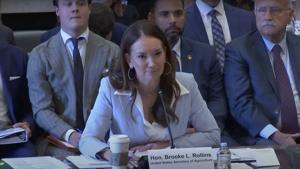
California, says the leader of the USDA and a North Carolina congressman, has the right to enforce its Proposition 12.
The state line, however, is where that enforcement should end.
In the battle of pork production, U.S. Department of Agriculture Secretary Brooke Rollins affirmed that position in a congressional hearing this month. This week, U.S. Rep. David Rouzer, R-N.C., reminded Tarheel State farmers of her allegiances.
“North Carolina pork producers have a friend at USDA in Secretary Brooke Rollins,” Rouzer said, expressing gratitude for her push back against Prop 12. “Secretary Rollins is right, California has the right to do what California wants to do, but NC-07 farm families feed the nation, and they deserve fair, science-based regulations, not California mandates.”
Proposition 12 is the colloquial term for the Farm Animal Confinement Initiative. Egg-laying hens, breeding pigs and veal calves have space requirements, and sale of products from the animals is prohibited if not meeting the standard.
Rouzer comes from the 7th Congressional District, the southeastern portion of the state where trips on country roads often mean getting behind a hog truck hauling to the world’s largest pork production facility in the Bladen County crossroads community of Tar Heel. North Carolina’s $111.1 billion agriculture industry includes a No. 3 national ranking in pork production behind Iowa and Minnesota.
California’s market includes about 40 million people and 15% of domestic pork consumption. Compliance with the Golden State’s law can require new construction or retrofits with enormous fiscal impact.
In the Committee on Agriculture, Rollins told panelists, “No one is more of a believer in federalism, the 10th Amendment, and our Founders vision of the state’s rights to be able to be their own laboratories of innovation. When those ideas, those rules and laws begin to impact other states in such a negative way, that is not what our Founders intended.
“The extreme impact of Prop 12, especially on our pork producers – I believe this is a bipartisan question. We may not all agree in this room, but I think most agree even on the Democrat side of the House, that it cannot stand. I stand in full support of your effort.”
Rollins said her department may be able to inject something toward a solution.
“California has a right to do what California wants to do,” she said. “The minute that crosses the border and begins to compromise, in such a significant way, our pork producers we need to act.”
China undermining American energy independence, report says
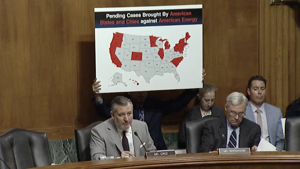
The Chinese Communist Party is exploiting the left’s green energy movement to hurt American energy independence, according to a new report from State Armor.
Michael Lucci, founder and CEO of State Armor, says the report shows how Energy Foundation China funds green energy initiatives that make America more reliant on China, especially on technology with known vulnerabilities.
“Our report exposes how Energy Foundation China functions not as an independent nonprofit, but as a vehicle advancing the strategic interests of the Chinese Communist Party by funding U.S. green energy initiatives to shift American supply chains toward Beijing and undermine our energy security,” Lucci said in a statement before the Senate Judiciary Subcommittee’s hearing on Wednesday titled “Enter the Dragon – China and the Left’s Lawfare Against American Energy Dominance.”
Lucci said the group’s operations represent a textbook example of Chinese influence in America.
“This is a very good example of how the Chinese Communist Party operates influence operations within the United States. I would actually describe it as a perfect case study from their perspective,” he told The Center Square in a phone interview. “They’re using American money to leverage American policy changes that make the American energy grid dependent upon China.”
Lucci said one of the most concerning findings is that China-backed technology entering the U.S. power grid includes components with “undisclosed back doors” – posing a direct threat to the power grid.
“These are not actually green tech technologies. They’re red technologies,” he said. “We are finding – and this is open-source news reporting – they have undisclosed back doors in them. They’re described in a Reuters article as rogue communication devices… another way to describe that is kill switches.”
Lucci said China exploits American political divisions on energy policy to insert these technologies under the guise of environmental progress.
“Yes, and it’s very crafty,” he said. “We are not addressing the fact that these green technologies are red. Technologies controlled by the Communist Party of China should be out of the question.”
Although Lucci sees a future for carbon-free energy sources in the United States – particularly nuclear and solar energy – he doesn’t think the country should use technology from a foreign adversary to do it.
“It cannot be Chinese solar inverters that are reported in Reuters six weeks ago as having undisclosed back doors,” he said. “It cannot be Chinese batteries going into the grid … that allow them to sabotage our grid.”
Lucci said energy is a national security issue, and the United States is in a far better position to achieve energy independence than China.
“We are luckily endowed with energy independence if we choose to have it. China is not endowed with that luxury,” he said. “They’re poor in natural resources. We’re very well endowed – one of the best – with natural resources for energy production.”
He said that’s why China continues to build coal plants – and some of that coal comes from Australia – while pushing the United States to use solar energy.
“It’s very foolish of us to just make ourselves dependent on their technologies that we don’t need, and which are coming with embedded back doors that give them actual control over our energy grid,” he said.
Lucci says lawmakers at both the state and federal levels need to respond to this threat quickly.
“The executive branch should look at whether Energy Foundation China is operating as an unregistered foreign agent,” he said. “State attorneys general should be looking at these back doors that are going into our power grid – undisclosed back doors. That’s consumer fraud. That’s a deceptive trade practice.”
AZ governor says she’ll sign $17.6 billion budget
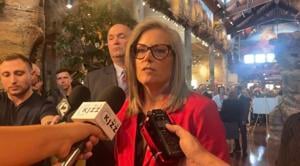
Arizona Gov. Katie Hobbs announced Friday afternoon she will sign the bills for the bipartisan $17.6 billion budget passed by the Legislature earlier in the day.
Hobbs said she expected to sign the legislation later on Friday. When she does, that will avert what would have been Arizona’s first state government shutdown on Monday.
Earlier Friday, the Senate approved the budget bills with the help of a bipartisan coalition.
“I am thrilled that the legislature passed the bipartisan and balanced Arizona Promise budget to expand opportunity, security and freedom in our state,” the Democratic governor said in a statement Friday afternoon.
“By working together, we have secured pay raises for state police and firefighters, made child care more affordable and accessible, taken action to stop drug smuggling and human trafficking, and invested in public education from kindergarten through higher ed,” Hobbs said.
Hobbs noted the budget includes 5% pay raises for state troopers and 15% pay raises for state firefighters and $8 million for the governor’s SAFE Initiative to secure the border by helping law enforcement fight drug smuggling and human trafficking. The governor added the budget fully funds K-12 education and includes $297 million to build new K-12 schools and improve existing school facilities.
The budget was championed by Sen. John Kavanagh, the Republican who chairs the Senate Appropriations Committee. He noted it ultimately took “three to tango,” with the House on Thursday night passing a budget that Hobbs would sign. That came after Hobbs vetoed two House budget proposals Wednesday, but Kavanagh said the latest budget had the support of the two chambers and the governor.
After the budget’s passage Friday in the Senate, House Speaker Steve Montenegro said the chamber’s Republican majority had a choice: “Allow a shutdown or improve the plan left on the table.”
“We chose to fight — and secured more than $100 million in savings and critical reforms that would not have happened without us,” the Republican said in a statement emailed Friday afternoon to The Center Square.
Back in the Senate, lawmakers quickly approved a series of bills on the budget and other matters before adjourning and ending the chamber’s 2025 session at 1:20 p.m.
And in other legislative news, Republicans announced they decided to promote Kavanagh to majority leader. He succeeds Sen. Janae Shamp, R-Surprise.
“As a state lawmaker for 19 years, Sen. Kavanagh brings a wealth of experience and institutional knowledge of the inner-workings of state government and will be able to unite the caucus as we work to advance a conservative agenda for the citizens of Arizona,” Senate President Warren Petersen, R-Gilbert, said in a statement emailed Friday afternoon to The Center Square.
Kavanagh said he was humbled to be elected to the position and wanted “to concentrate on moving forward — united.”
The next regular legislative session will start in January 2026.
Judge orders overseer for LA’s ‘failed’ homeless programs

A federal judge ruled the city of Los Angeles is failing to meet its court-ordered agreement to provide another 12,915 new beds for the homeless by 2027.
U.S. District Court Judge David Carter ordered the selection of a third-party monitor and quarterly, in-person court hearings on the status of the city’s programs.
In 2022, the LA Alliance for Human Rights reached a settlement with the city of Los Angeles to create new “housing or shelter solutions” by June 13, 2027.
The federal ruling focused on the city’s failure to adhere to the agreement. The judge noted the city did not verify that contractors are providing the services they are paid for and that half of the new homeless beds it says it created were either not open or could not be verified. According to the ruling, the city has recently inflated its bed count by counting nearly 2,000 beds from the city’s Inside Safe program, which places homeless individuals in hotels.
The Inside Safe program has been particularly controversial due to its high costs and limited outcomes.
In 2023, an investigation from The Center Square uncovered that Los Angeles was spending $17,009 per homeless individual per month on the Inside Safe program, which temporarily places homeless individuals in hotels.
Last summer, City Controller Kenneth Mejia released data showing the $341 million spent thus far on Inside Safe had served only 2,728 individuals, only 30 of whom were either reunited with family or back on their feet in unsubsidized housing.
City officials now say taxpayer costs for room and board alone for Inside Safe beneficiaries are $7,000 per month, a figure that does not include additional, often standard supportive services.
The $84,000 annual room and board cost per Inside Safe beneficiary is even higher than the Census-reported $80,366 median household income in the city, which typically supports a family of three.
The ruling also found the Los Angeles Homeless Services Authority has failed to consistently verify “programmatic compliance” — that contracted services are provided — and that “over half (51%) of planned reviews omitted such checks.”
“In a sample of 10 contract monitoring reviews for fiscal year 2023–24, LAHSA failed to maintain adequate workpapers for any of the reviews — one review had no documentation at all, and the remaining nine lacked clear support for the conclusions drawn,” wrote Carter. “Additionally, none of the reviews showed evidence of supervisory oversight.”
The ruling also identified that while Los Angeles had set its own milestones in the settlement agreement, it has consistently failed to meet them, and has not presented accurate information on its milestone status.
Carter said a review of 1,106 reported beds found “28% of those beds were not actually open and occupiable, and the City could not provide documentation to confirm that another 24% were either,” meaning half of the 4,815 beds the city reports to have cumulatively created by December 2024 may not exist.
Carter also reported the city’s most recent quarterly bed count from March jumped to 6,724 created beds due to the “the recent inclusion of Inside Safe beds,” which the judge noted city officials estimated to be nearly 2,000, or about the same as the quarterly increase.
By counting the Inside Safe beds, the city was able to quickly jump to just 58 beds short of its 6,724 bed required milestone at the time, but should, as supported by the bed count audit, a couple thousand of the reported beds not exist, the city would be well short of its mandated goal.
Carter also explained his reasons for not appointing the rumored receivership of the city’s homelessness programs, writing such an action is “the last resort after all other less intrusive remedies have been exhausted,” and that “a gradual approach incrementally ramping up compliance measures” is “more appropriate.”
“Although democracies can be inefficient and even wasteful, only the voters of Los Angeles have the power to elect representatives to solve these problems,” the judge wrote. “Public pressure has recently led the City and the County to begin to make structural reforms to the homelessness system including withdrawing funding from LAHSA and forming new agencies.”
The Los Angeles County Board of Supervisors defunded LAHSA, which had been jointly funded by the the county and city of Los Angeles. It’s unclear if the city will continue to fund and opt to reform LAHSA, or create a new homelessness agency.
“Plaintiffs speculate that these impending, massive changes will not make a difference, but the people and their elected officials have the right to try,” concluded Carter.
Los Angeles Mayor Karen Bass seems to have responded to the ruling by continuing to tout the effectiveness of the Inside Safe program. She announced Friday that a new operation at an encampment in Highland Park allegedly brought “more than 45” homeless individuals “inside.”
“Through more than 100 operations, Inside Safe has and will continue to save lives,” Bass said in a statement. “Inside Safe is urgently bringing Angelenos inside from schools, places of worship, businesses and more to restore communities through Los Angeles.”
Newson sues Fox News for $787M for alleged defamation
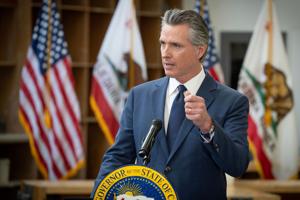
California Gov. Gavin Newsom is suing Fox News for alleged defamation over its coverage of a phone call he had with President Donald Trump during immigration enforcement protests in Los Angeles.
Newsom filed a $787 million lawsuit against Fox News Friday morning, accusing the cable network of playing an edited clip of Trump that made it appear Newsom had lied about the timing of their phone call. Newsom’s legal team is arguing the situation meets the legal standard for defamation and will harm the governor’s vote counts in future elections.
Newsom is termed-out as governor, but is widely expected by politicians and others to run for president in 2028, although he hasn’t made an announcement.
In Newsom’s lawsuit filing, the governor claims his phone call with Trump was on June 7, the day before Trump deployed 2,000 California National Guard members to Los Angeles in response to immigration protests. Newsom said the call lasted approximately 16 minutes.
While taking questions in the Oval Office on June 10, Trump told a reporter he had a phone call with Newsom “a day ago,” implying he spoke to the governor the same day he deployed 700 Marines to Los Angeles.
“There was no call,” Newsom said in response to Trump’s claim on X June 10. “Not even a voicemail.”
Trump reached out to Fox News reporter John Roberts on June 10 and shared his call log from June 7 showing he had a phone call with Newsom.
“More than anything else, this shows what a liar he is – Said I never called,” Trump told Roberts according to a post on X from Roberts. “Here is the evidence.”
Newsom’s lawyers said in a letter Roberts reported the situation on air later that evening, claiming Trump said he had his phone call with Newsom “yesterday or the other day.”
“Mr. Roberts chose to present a factually incorrect picture to Fox viewers to obscure President Trump’s false statement of fact,” Newsom’s lawyers said in the letter.
Newsom’s attorneys also said that that same night, Fox host Jesse Watters went on air and played an edited clip of Trump’s remark from the Oval Office, which was edited to have Trump only speaking after he had already said “a day ago.”
The governor claims his response to Trump’s statement on X was in reference to Trump’s claim of having a phone call with him on June 9.
The governor said he will dismiss the lawsuit if Fox retracts its claim that Newsom lied about the timing of his phone call with Trump, and if anchor Jesse Watters and Fox issue a formal on-air apology, according to the letter from Newsom’s lawyers.
“Governor Newsom’s transparent publicity stunt is frivolous and designed to chill free speech critical of him,” Fox News said in a statement, according to Politico. “We will defend this case vigorously and look forward to it being dismissed.”