Posts by Newspaper Staff
WATCH: Against odds, GOP’s ‘big, beautiful bill’ passes House, heads to Trump’s desk
Against all odds, U.S. House Republicans finally united around the Senate-revised “big, beautiful bill” and passed it in a 218-214 vote Thursday afternoon, sending the multitrillion-dollar budget reconciliation package to the president’s desk.
The bill’s passage marks yet another herculean feat by House Speaker Mike Johnson, R-La., who not only persuaded – with President Donald Trump’s help – the most recalcitrant GOP holdouts to vote for the bill as is, but also passed it by a self-imposed July 4 deadline.
The $3.3 trillion megabill, formerly titled the One Big Beautiful Bill Act, hikes the debt ceiling by $5 trillion and implements the bulk of Trump’s tax, energy, border and defense agenda.
When Johnson barely passed the first version in the House last week, he promised fiscal hawks that the Senate would pair any additional tax cuts with dollar-for-dollar spending cuts. The House version extended most of the 2017 Tax Cuts and Jobs Act for the next 10 years while finding $1.7 trillion in offsets.
But Senate Republican leaders, itching to permanently extend the boosted maximum standard deduction and reduced cross-bracket tax rates, adopted a controversial accounting method to theoretically zero out the cost of codifying Trump’s tax policies.
That move and other changes, reported on by The Center Square, alienated multiple House Republicans and upset multiple delicate political compromises House Speaker Mike Johnson, R-La., had made his constituents earlier.
Despite threats by many Republicans in the House to oppose the final bill when it returned to their chamber, Johnson decided to muscle the bill through the House Rules Committee and onto the floor Wednesday, where he and other GOP congressional leaders spent all night pushing hardliners to fold.
“I do so deeply desire to have just normal Congress, but it doesn’t happen anymore,” Johnson told reporters around 1:30 a.m. Thursday. “I don’t want to make history, but we’re forced into these situations.”
Ultimately, Johnson’s gamble paid off, garnering praise from his colleagues and condemnation from Democrats.
House Minority Leader Hakeem Jeffries, D-N.Y., called the bill a “disgusting abomination” that will “have devastating consequences for everyday Americans” during his eight-hour long speech leading up to the final vote.
Among other things, the bill codifies the $15,000 maximum standard deduction, the 20% Qualified Business Income deduction, and the doubled child tax credit of $2,000, though both parents now need a Social Security number to claim it.
Key business tax credits would become permanent as well – full reimbursement for capital investments, an expanded deduction for corporation’s interest on debt, and streamlined deductions for companies’ research costs.
The bill also implements some temporary tax provisions that Trump promised during his campaign, such as creating a $6,000 deduction for eligible seniors and nixing taxes on tips and overtime. The Senate version requires seniors to have a Social Security number to claim the deduction, as well as caps deductions for tips at $25,000 and deductions for overtime at $12,500 for single filers.
To partially offset the bill’s cost and advance Trump’s goal to cut waste and fraud, the legislation would require able-bodied adults without dependents to fulfill work-related requirements to receive welfare benefits and cap the Medicaid provider tax at 3.5% – down from the current 6% rate – by 2030.
It also cracks down on states with high SNAP payment error rates and hikes states’ share of the program’s administrative cost by 2027.
Costly solar and wind subsidies from the 2022 Inflation Reduction Act will have slightly faster phaseouts than originally intended, saving about $517 billion over the next 10 years. The savings are less than fiscal hawks wanted, but a substantial enough spending decrease to eventually get them on board.
“The One, Big, Beautiful Bill is for the people who don’t have lobbyists in this town,” House Ways and Means Committee Chairman Jason Smith, R-Mo., told lawmakers early Thursday morning. “It’s about restoring sanity in a town that’s lost it, cutting waste and reining in reckless spending. It demands that if you’re able to work, you should. It stops asking working families to foot the bill for Washington’s bad decisions.”
The White House has scheduled a bill signing ceremony Friday.
Trump touts June jobs report, lower gas, egg prices

The Trump administration is jubilant heading into the weekend of July 4th, as gas prices and unemployment are down, jobs are up, and the president, once again, touts the price of eggs.
After highlighting that gas prices are the lowest they’ve been in four years heading into the holiday, the administration is amplifying the news of the latest jobs report from the U.S. Bureau of Labor Statistics.
The U.S. economy added 147,000 jobs in June and the unemployment rate also decreased slightly from 4.2% to 4.1%, beating expectations.
While some of the jobs reports released during President Donald Trump’s second term have been stronger than others, the economy continues to stave off a recession, despite continued speculation, especially from Trump’s harshest critics, that one could be right around the corner.
January and February’s jobs reports came in below expectations, but March, April and May’s exceeded expectations, with a whopping 228,000 estimated job gain in March – though it has since been revised downward.
State and local government saw the largest job gains in June, up 73,000 total over the previous month, while the federal government continues to shed employees, down 69,000 since the administration change.
The sector with the second-highest growth was health care, adding approximately 39,000 jobs and in line with the previous 12 months, where average job gains have been roughly 43,000 per month.
So far, job growth in 2025 is down from 2024, which averaged about 186,000 jobs per month. However, unemployment remains near 2024 levels, which were lowest between August and October at 4.0%.
In February, the USDA launched a $1 billion, five-pronged strategy to curb the bird flu, “protect the U.S. poultry industry, and lower egg prices.” One week ago, Agriculture Secretary Brooke Rollins announced that “wholesale egg prices have now dropped 64%, with retail prices falling 27% from their peak earlier this year.”
Restaurant chain Waffle House also removed its egg surcharge this week.
In addition to posts touting the jobs report, Trump shared a post about Waffle House’s news on Truth Social Thursday, adding his own commentary.
“We brought the price of Eggs back to what they were supposed to be,” Trump wrote. “When I took over on January 20th, the Fake News was screaming that, ‘Egg prices have gone through the roof, quadrupled,’ they said. Now they’re plentiful, and inexpensive. ‘Thank you President Trump!’”
The U.S. is days away from the end of Trump’s tariff pause, with deals announced for only a handful of countries. The administration has indicated it’s sticking to Trump’s deal deadline of July 9, meaning countries that haven’t reached agreements could soon face a return of elevated tariffs and repercussions could be felt in the U.S. economy.
Talk dies down on dismantling Department of Education

Steps to dismantle the U.S. Department of Education have quieted since the Trump administration started celebrating education victories.
In March, President Donald Trump signed an executive order to essentially dismantle the U.S. Department of Education.
Despite this effort, in recent weeks, the department has taken steps on projects such as fighting gender ideology in federally funded curriculum. And Title IX investigations have become a priority.
“There has been very little updated news from the federal government on the status of the U.S. Department of Education,” communications for the Arizona Education Department told The Center Square.
Republicans believe the U.S. Department of Education is a waste of money and inserts the federal government into decisions that should be left to the states and schools. This idea has recently gained popularity with conservative parents as they demand more authority over their children’s schooling.
Some in education believe that this kind of change could have huge negative effects.
“It’s massive. We’re looking at 7.4 million students with disabilities who could potentially be impacted by changes with funding through the Individuals with Disabilities Education Act,” explained Leslie Babinski, a research professor in the Sanford School of Public Policy.
“There are 9.8 million students in rural schools who depend on federal support for bridge funding in communities with more limited local tax bases. It’s going to impact so many people,” said the professor at the school, which is part of Duke University in Durham, North Carolina. “If it doesn’t impact you and your family directly, you’ll know someone who is impacted.”
A big part of this initiative is to give the power back to the states, but Babinski argued that only 10% of public school funding comes from the federal government.
States already control local funding but there is a push for “block grants” — a form of federal funding provided to state and local governments for broadly defined purposes
The real issue, Babinski said, is the impact of federal programs that are focused on low-income communities and disabled students.
“So if we think about handing that funding over to the states to make their own decisions, they may or may not prioritize those groups in terms of enhancing the educational opportunities for students from low-income communities or students with a range of disabilities,” Babinski said.
Yet Secretary of Education Linda McMahon explained back in April that those kinds of programs would not change if the department was dismantled.
“The president has said from day one that dismantling the Department of Education will not mean defunding those programs,” Secretary McMahon said. “That money is appropriated by Congress … parents, teachers and kids should not be worried.”
Other education officials think the U.S. Department of Education is useless.
“Shutting down the U.S. Department of Education would not result in a loss of federal formula funding for Arizona,” State Superintendent of Public Instruction Tom Horne said.
“I have seen comments saying that the federal department is needed because national test scores in reading, writing and math have gone down over the past 40 years. That just proves the USDoE is useless since those declines happened under its watch. The money used to operate this bureaucracy should go to local schools instead,” Horne said.
According to a report by the Office of Management and Budget at the White House, more than half of Department of Education employees don’t bother coming into the office to work.
According to Horne, the department is “hopelessly ineffective.”
“This is a waste of taxpayer dollars, shows a poor work ethic and sets a bad example to teachers and students who gather in person to learn. Educators should have a passion for academic excellence, but that is not evident at USDoE,” Horne said.
The Center Square reached out to the White House and U.S. Department of Education but has not received a response on whether dismantling the department continues to be a priority.
Madre Fire burns 35,530 acres in less than 24 hours

The Madre Fire has grown to 35,530 acres in less than 24 hours, making it this year’s largest wildfire in California.
The vegetation fire, which burned 3,300 acres within two hours after starting around 1 p.m. Wednesday near State Route 166 east of Santa Maria, is in the area by the border between Santa Barbara and San Luis Obispo counties. Pushed by fast winds and topography, it’s burning primarily in San Luis Obispo County on federal land: Los Padres National Forest and Bureau of Land Management parcels.
The fire is 20 miles northwest of a small northern Santa Barbara County town, New Cuyama.
The blaze is burning east and northeast onto the Carrizo Plain, Los Padres National Forest reported.
Multiple agencies are responding to the fire with seven air tankers, two helicopters, several engines, bulldozers and hand crews, the national forest reported at an intergency website, inciweb.wildfire.gov/incident-information/calpf-2025-madre-fire. There are 303 personnel responding to the fire.
The fire is burning along grass and dry brush, Los Padres National Forest spokesman Andrew Madsen in Solvang told The Center Square Wednesday.
“The presence of dry, cured annual grasses will support high rates of spread with intense flame lengths,” Los Padres National Forest said Thursday.
The national forest noted hot conditions, with highs in the mid- to upper 90s, was expected Thursday. Light winds Thursday morning were expected to increase from the west, eventually reaching gusts of 20 to 25 mph.
Evacuations have been ordered in eight zones, with another evacuation warnings issued in another six areas.
California Department of Forestry and Fire Protection, Los Padres National Forest and the Bureau of Land Management are in a unified command responding to the fire.
In other blazes further south, the Wolf Fire in Riverside County hasn’t expanded beyond the 2,414 acres reported on Tuesday and is now 55% contained, Cal Fire reported. The fire started Sunday.
Two smaller fires in the county, Juniper and Mindy, are almost entirely contained, according to Cal Fire.
Trump touts falling gas prices for holiday weekend

Gas prices are the lowest they’ve been in four years coming into the holiday weekend, sitting at a national average of $3.14 per gallon of unleaded, according to gas prices tracker GasBuddy.
They’re down more than 8 cents from one week ago and over 37 cents from one year ago, in line with trends from earlier this year.
“Americans will spend over $500 million less on gasoline from Thursday, July 3, through Sunday, July 6, compared to last year” if prices continue on their current trajectory, according to the fuel price comparison tool.
President Donald Trump has touted falling gas prices multiple times since the start of his second term. The White House publicized lower gas prices on Memorial Day, as well, which were also the cheapest they had been since 2021.
Prices are $1.69 per gallon less than this day in 2022, when the U.S. was still climbing out of the economic quagmire of the pandemic, despite rising some in the past couple weeks while tensions escalated in the Middle East between Israel and Iran. They’ve fallen again with the solidification of the Israel-Iran ceasefire last week.
While major conflicts have continued or broken out around the globe, gas prices have fluctuated within an approximately 20-cent window over the past five-plus months, from $3.02, at the lowest, to a high of $3.25 in April.
The president has encouraged domestic energy production, attempting to lift certain permitting restrictions and regulatory burdens that have interfered with American oil and gas production – in part to lessen U.S. dependence on other countries.
Gas prices are highest in the West, topping out at an average $4.55 per gallon in California, and generally lowest in the South, falling to an average $2.69 per gallon in Mississippi. Midwest state gas prices peak in Illinois at an average $3.44 per gallon and Pennsylvania has the highest average price in the Northeast at an average $3.35.
U.S. Supreme Court to take up two transgender athlete cases
The U.S. Supreme Court on Thursday agreed to take up two cases in its next term on laws banning transgender women from participating in girls and women’s sports, based on biological sex.
The Supreme Court will hear arguments on Little v. Hecox and West Virginia v. B.P.J. The cases come out of Idaho and West Virginia, respectively, where individual athletes filed suit in the states alleging discrimination on the basis of sex.
In Idaho, the 2020 Fairness in Women’s Sports Act placed a categorical ban on participation of transgender women and girls from competing in women’s and girls sports across all ages and levels of competition. The act also allowed any student to “dispute” the sex of any student participating in female athletics and required that athlete to undergo medical procedures to verify sex.
Lindsay Hecox, a transgender athlete, sued the state and an Idaho district court enjoined the order on the basis of sex discrimination. The Ninth Circuit Court of Appeals affirmed the district court’s judgment and prevented the Idaho law from going into effect.
In West Virginia, the Save Women’s Sports Act prevented biological males from competing in girls and womens sports across the state. Becky Pepper-Jackson, a 13-year-old transgender girl, challenged the law.
Pepper-Jackson said she identified as transgender since third grade and was taking puberty-blocking medication. The law prevented Pepper-Jackson from participating on the cross-country team.
The West Virginia district court decided the case did not discriminate on the basis of sex and the state’s law was constitutional. On appeal, the Fourth Circuit Court of Appeals reversed the lower court’s decision.
The Supreme Court took up the West Virginia case in 2023 and decided to vacate the circuit court’s decision, sending it back to the lower court.
In each case, the state governments filed petitions to the Supreme Court and were granted a hearing.
Sarah Parshall Perry, vice president at the advocacy group Defending Education, celebrated the court’s decision to take up each case.
“To those of us who have been advocating for common sense athletic policies separating boys and girls based on notions of fairness, safety, equality, and the black letter text of Title IX – we are, today, breathing a sigh of relief,” Perry said.
“It appears the grownups are finally in the room, and the Court is likely to – based on its recent jurisprudence – overturn the decisions of the 4th and 9th Circuits striking down women’s sports protection laws,” she added.
The court’s next term will begin in October. Arguments are likely to be heard in the fall with a decision coming out in spring 2026.
‘We look forward to continuing to vigorously defend the cause of educational equality in the coming months until all women and girls can reclaim their rightful spots on athletic fields across the nation,” Perry said
State ends fiscal year with record revenue
Capitol News Illinois
Article Summary:
Illinois closed fiscal year 2025 with record $54 billion in revenue.
While that marked a surplus from the enacted budget, the extra revenue was anticipated when lawmakers approved the current-year budget in May.
It doesn’t give lawmakers any extra breathing room for an expected volatile fiscal year 2026.
This summary was written by the reporters and editors who worked on this story.
Despite uncertainty over the economy and federal funding during the second half of fiscal year 2025, the year closed on June 30 with the state setting a new record for annual revenue.
Numbers compiled by the independent Commission on Government Forecasting and Accountability show FY25 concluded with $54 billion in revenue, the most the state has ever received in a fiscal year. The state also brought in $717 million more in revenue than lawmakers originally budgeted for when they passed a $53.3 billion budget in May 2024.
All told, the final revenue numbers track closely with projections made in May by both COGFA and the Governor’s Office of Management and Budget that formed the basis of the FY26 budget. In other words, June revenues produced no surprises, and lawmakers aren’t sitting on any substantial surplus as the new fiscal year begins.
The record revenues also don’t alleviate any uncertainty for the current or future fiscal years as Congress considers drastic reductions to the social safety net and aid to states.
Causes of revenue growth
Strong personal income tax growth drove the revenue increase in FY25, largely thanks to a “true up” conducted by the Department of Revenue that reallocated business related income tax revenue into the personal income tax category. Personal income tax revenue was 10% higher than in FY24, but corporate income taxes declined by 9.5%.
Some other revenue sources also saw minimal growth. Sales tax revenue grew by less than 1%, though COGFA noted it increased by nearly 3% in the second half of FY25 after a weak start last summer as gas prices dropped and people cut back on large purchases amid growing economic uncertainty.
Federal income was also down 4.6% in FY25, even when excluding one-time pandemic relief funds the state received in FY24. But in a bright spot for the state, COGFA found that state revenue sources grew more than anticipated to offset the $178 million decline in federal revenue.
Despite solid revenue growth this year, questions remain about how well it will perform in FY26.
“Whether this record will be surpassed in FY 2026 remains to be seen, though the FY 2026 enacted budget assumes revenues of $55.297 billion – nearly $1.3 billion above the FY 2025 final total,” COGFA Revenue Manger Eric Noggle wrote.
Bills paid and money left over
The state also ended the fiscal year with $1.9 billion of cash in the General Revenue Fund after all bills were paid, according to the Comptroller Susana Mendoza’s office.
“We work hard each year to pay bills on time, build up the state’s emergency reserves and stress fiscal discipline, even in these uncertain times,” Mendoza said in a statement. “My office will strive for continued improvement in state finances and credit ratings in the new budget year.”
Mendoza’s office also put $256 million into the “rainy day” fund, growing it to a balance of $2.5 billion. The fund is expected to grow at a slower rate in FY26, however, as lawmakers suspended a monthly transfer that will free up $45 million.
With an extra cash balance to start the new fiscal year, Mendoza said she plans to pre-pay monthly pension payments for FY26. Lawmakers gave the comptroller authority last year to make pension payments earlier in the year rather than on a monthly basis when extra money is available.
“This will enable the systems to plan accordingly and keep additional dollars in their investment portfolios into the new budget year,” Mendoza said.
An uncertain future
With good new concluding FY25, attention now turns to FY26, which began Tuesday, and the vast uncertainty the state faces from budget talks in Congress and the economic fallout of decisions by the Trump administration.
Gov. JB Pritzker signed a $55.1 billion spending plan in mid-June that relies on $55.3 billion in revenue. It’s the largest budget in state history despite minimal discretionary spending growth, and it relies on $1.2 billion of tax increases or one-time revenues.
Read more: Pritzker signs $55.1B state budget reliant on $700M of new taxes
But state lawmakers have left the door open to the possibility that changes Congress makes to federal funding that requires states to cover greater portions of government programs and ceases funding in certain areas will require lawmakers to change the budget.
“The ability of the state to try to step in and try to mitigate the damage is somewhat limited, although we have the ability to do certain things and may have to in special session or we may have to in veto session,” Pritzker told reporters in Peoria on Tuesday. “It’s a little hard to tell yet. Some of the provisions of this terrible bill in Washington, D.C. don’t go into effect until next year and so we’ll have to evaluate what changes to make in order to deal with it.”
Work requirements for health care and food assistance programs, cuts to Medicaid reimbursements and the elimination of clean energy tax credits could all require the state to take on more costs.
Capitol News Illinois is a nonprofit, nonpartisan news service that distributes state government coverage to hundreds of news outlets statewide. It is funded primarily by the Illinois Press Foundation and the Robert R. McCormick Foundation.
The post State ends fiscal year with record revenue appeared first on Capitol News Illinois.
Medical group pleased with new accreditor focused on academic excellence
Six university systems across the nation established a new accreditor focused on academic excellence, with a medical group seeing it as a sign that accreditors’ “stranglehold” on public education may be nearing its end.
Do No Harm medical director Dr. Kurt Miceli told The Center Square that “the creation of the Commission for Public Higher Education marks a promising step forward for public postsecondary education.”
The new accreditor – the Commission for Public Higher Education – “will create a first-of-its-kind accreditation model for public higher education institutions that will offer high-quality, efficient services prioritizing academic excellence, student outcomes and achievement,” according to a news release.
The six systems making up the commission are the State University System of Florida, the University System of Georgia, the University of North Carolina System, the University of South Carolina, the University of Tennessee System, and Texas A&M University System.
According to the joint statement for the commission obtained by The Center Square via communications with the State University System of Florida, a few of the commission’s principles include reducing bureaucracy, ensuring accountability to the states of its member institutions, and remaining recognized by the Department of Education “for the purposes of Title IV participation by its accredited institutions.”
Medical group Do No Harm is pleased with the establishment of a new accreditor, seeing the action as a sign “accreditors’ stranglehold on public education may be breaking,” according to a news release.
Do No Harm is a group of medical professionals committed to keeping identity politics out of the medical field, including medical education, according to its website.
In their position of power over the schools they accredit, accreditors are able to – as Do No Harm puts it – “inject political agendas into universities’ policies” if they please. Do No Harm is especially concerned with this issue of political agenda as it pertains to medical education.
“Medical education could likewise stand to gain from this same spirit of innovation,” Miceli said.
Miceli said “accreditors wield considerable power in shaping higher education, particularly within healthcare.”
“They’ve unfortunately misused this influence to push political agendas through university policies that have proven both divisive and discriminatory,” Miceli said.
“In the landscape of medical education, some of these DEI standards have recently been rolled back by two of the main medical education accreditors,” Miceli said. “Yet, more needs to be done to ensure and maintain an unwavering focus on excellence and outcomes.”
When asked how the newly formed commission can be kept from enforcing political agendas as other accreditors have done, Miceli told The Center Square that “one of the most effective ways of ensuring accountability is by fostering competition.”
“President Trump underscored this in his Executive Order on Reforming Accreditation, instructing the Secretary of Education to recognize new accrediting agencies as a means of promoting competition,” Miceli said.
“Additional accreditors create greater choice for institutions,” Miceli said.
“And with no single accrediting agency holding monopoly power, all accreditors are naturally compelled by market forces to better serve the genuine needs of higher education – focusing on academic rigor and quality outcomes over political agendas,” Miceli said.
When reached for comment, the University System of Georgia told The Center Square: “The University System of Georgia (USG) is working with neighboring higher education systems on a new accreditation approach that keeps academic and institutional rigor front and center.”
“While this effort expands accreditation options, USG institutions and programs remain accredited by SACSCOC and other accrediting bodies,” USG’s statement said. “We’re grateful to the federal administration for its support and look forward to how this collaboration opens the door to future opportunities by strengthening and innovating higher education oversight.”
The University of North Carolina System, the University of South Carolina, the University of Tennessee System, and Texas A&M University System have not yet responded to The Center Square’s requests for comment.
Pritzker signs health care legislation
Capitol News Illinois
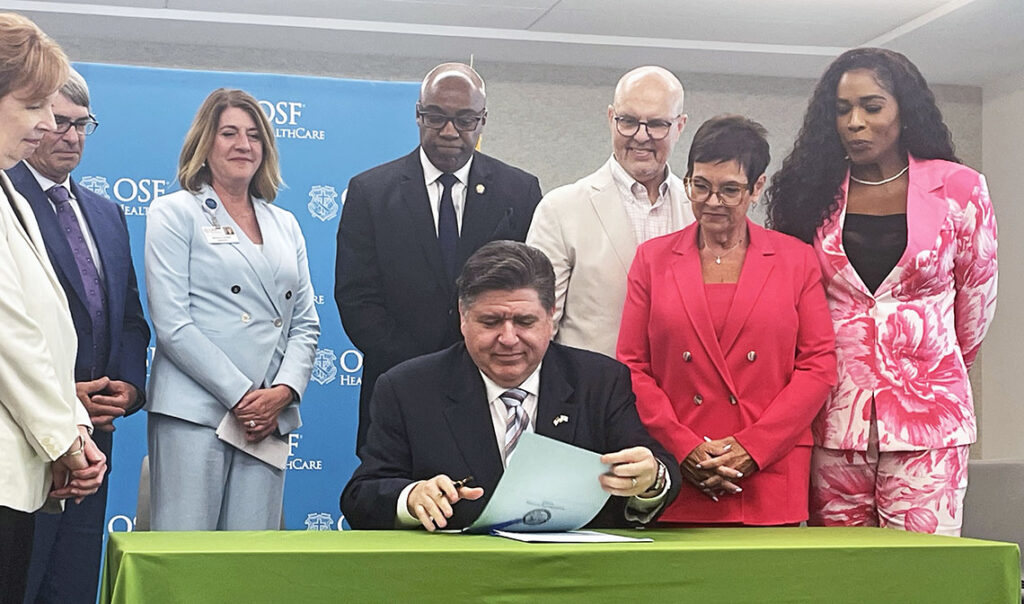
Gov. JB Pritzker signed a pair of health care-related bills Tuesday that he said would put more controls on the pricing of pharmaceutical drugs sold through insurance plans while expanding insurance coverage for certain kinds of hospital costs.
“For too long our health care system has been infected by profit-seeking middlemen and predatory actors looking to make an extra dime at the expense of Illinois patients,” Pritzker said at a bill signing ceremony in Peoria. “Seniors have been forced to pay through the nose for life-saving medications. Families have had to delay or decline medically necessary treatments because they can’t afford it anymore. And family businesses like independent pharmacies have had to shut their doors.”
House Bill 1697, known as the Prescription Drug Affordability Act, will impose new restrictions on practices of pharmacy benefit managers, or PBMs, a powerful but little-understood segment of the pharmaceutical industry.
PBMs are companies that act as a kind of middleman between health insurance plans and pharmaceutical companies by negotiating drug prices and designing drug formularies that are intended to steer patients toward lower-cost medications.
But they have come under intense criticism in recent years for steering patients toward their own affiliated retail chain pharmacies, often to the detriment of smaller independent pharmacies, and for operating pricing systems that are designed to maximize profits for the PBMs rather than producing savings for patients.
Under the legislation, PBMs will be prohibited from steering consumers toward large pharmacies in which they have a financial interest. They will also be prohibited from engaging in “spread pricing” – the practice of charging health plans a higher price for a drug than the PBM pays a pharmacy for dispensing the drug.
The bill also establishes a grant program that will distribute $25 million a year in financial support for independent pharmacies, funded through a tax levied on PBMs operating in Illinois.
David Bagot, an independent pharmacist from Petersburg who is also president of the Illinois Pharmacists Association, called the bill “landmark legislation” that he predicted would be studied and replicated in other states.
“This bill represents the most comprehensive reform of pharmacy benefit managers we have seen in Illinois,” he said. “For far too long, these companies have used our nation’s drug supply chain to benefit shareholders and executives while driving up costs for people who rely on medications and driving pharmacies out of business.”
But the Pharmaceutical Care Management Association, the lobbying organization that represents PBMs, called the bill “misguided legislation” and predicted it would have little or no impact on the prices consumers pay for medications.
“Unfortunately, the legislation does nothing to address the fact that Big Pharma sets the price of the prescription drugs – and the price is the problem when it comes to some Illinoisans facing difficulty affording their prescription drugs,” the group said in a statement. “Lawmakers have passed 20 bills regulating and restricting PBMs since 2016, none of which have led to lower drug prices.”
Insurance coverage expansion
Pritzker also signed House Bill 3019, known as the Healthcare Protection Expansion Act.
Among other things, it prohibits state-regulated health plans from requiring prior authorization for outpatient mental health services. Last year, lawmakers imposed a similar prohibition for inpatient and emergency mental health services.
It also requires insurance plans to cover a patient’s travel-related expenses whenever they have to travel long distances to receive in-network care, a problem often faced by patients who live in rural areas of the state.
“Building on protections that make mental health care accessible for all Illinois residents, this law gives people more opportunities and flexibility to receive necessary services,” state Sen. Laura Fine, D-Glenview, a lead sponsor of the bill, said in a statement.
Capitol News Illinois is a nonprofit, nonpartisan news service that distributes state government coverage to hundreds of news outlets statewide. It is funded primarily by the Illinois Press Foundation and the Robert R. McCormick Foundation.
The post Pritzker signs health care legislation appeared first on Capitol News Illinois.
Will County Seeks Asian Carp Provision in Federal Legislative Agenda

Will County Board member Julie Berkowicz is pushing to add specific language addressing Asian carp invasion to the county’s federal legislative agenda, citing the ongoing threat to local waterways as a critical regional concern. During Monday’s Legislative Committee meeting, Berkowicz renewed her annual request to include dedicated Asian carp language in the county’s federal priorities,…
Read More