Posts by Newspaper Staff
Low illegal border crossings continued in February
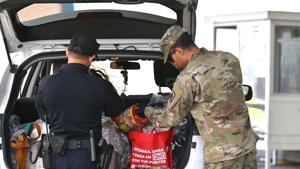
Illegal border crossings and apprehensions in February saw continued record declines and the lowest number so far this year.
Nationwide apprehensions totaled 26,963 in February, according to the latest U.S. Customs and Border Protection data. That’s down from 29,613 last February and 34,626 in January, The Center Square reported.
The sustained decline in illegal border crossings and apprehensions – now at levels not seen in over three decades – “shows the impact of robust enforcement policies,” the Department of Homeland Security said. “With daily apprehensions down 95% from the previous administration and 13 consecutive months of fewer than 9,000 southwest border apprehensions, the border remains more secure than at any point in history.”
Total apprehensions so far this fiscal year, 153,155, represent 40% fewer than the 242,530 reported in February 2024 alone. The fiscal year goes from Oct. 1 through Sept. 30.
Border Patrol apprehensions along the southwest border in February totaled 6,603, according to the data, representing a 92% drop in the monthly average over the last 33 years. It also represents a 97% drop from the peak of the border crisis in December 2023 of 341,073 apprehensions, according to the data.
February’s numbers also represent the 13th consecutive month of less than 9,000 monthly apprehensions at the southwest border. During the height of the border crisis, 10,000 apprehensions a day was considered a good day by Border Patrol agents inundated by a record high number of illegal crossings during the Biden administration, The Center Square reported.
By contrast, in February, Border Patrol’s daily average of southwest border apprehensions was 236, or 95% lower than the daily average under the Biden administration. It was also less than a single hour during the height of the Biden administration in December 2023 when an average 336 were apprehended an hour, according to the data.
In February, Border Patrol and CBP agents also seized the greatest volume of illicit drugs since October 2021 of 79,609 pounds. Compared to January, seizures were up of marijuana (129%), fentanyl (67%), methamphetamine (46%), cocaine (39%) and heroin (10%), according to the data.
DHS once again claimed, as it has nearly every month, that illegal border crossers aren’t being released into the U.S. February marked the “tenth consecutive month of zero releases at the border, continuing its trend of historically low border crossings,” it said.
Outgoing DHS Secretary Kristi Noem said, “Ten straight months of ZERO illegal aliens released at the border. President Trump promised to secure the Border, and that is a promise we delivered.”
Their claims are disputed by TRAC, the Transactional Records Access Clearinghouse, a nonpartisan organization affiliated with Syracuse University. Publishing data it obtained from CBP through a public information request, TRAC explains, CBP officers working at ports of entry “allowed more and more noncitizens entry to this country through parole.
“Immigration parole allows noncitizens to temporarily enter and reside in the U.S. without formal admission, usually for urgent humanitarian reasons or significant public benefit. The number of individuals granted immigration parole increased from 3,304 in February 2025 to 12,639 in January 2026.”
January’s numbers increased “above the monthly numbers during the last months of the Biden administration,” it said. It also argues that illegal foreign nationals who were paroled into the U.S. by the Trump administration “now comprise a record-breaking 61.5 percent of all inadmissibles.”
“Almost every [CBP] field office experienced growth in the number of inadmissibles,” it adds, with a CBP Boston Port of Entry “showing the largest increase in inadmissibles of 153 percent over the last three months. Boston also led rankings in the largest jump in foreign nationals granted immigration parole – up over 600 percent.”
TRAC also notes that the largest number, 85%, of illegal foreign nationals granted parole and released into the country in January were from India. “Eighty-five percent of all individuals from India who recently sought entry to the U.S. without proper papers were granted parole,” it says.
The next greatest numbers were from Mexico, China, Canada, Brazil, Colombia, Guatemala, Dominican Republic, United Kingdom and Jamaica.
Since February 2025, 50,781 foreign nationals have been paroled into the U.S., according to the data.
Bill renaming highway for Charlie Kirk faces uncertainty
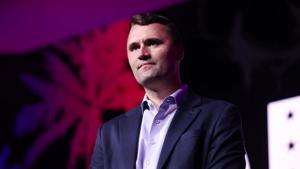
The Arizona Legislature this week passed a bill renaming a major Arizona highway after conservative leader Charlie Kirk.
Senate Bill 1010 renames Loop 202 as the “Charlie Kirk Loop 202.”
Senate President Warren Petersen, R-Gilbert, who is SB 1010’s sponsor, said, “Loop 202 runs right through the heart of the Phoenix metro area and connects communities across the Valley. It’s a corridor millions of Arizonans rely on every day.”
“Charlie built a national platform, but he called Arizona home,” Petersen said, answering The Center Square’s questions by email. ”Naming one of the state’s most visible, heavily used roadways after him reflects the scale of his influence and ensures his impact is seen and remembered by future generations.”
After its passage, SB 1010 headed to Gov. Katie Hobbs’ desk, where, according to Petersen, its fate is uncertain.
Earlier in March, the Democratic governor vetoed SB 1439, which would have created a license plate honoring Charlie Kirk. Republicans hold majorities in both houses of the Legislature, but lack enough seats to override Hobbs’ vetoes.
In her explanation of why she vetoed it, Hobbs called Kirk’s assassination “tragic.”
“Political violence puts us all in harm’s way and damages our sacred democratic institutions,” Hobbs said.
The governor added she would work “toward solutions that bring people together,” but noted SB 1439 fell “short of that standard by inserting politics into a function of government that should remain nonpartisan.”
Petersen told The Center Square that he was disappointed Hobbs vetoed SB 1439.
He said the bill was a “simple way for people to voluntarily show support for someone who encouraged civic engagement.”
Petersen is hopeful Hobbs will sign the highway bill.
“We have many roads in Arizona named after political figures,” Petersen explained, adding that the state has a “long tradition of recognizing people for their contributions, not their party affiliation.”
“I’m hopeful the governor will do the right thing with this bill,” he said.
Petersen said he has not had any feedback from Hobbs’ office regarding the highway bill.
“Unfortunately, the governor does not communicate well with the Legislature on bills,” the Senate president said. “We’ve had more productive communication with prior administrations when it comes to working through legislation.”
“At the end of the day, this is a straightforward decision. It’s about whether we continue Arizona’s tradition of recognizing impact, regardless of politics,” Petersen added.
Regarding feedback from his constituents, Petersen told The Center Square that his bill has had “overwhelming support from Arizonans.” He said this was “understandable when [people] look at the number of people who showed up to honor Charlie after his death.”
Kirk was a Scottsdale, Ariz., resident who cofounded Phoenix-based Turning Point USA. He was appearing at a rally Sept. 10 at Utah Valley University in Orem when he was shot and killed. Tyler James Robinson, 22, has been charged with aggravated murder, and there have been several pretrial hearings at the Fourth Judicial Court in Provo, Utah. Another hearing is scheduled there on April 17.
“Charlie was the only person in Arizona history to ever fill two stadiums at his funeral,” Petersen said. “Charlie’s passion for American values and his ability to bring young people into civic engagement is exactly why so many believe his impact should be recognized.”
Poll: More than a third of American voters don’t trust U.S. power grid
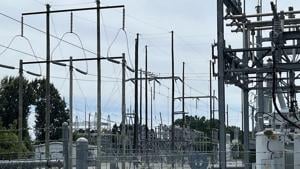
Slightly more than half of American voters say they at least “somewhat trust” the American power grid, according to a new poll.
The Center Square Voters’ Voice Poll found that 55% of American voters said they completely or somewhat trust the American power grid. When that figure is broken down, 42% of voters said they only “somewhat trust” the power grid and 13% of voters said they “completely trust” the power grid. But 37% of voters say they don’t trust the grid, including 13% who “completely distrust” it.
The Center Square Voters’ Voice Poll was conducted by Noble Predictive Insights between March 2-5, 2026. The poll sample included 2,659 registered voters, comprising 1,177 Republicans, 1,270 Democrats, and 773 Independents, of which 330 do not lean toward either major party. The tracking poll is among the most comprehensive in the country.
Across partisan lines, Republican respondents had a greater overall level of trust in the U.S. power grid. About 66% of Republicans said they at least “somewhat trust” the U.S. power grid whereas only 45% of Democrats said the same.
However, 45% of Democrat respondents said they either somewhat or completely distrust the power grid.
Mike Noble, founder of Noble Predictive Insights, said this issue reflects general lack of trust in institutions across the country. He said independent voters are stuck between Republicans and Democrats in the midst of this increasing distrust.
Only 34% of independents respondents who do not lean toward either major party at least “somewhat trust” the power grid. About 20% of those independents said they “completely distrust” the U.S. power grid and 30% “somewhat trust the grid.
“There’s just overall lower confidence in general, and they have shaky confidence with it,” Noble said. “People just don’t really trust institutions or things that have just been around for a long time that have been really reliable.”
The U.S. Department of Energy has stressed the importance of greater reliance on the domestic power grid, especially as companies continue investing in artificial intelligence data centers. The department projected a 100 times increase in risk by 2030 if grid facilities continue to retire at the current rate.
The Energy Department’s models predicted as much as 800 outage hours per year. Recent winter storms have led Energy Secretary Chris Wright to call on grid operators to use backup generation resources at data centers across the country.
“President Trump and the Energy Department remain committed to doing everything in our power to mitigate blackouts and lower energy costs for the American people,” Wright said.
Power outages cost Americans roughly $44 billion per year, according to data from the DOE’s national laboratories.
Respondents with more education reported fewer concerns about the country’s power grid. About 59% of respondents with college degrees said they at least “somewhat trust” the power grid whereas 49% of respondents with some college experience said the same. About 63% of respondents with post-graduate degrees at least somewhat trust the grid.
Black and Hispanic or Latino respondents had the highest levels of distrust in the power grid. About 17% of Black respondents said they “completely distrust” the power grid and 19% of Hispanic or Latinos said the same.
About 14% of Black respondents “completely trust” the power grid and 16% of Hispanics or Latinos said the same.
“There’s this degradation in institutions and structures,” Noble said. “A decade or so ago, were any of your parents ever talking about, ‘Oh, how is the power grid doing?’ It just seems now there is more distrust.”
Harvard sued after Jewish students harassed

Harvard University found itself at the center of a federal discrimination lawsuit on Friday after the Trump administration said it failed to protect Jewish and Israeli students from harassment on campus.
Filed in federal District Court in Massachusetts, the lawsuit says university administration sat idle while “antisemitic mobs” assaulted, stalked and intimidated students following Hamas’ attack on Israeli citizens on Oct. 7, 2023.
“Since October 7th, 2023, too many of our educational institutions have allowed antisemitism to flourish on campus – Harvard included,” said Attorney General Pam Bondi. “Today’s litigation underscores the Trump administration’s commitment to demanding better from our nation’s schools and putting an end to discriminatory behavior that harms students.”
The administration wants to recover billions of dollars in support it sent to the university despite its purported violation of anti-discrimination laws. Another $2.6 billion in grants from the Department of Health and Human Services is slated to funnel to the university this year.
“Every student deserves to learn without fear of harassment or exclusion,” said Health and Human Services Secretary Robert F. Kennedy Jr. “When institutions take taxpayer dollars, they accept a duty to protect civil rights. We hold Harvard accountable on the principle that antisemitism has no place in any program funded by the American people.”
The lawsuit comes six weeks after Trump told officials that the institution needed to repay $1 billion it had received in federal support over the allegations. Former Harvard President Claudine Gay criticized that proposal, calling the amount arbitrary and unjustified.
Harvard has filed two lawsuits challenging the administration’s actions, arguing it is being penalized for declining to adopt the administration’s policy positions.
In December, a federal judge blocked the funding cuts, ruling that the administration had not adequately justified them.
In one year, U.S. military conduct tens of thousands of missions at southwest border
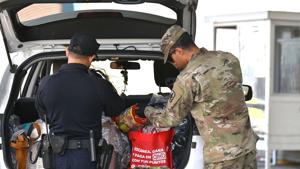
In one year, U.S. military conducted tens of thousands of detection, monitoring and security site missions at the southwest border.
More than 20,000 service members have served at the southwest border over the last year through Joint Task Force Southern Border (JTF-SB). The operation reached its one-year anniversary on March 14 and is ongoing.
“During this first year, Joint Task Force-Southern Border and partners have proven what a whole-of-government approach to our nation’s southern border can accomplish,” Army Maj. Gen. David Gardner, commanding general of the JTF-SB and 101st Airborne Division, said in a statement. “Our joint teammates and partners have strengthened border security through unity of effort, accelerated decision-making and enhanced detection capability. While the environment is complex, our mission is clear: to secure the homeland with precision, professionalism and respect for the rule of law.”
Soldiers assigned to the 10th Mountain Division in Fort Drum, New York, were deployed to Fort Huachuca, Arizona, to establish JTF-SB last March. Last October, the 101st Airborne Division from Fort Campbell, Kentucky, assumed control of the JTF-SB mission.
President Donald Trump established JTF-SB through several executive orders he issued on his first day and week in office. Trump was the first president to declare an invasion at the southwest border and directed the Department of Defense’s United States Northern Command (USNORTHCOM) to “seal the borders and maintain the sovereignty, territorial integrity, and security of the United States by repelling forms of invasion including unlawful mass migration, narcotics trafficking, human smuggling and trafficking, and other criminal activities.”
JTF-SB’s stated mission is to “safeguard U.S. territorial integrity and protect the American people.” It seeks to do this by increasing situational awareness across the 1,954-mile U.S.-Mexico border by “accelerating response capabilities and supporting federal law enforcement partners so they can focus on frontline duties.”
By last March, more than 10,000 U.S. troops were deployed to support southern border security efforts, The Center Square reported. That number has since doubled.
JTFSB service members began conducting enhanced detection and monitoring, including providing “mobile ground-based support to detect, track and monitor movements of suspected illegal activity using military tactical vehicles or foot patrols” in areas identified by U.S. Customs and Border Protection and Border Patrol. So far, five National Defense Areas (NDA) have been established and expanded along the southwest border including in New Mexico and Texas, The Center Square reported.
Over the past year, troops conducted remote and mobile detections, synchronized planning, rapid mobility and persistent presence along the Rio Grance River, in the air and in high traffic urban-to-urban corridors.
This involved roughly 22,000 enhanced detection and monitoring missions, including nearly 3,000 joint patrols with Border Patrol agents. Aviation assets executed nearly 1,600 aerial observation flight missions and 220 unmanned aerial missions last year.
Troops conducted more than 800 mirrored patrols on both sides of the southwest border, working with Border Patrol agents and the Mexican Secretariat of National Defense, according to Department of War data.
They also conducted more than 84,000 security site missions last year, providing continuous detection and monitoring across the southwest border using sensor-borne technology, fixed and mobile ground sensors and long-range systems. They tested new equipment and technology to conduct the operations, including: “the TRV-150C tactical resupply vehicle; an infantry squad vehicle Marines trained on for the first time in an operational environment; an unmanned surface vessel and solar-powered maritime detection device; and various kinetic and nonkinetic counter-unmanned aerial systems.”
JTF-SB troops also installed nearly 6,000 signs and 2,000 marine buoys along 656 miles of the southwest border to demarcate five new NDAs.
They delivered more than 51,000 rolls of concertina wire and erected wire barriers in key locations in conjunction with Customs and Border Protection. New barrier reinforcement measures represent “the largest of its kind in U.S. history, adding a layer of deterrence in areas most needed to deter and deny illegal crossings,” the DOW said.
Entering its second year, JTF-SB troops remain dedicated to their mission, to strengthening integration, advancing data-driven operations and providing support to CBP and Border Patrol, Gardner said. He added that JTF-SB operations are helping expand detection and monitoring and improve data sharing to enable federal, state and local law enforcement apprehend illegal border crossers, target drug and human smugglers and locate criminal elements in the interior of the U.S.
Supreme Court upholds preacher’s First Amendment lawsuit
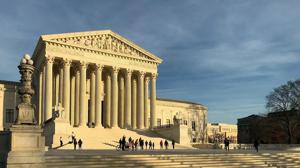
The U.S. Supreme Court, in a unanimous decision, upheld that a street preacher can sue over a city ordinance that prevented him from exercising free speech rights.
The case, Olivier v. City of Brandon, focused on Gabriel Olivier, a man who regularly preached in public outside an amphitheater in Brandon, Mississippi. In 2019, Olivier was restricted from speaking outside the theater and using signs or speakers during live events.
In 2021, Olivier was arrested for violating the town’s ordinance that placed restrictions on where he could publicly speak. He later sued, claiming the city violated his First Amendment free speech rights.
Olivier did not sue over the $350 fine he was charged. Instead, he sued to ensure the city ordinance would not block him or someone else like him from preaching outside the theater.
“Assuming a credible threat of prosecution, a plaintiff can bring a[n] action to challenge a local law as violating the Constitution and to prevent that law’s future enforcement,” Justice Elena Kagan wrote in the court’s majority opinion.
The case challenged precedent set by Heck v. Humphrey, where the Supreme Court determined an individual cannot proceed with a lawsuit to challenge a previous conviction.
Kagan said a lawsuit seeking future relief from an activity, like Olivier exercising his First Amendment rights, was valid under the court’s precedent. She compared it to a prisoner seeking a more fair trial in the future.
“Olivier’s suit merely attempts to prevent a future prosecution, so the Heck bar does not come into play,” Kagan wrote.
“There is no looking back in Olivier’s suit; both in the allegations made, and in the relief sought, the suit is entirely future oriented – even if success in it shows that something past should not have occurred,” Kagan continued. “His suit to enjoin the ordinance, so he can return to the amphitheater, may proceed.”
United, American clash at O’Hare as growth strains capacity

The Federal Aviation Administration is expected to scale back flights at O’Hare International Airport this summer as two major carriers rapidly expand service, raising concerns about delays, congestion and market imbalance.
This week, the FAA proposed flight reductions at O’Hare, capping daily operations at 2,608 takeoffs and landings. With the reductions, United stands to lose more flights compared to American Airlines. Ahead of the proposal, United aggressively added flights, adding more than 200 additional flights a day compared to last year (United planned about 750 O’Hare flights vs. 541 last year). By contrast, American sought to add about 45 flights a day, anticipating 525 daily flights during summer peak days compared to just over 480 last year.
Joe Schwieterman is a transportation expert at DePaul University.
“They’ve evolved into this big market share war that is pretty public and pretty emotional,” said Schwieterman.
Federal regulators are considering capping or reducing daily flights after airlines scheduled more than 3,000 peak-day operations this summer – far above what officials consider manageable.
The FAA has discussed limiting operations closer to about 2,600 to 2,800 daily flights to prevent widespread disruptions. Schwieterman said the move is unusual.
“This is pretty unprecedented for the federal government to come in and tell airlines what to do at a particular airport” outside of emergencies like staffing shortages or construction, he said.
The agency’s concern centers on a sharp ramp-up in flights this spring, combined with uncertainty about air traffic control staffing and gate capacity as the Transportation Security Administration remains unfunded and TSA workers aren’t getting paid.
If no FAA action is taken, Schwieterman warned travelers could face a difficult summer.
“The airport will just, in effect, be splitting from the seams in terms of what it can handle,” he said.
American CEO Robert Isom spoke strongly about United’s recent capacity boost at Chicago O’Hare, where American is seeking to restore its pre-pandemic capacity. Isom said he applauds the caps.
“Where we were headed due to the reckless scheduling of our competitor was going to be gridlock, plain and simple,” Isom said, according to Forbes. “It doesn’t help anyone to have Chicago in a situation not only where it can’t operate, but it impacts the entire country.”
Despite the tension, Schwieterman said maintaining two strong hub carriers in Chicago has clear benefits for travelers.
The competition helps keep ticket prices lower and improves scheduling options.
“That often means there’s more discount seats available,” he said. “They compete to have the best schedules, and that brings out the best in both airlines.”
The FAA is expected to require some level of cuts, potentially applied evenly across airlines to avoid favoritism.
“I don’t envy their position,” Schwieterman said. “No matter what they decide, there’s going to be controversy.”
Former Transportation Secretary and longtime Illinois congressman Ray LaHood weighed in on the issue in an op-ed in Crain’s Chicago Business.
“Chicago is the only city in America that enjoys the advantage of a true dual‑hub system, with a multitude of options for consumers from two global airlines, American Airlines and United Airlines,” :aHood wrote. “Together that creates competitive pricing, strong connectivity, and business development opportunities for the whole region … It is a balance that has kept both carriers strong and costs reasonable for consumers. But United’s scheduling surge is threatening that balance. If it continues, O’Hare’s dual‑hub model — and the economic advantages that come with it—are at risk.”
Meeting Summary and Briefs: Will County Board Ad-Hoc Ordinance Review Committee for March 10, 2026

Will County Board Ad-Hoc Ordinance Review Committee Meeting | March 10, 2026 The Will County Board Ad-Hoc Ordinance Review Committee met on Tuesday, March 10, 2026, to review a backlog of proposed updates to Title XI Business Regulations. While sweeping changes to the county’s liquor, tobacco, and video gaming ordinances dominated the discussion and were…
Read More‘Illinois farmers can feed Illinois’: State grant program offers assistance
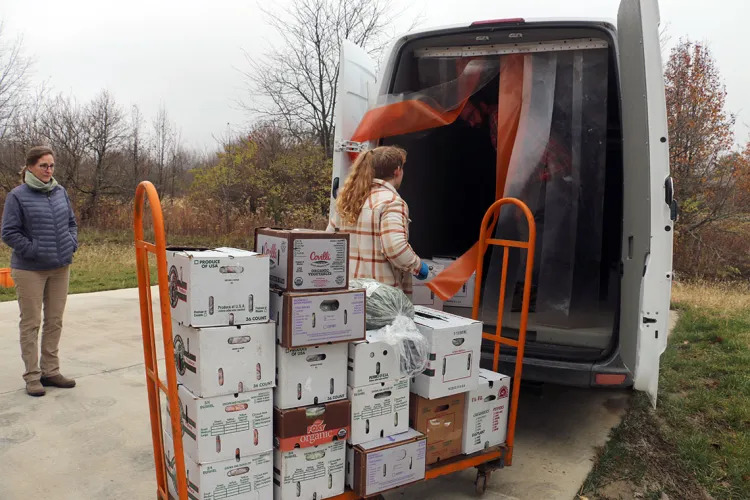
Illinois food producers and businesses can apply for a share of $3.6 million in funding to support local food systems.
Read MoreMoore: How ‘Strattmentum’ upended Krishnamoorthi’s once-seemingly inevitable Senate path
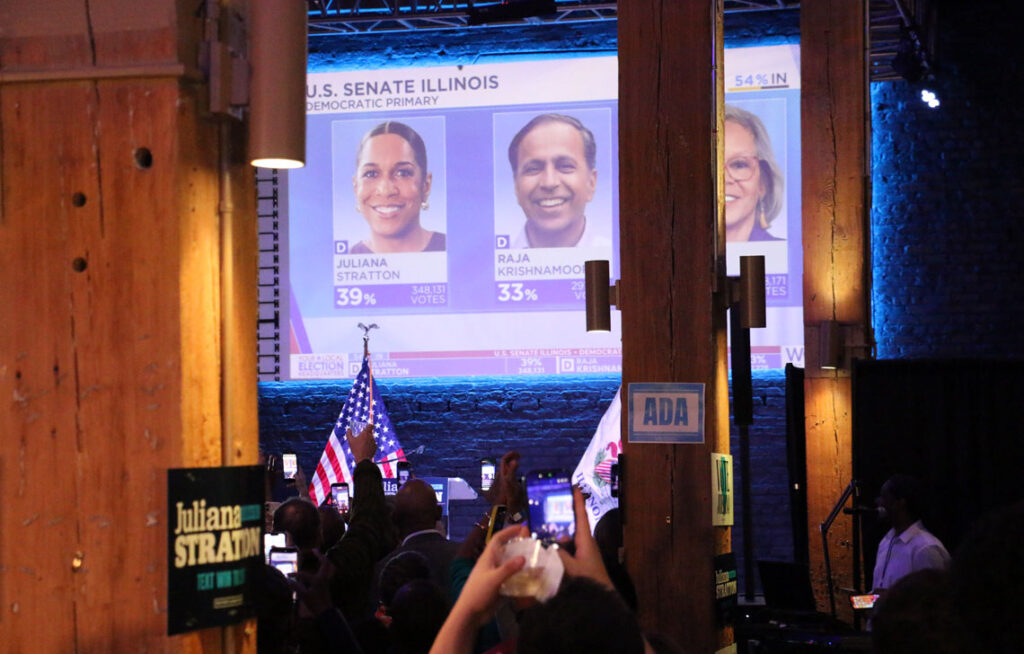
Everyone has a take on the impact the flood of money had on the Democratic U.S. Senate primary. Brenden Moore’s? Money was obviously a factor. The leading candidates needed it to communicate with voters. But money isn’t worth anything without a winning message and an effective messenger to deliver it.
Read More