Posts by Newspaper Staff
Frankfort Approves $1.3 Million in Bills, Including Annual Insurance Payment
The Frankfort Village Board authorized over $1.3 million in payments at its meeting Monday, with nearly half of the total amount covering the village’s annual insurance premiums. Trustees unanimously approved the schedule of bills totaling $1,308,224.37. Trustee Adam Borrelli explained the composition of the substantial figure, highlighting the largest single expenditure. “About half of that…
Read MoreMeeting Briefs: Frankfort Village Board for June 2, 2025
Wendy’s Project Approved with Multiple Variances: The Village Board gave final approval for a new Wendy’s restaurant at U.S. Route 30 and Frankfort Square Road. The project required a major change to the Cappel Commons development plan and included 10 variances for items such as a larger trash enclosure, reduced setbacks, and extended drive-thru hours until…
Read MoreWhat’s next for U.S. Steel after $14B merger?

What’s next for U.S. Steel after its $14 billion merger?
It’s either the golden age or a clever mirage, depending on who gets asked. That’s because the final details, while still scant, don’t satisfy critics about the iconic Pittsburgh company’s new partnership with Japanese-owned Nippon Steel.
What is known is that on Friday, President Donald Trump took a victory lap in West Mifflin to celebrate the agreement, surrounded by mill workers, labor unions and state and congressional lawmakers. Calling it the most significant investment in the history of the American steel industry, the president said it will ensure “the best and strongest steel in America will forever be made in America and made in Pennsylvania.”
It’s also an about-face for the 47th commander-in-chief. When Nippon first approached U.S. Steel for an acquisition deal 18 months ago, Trump and then-President Joe Biden said the federal government should block it. Both wanted to keep the company domestically owned and operated, though the latter said unfair trading practices on the foreign market would hurt national security.
Biden eventually stopped the sale in the waning days of his administration. Six months later, at the pleading of state and congressional leaders worried about the economic and psychological fallout of losing U.S. Steel’s Pittsburgh headquarters, Trump said Nippon’s renewed promises took care of the workers most of all.
As part of its commitment, Nippon will invest $2.2 billion to increase steel production in southwestern Pennsylvania, including $200 million in a planned Advanced Technology Research and Development Center. Trump said another $7 billion is earmarked to modernize steel mills, expand ore mines, and build facilities in Indiana, Minnesota, Alabama, and Arkansas.
The bulk of expenditures would be made in the next 14 months, he said, and it will create and save over 100,000 American jobs, including 14,000 in Pennsylvania. As part of the deal, U.S. Steel will maintain all its current operating blast furnaces at full capacity for at least the next 10 years.
For critics of the deal, the timing of the investments is suspicious.
The United Steelworkers Union noted the scant details of the “partnership” sound the same as what was proposed in December 2023 in a deal the organization said would move jobs south to avoid collective bargaining. The 14-month timeline touted by the president aligns closely with the end of its current member contract, the union said.
“Throughout recent months, as the public conversation has turned to Nippon ‘investing’ in U.S. Steel or ‘partnering with’ U.S. Steel, Nippon has maintained consistently that it would only invest in U.S. Steel’s facilities if it owned the company outright,” the union said. “We’ve seen nothing in the reporting over the past few days suggesting that Nippon has walked back from this position.”
The union represents 850,000 workers across the country, including some from Nippon, of which 4,000 work in Pennsylvania, Alabama, Virginia and West Virginia.
“We also cannot confirm how much of the publicly claimed $14 billion in proposed investment would be directed to our union-represented plants, or how much of that sum would go toward genuinely new capital improvements as opposed to routine repair and maintenance,” the union’s statement said. “Further, Nippon has not disputed reports that suggest up to $4 billion of the $14 billion would be earmarked for greenfield operations — and our members already know that our plants are not “greenfields,” and generally that means non-union.”
The skepticism, however, was nowhere to be found on Friday in West Mifflin, where the crowd of steel workers cheered when Trump announced there would be no layoffs or outsourcing, and every worker would soon receive “a well-deserved $5,000 bonus.”
The president also emphasized how tariffs protect the American steel industry, stating he would be increasing steel tariffs from 25% to 50%, and that U.S. Steel will maintain control as an American company.
Praising their role in shaping the deal, Trump brought several local union leaders up to the podium.
Second-generation steel worker and president of USW Local 2227, Jack Maskil, said he researched and spoke with executives to get the answers they needed and then dug in.
“The chance for a significant investment was something I knew we couldn’t afford to lose,” he said. “It meant jobs in the valley for generations.”
The local’s vice president, Jason Zugai, is also a third-generation U.S. Steel employee. He said he knew there would be obstacles in standing up for the workers in the Mon Valley, and that they could have given up at any given point.
“But we are steel workers, and giving up just isn’t something we do,” he said.
U.S. Steel’s President and CEO David Burritt called it a new beginning, and said that with the right partner, the company are ready to build something better and bigger.
He took the opportunity to introduce Takahiro Mori, Nippon Steel’s executive vice president and vice chairman, explaining the two have forged a friendship over the past year and a half. “I’ve seen firsthand Mr. Mori respects U.S. Steel. He respects our legacy, and he respects our purpose.”
Takahiro Mori, executive vice president and vice chairman for Nippon, told the crowd the company will begin making the massive investments that will transform U.S. Steel on the world stage.
“You have placed your trust in us, and we will work hard in the years ahead to keep earning that trust,” he said.
Among the officials in attendance, and recognized by President Trump, were U.S. Treasury Secretary Scott Bessent; U.S. Secretary of Labor Lori Chavez-DeRemer; Republican U.S. Reps. Mike Kelly, Dan Meuser and Guy Reschenthaler; and Pennsylvania Senate President Pro Tempore Kim Ward, R-Greensburg.
“The Golden Age of America has only just begun, and together, we are going to make America great again, greater than ever before,” Trump said.
Attacker targets pro-Israel demonstration in Boulder, Colo.
Local and federal authorities are investigating what FBI Director Kash Patel said was a “targeted terror attack” in Boulder, Colo., Sunday in which multiple people were set on fire during an event hosted by a group that seeks the release of Israeli hostages held by the anti-Israel terrorist group Hamas.
The suspect in the attacks was arrested at the scene, authorities said. He was identified as Mohamed Sabry Soliman, 45. FBI Denver’s field office said he was heard yelling “Free Palestine.”
“The initial callers indicated that there was a man with a weapon and that people were being set on fire,” Boulder Police Chief Steve Redfearn said during a Sunday afternnoon news conference. There were at least six victims, all aged 67 or older.
Redfearn said authorities do not think there was a second attacker but he could not say definitively without further investigation.
Redfearn said the attack occurred during a pro-Israel demonstration on Pearl Street near the county courthouse but authorities were still investigating if it was antisemitic in nature.
Witnesses told police that the suspect threw Molotov-style cocktails.
Colorado Gov. Jared Polis called the attack a “heinous act of terror” in a post on X.
“I am closely monitoring the situation in Boulder, and my thoughts go out to the people who have been injured and impacted by this heinous act of terror,” Polis wrote. “Hate-filled acts of any kind are unacceptable. While details emerge, the state works with local and federal law enforcement to support this investigation.”
This is a developing story.
PHOTOS: Trump celebrates U.S. Steel merger in Pennsylvania
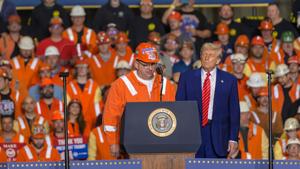
President Donald Trump visited West Mifflin, Pa. on May 30 to celebrate U.S. Steel’s merger with Nippon Steel.
Read MoreSenate’s transit funding, delivery tax proposal stalls in House
Capitol News Illinois
SPRINGFIELD – With public transit agencies in Chicagoland facing a fiscal cliff and the potential for thousands of layoffs, the state did not pass a bill that would have provided the agencies with potentially over $1 billion in new funding.
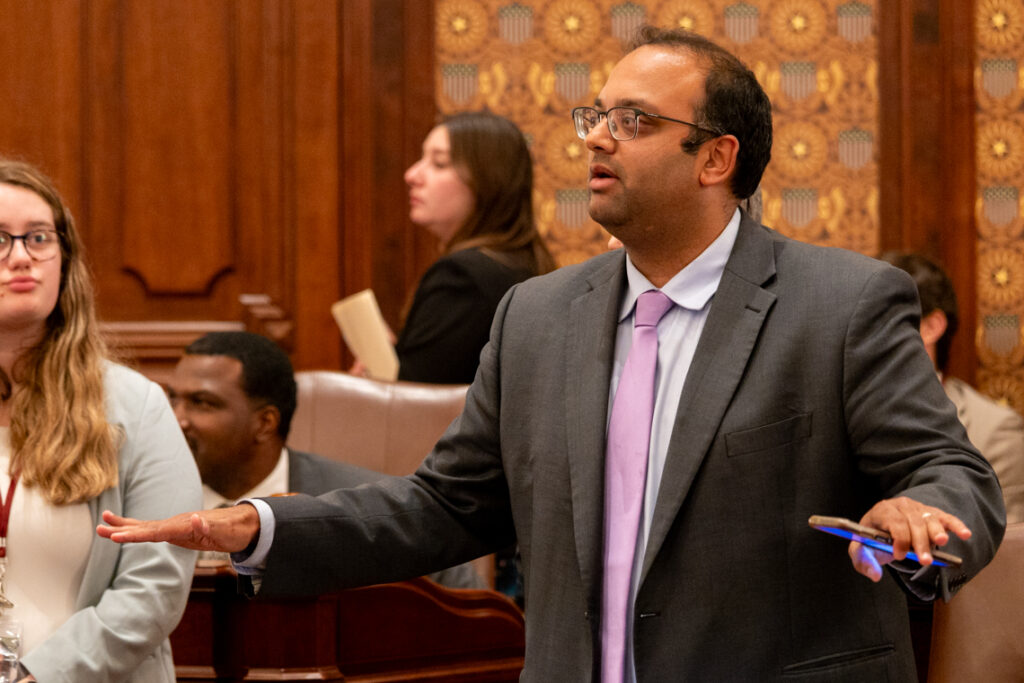
A version of the bill passed in the Senate, sponsored by Sen. Ram Villivalam, D-Chicago. But the House adjourned early Sunday morning without concurring as some of its tax hikes became too controversial. Now, the future of Chicagoland transit is in limbo as the bill awaits further action.
The Regional Transportation Authority — which oversees the Chicago Transit Authority, Metra commuter rail and Pace Suburban Bus — projects a $771 million annual operating budget shortfall.
At a hearing in the days leading up to adjournment, Amalgamated Transit Union political director Clem Balanoff told lawmakers that thousands of union bus drivers and train operators would be laid off if action wasn’t taken to fill the budget gap. RTA officials have estimated 40% service cuts are necessary to address the fiscal crisis.
Gov. JB Pritzker on Sunday said there is “significant work” left to address Chicagoland transit funding over the summer and into the fall.
“The fact is that we need to address transit funding as fast as possible,” Pritzker said.
The Senate’s proposal to do so included statewide taxes on deliveries and electric vehicle charging, as well as expanding taxes on rideshares and expanded certain Chicago taxes to the rest of Cook County and surrounding counties.
RTA and its subsidiary transit agencies will create their budgets for the upcoming fiscal year in the coming weeks. According to RTA spokesperson Tina Fassett Smith in a statement, those budgets “by law must only include funding we are confident the system will receive in 2026.”
“We think there’s probably a billion dollars for mass transit in there,” RTA Board Chairman Kirk Dillard said shortly after the Senate passed its transit bill late Saturday night.
Now, Dillard and other transit officials are going to work to minimize or avoid cuts.
“It’s clear that many in both the House and Senate support transit and our intention is to build on that shared support to identify the funding needed to avoid devastating cuts and disruption for everyone in Northeast Illinois,” Smith said in a statement.
The senate’s solution
House Bill 3438, the proposal approved by the Senate, would bail out transit authorities and send some funding outside northern Illinois. The reform package includes multiple tax increases. It’s unclear if any of these increases could come up again in future attempts to reform transit, although the House could pass it at a special legislative session or at a a future regular session.
The most controversial tax increase was a $1.50 fee added to any home delivery order placed online, with exceptions for some small businesses as well as orders containing only groceries and medication. Of the funds raised from this statewide tax, 80% would go to northern Illinois transit systems under a renamed RTA and 20% would be put into a fund for downstate transit agencies.
The bill would have also instituted a tax on real estate transfers in Cook County and the counties surrounding it. That tax is similar to one already in place in Chicago. It would have also required a charge on taxi and rideshare services in that region and a statewide 3 cents-per-kilowatt hour fee for charging electric vehicles.
“All told, we have achieved with the Senate package, a $1.5 billion investment for the northeast Illinois region,” Villivalam said. “And we have received more than double what downstate transit agencies requested for a historic investment.”
Over the two years that lawmakers have worked with the RTA on this transit funding issue, Democratic lawmakers have consistently repeated their mantra: there would be no funding without reform. To that end, they sought to institute sweeping reforms to the RTA.
Read more: Lawmakers offer 2 incomplete pitches for public transit and funding reform
The bill would rename the RTA to the Northern Illinois Transit Authority. The agency would have ultimate control over fares as well as a restructured board that places more power in the hands of the state.
While the bill will not become law soon, similar governance reforms were proposed by House lawmakers, who indicated there was agreement between the Senate and House on the reforms likely to be included in any deal.
Even still, those reform proposals drew fierce criticism from some suburban lawmakers
“This has become a bailout for Chicago CTA,” Sen. Seth Lewis, R- Bartlett, said. “We’re giving the mayor more control. We’re giving him more than a billion dollars in revenue.”
The board, under the Senate bill passed Saturday, would have five members appointed by the governor, five appointed by the president of the Cook County Board, five from the mayor of Chicago and one each from the collar counties.
Capitol News Illinois is a nonprofit, nonpartisan news service that distributes state government coverage to hundreds of news outlets statewide. It is funded primarily by the Illinois Press Foundation and the Robert R. McCormick Foundation.
The post Senate’s transit funding, delivery tax proposal stalls in House appeared first on Capitol News Illinois.
Unpacking the baseline battle: Trump’s ‘big, beautiful bill’ and the national debt
Top U.S. Senate Republicans are eyeing a controversial accounting method to theoretically slash the multi trillion-dollar price tag of President Donald Trump’s “big, beautiful bill.”
However, tax policy experts remain strongly divided over whether the tactic would constitute legitimate policy or a recipe for fiscal disaster.
The current version of the budget reconciliation package, entitled the One Big Beautiful Bill Act, passed the U.S. House on a razor-thin margin. The bill would give a 10-year extension to key portions of the expiring 2017 Tax Cuts and Jobs Act, raise the debt ceiling by $4 trillion, and fulfill Trump’s energy, border security and defense agenda.
Using the traditional current law baseline, House leaders calculated that the tax cut extensions would lead to an estimated $4.3 trillion in lost revenue over the next decade.
To help offset the cost, House committees included more than $1.7 trillion in savings in the package. They assumed that economic growth from the tax cut extension would cover the rest, though the Committee for a Responsible Federal Budget estimates the bill would still add at least $3.1 trillion to the national debt by 2034.
But Senate leaders want to make the tax cuts permanent, which, under the traditional current law baseline understanding, would increase the federal debt and deficit.
As a result, lawmakers are planning to use the current policy baseline to score their portion of the bill instead, which would treat the tax cut extension as a continuation of current law rather than new policy, theoretically zeroing out the cost.
In a recent statement, CRFB President Maya MacGuineas called the plan “nothing short of a fiscal failure.”
“The problem with the use of a current policy baseline in this bill is that they are using it to extend provisions originally scored under current law back in 2017 to bring down their score,” MacGuineas said. “This two-step would allow policymakers to avoid ever acknowledging the deficit impact of the TCJA for 2026 and beyond.”
The unprecedented move would not only pave the way for tax cut permanence but also allow the Senate to tack on an additional $1.5 trillion in spending to the bill for other wishlist items.
The White House fully endorsed the method Thursday, with White House Deputy Chief of Staff Stephen Miller calling the dire estimates from the Congressional Budget Office and others a “ludicrous theory” in multiple social media posts.
“Private money yet to be earned does not ‘belong’ to the government,” Miller said. “CBO says maintaining *current* rates adds to the deficit, but by definition leaving these income tax rates unchanged cannot add one penny to the deficit.”
Multiple Republicans in both the House and Senate have pledged to oppose a final bill that operates under current policy baseline or lacks additional spending cuts. Under the budget reconciliation process, Senate Majority Leader John Thune, R-S.D., needs only a majority vote for the One Big Beautiful Bill Act to pass.
Amid uncertainty in Washington, Illinois lawmakers pass slimmed-down Medicaid package
Capitol News Illinois
SPRINGFIELD — Nearly every year, Illinois lawmakers pass a package of measures dealing with the state’s Medicaid program, the joint federal and state health care program that covers low-income individuals.
Known as the Medicaid omnibus bill, it sometimes includes bold components, like a 2021 initiative that made millions of dollars available to local communities to help them plan and design their own health care delivery systems. Other packages have focused on smaller changes like guaranteeing coverage for specific conditions and medications or adjusting reimbursement rates for different categories of health care providers.
And moThe Illinois General Assembly passed a scaled-back Medicaid package on the last day of the session Saturday.st years, the packages receive bipartisan support because they are negotiated, largely behind closed doors, by an unofficial, bipartisan Medicaid Working Group.
This year, however, lawmakers passed one of the narrowest packages in recent memory, due mainly to the Trump administration’s vows to make sweeping cuts in federal funding for the program while state lawmakers faced their own set of budget constraints.
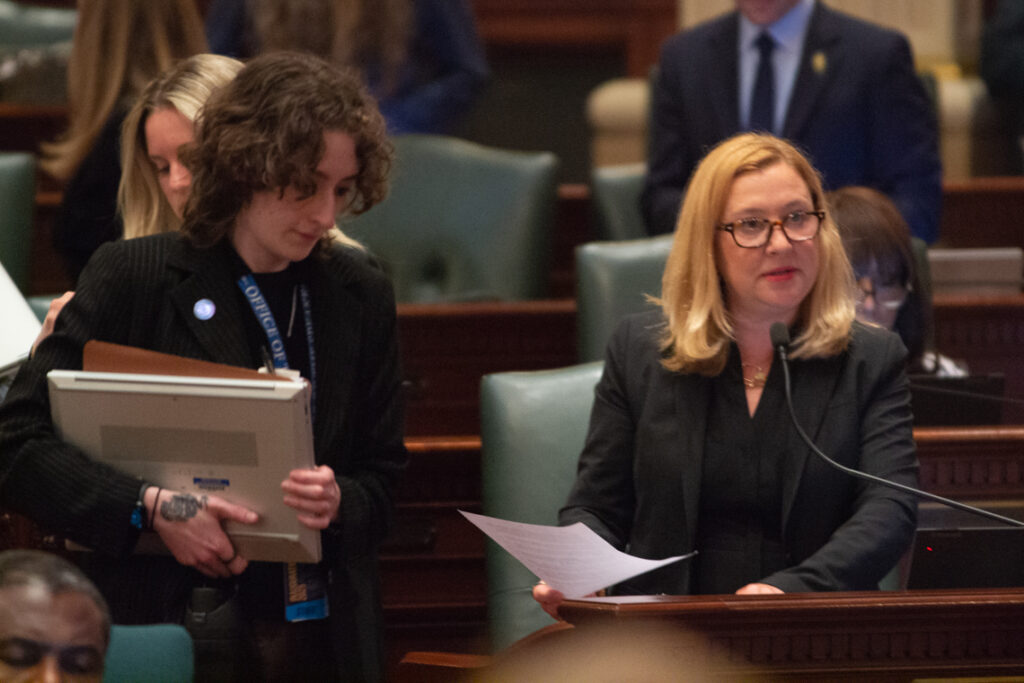
“There were many, many, very worthy program expansions, rate increases that we considered during this process that we were unable to include because of the uncertainty in Washington,” Rep. Anna Moeller, D-Elgin, the current chair of the Medicaid Working Group, said on the House floor Saturday.
The Illinois Medicaid program currently costs about $33.7 billion a year, according to the Department of Healthcare and Family Services. Of that, $20.9 billion, or about 62%, comes from the federal government while much of the state’s share comes from taxes levied on hospitals, nursing homes and managed care organizations – money the state uses to draw down federal matching funds.
The program covers nearly 3.5 million people in Illinois, or about a quarter of the state’s population. According to the nonpartisan health policy think tank KFF, the program pays for 40% of all child births in Illinois while covering 69% of all nursing home residents.
This year’s Medicaid omnibus bill, a 231-page amendment inserted into Senate Bill 2437, contains items that could be hugely beneficial to many Medicaid enrollees, but which don’t carry large price tags. In fact, the entire package is estimated to cost just under $1 million.
One of this year’s additions would make it easier for family members of medically fragile children who qualify for in-home nursing care to receive training to become certified family health aides, a designation that would enable them to administer medications, help with feeding and perform many of the same tasks as a certified nursing assistant.
Another provision would require all hospitals with licensed obstetric beds and birthing centers to adopt written policies that permit patients to have an Illinois Medicaid certified doula of their choosing to accompany them and provide support before, during and after labor and delivery.
Although those provisions enjoyed bipartisan support, another provision that extends coverage to certain categories of noncitizens drew Republican opposition Saturday, resulting in a partisan roll call vote.
The program covers noncitizens who meet the income requirements for Medicaid and have pending applications for asylum in the United States or for special visas as victims of trafficking, torture or other serious crimes. Those individuals can receive coverage for up to 24 months, provided they continue to meet the eligibility requirements.
Moeller said the language was not a new extension of health care benefits to noncitizens, but instead a “technical and administrative fix” to an existing program that had been requested by the Department of Healthcare and Family Services.
But for Republicans, the programs sounded too similar to the more controversial programs, Health Benefits for Immigrant Seniors and Health Benefits for Immigrant Adults, that extend health care to a large category of people who are not U.S. citizens, including some who are in the country illegally.
“For us on this side of the aisle, that is the poison pill,” said Rep. Noreen Hammond, R-Macomb, the deputy House minority leader. “So in spite of the fact that we have article after article in here, that is very worthy of a yes vote, I would urge a no vote.”
At Gov. JB Pritzker’s request, the budget bill lawmakers passed Saturday night cancels the program for immigrant adults, which had covered about 31,000 noncitizens age 42-64. But it provides $110 million over the next year, all in state funds, for the immigrant seniors program, which covers about 8,900 noncitizens age 65 and over.
The Medicaid bill passed the House late Saturday night, 76-39. It then passed the Senate shortly after midnight, 36-19.
It next goes to Pritzker’s desk for his consideration.
Capitol News Illinois is a nonprofit, nonpartisan news service that distributes state government coverage to hundreds of news outlets statewide. It is funded primarily by the Illinois Press Foundation and the Robert R. McCormick Foundation.
The post Amid uncertainty in Washington, Illinois lawmakers pass slimmed-down Medicaid package appeared first on Capitol News Illinois.
New taxes on sports bets, nicotine products as Democrats pass $55.2B budget
Capitol News Illinois
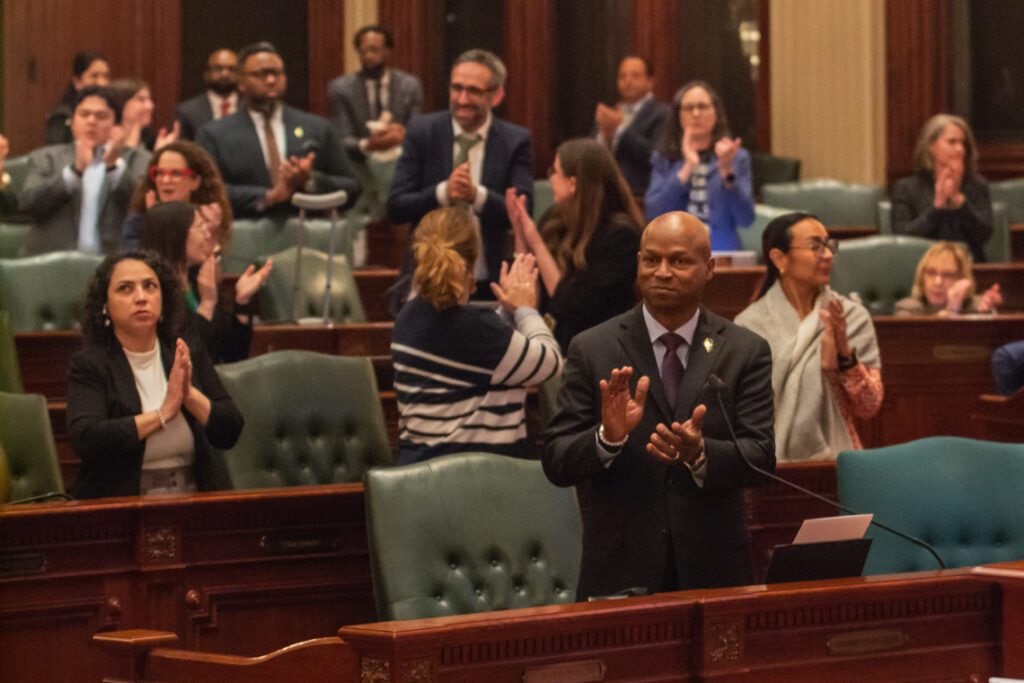
SPRINGFIELD – Giving almost no time for public review, Illinois Democrats pushed through a $55.2 billion budget for next fiscal year late Saturday, bolstering coffers with new taxes on sports bets, nicotine products and businesses.
The $55.2 billion spending plan is supported by $55.3 billion of revenue, including just over $1 billion in new taxes and revenue changes.
The four bills making up the budget and capital spending plan, were part of a flurry of thousands of pages of legislation that went from introduction to passage in the final 48 hours of the legislative session.
The budget marked a roughly 3.9% spending increase from the current year, while Republicans criticized it for containing few cuts. It raises about $500 million more in new revenue than what Gov. JB Pritzker proposed in February to make up for declining base revenues.
The minority party also aired frustration with supermajority Democrats for providing next to no time for public review of the massive spending plan and other major bills.
“We’re rushing this process like we always do. ‘Let’s hide this stuff. Let’s hide it so that the public doesn’t see it until it’s too late,’” Rep. John Cabello, R-Machesney Park, said.
Democrats said it was the best budget they could manage in a difficult year. To address potential uncertainties stemming from federal policy changes, they gave the governor authority over a new $100 million “emergency” fund. And they frequently lobbed criticisms at President Donald Trump and Republicans in Congress.
“I am very pleased to be able to present a balanced budget crafted to be fiscally and socially responsible, because we see the decisions made in Washington right now are neither,” House Majority Leader Robyn Gabel, D-Evanston said. “Erratic leadership in Washington has affected our economic outlook, our revenue projections, and even threatened federal funding for our most crucial services.”
The GOP also took issue with the tax increases, although the measure did not raise or create new sales, income or service taxes.
Instead, the measures expand state taxes on foreign and out-of-state income for businesses, raise tax rates on tobacco, vapes and sports gambling, and sweep fund balances from several lesser-known and utilized state funds.
The spending measure, Senate Bill 2510, passed the House 75-41 just before 10 p.m. The Senate followed around 11:30 p.m. with a 34-23 vote. The revenue and tax changes, House Bill 2755, and the budget implementation bill, House Bill 1075, both passed with relative ease before the constitution’s midnight deadline and only Democratic votes as well. Gov. JB Pritzker issued a statement saying he would sign it.
Another spate of tax increases included in a transit governance overhaul bill surfaced late but sputtered. The failed measure would have added a $1.50 fee on food and package deliveries and taxed electric vehicle charging statewide among other changes. Talks on that bill could resume later this year.
New taxes on vaping, gaming, deliveries
The revenue bill creates a tax of 25 cents per wager for a sports betting licensee’s first 20,000 wagers accepted, and 50 cents per wager after that.
Consumers will also see new taxes on tobacco products. The tax rate will rise to 45% from 36%. Vape products and nicotine pouches would also now be included under the tax.
The revenue plan amends state law to tax sales from all businesses that transact in the state, rather than only businesses with a physical presence in Illinois. The plan also eliminates a “safe harbor” exemption for businesses that move money outside the state.
Businesses that move profits to other countries would also be subject to the state’s corporate income tax. The federal government currently taxes half of income moved offshore and Illinois would tax the other half under the revenue plan.
Businesses outside Illinois that sell $100,000 or more to people in the state must also collect Illinois sales taxes even if the business doesn’t have a physical location in Illinois. This would apply to businesses like Amazon.
“I will not support this betrayal of hard-working Illinoisans,” Sen. Don DeWitte, R-St. Charles, said. “And if you care about the people who sent you here, if you truly represent them, you’ll vote no too. Enough is enough. It’s time for this body to stand with taxpayers, not stand up against them.”
Another source of new revenue is a delinquent tax payment incentive program designed to help the state recuperate overdue tax payments. It will generate $228 million, Rep. Will Guzzardi, D-Chicago, said.
The state would also pause the final transfer of motor fuel sales tax revenue to the road fund in order to free up $171 million, according to the governor’s office’s estimate.
A separate bill designed to lower prescription drug prices calls for levying a fee on pharmacy benefit managers based on the number of patients they insure. Money from that fee would go into a fund for the Department of Commerce and Economic Opportunity to award up to $25 million a year in grants to independent pharmacies and pharmacies located in rural counties. The remaining money would go to the state’s general revenue fund.
The measure also extends the state’s Hotel Operators’ Occupation Tax to short-term rentals like Airbnb and Vrbo.
Immigrant health cuts
A controversial program that provides health insurance to more than 30,000 noncitizens between ages 42 and 64 will be cut in FY26. The program’s elimination saves the state $330 million, but a $110 million program for seniors will remain in place.
Together, the two programs have cost the state at least $1.6 billion, according to an audit released in February, far exceeding budgeted costs for the program.
“We had to make some tough decisions here. That program grew at greater rates, financially, than we thought it would, and we had to make some hard decisions,” Gabel said.
Federally Qualified Health Centers are set to receive $40 million in the budget. The centers provide health services to low-income and uninsured people. Democrats touted that increase to provide care for immigrants who would have qualified for the health care program.
Illinois still risks losing some Medicaid funding under a proposal in Congress that threatens to slash reimbursements for states that provide health insurance to people illegally in the United States. But Gabel noted it’s possible those reductions won’t take place until 2027.
The budget also increases funding for safety-net hospitals with federal Medicaid funding cuts possible.
Education spending
The state’s evidence-based funding model for K-12 schools calls for $350 million in additional funding each year, with a portion of that going to a property tax relief fund and the rest directly to schools. The proposed budget fully funds the K-12 education portion at $307 million but does not add $43 million in property tax relief funds, according to Democratic leaders.
Funding for the Illinois Community College Board would also decrease by $24 million, mostly because lawmakers reduced spending on a workforce development grant that Democrat leaders said was not being fully utilized.
Funding for state universities would only increase by 1%. Pritzker proposed a 3% increase for higher education even as most other areas of his budget would’ve increased by 1%. Senate Democrats’ budget leader Sen. Elgie Sims, D-Chicago, said the budget allows for an additional 2% increase in FY26 if the federal government eliminates substantial funding.
Pensions
Despite more than a year of discussions, Illinois lawmakers did not tackle pension reform this spring. Illinois’ Tier 2 pension system is likely out of compliance with Social Security’s “safe harbor” law that requires pension benefits to be at least equal to Social Security.
Part of the budget package created a new Tier 2 reserve fund that can be accessed if there are violations of the “safe harbor” law. Lawmakers appropriated $75 million for the fund this year, in line with Pritzker’s proposal.
‘Emergency’ fund, raises, more
Notably not in this year’s budget is an increase to the “rainy day” fund. Pritzker has taken pride in the fund’s increases in recent years, as it’s grown to a balance of $2.3 billion, up from less than $60,000 when Pritzker took office. The FY26 budget would suspend the monthly transfer for one year, freeing up $45 million for general fund use.
The budget package also establishes a new $100 million fund that the governor can tap into “in the event of unanticipated delays in or failures of revenues.” The measure, an apparent nod to the uncertainty of federal funding amid ongoing congressional budget negotiations, will come from money swept from other funds.
“That will allow us to respond to actions by the federal government and challenges that present themselves and costs that have been diverted from the federal government to the state government,” Sims said in a committee hearing.
The attorney general’s office would get $116 million from the general fund. Attorney General Kwame Raoul asked lawmakers to boost funding for his office as he engages in a growing number of lawsuits against the Trump administration. Raoul was hoping to receive $120 million in funding.
Direct service providers are in line for an 80-cent per hour wage increase, but Republicans said calling it a funding increase is “sleight of hand,” because the measure would also reduce work hours for DSPs by the hundreds of thousands. That makes the increase negligible, Sen. Chapin Rose, R-Mahomet, said in committee.
“It’s not a great budget, but it is a good budget and it is the budget we need for this very difficult moment,” Rep. Lindsey LaPointe, D-Chicago, said.
Lawmakers will see their salaries rise as part of the budget, going to a $98,304 base salary from roughly $92,000. That’s an annualized rate of increase that is set by law.
“You raised our pay, you gave yourselves hundreds of millions of dollars of our taxpayers funds to spend on your pet projects,” Rep. Amy Elik, R-Godfrey, said. “So I simply don’t believe you anymore that you ever intended to be fiscally careful.”
No Bears stadium funding
Lawmakers did not appropriate funding for the Chicago Bears to build a new stadium. But NASCAR would be the recipient of a $5 million grant ahead of the sport’s third downtown Chicago race in July, and the PGA Tour would receive a $1 million grant as part of hosting the 2026 President’s Cup in DuPage County. Those were two economic development measures criticized by Republicans during the Senate committee hearing.
The budget also contains $200 million to prepare unused state properties to be repurposed for development, Sims said. Lawmakers removed another $300 million that Pritzker had sought in spending aimed at offloading surplus property.
Gabel said the state’s employee management department has negotiated more than $100 million in health care cost savings as well.
Any remaining federal pandemic relief funding would also be sent to recipients that have not received payments in previous years before the funding expires in 2026.
Jade Aubrey contributed.
Capitol News Illinois is a nonprofit, nonpartisan news service that distributes state government coverage to hundreds of news outlets statewide. It is funded primarily by the Illinois Press Foundation and the Robert R. McCormick Foundation.
The post New taxes on sports bets, nicotine products as Democrats pass $55.2B budget appeared first on Capitol News Illinois.
In just a few months, ICE makes 1,000+ worksite enforcement actions

In just a few months, U.S. Immigration and Customs Enforcement agents have arrested more than 1,000 “illegal alien workers without employment authorization.”
It’s “the highest rate of arrest in HSI’s history,” HSI acting Executive Associate Director Robert Hammer said in April. “We’ve subpoenaed the business records of about 1,200 businesses, and as part of our review, we’ve proposed close to $1 million in fines.”
Fast forward into the end of May and hundreds more have been arrested through targeted worksite multiagency enforcement actions nationwide, with more than $8 million in fines levied in Denver alone.
On May 29, more than 100 citizens of Colombia, El Salvador, Honduras, Guatemala, Mexico, Nicaragua and Venezuela were arrested at construction sites in Tallahassee. One was “taken into state custody for resisting arrest and is being charged with four counts of assault on law enforcement officers. Another attempted to pull a weapon on officers,” ICE said.
In Tampa, 33 citizens of Guatemala, Honduras and Mexico were arrested at construction sites “in one of the fastest growing communities in the nation located 20 miles south of Ocala,” ICE said. Four were charged with felony reentry; more than 30 “could be seen fleeing from the construction sites,” ICE said.
In Atlanta, ICE agents found two unaccompanied minors (UACs) and five adults from Guatemala and Mexico during a worksite enforcement operation at a subdivision in Theodore. One of the adults was previously twice deported.
The minors illegally entered the U.S. in 2023, were apprehended by Border Patrol agents and transferred into the custody of U.S. Department of Health and Human Services’ Office of Refugee Resettlement. ORR has a long history of documented abuse of minors within facilities it manages, paid for by taxpayers. Allegations and criminal charges include sex abuse, trafficking and forced labor, The Center Square has reported.
This case was no different. ICE agents learned that “neither UAC was enrolled in school nor had any relatives in the area.” The children were sent back to ORR, ICE said.
In Denver, three businesses received more than $8 million in fines after ICE worksite audits “uncovered widespread employment eligibility violations.” CCS Denver, Inc. was fined $6.18 million “after a 100% substantive violation rate and evidence of knowingly hiring and employing at least 87 unauthorized workers.” PBC Commercial Cleaning Systems, Inc., was fined nearly $1.6 million “for a 74% violation rate and a pattern of knowingly employing at least 12 unauthorized workers;” Green Management Denver was fined $270,195 “after a 100% violation rate and identification of 44 unauthorized employees.”
In Detroit, ICE filed a civil complaint against a Chinese money laundering organization and seized 14 properties, seven bank accounts and 15 vehicles worth millions of dollars. It was charged with operating “a staffing company to supply illegal workers to a factory in Ohio and harbored that illegal workforce.”
In Louisiana, 15 citizens of El Salvador, Guatemala, Honduras and Nicaragua were arrested at construction sites in the New Orleans area. In another operation, 11 citizens of Ecuador, Mexico and Nicaragua were arrested as part of an investigation “into the illegal hiring of unauthorized employees by commercial and industrial general contractors currently engaged in a construction project within the Port of Lake Charles.”
In Lowell, Mass., ICE agents arrested 11 Ecuadorians working for a roofing business; in Philadelphia they arrested four Brazilian nationals at a meat market; at the Port of New York/New Jersey, they arrested 16 illegal foreign nationals.
In Laredo, Texas, ICE agents arrested 31 citizens of El Salvador, Honduras and Mexico at business and construction sites with prior convictions, including “aggravated criminal sexual assault, bodily harm, possession of a controlled substance, evading arrest, transporting noncitizens, domestic violence/strangulation, terroristic threats,” weapons charges and others.
“Businesses that exploit and hire illegal workers are harming the American public,” Hammer said. “ICE’s statutory duties include protecting Americans and enforcing more than 400 laws that relate to immigration, so there are two aspects to our worksite enforcement operations.”
Investigators conduct I-9 inspections and audits in accordance with federal law, which requires employers to verify the identity and employment eligibility of everyone they hire using the Employment Eligibility Verification Form I-9. “These inspections are among the federal government’s most effective tools to enforce U.S. employment laws,” ICE says.
ICE imposes civil fines, makes criminal referrals, makes criminal arrests of employers and administrative arrests of unauthorized workers after uncovering “multiple forms of criminal activity,” including human trafficking, document fraud, and human rights abuses, including forced labor.
In fiscal 2024, the Department of Labor investigated 736 cases of child labor violations impacting more than 4,000 children. It fined employers more than $15 million, an 89% increase from the previous year.