Archive for December 7, 2025
After Kirk assasination, students less comfortable with ‘controversial’ events on campus

Following the assassination of Charlie Kirk, half of the nation’s college students report feeling less comfortable attending controversial public events on campus and nearly half are less comfortable voicing opinions on controversial subjects in class.
Chief Research Advisor Dr. Sean Stevens at the Foundation for Individual Rights and Expression told The Center Square that Charlie Kirk’s September assassination at Utah Valley University “has had a chilling effect — not just at UVU, but across the country.”
The Foundation for Individual Rights and Expression (FIRE) surveyed 2,028 undergraduates nationwide – including an “oversample” of 204 students from Utah Valley University – in order to “understand how the assassination is shaping student attitudes and behavior.”
Stevens told The Center Square that “some of the data from Utah Valley University students are encouraging – revealing signs of increased tolerance, and even relative trust in administrative protections for free speech.”
However, Stevens also said that the assassination of Kirk “appears to have deepened existing ideological fractures between liberals and conservatives on campus.”
A press release on the survey showed that following the assassination, “moderate and conservative students across the country became significantly less likely to say that shouting down a speaker, blocking entry to an event, or using violence to stop a campus speech are acceptable actions.”
“In contrast, liberal students’ support for these tactics held steady, or even increased slightly,” the release said.
Additionally, according to the survey, half of the participating students reported they are “less comfortable attending or hosting controversial public events on their campus.”
Forty-five percent of students surveyed are “less comfortable expressing their views on controversial topics in class,” with one in five students saying that “they are now less comfortable attending class” – all following the killing of Kirk.
Stevens told The Center Square that “the worst thing colleges and universities could take away from Charlie Kirk’s assassination is that open debate and controversy are too dangerous.”
“Instead, schools need to stop using ‘safety’ as a pretext for censorship, apply the same free-speech rules to everyone, and protect the speech rights of students, faculty, staff, and speakers better,” Stevens said.
Stevens outlined three ways in which schools can begin to accomplish this free speech initiative.
For one, schools can begin “emphasizing that violence and true threats are unacceptable no matter who the speaker is,” Stevens said.
Additionally, Stevens said schools can make “their policies viewpoint neutral so that the same procedures are applied regardless of the speaker’s ideological views.”
Furthermore, schools can begin “defending speech about the assassination regardless of how offensive or loathsome it may be, provided the speech is protected by the First Amendment,” Stevens said.
Everyday Economics: The case for a December rate cut
Last week brought the delayed September numbers on personal income, consumption, and the Fed’s preferred inflation gauge, the Personal Consumption Expenditures (PCE) price index. It’s backward-looking, but it’s the last clean read on inflation before the Fed meets in December.
Headline PCE prices were up 2.8% year over year in September, a touch higher than August’s 2.7%. Core PCE, which strips out food and energy, also rose 2.8% from a year earlier, down slightly from 2.9% in August. Goods prices moved higher as tariffs filtered through, while services inflation ticked down: prices for goods were up 1.4% from a year earlier in September (vs. 0.9% in August), while services inflation eased to 3.4% from 3.6%.So far, that’s a far cry from the worst-case fears that tariffs would send prices sharply higher. The September report instead shows a modest re-acceleration in goods prices layered on top of a slow, grinding disinflation in services.On the spending side, the consumer is cooling, not collapsing. Current-dollar personal consumption expenditures rose 0.3% in September, with services spending up 0.4% and goods spending roughly flat; after adjusting for inflation, real spending was essentially unchanged on the month. On a year-over-year basis, nominal PCE growth has downshifted from the mid-6% range late last year toward the mid-4% range in recent months – still positive, but clearly slower than the post-pandemic surge.High-income households, cushioned by strong balance sheets and stock-market gains, are still spending freely on services like travel, healthcare and dining out. Middle- and lower-income households are increasingly price-sensitive and pulling back on discretionary goods, a pattern echoed in recent private-sector card and bank data.That mix explains why the impact of tariffs on inflation has been muted so far. We’re seeing more of a squeeze on profit margins than a broad second wave of price hikes: businesses are absorbing part of the higher import costs rather than fully passing them on to customers. At the same time, high household wealth has helped prevent an outright collapse in demand. The result is a gradual downshift in spending growth, not a sudden stop.Why it matters for the Fed this weekFor the Fed, the September data confirm that the balance of risks has shifted. Inflation is still above the 2% target but looks relatively contained and is no longer clearly accelerating. The 12-month PCE inflation rate has edged up only gradually – from around 2.6% in early summer to 2.8% in September – while core PCE is effectively moving sideways in the high-2s.By contrast, labor-market risks are mounting. Recent official and private-sector indicators point to softer hiring, slower wage growth, and more caution from employers even as layoffs remain low – a late-cycle pattern of labor hoarding rather than aggressive expansion. That combination – a cooling, K-shaped consumer and a labor market that’s losing momentum – argues that the greater danger now is keeping policy too tight for too long.This week’s main event is the FOMC interest rate decision. The September report suggests inflation may not re-accelerate meaningfully from here, especially with demand already sluggish in large swaths of the economy – housing among them. The bigger risk is that further cooling in the labor market lands hardest on households that haven’t benefited from the AI- and asset-driven wealth boom and are already pulling back on discretionary spending.The Fed is widely expected to cut again in December, though a follow-up move in January is far from guaranteed. November labor-market data – whenever they finally arrive – will be crucial in determining whether this is a one-and-done insurance cut or the start of a more extended easing cycle.
Joliet Unity Movement Criticizes Board’s Handling of Cannabis Tax Revenue
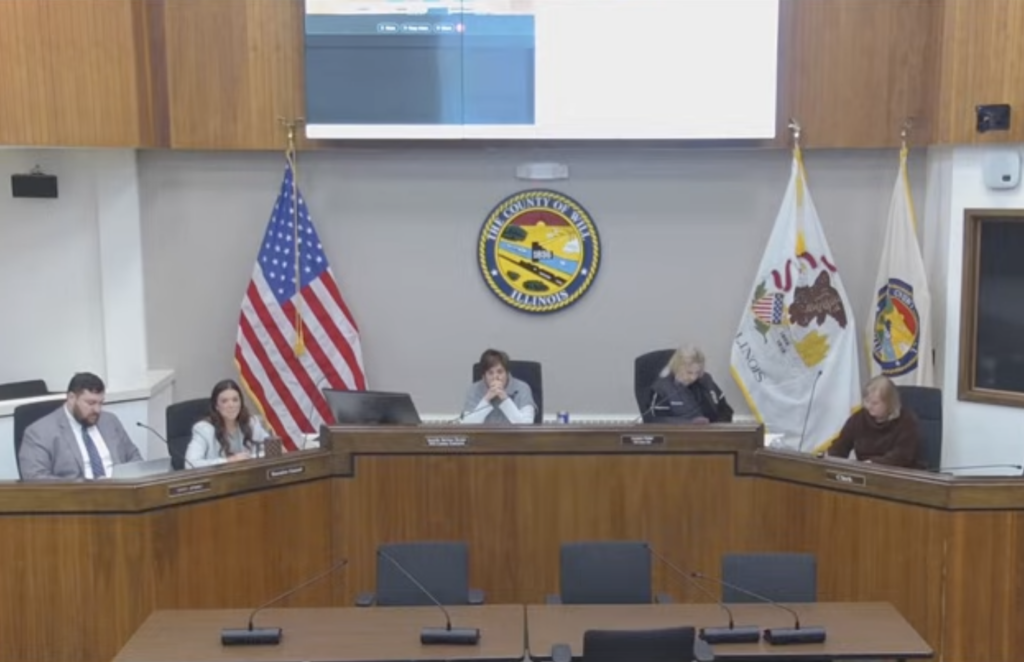
Will County Board Meeting | December 4, 2025 Article Summary: During public comment, the Joliet Unity Movement denounced a recent board vote that redirected cannabis tax revenue away from community reinvestment programs. Board Member Julie Berkowicz later echoed calls for greater transparency regarding how those funds are allocated. Cannabis Funding Dispute Key Points: Public Protest: Amy…
Read More