Posts Tagged ‘Westchester’
Who is contributing to Illinois’ U.S. Senate candidates?
Capitol News Illinois
Article Summary
U.S. Rep. Raja Krishnamoorthi raised the most money in the first quarter of fundraising for the 2026 Illinois Democratic primary for U.S. Senate and has already launched a TV ad.
Lt. Gov. Juliana Stratton received money from some of the most politically connected donors in state politics, from Gov. JB Pritzker to lobbyists and owners of Chicago sports teams.
U.S. Rep. Robin Kelly had the lowest fundraising total but has more than $2 million available.
Ten other candidates in both parties have also filed federal campaign committees but did not report substantial contributions.
This summary was written by the reporters and editors who worked on this story.
TV advertising has already begun in Illinois’ 2026 Democrat primary for U.S. Senate, and new fundraising numbers released Tuesday show the race is shaping up to be expensive.
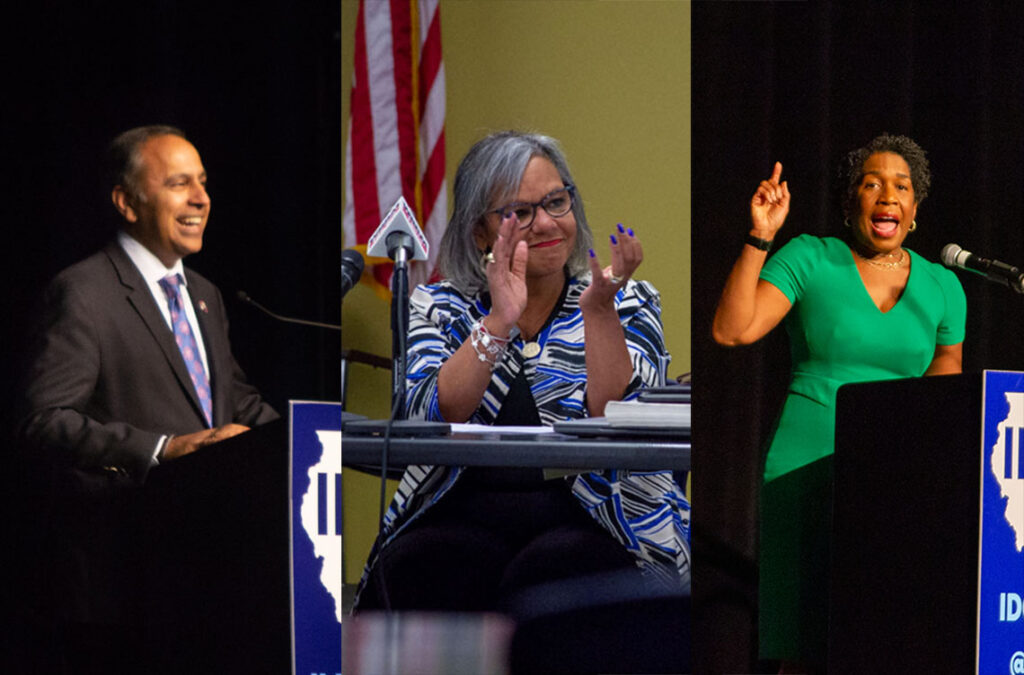
The quarterly reports submitted to the Federal Elections Commission shed light on how candidates are spending money as well as who is contributing to them. Donations are pouring in for U.S. Rep. Raja Krishnamoorthi, U.S. Rep. Robin Kelly and Lt. Gov. Juliana Stratton — the three most high-profile Democrats so far to launch their campaign.
Gov. JB Pritzker has already put his thumb on the scale of the race, endorsing Stratton a day after she launched her campaign in April. But the billionaire governor has a financial stake in the contest as well.
Pritzker contributed $3,500 to Stratton’s primary campaign, and another $3,500 earmarked for the general election. It’s the maximum amount allowed in an election cycle for an individual contribution under federal rules, meaning he can’t contribute anything close to the $300 million he’s dumped into his own campaigns for governor.
Pritzker can still find other avenues to financially support Stratton later, such as through a dark money political action committee he launched in 2023. And he wasn’t the only Pritzker to donate to Stratton. His wife, MK, his two adult children, and his cousins Adam, John, Gigi and Jennifer, all contributed the maximum $7,000. Jennifer Pritzker is a former supporter of President Donald Trump who has more recently supported Democratic candidates.
Kelly vs. Pritzker round 3
The race has also set a third battle between a Pritzker ally and Kelly.
Underlying the contest is Kelly’s past history as chair of the Democratic Party of Illinois. She was elected party chair in 2021 against Pritzker backed candidate and Chicago Ald. Michelle Harris to replace Mike Madigan who bowed out of the job after losing the speakership that year. But the following year, Kelly ended her bid for reelection as party chair after it became clear she would not have enough support to beat State Rep. Lisa Hernandez, D-Cicero, for the leadership role. Hernandez was also backed by Pritzker.
Read more: Democratic Party chair bows out in re-election bid, paving way for state Rep. Lisa Hernandez
Kelly, of Matteson, argued a lot of people on the party’s state central committee “were sad to see me go.”
“The people in the party, they know me, they know the work that I’ve done,” Kelly told Capitol News Illinois last week. “Despite what happened, I’ve still been an effective leader. I’m the only one that’s been an effective leader on every level of government and has delivered on every level.”
Kelly says money isn’t going to decide the race.
“They have a lot of money, but you know what, I’m just using every opportunity to tell my story and I don’t feel like I need the most money in the race to win the race because I feel like I have an excellent story to tell,” Kelly said.
Between her two campaign committees for her U.S. House seat and a new committee for her Senate bid, Kelly raised $565,775 from April 1 through June 30 and has $2 million in her campaign accounts.
Her donors include a lengthy list of corporate political action committees, many local officials in her 2nd Congressional District, and some notable names in Illinois government. They include former state Sen. Jacqueline Collins, Chicago Fire Department Commissioner Annette Nance-Holt and Cook County Clerk Monica Gordon. Gordon also contributed to Stratton’s campaign.
Stratton’s contributions
Stratton’s cash balance of $666,416 is the smallest in the race, as it is her first time running for federal office and first time running for office alone since she was a state representative in 2016. She raised just over $1 million since launching her campaign in late April.
Stratton has pledged not to take any money from corporate political action committees, though Krishnamoorthi and Kelly have received such donations. She returned a contribution from the central Illinois energy company Marquis Energy’s PAC, although accepted contributions from several Marquis family members who hold top leadership positions at the company, according to FEC filings.
The rest of her list of donors is a “who’s who” of Illinois Democrats.
Stratton has touted many endorsements from members of the General Assembly in recent days and 12 have contributed to her campaign. The list also includes many Lake County Democrats, including State’s Attorney Eric Rinehart, Highland Park Mayor Nancy Rotering, and county party chair Lauren Beth Gash.
Stratton also received support from owners of most of the city’s sports teams: Cubs co-owner Laura Ricketts and her wife; White Sox and Bulls owner Jerry Reinsdorf, along with his son and Bulls President Michael Reinsdorf; and Blackhawks CEO Danny Wirtz.
Other donors come from all sectors of state politics, including Sen. Tammy Duckworth, former legislators, high-profile lobbyists and consultants, Pritzker’s top political advisor, business executives, and lawyers at Chicago’s top law firms.
Some donors also hold positions in state government, including Department of Human Rights Director Jim Bennett and the Department of Labor’s top attorney, Deborah Baker.
Stratton has also formed her own political action committee called “Level Up.” Fundraising numbers for the committee have not yet been released as political action committees follow a different reporting schedule than campaigns.
Krishnamoorthi continues strong fundraising
Krishnamoorthi, of Schaumburg, has been one of the most prolific fundraisers in Congress, reporting millions of dollars in contributions every quarter. His first months running for Senate were no different.
Krishnamoorthi raised just shy of $3 million between his House campaign account and new Senate campaign account. Candidates running for a new federal office are generally allowed to transfer funds from their old campaign to their new campaign. In total, Krishnamoorthi has $21 million on hand.
“I’m just blessed to have a lot of individual donors throughout Illinois and elsewhere who believe in my mission,” Krishnamoorthi told Capitol News Illinois.
The March 17, 2026, primary is still eight months away, but Krishnamoorthi launched the election cycle’s first TV ad on Tuesday, which cost $500,000 for the first week, according to his campaign. It’s airing in TV markets around the state and on digital platforms.
Open interactive chart in new tab
The 30-second segment serves as an introduction of Krishnamoorthi, who currently represents the 8th Congressional District in the northwest suburbs. It portrays him as a fighter against “bullies,” which is how he describes Trump.
“When I see underdogs hurt by a rigged system, I fight back … Bullies like Trump can call us names, but you can just call me Raja,” Krishnamoorthi says in the ad, playing off his “just call me Raja” slogan that has been a hallmark of his TV advertisements since he first ran for Congress in 2016.
Most of Krishnamoorthi’s fundraising came from individual donors and less than $200,000 was from political action committees. But unlike his opponents, he had very few donors who are involved in state politics. One of the most notable names contributing to his campaign was Vinai Thummalapally, a former ambassador to Belize.
Other candidates
Six Republicans have filed as candidates with the Federal Elections Commission but did not raise substantial amounts of money. They include Casey Chlebek, a former IT professional who is active in Polish-American civic groups; Douglas Bennett, who ran unsuccessfully in the 10th Congressional District in 2018; Air Force veteran John Goodman; Pamela Denise Long, an occupational therapist and former political commentator for Newsweek; former Illinois International Port District board member Cary Capparelli, and Westchester resident Panagioti Bartzis.
On the Democrat side, four other candidates have filed with the FEC: Kevin Ryan, a Marine veteran and diplomat; Christopher Swann, a program manager for Feeding America; Carmi resident Stan Leavell, and Awisi Bustos, CEO of the Illinois Alliance of Boys and Girls Clubs.
Bustos is daughter-in-law of former U.S. Rep. Cheri Bustos, who represented the 17th Congressional District for 10 years. Cheri Bustos is not supporting Awisi Bustos’ campaign amid an ongoing divorce case, the D.C. insider newsletter Punchbowl reported.
Capitol News Illinois is a nonprofit, nonpartisan news service that distributes state government coverage to hundreds of news outlets statewide. It is funded primarily by the Illinois Press Foundation and the Robert R. McCormick Foundation.
The post Who is contributing to Illinois’ U.S. Senate candidates? appeared first on Capitol News Illinois.
‘We think about the state in the same way’: Mitchell ready to back up Pritzker
Capitol News Illinois
Article Summary
JB Pritzker’s new running mate Christian Mitchell has held several roles in state government, including lawmaker and deputy governor.
Pritzker said he trusts Mitchell is ready to take over as governor if required and Mitchell said he shares Pritzker’s vision for Illinois.
Mitchell spearheaded some of Pritzker’s top legislative accomplishments during his first term.
Affordability will be a top issue for Pritzker’s campaign, Mitchell said.
Mitchell said he’s willing to consider ethics reform after holding a top leadership position in the Democratic Party of Illinois under former Chair Mike Madigan.
This summary was written by the reporters and editors who worked on this story.
At 38 years old, Christian Mitchell has been inside most corners of state government as a top advisor on political campaigns, state legislator, deputy governor and civic engagement leader at a major university.
All those experiences make him ready to be Gov. JB Pritzker’s running mate next year in the governor’s campaign for a third term, Mitchell said.
“Bringing somebody who will continue to do the work, who with the governor, will go everywhere in the state of Illinois, advocating for the state of Illinois — that’s the thing I think I bring to the ticket. And I think we think about the state the same way,” Mitchell said in an interview with Capitol News Illinois.
Mitchell, a Black Bronzeville resident who currently works as vice president of civic engagement for the University of Chicago, was raised by his single mom and his grandfather and attended the now-shuttered St. Joseph High School in Westchester. He got an undergraduate degree in public policy from the University of Chicago, and while serving in the General Assembly, earned his law degree at Loyola University.
Mitchell represented a South Side of Chicago district in the Illinois House from 2013 until 2019 when Pritzker selected him to be one of four deputy governors, which serve a chief of staff-like role in Pritzker’s administration overseeing specific state agencies and policy areas.
Related: Pritzker selects former Deputy Gov. Christian Mitchell as running mate
He also joined the Illinois Air National Guard in 2023 shortly after leaving the governor’s office.
“It’s certainly not great for my free time, but your time is the most precious thing you have and the ability to give my time in service of my state and my country is very important to me,” Mitchell said.
Why Pritzker picked Mitchell
Pritzker told reporters in the days after he launched his campaign he was looking for a running mate who shared the same affinity for Illinois and was qualified to step in as governor if required. He said he picked Mitchell more than a week before announcing his reelection in late June, but he declined to say how many people he considered.
“He is somebody that I have grown to trust,” Pritzker said at an event in Peoria. “I’ve seen him usher enormous legislation through the legislature. … He’s a guy who knows how to get big things done and I’ve worked with him to get it done and I’m excited for the people of Illinois to get to know him.”
Lieutenant governors in Illinois have virtually no constitutional authority, other than to replace a governor who is impeached, resigns or dies in office. Pritzker’s running mate selection has received more attention as the governor is believed to be considering running for president in 2028 and would resign as governor if victorious.
Mitchell said he’s running to be Pritzker’s right-hand man for four years, but said Pritzker would make a good candidate for president.
“Illinois is the state most representative of the nation and it’s really exciting to see a governor who is considered for president and not for prison,” Mitchell said, referring to the fact that two of Illinois’ last five governors and four of the last 11 have served time in prison.
“I think he would be excellent. Having said that, that’s why I’m so excited he’s running for reelection to continue the progress of the last seven years,” Mitchell added.
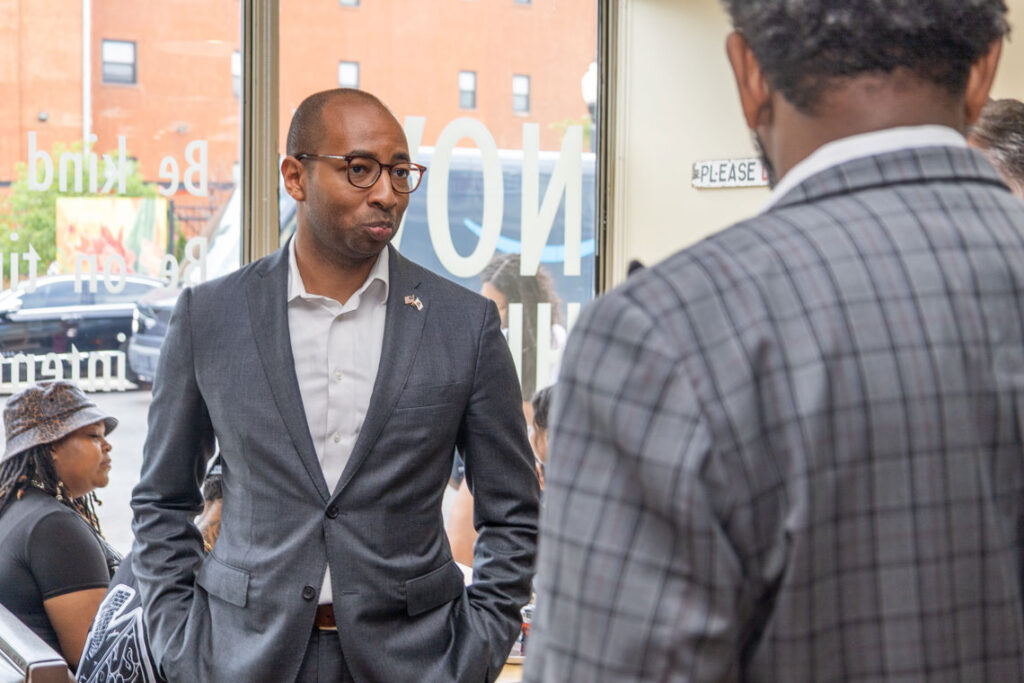
Christian Mitchell, Gov. JB Pritzker’s running mate, listens during a conversation at Peach’s Restaurant in Chicago’s Bronzeville neighborhood on July 2. (Capitol News Illinois photo by Andrew Adams)
Though Mitchell hails from Chicago, Pritzker said he believes Mitchell can appropriately address the needs of all areas of the state.
“When you’re a state representative, you don’t just represent the people of your district; you are also voting on things that are good for people all across the state,” Pritzker told reporters last week after greeting Chicagoans at a Bronzeville coffee shop with Mitchell.
Policy goals
As deputy governor, Mitchell led some of Pritzker’s hallmark initiatives through the General Assembly during his first term: a $45 billion infrastructure plan, legalization of cannabis for recreational use by adults, and a climate initiative setting clean energy goals for the state.
Mitchell has a reputation as a hard-nosed negotiator, even among fellow Democrats. Though he has sometimes angered political allies, Mitchell said he’s open to listening to anyone’s ideas.
“For me, it’s build the biggest tent that you possibly can, ask people for their ideas and be willing to listen to them and change your mind when something is different than you thought it was,” Mitchell said. “That’s how Gov. Pritzker has always led, that’s how he has always directed me when I was deputy governor, that’s what we’ll do as partners in state government going forward.”
Christian Mitchell, candidate for lieutenant governor, speaks to former Democratic U.S. Rep. Bobby Rush at Peach’s restaurant in Chicago’s Bronzeville neighborhood on July 2. (Capitol News Illinois photo by Andrew Adams)
Economic affordability is a top concern for Pritzker, who has preached in national media interviews that Democrats must champion policies addressing cost-of-living concerns for Americans. Mitchell said he shares those goals.
“People want to know that you understand what’s going on in their lives, that you’re working on your behalf every single day and when you do things that they can see on their paycheck, in their pocketbook, that is how you inspire confidence and that is something I think we can do as statewide elected officials,” Mitchell said.
He acknowledged price concerns are a macroeconomic issue outside the state’s total control, but Mitchell said state lawmakers can promote policies that lower costs within the state’s control. Reducing the education system’s reliance on property taxes could be a priority in a third Pritzker administration.
“The governor has put … hundreds of millions of new dollars into education every single year to help drive down that burden,” Mitchell said. “We do now need to work with our local governments to make sure those savings are being passed along. That’s another way in which you touch people’s pocketbooks directly.”
Mitchell said he sees some of the same themes surrounding affordability concerns for voters playing out in the 2026 election that helped Democrats win big victories in Illinois in 2018 when he was executive director of the Democratic Party of Illinois. Democrats swept races for statewide offices that year and gained supermajorities in the legislature that have remained strong since then.
Madigan ties and ethics reform
Mike Madigan was chair of the state party while Mitchell worked as executive director. Madigan, the longtime speaker of the Illinois House until early 2021, was sentenced last month to 7 ½ years in federal prison for bribery and corruption.
Read more: Ex-Speaker Madigan sentenced to 7 ½ years in prison for bribery, corruption | Madigan: The rise and fall
Prosecutors accused Madigan of using his positions as House speaker, party chair and as partner in his real estate law firm as a “criminal enterprise” meant to maintain and increase his power while enriching his allies. He was not convicted of the overarching racketeering charge regarding the alleged “enterprise,” but was convicted on lesser bribery counts.
Mitchell took over the administrative reins of the party from Tim Mapes, Madigan’s trusted chief of staff who was accused in early 2018 of sexual harassment and bullying, who is now in prison for perjury.
A woman shakes Christian Mitchell’s hand at a campaign event hosted by Peach’s Restaurant in Chicago’s Bronzeville neighborhood on July 2. (Capitol News Illinois photo by Andrew Adams)
Like many other Democrats, Mitchell said Illinois has moved beyond Madigan’s era and brand of politics.
“I think it’s important to take the message that not just voters but now a jury has sent, which is let’s make Illinois the most ethical state in the nation,” Mitchell said.
Mitchell argued that work started with the Climate and Equitable Jobs Act – the 2021 clean energy policy he led for the governor’s office. In addition to setting decarbonization goals, it also ended the formula rate system that was at the center of bribery allegations against Madigan and the electric utility Commonwealth Edison.
State lawmakers passed other ethics legislation in 2021 months after Madigan left Springfield and nearly a year before he would ever be charged with a crime. But the legislature has largely not dealt with the issue since then, even after Madigan was convicted early this year.
Mitchell said he and Pritzker would be open to any ethics proposals in the future.
Capitol News Illinois is a nonprofit, nonpartisan news service that distributes state government coverage to hundreds of news outlets statewide. It is funded primarily by the Illinois Press Foundation and the Robert R. McCormick Foundation.
The post ‘We think about the state in the same way’: Mitchell ready to back up Pritzker appeared first on Capitol News Illinois.