Posts Tagged ‘Swansea’
Illinois to roll out direct admissions program for most state universities
Capitol News Illinois
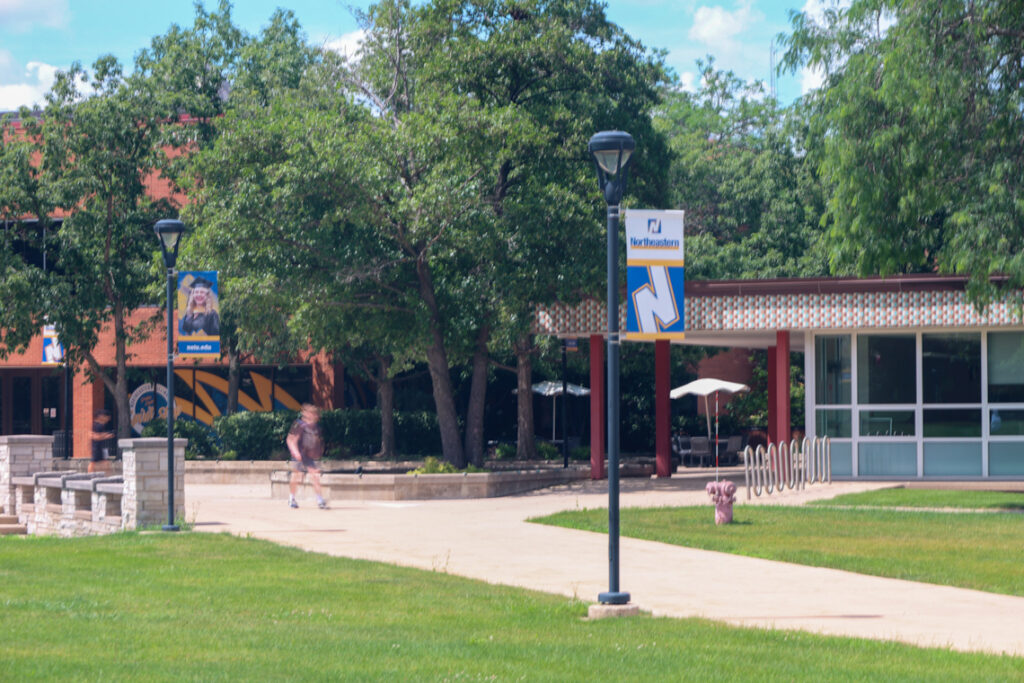
Editor’s note: This story was updated to refer to the correct building on the campus of Northeastern Illinois University in the featured photo caption.
CHICAGO — Illinois students won’t need to fill out applications for most state universities to be admitted — if they have high enough grades.
With his signature, Gov. JB Pritzker on Monday approved a bill creating the direct admissions program. Along with it, he approved bills that implement new state standards for programs offering college credits to high school students, and new requirements for financial aid application assistance.
“These bills streamline the application process for college-bound seniors in Illinois, enhance support for applicants, and open up new horizons for prospective students,” Pritzker said in a statement. “Enacting these laws is what all government work should be about — making life easier for our people.”
Pritzker had said college admissions and higher education accessibility would be a priority of his during this year’s legislative season, which ended May 31. But one of his signature initiatives — allowing community colleges to offer four-year degrees — failed earlier this year.
Direct college admissions
Illinois will implement a direct admissions program so that students hoping to go to a state school will be automatically admitted — if they have a high enough grade point average.
“For eligible seniors and community college transfer students, you will receive offers from the schools that you are admitted to without raising a finger. That’s huge,” Sen. Christopher Belt, D-Swansea, said. “It takes away the anxiety, it takes away the angst of that whole process.”
The bill outlining the direct admissions program, House Bill 3522, passed unanimously in the Senate and with broad bipartisan support in the House in late May.
Read more: House approves new abortion protection, plan to ease college admissions | Senate Democrats champion program to streamline Illinois college applications
The program will begin in the 2027-28 school year, with nine of the state’s 11 public universities participating:
University of Illinois Springfield
Southern Illinois University
Chicago State University
Eastern Illinois University
Governors State University
Illinois State University
Northeastern Illinois University
Northern Illinois University
Western Illinois University
High school students and community college students hoping to transfer to a state school must opt-in to the program to receive offers. Community colleges already admit all students interested in attending but will still participate in the direct admissions program.
The University of Illinois Urbana-Champaign and University of Illinois Chicago will not participate in the direct admission program. The state will, however, provide information about traditional applications to qualifying students through an “access and outreach campaign.”
The criteria for the direct admissions program and outreach campaign will be set by individual schools.
“This new, statewide direct admissions program will make a college degree more accessible for students and will motivate them to continue in their life-changing college journey by ensuring them a spot at their community college or at one of the state’s public universities,” Illinois Board of Higher Education Executive Director Ginger Ostro said in a Monday statement.
Financial aid application assistance
Two more bills signed by Pritzker on Monday, House Bills 3096 and 3097, aim to make it easier for students to navigate the financial aid process.
HB 3096 requires high schools in Illinois to designate at least one staff member as a point-of-contact for information about the Free Application for Federal Student Aid, or FAFSA. HB 3097 requires high schools to offer students time during the school day to fill out FAFSA forms and to receive assistance in doing so.
The new requirements go into effect in the 2025-26 school year.
Information collected through FAFSA is used to determine eligibility for federal loans. Many schools use FAFSA for their own aid programs, and the state offers need-based grants based on information submitted through FAFSA.
“As a father of college students, I just currently went through this fun exercise with my daughter filling out a FAFSA form,” Sen. Javier Cervantes, D-Chicago, said. “I’m being a little sarcastic calling it fun because we had deadlines, we had to make sure we had our documentation together and it wasn’t easy.”
From the 2010 to 2020 school years, an average of 86% of first-time students at four-year schools and 78% of first-time students at two-year schools received federal financial aid, according to data from the U.S. Department of Education.
The Illinois Community College Board offices sits blocks away from the state Capitol. Under a new law, the ICCB and other state agencies are tasked with improving dual credit programs in the state. (Capitol News Illinois photo by Andrew Adams)
Dual credit program
House Bill 2967, another bill approved by Pritzker on Monday, outlines new requirements for high schools and community colleges offering “dual credit” programs, through which students earn high school and college credit for completing a single course.
It requires teachers teaching dual credit classes to have a master’s degree in the subject they’re teaching or a master’s degree and some graduate coursework in the subject. It also requires high schools and community colleges to designate individuals responsible for negotiating what individual dual credit agreements look like.
“HB 2967 reinforces the vital role that strong, robust partnerships between community colleges and high schools play in delivering high quality dual credit programs,” Illinois Community College Board Executive Director Brian Durham said in a statement. “These programs help students get a head start on their college education and a path towards career success.”
The bill also requires schools to consider in-state colleges and universities when setting up dual credit programs over out-of-state institutions.
The bill also creates a committee made up of education officials, representatives from two different statewide teachers’ unions and others to work on improving dual credit programs’ accessibility and quality, as updating a template used by school districts to develop dual credit agreements with community colleges.
Four-year degrees at community college
One key proposal didn’t make the cut this spring — a measure allowing community colleges to offer bachelor’s degrees. Despite being backed by Pritzker in his State of the State address earlier this year, it faced pushback in the General Assembly, which did not pass a bill implementing the policy.
Read more: Pritzker’s community college initiative stalls in House committee
That proposal drew concerns from some lawmakers who worried it could undercut programs to attract local students to state universities. In particular, some lawmakers worried that it could hurt schools like Northeastern Illinois University and Chicago State University, which serve largely minority student populations.
But Pritzker on Monday said he would continue working on a proposal to allow more schools to offer bachelor’s degrees in “very specific, niche areas” like nursing and advanced manufacturing.
“You sometimes have to work two, four, six years, maybe longer to get something done,” Pritzker said.
Capitol News Illinois is a nonprofit, nonpartisan news service that distributes state government coverage to hundreds of news outlets statewide. It is funded primarily by the Illinois Press Foundation and the Robert R. McCormick Foundation.
The post Illinois to roll out direct admissions program for most state universities appeared first on Capitol News Illinois.
GOP lawsuit seeks to end ‘gut-and-replace’ legislation
Capitol News Illinois
SPRINGFIELD — A group of Republican lawmakers filed a lawsuit this week that seeks to nullify legislation they say would indelibly alter both the business and legal landscape of Illinois.
Senate Bill 328 would amend a key provision of Illinois civil law by allowing, in certain kinds of cases, any company authorized to do business in the state to be sued in Illinois courts, even if the underlying claims and the parties have no connection to the state.
As written, the bill would apply only in cases filed under the Uniform Hazardous Substances Act in which the plaintiff claims an injury or illness resulting from exposure to a toxic substance.
What is unique about the GOP lawsuit, however, is that it doesn’t just seek to nullify the legislation before Gov. JB Pritzker signs it. It also asks the court to bar the legislature from using a procedure that has become common in the General Assembly known as “gut-and-replace.” This effectively allows lawmakers to sidestep the Illinois Constitution’s requirement that every bill be read, by title, three times on three different days in each chamber before it is passed because amendments are not required to be read on three different days in each chamber.
That procedure is used frequently for major legislation passed in the final days of a legislative session, including budget bills.
“Illinois’ reputation as one of the most corrupt states in the nation and one of the worst states in the nation for business go hand in hand,” Senate Republican Leader John Curran, R-Downers Grove, said during a virtual news conference Wednesday. “Allowing legislators to disregard the Constitution and good government transparency processes to make laws that are bad for our state is the root cause of both narratives.”
The proposal stems from a 2022 U.S. Supreme Court case, Mallory v. Norfolk Southern Railway Co., in which the court upheld a Pennsylvania law that requires out-of-state corporations to agree to allow Pennsylvania courts to exercise “general personal jurisdiction” over them, just as those courts exercise over domestic corporations.
“This is legalized litigation tourism,” said Sen. Jason Plummer, R-Edwardsville. “And it further damages Illinois’ reputation as a state that’s hostile to businesses and job creators.”
SB 328 began as what’s known in the General Assembly as a “shell bill” — one that has a title and a bill number but no substantive content. In this case, the original language called for making a technical change in one sentence in the Code of Civil Procedure, deleting the word “and” and replacing it with the word “and.”
Each session, lawmakers in both chambers introduce hundreds of such bills, most of which are never acted upon. But they are often amended into substantive legislation later in the session, especially after deadlines for introducing new bills or passing bills out of committees have passed.
That is what happened with SB 328, which began as a shell bill but was amended in the Senate to make a technical change to the way court clerks handle electronically filed documents. It passed out of the Senate on April 10 by a vote of 56-0 and was sent to the House.
In the House, it was read for the first time on April 11 and was assigned to a committee, which voted April 30 to recommend it be passed. It was read a second time on May 13.
On May 30, the next-to-last day of the session, Rep. Jay Hoffman, D-Swansea, introduced a “gut-and-replace” amendment that removed the language about electronic court filings and replaced it with the new language allowing out-of-state corporations to be sued in Illinois courts over acts that may have occurred elsewhere.
House Republican Leader Tony McCombie, left, and Senate GOP Leader John Curran speak to reporters about their lawsuit challenging passage of a controversial bill regarding corporate liability during a virtual news conference Wednesday, June 18. (Credit: Zoom.us)
That amendment was never sent to a substantive committee but instead was debated on the floor of the House where it passed the night of May 31 by a partisan vote of 77-40. That vote also counted as the third reading of the bill in the House, meaning the bill number had now been read on three different days in each chamber. It was then sent back to the Senate, which voted 37-19 shortly after midnight on June 1 to concur in the House amendment.
“We have long discussed with our partners, members and constituents filing suit on this issue, even prior to me being in leadership this year,” House Republican Leader Tony McCombie, of Savanna, said during the news conference. “The caucus members brought forward this egregious example of SB 328, and said let’s move forward.”
The lawsuit was filed in circuit court in Sangamon County. It lists 47 Republican lawmakers as plaintiffs. House Speaker Emanuel “Chris” Welch and Senate President Don Harmon are named as defendants.
Harmon, D-Oak Park, who sponsored the amended bill in the Senate, did not immediately respond Wednesday to a request for comment.
Separately, the Illinois Freedom Caucus has also filed a lawsuit in Sangamon County alleging the state’s budget bill did not satisfy the three readings requirement for similar reasons. A hearing in the case is scheduled for July 3.
Capitol News Illinois is a nonprofit, nonpartisan news service that distributes state government coverage to hundreds of news outlets statewide. It is funded primarily by the Illinois Press Foundation and the Robert R. McCormick Foundation.
The post GOP lawsuit seeks to end ‘gut-and-replace’ legislation appeared first on Capitol News Illinois.