Posts Tagged ‘Susana Mendoza’
Margaret Croke wins Democratic primary for Illinois comptroller

Croke’s win solidified what was an impressive election night for candidates endorsed by Gov. JB Pritzker.
Read MoreDemocrats offer muted praise of Pritzker’s speech, Republicans dismiss ‘campaign’ rhetoric
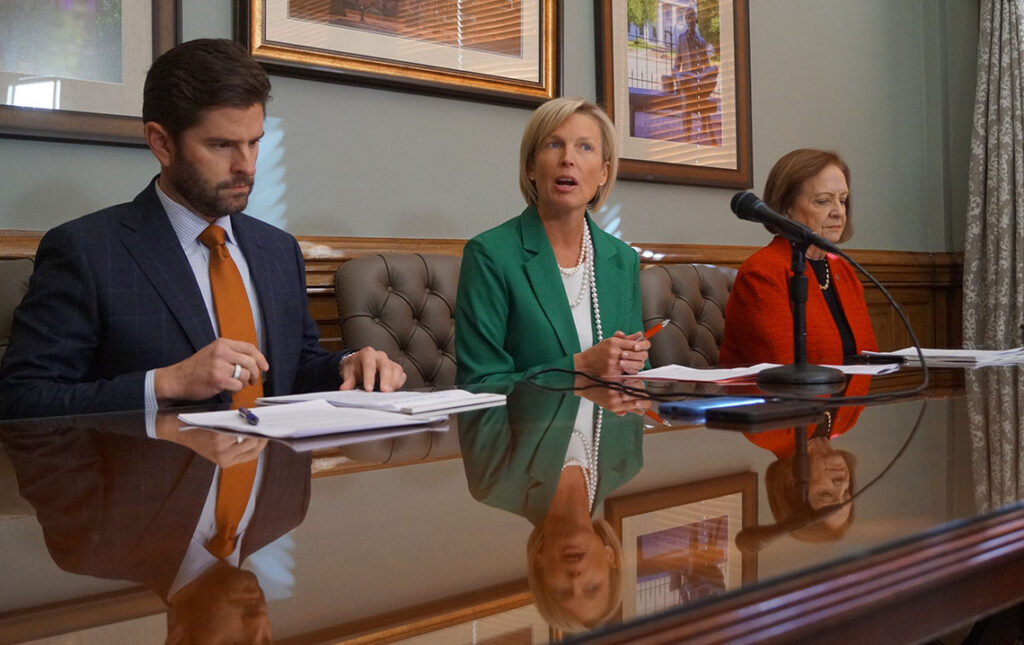
Democrats offered muted praise while Republicans dismissed the governor’s affordability message as campaign-style rhetoric.
Read MoreCook County Dems back Croke for comptroller, no endorsement for Senate race
Capitol News Illinois
Article Summary
The Cook County Democratic Party, one of the most powerful political organizations in the state, chose to back Rep. Margaret Croke, D-Chicago, in her bid to be the next state comptroller.
The comptroller endorsement sparked an intraparty fight, with House Speaker Chris Welch on one side and Senate President Don Harmon on the other.
The party made no endorsement in the race for U.S. Senate.
This summary was written by the reporters and editors who worked on this story.
CHICAGO — At a union hall on Chicago’s South Side, a powerful Democratic Party organization decided who to endorse in the March 17 primary in one key statewide race.
The Cook County Democratic Party Central Committee decided Friday to back Rep. Margaret Croke, D-Chicago, in her bid for Illinois comptroller, the state’s chief financial officer.
That decision sparked conflict between Illinois House Speaker Emanuel “Chris” Welch and Senate President Don Harmon, who backed different candidates.
In the race for U.S. senate however, the party declined to endorse. It’s the first open Senate election in the state since 2010.
“I think the party made the correct decision in making no endorsement in the U.S. Senate race,” Harmon told Capitol News Illinois. “It’s a marquee race with terrific candidates and I’m sure the voters will be able to make an informed decision without an endorsement.”
House Speaker Emanuel “Chris” Welch speaks in favor of slating state Rep. Margaret Croke as the Cook County Democratic Party’s choice for comptroller in the 2026 primary at a meeting Friday in Chicago. (Capitol News Illinois photo by Andrew Adams)
But Harmon objected to the party’s endorsement in the comptroller’s race, sparking a protracted closed-door debate.
Ultimately, Croke bested a list of competitors that included state Sen. Karina Villa, a member of Harmon’s caucus in Springfield.
While an endorsement from the Cook County Democrats does not guarantee a win, it is a major step for a campaign in Illinois.
Cook County has about 40% of the state’s population, and its Democratic Party has been a dominant political force for decades. Beyond the potential for turning out votes in the state’s most populous county, an endorsement from the Cook County Democrats can be a litmus test for support from state-level Democrats.
The group of party insiders considering who to endorse includes Welch and Harmon — both from suburban Cook County — and the committee that oversees statewide endorsements is chaired by state Rep. Bob Rita, D-Blue Island.
Additionally, influential Democrats in the General Assembly, like Rep. Kam Buckner, D-Chicago; Sen. Laura Murphy, D-Des Planes, and Sen. Elgie Sims, D-Chicago, were all present for the meeting.
Party backs Croke for comptroller
The race for comptroller, which opened up this week after sitting comptroller Susana Mendoza announced she was not seeking reelection, sparked a clash between several of the state’s most powerful politicians.
Five candidates asked for the party’s backing. Croke, Lake County Treasurer Holly Kim and Villa, D-West Chicago, were the favored candidates going into the meeting. Champaign County Auditor George Danos and former state Sen. Rickey Hendon also presented at the meeting.
Welch photo
Welch spoke at length in favor of Croke during the slating meeting, adding that he was “very happy to support” Croke. Croke is close to Gov. JB Pritzker, having worked in the Department of Commerce and Economic Opportunity and on his first campaign.
Meanwhile, Harmon backed Villa.
During discussions over comptroller candidates, Cook County Board President Toni Preckwinkle also noted she believed it is “really important for this party to support a Latino for statewide office.”
Read more: Comptroller Mendoza won’t run for reelection, opening up statewide office
In a private session and on a very narrow vote, the subcommittee that recommends statewide endorsements backed Croke. Back in the public session, Harmon fought to try and reject the recommendation.
“We have a slate that does not have any representation from the Latino Caucus, no representation from the Asian Caucus, no one from outside the city of Chicago. I think this is the problem,” Harmon said.
Senate President Don Harmon watches during presentations from comptroller candidates at a meeting to decide who the Cook County Democratic Party will support. Harmon said he had concerns about diversity on the ticket and had backed Sen. Karina Villa. The party ultimately slated Croke. (Capitol News Illinois photo by Andrew Adams)
This sparked another closed-door debate after which Croke emerged with the ultimate endorsement, something that “disappointed” Harmon.
“I worry that the party was more divided than evidenced by the final outcome,” he said. “But it’ll be up to the voters.”
No endorsement for U.S. Senate
After Dick Durbin, Illinois’ current senior U.S. senator, announced his retirement, several candidates quickly popped up to replace him at the end of his final term.
The three frontrunners so far are Lt. Gov. Juliana Stratton, U.S. Rep. Raja Krishnamoorthi and U.S. Rep. Robin Kelly.
Read more: Who is contributing to Illinois’ U.S. Senate candidates?
Several other candidates are in the race and three spoke to party insiders Friday: Christopher Swan, Kevin Ryan and Jump Shepherd. Kelly did not appear at Friday’s meeting, instead having an ally speak on her behalf following travel issues after a late night of voting in Washington.
In the end, the Cook County Democrats didn’t endorse any of them, setting up a contentious primary fight between a current statewide office holder, the one-time state party chair and a man who has nearly 10-to-1 funding advantage.
Durbin, meanwhile, plans on mostly staying out of the race. The retiring senator said Friday that there are three good candidates in the race. While he said he hasn’t “ruled out completely” endorsing someone, he probably won’t.
“I’m not likely to endorse in the race,” Durbin said. “I may in some other races but not that one.”
Governor, other endorsements
The governor couldn’t make the meeting due to a family commitment. In his stead, Pritzker’s running mate Christian Mitchell addressed the collection of party insiders. In a brief speech, Mitchell echoed many of Pritzker campaign talking points.
Christian Mitchell, who is Gov. JB Pritzker’s running mate, took pointed questions from Cook County Democrats on Friday during a meeting about slating candidates for the 2026 primary. (Capitol News Illinois photo by Andrew Adams)
But when the floor was opened to questions, Mitchell started taking heat.
Mitchell, who oversaw Pritzker’s cannabis legalization efforts early in the governor’s first term, once tweeted that he was “stunned at the level of ignorance” at a Chicago City Council meeting, something that multiple alderpeople in attendance on Friday took exception to.
“I don’t recall using that term, but if I did, I apologize,” Mitchell said when questioned by Chicago Ald. David Moore.
Mitchell also faced heat from Chicago Ald. Raymond Lopez, who pressed him on the administration’s relationship to the Latino community. Several Chicago alderpeople also interrogated Mitchell over the administration’s plans on Chicagoland transit, Chicago Public Schools and the closure of manufacturing plants on Chicago’s South Side.
But Mitchell did have his fans in the audience, with one committee member noting that Mitchell’s appearance at a fundraiser helped increase donations, something Mitchell said he wanted to replicate.
“I want to go everywhere, I want to be everywhere,” he said.
The party voted to endorse the Pritzker-Mitchell ticket, which faces no serious challengers within the Democratic party.
Attorney General Kwame Raoul, Treasurer Michael Frerichs and Secretary of State Alexi Giannoulias also received endorsements.
Capitol News Illinois is a nonprofit, nonpartisan news service that distributes state government coverage to hundreds of news outlets statewide. It is funded primarily by the Illinois Press Foundation and the Robert R. McCormick Foundation.
The post Cook County Dems back Croke for comptroller, no endorsement for Senate race appeared first on Capitol News Illinois.
State ends fiscal year with record revenue
Capitol News Illinois
Article Summary:
Illinois closed fiscal year 2025 with record $54 billion in revenue.
While that marked a surplus from the enacted budget, the extra revenue was anticipated when lawmakers approved the current-year budget in May.
It doesn’t give lawmakers any extra breathing room for an expected volatile fiscal year 2026.
This summary was written by the reporters and editors who worked on this story.
Despite uncertainty over the economy and federal funding during the second half of fiscal year 2025, the year closed on June 30 with the state setting a new record for annual revenue.
Numbers compiled by the independent Commission on Government Forecasting and Accountability show FY25 concluded with $54 billion in revenue, the most the state has ever received in a fiscal year. The state also brought in $717 million more in revenue than lawmakers originally budgeted for when they passed a $53.3 billion budget in May 2024.
All told, the final revenue numbers track closely with projections made in May by both COGFA and the Governor’s Office of Management and Budget that formed the basis of the FY26 budget. In other words, June revenues produced no surprises, and lawmakers aren’t sitting on any substantial surplus as the new fiscal year begins.
The record revenues also don’t alleviate any uncertainty for the current or future fiscal years as Congress considers drastic reductions to the social safety net and aid to states.
Causes of revenue growth
Strong personal income tax growth drove the revenue increase in FY25, largely thanks to a “true up” conducted by the Department of Revenue that reallocated business related income tax revenue into the personal income tax category. Personal income tax revenue was 10% higher than in FY24, but corporate income taxes declined by 9.5%.
Some other revenue sources also saw minimal growth. Sales tax revenue grew by less than 1%, though COGFA noted it increased by nearly 3% in the second half of FY25 after a weak start last summer as gas prices dropped and people cut back on large purchases amid growing economic uncertainty.
Federal income was also down 4.6% in FY25, even when excluding one-time pandemic relief funds the state received in FY24. But in a bright spot for the state, COGFA found that state revenue sources grew more than anticipated to offset the $178 million decline in federal revenue.
Despite solid revenue growth this year, questions remain about how well it will perform in FY26.
“Whether this record will be surpassed in FY 2026 remains to be seen, though the FY 2026 enacted budget assumes revenues of $55.297 billion – nearly $1.3 billion above the FY 2025 final total,” COGFA Revenue Manger Eric Noggle wrote.
Bills paid and money left over
The state also ended the fiscal year with $1.9 billion of cash in the General Revenue Fund after all bills were paid, according to the Comptroller Susana Mendoza’s office.
“We work hard each year to pay bills on time, build up the state’s emergency reserves and stress fiscal discipline, even in these uncertain times,” Mendoza said in a statement. “My office will strive for continued improvement in state finances and credit ratings in the new budget year.”
Mendoza’s office also put $256 million into the “rainy day” fund, growing it to a balance of $2.5 billion. The fund is expected to grow at a slower rate in FY26, however, as lawmakers suspended a monthly transfer that will free up $45 million.
With an extra cash balance to start the new fiscal year, Mendoza said she plans to pre-pay monthly pension payments for FY26. Lawmakers gave the comptroller authority last year to make pension payments earlier in the year rather than on a monthly basis when extra money is available.
“This will enable the systems to plan accordingly and keep additional dollars in their investment portfolios into the new budget year,” Mendoza said.
An uncertain future
With good new concluding FY25, attention now turns to FY26, which began Tuesday, and the vast uncertainty the state faces from budget talks in Congress and the economic fallout of decisions by the Trump administration.
Gov. JB Pritzker signed a $55.1 billion spending plan in mid-June that relies on $55.3 billion in revenue. It’s the largest budget in state history despite minimal discretionary spending growth, and it relies on $1.2 billion of tax increases or one-time revenues.
Read more: Pritzker signs $55.1B state budget reliant on $700M of new taxes
But state lawmakers have left the door open to the possibility that changes Congress makes to federal funding that requires states to cover greater portions of government programs and ceases funding in certain areas will require lawmakers to change the budget.
“The ability of the state to try to step in and try to mitigate the damage is somewhat limited, although we have the ability to do certain things and may have to in special session or we may have to in veto session,” Pritzker told reporters in Peoria on Tuesday. “It’s a little hard to tell yet. Some of the provisions of this terrible bill in Washington, D.C. don’t go into effect until next year and so we’ll have to evaluate what changes to make in order to deal with it.”
Work requirements for health care and food assistance programs, cuts to Medicaid reimbursements and the elimination of clean energy tax credits could all require the state to take on more costs.
Capitol News Illinois is a nonprofit, nonpartisan news service that distributes state government coverage to hundreds of news outlets statewide. It is funded primarily by the Illinois Press Foundation and the Robert R. McCormick Foundation.
The post State ends fiscal year with record revenue appeared first on Capitol News Illinois.