Posts Tagged ‘SNAP’
Trump’s ‘big bill’ takes center stage in Illinois’ U.S. Senate race
Capitol News Illinois
Article summary
The three Democrats running for Illinois’ open Senate seat voiced concerns about the new domestic policy plan at events around Illinois.
Lt. Gov. Juliana Stratton discussed how SNAP cuts will affect Illinois at an event in Chicago.
Rep. Robin Kelly spoke with voters in Peoria about their concerns with federal spending cuts.
Rep. Raja Krishnamoorthi met with central Illinois independent pharmacist owners to highlight how spending cuts could hurt health care in rural areas.
This summary was written by the reporters and editors who worked on this story.
PEORIA – With major future cuts to social service programs now written into law, Democrats seeking Illinois’ open U.S. Senate seat in 2026 are hitting the campaign trail seeking to position themselves among the law’s most vocal opponents.
“We want Illinoisians throughout our state to understand the ripple effects of the Trump administration’s cruelty and be prepared for what’s to come,” Lt. Gov. Juliana Stratton said during a panel discussion at the Greater Chicago Food Depository Thursday.
The federal policy bill, dubbed the “One Big, Beautiful Bill,” signed by President Donald Trump on July 4 will slash federal spending for health care and other human service programs over the next several years, in many cases leaving states to pick up the tab if they are to continue providing benefits. The bill is expected to cost Illinois more than $700 million for the Supplemental Nutrition Assistance Program, cut Medicaid spending in Illinois by $48 billion over the next 10 years, and potentially force some rural hospitals to close.
As Illinois’ 2026 candidates prepare to begin circulating nominating petitions next month, the three Democrats vying for retiring Sen. Dick Durbin’s Senate seat met with residents around the state to hear about the local impacts of the bill and rally support for their campaigns.
Stratton held an official state event in Chicago to discuss the Pritzker administration’s response to SNAP changes, while U.S. Reps. Robin Kelly and Raja Krishnamoorthi visited downstate communities to discuss the bill.
Kelly gets feedback in Peoria
Kelly, who represents the state’s 2nd Congressional District across parts of Chicago, the south suburbs and rural eastern Illinois, visited with voters in Peoria to hear their concerns about the bill.
The Bradly University graduate said her goal is to make sure Americans are aware of the bill’s effects – even though many of them are slated to begin after the 2026 midterm election.
U.S. Rep. Robin Kelly speaks to voters at an event at the Peoria Public Library on Wednesday, July 9, 2025. (Capitol News Illinois photo by Ben Szalinski)
“In polling and different things that we’ve done, half of the population doesn’t even realize what’s going on,” Kelly said.
Kelly played up her relationship with U.S. House Minority Leader Hakeem Jeffries, saying she has been part of a coalition of House Democrats that have been traveling the country holding town hall meetings about federal spending cuts.
“Every group that we can speak in front of, we need to speak in front of,” Kelly said. “And so that’s one of the reason’s we’re traveling.”
Krishnamoorthi visits rural pharmacy
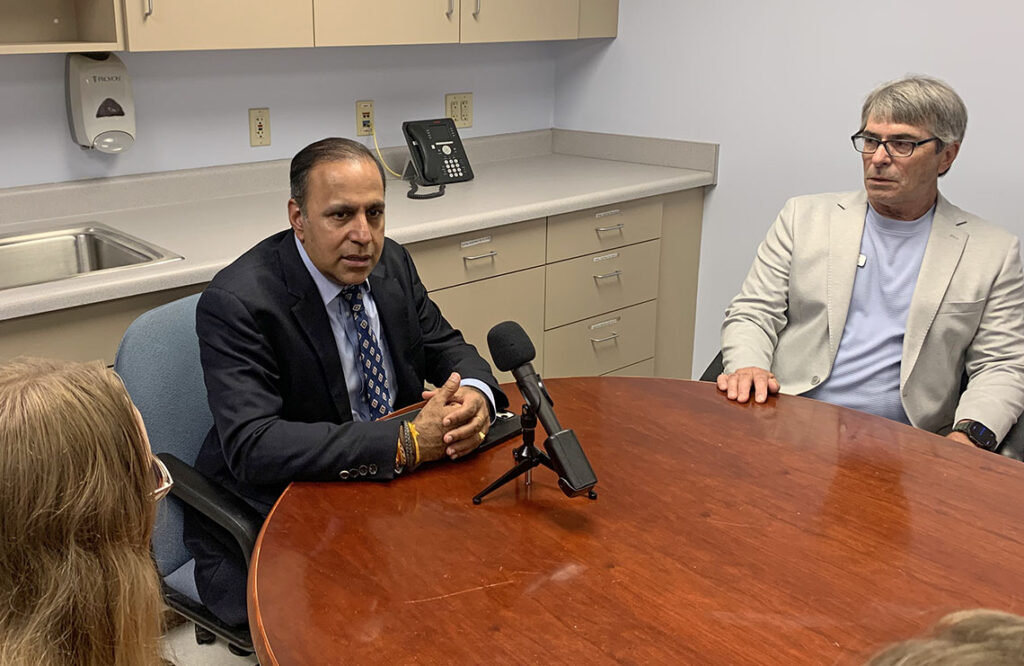
Krishnamoorthi, who represents the 8th Congressional District in the northwest suburbs, visited a pharmacy in Petersburg about 30 minutes northwest of Springfield.
He echoed concerns other Illinois Democrats have expressed about the “large, lousy law” cutting Medicaid and that it could limit health care services in rural communities.
Read more: Illinois hospitals fear massive cuts under Trump domestic policy law
“When you have that many people who all of a sudden don’t have a way of paying for their health care, then it hurts all those rural health care providers that depend on Medicaid as a form of payment for so many of their patients,” Krishnamoorthi said.
Krishnamoorthi also worried about domino effects from growing deficits as a result of the bill, which the Congressional Budget Office estimates will increase by more than $3 trillion. According to the nonpartisan health research organization KFF, the growing deficit could trigger automatic spending cuts, which could force Medicare cuts even though it was not reduced in the bill.
“We’re also talking about seniors who could be affected by Medicare cuts,” Krishnamoorthi said. “And so at the end of the day, however, everybody’s going to be affected because if, God forbid, one of these hospitals in these areas in the rural parts of Illinois are closed, then everyone, regardless of how their health care is paid for, would be affected negatively.”
SNAP cuts worry candidates
Stratton did not hit the campaign trail with any public events this week, but the Pritzker administration must now decide how it will proceed with new spending requirements signed by the president and the effects of fewer residents receiving social service benefits.
Lt. Gov. Juliana Stratton speaks at a panel discussion on SNAP benefits at the Greater Chicago Food Depository in Chicago on Thursday, July 10, 2025. (Screenshot from Illinois.gov live feed)
Stratton and other top Pritzker administration officials discussed the impact of cuts to the SNAP program during a panel discussion at the Greater Chicago Food Depository as the state seeks more immediate solutions that lawmakers could approve before the 2026 election. The lieutenant governor, who resides on Chicago’s South Side, said reducing eligibility for a food program exacerbates other issues such as crime, economic productivity and learning in schools.
“Hunger is not a problem that stays isolated,” Stratton said. “The repercussions seep out, harming everyone and everything in its path until something changes.”
Kelly told voters in Peoria that SNAP cuts aren’t just a problem for low-income recipients.
“If you cannot buy food, then you’re not shopping at Kroger or wherever you shop,” Kelly said. “And so then Kroger is not buying as much food from the farmers and then they won’t need as many people to work there.”
The Republican field in the Senate race has yet to take shape. Republican Rep. Darin LaHood from the Peoria area held a virtual townhall with 16th Congressional District voters to discuss why he believes the bill will benefit Illinois.
Capitol News Illinois is a nonprofit, nonpartisan news service that distributes state government coverage to hundreds of news outlets statewide. It is funded primarily by the Illinois Press Foundation and the Robert R. McCormick Foundation.
The post Trump’s ‘big bill’ takes center stage in Illinois’ U.S. Senate race appeared first on Capitol News Illinois.
Federal food assistance changes threaten benefits for thousands of Illinoisans
Capitol News Illinois
Article summary
The domestic policy law signed by President Donald Trump last week creates new work requirements that could jeopardize food assistance benefits for 360,000 Illinoisans.
Illinois will be required to cover a greater portion of the administrative costs and benefits of SNAP, which could cost several hundred million dollars.
The Congressional Budget Office estimates the changes will substantially reduce costs for the federal government while most states will have to pay significantly more.
This summary was written by the reporters and editors who worked on this story.
Hundreds of thousands of Illinoisans could lose benefits from a federal food assistance program while the state will be required to cover more costs under changes passed in the latest domestic policy plan.
President Donald Trump signed the “One Big, Beautiful Bill Act” into law on July 4, making sweeping changes to social services programs, including Medicaid. Among the programs being revamped is the Supplemental Nutrition Assistance Program, better known as SNAP. The bill institutes new work requirements for many people to remain eligible for benefits and shifts some costs for the program to the states.
Food stamps were first established in the 1930s during the Great Depression. Renamed to SNAP in 2008, the program provides monthly stipends for low-income Americans to purchase select foods at grocery stores. While states implement the program and pay a portion of administrative expenses, the federal government has historically covered the cost of the benefits.
Under the law, work requirements to qualify for SNAP benefits have been expanded to include people up to age 64, along with homeless people, veterans and young adults leaving foster care. Previously, only people age 18-54 had to meet work requirements.
Those populations didn’t previously have to prove they were doing a certain amount of work, but when the changes kick in, they will have to do 80 hours of paid, unpaid or volunteer work each month to qualify for benefits, according to the U.S. Department of Agriculture. The law continues to provide exemptions for people who are physically unable to work, such as for pregnancy.
The changes could leave 360,000 people in Illinois at risk of losing eligibility, according to the state.
“Trump and Republicans would rather children go hungry so their friends can receive tax cuts,” Gov. JB Pritzker said in a statement. “Here in Illinois, we have been working to combat food insecurity for years, and while no state can backfill these costs, the State of Illinois will continue to fight against these harmful impacts and stand up for working families.”
About 1.9 million people were using SNAP in Illinois as of March 2025, according to the USDA.
New costs for the state
Illinois and most other states will have to cover a greater portion of costs for SNAP under the law, including benefits based on the state’s error rate of over- and under-payments on benefits.
Beginning in federal fiscal year 2028, which begins in October 2027, the law requires states with an error rate greater than 10% as of at least FY25 to cover 15% of the cost of benefits. States with lower error rates would cover a smaller portion of the benefits. Illinois recorded an 11% error rate in FY24, according to the USDA.
More than 1.8 million Illinoisians received $4.7 billion of SNAP benefits in FY25, according to the state. If Illinois must pay 15% of the cost of benefits, it could leave the state on the hook for $705 million — or about 1.3% of the current-year budget.
Also beginning in federal fiscal year 2027, which begins in October 2026, states will have to cover 75% of administrative costs for SNAP, rather than 50%. This year’s state budget appropriates $60 million for administrative costs for SNAP — up $20 million from last year.
The changes are part of initiatives by congressional Republicans and the Trump administration to shift more responsibility for assistance programs to states. The nonpartisan Congressional Budget Office estimates changes to SNAP will reduce federal spending by $279 billion over 10 years but increase state spending on SNAP by $121 billion over the same time. The CBO predicts some states could abandon the program or choose to provide a lower level of benefits and not make up for reductions Congress made to the program.
Pritzker and 22 other governors sent a letter to Congress last month saying it’s possible states will have to leave or reduce the SNAP program because of the new cost requirements.
Capitol News Illinois is a nonprofit, nonpartisan news service that distributes state government coverage to hundreds of news outlets statewide. It is funded primarily by the Illinois Press Foundation and the Robert R. McCormick Foundation.
The post Federal food assistance changes threaten benefits for thousands of Illinoisans appeared first on Capitol News Illinois.