Posts Tagged ‘Raja Krishnamoorthi’
Mapping Juliana Stratton’s U.S. Senate Democratic primary win
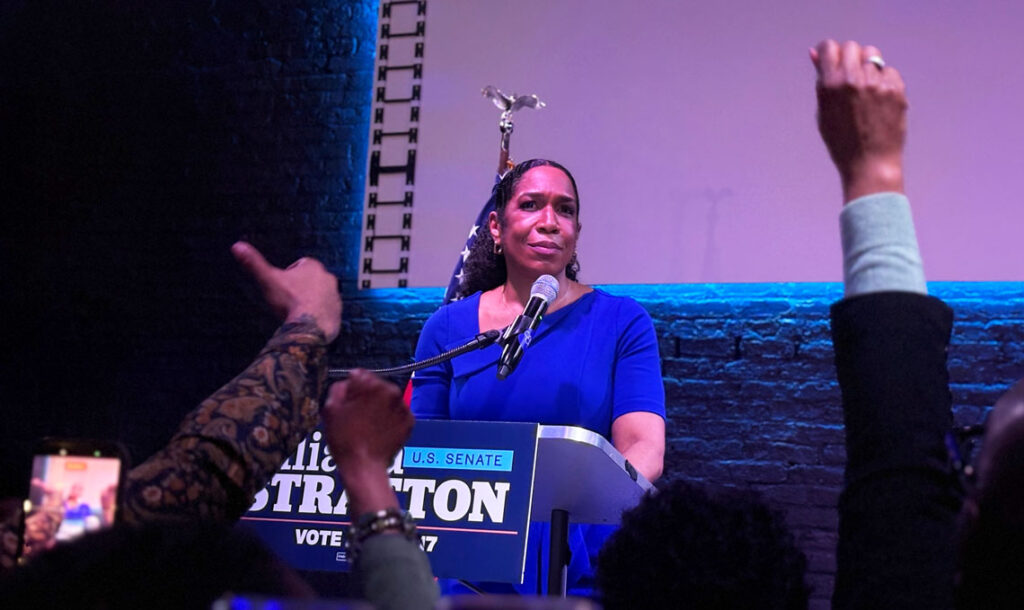
The foundation of Lt. Gov. Juliana Stratton’s larger-than-expected victory in the Democratic primary for Illinois’ open U.S. Senate was laid with a dominant performance in Chicago but padded by a surprisingly strong performance downstate. She also kept up with Rep. Raja Krishnamoorthi in the Chicago suburbs.
Read MoreMoore: How ‘Strattmentum’ upended Krishnamoorthi’s once-seemingly inevitable Senate path
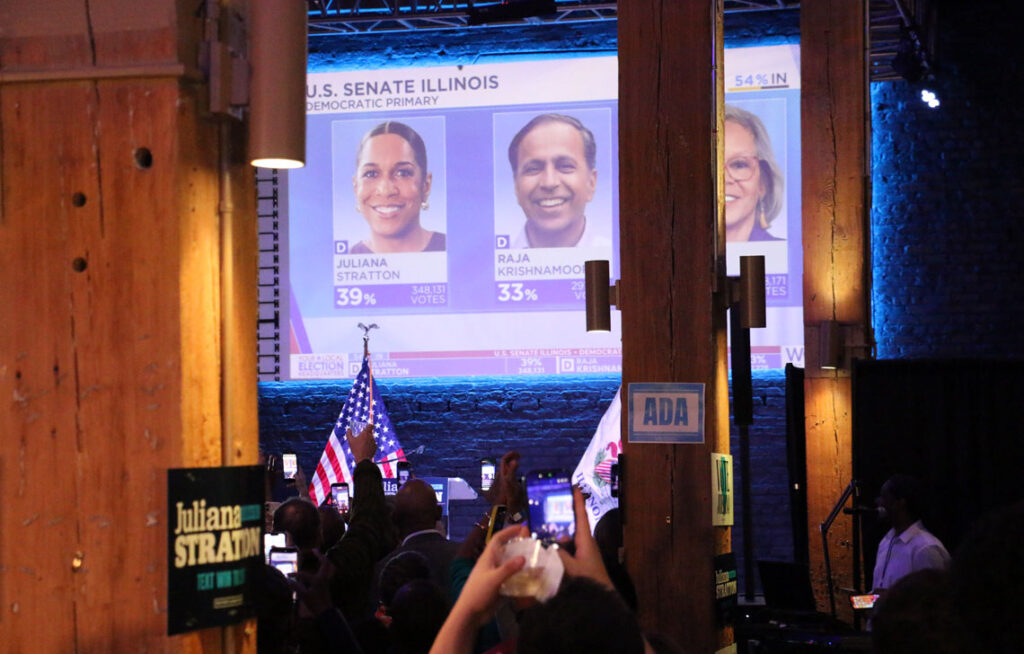
Everyone has a take on the impact the flood of money had on the Democratic U.S. Senate primary. Brenden Moore’s? Money was obviously a factor. The leading candidates needed it to communicate with voters. But money isn’t worth anything without a winning message and an effective messenger to deliver it.
Read MoreHow Illinois’ Democratic U.S. Senate candidates plan to address economic issues
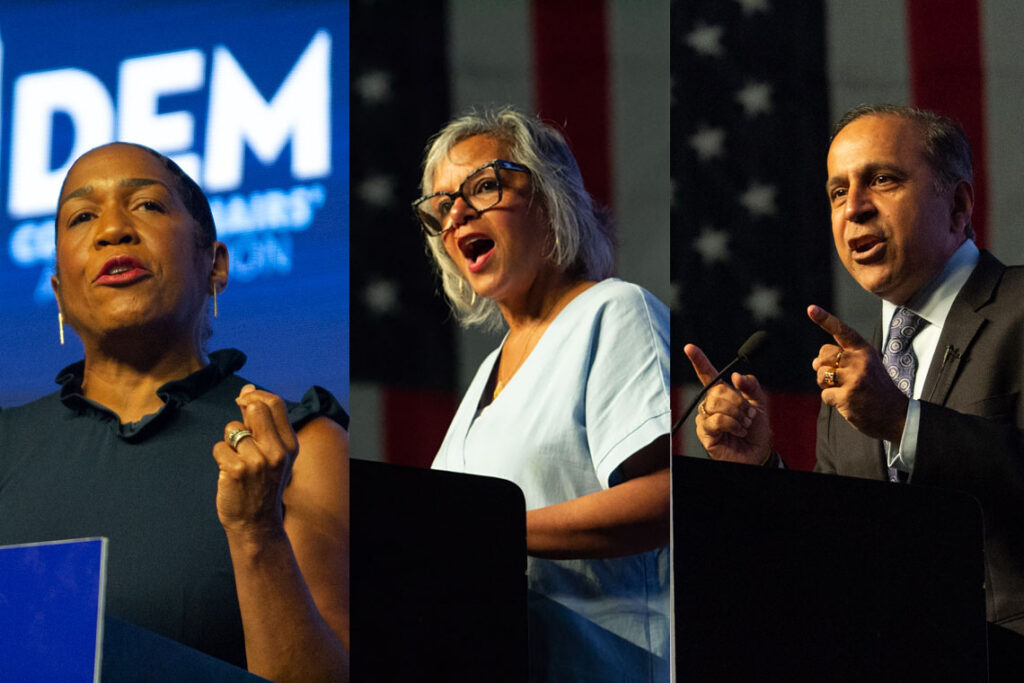
The top three Democrats running for U.S. Senate have released economic plans.
Read MoreKelly leans on experience in Illinois’ Democratic Senate primary
U.S. Rep. Robin Kelly, D-Matteson, speaks at an event on March 18, 2025. (Capitol News Illinois photo by Andrew Adams)
U.S. Rep. Robin Kelly is one of three high-profile Democrats hoping to join the U.S. Senate after the 2026 election.
The post Kelly leans on experience in Illinois’ Democratic Senate primary appeared first on Capitol News Illinois
Cook County Dems back Croke for comptroller, no endorsement for Senate race
Capitol News Illinois
Article Summary
The Cook County Democratic Party, one of the most powerful political organizations in the state, chose to back Rep. Margaret Croke, D-Chicago, in her bid to be the next state comptroller.
The comptroller endorsement sparked an intraparty fight, with House Speaker Chris Welch on one side and Senate President Don Harmon on the other.
The party made no endorsement in the race for U.S. Senate.
This summary was written by the reporters and editors who worked on this story.
CHICAGO — At a union hall on Chicago’s South Side, a powerful Democratic Party organization decided who to endorse in the March 17 primary in one key statewide race.
The Cook County Democratic Party Central Committee decided Friday to back Rep. Margaret Croke, D-Chicago, in her bid for Illinois comptroller, the state’s chief financial officer.
That decision sparked conflict between Illinois House Speaker Emanuel “Chris” Welch and Senate President Don Harmon, who backed different candidates.
In the race for U.S. senate however, the party declined to endorse. It’s the first open Senate election in the state since 2010.
“I think the party made the correct decision in making no endorsement in the U.S. Senate race,” Harmon told Capitol News Illinois. “It’s a marquee race with terrific candidates and I’m sure the voters will be able to make an informed decision without an endorsement.”
House Speaker Emanuel “Chris” Welch speaks in favor of slating state Rep. Margaret Croke as the Cook County Democratic Party’s choice for comptroller in the 2026 primary at a meeting Friday in Chicago. (Capitol News Illinois photo by Andrew Adams)
But Harmon objected to the party’s endorsement in the comptroller’s race, sparking a protracted closed-door debate.
Ultimately, Croke bested a list of competitors that included state Sen. Karina Villa, a member of Harmon’s caucus in Springfield.
While an endorsement from the Cook County Democrats does not guarantee a win, it is a major step for a campaign in Illinois.
Cook County has about 40% of the state’s population, and its Democratic Party has been a dominant political force for decades. Beyond the potential for turning out votes in the state’s most populous county, an endorsement from the Cook County Democrats can be a litmus test for support from state-level Democrats.
The group of party insiders considering who to endorse includes Welch and Harmon — both from suburban Cook County — and the committee that oversees statewide endorsements is chaired by state Rep. Bob Rita, D-Blue Island.
Additionally, influential Democrats in the General Assembly, like Rep. Kam Buckner, D-Chicago; Sen. Laura Murphy, D-Des Planes, and Sen. Elgie Sims, D-Chicago, were all present for the meeting.
Party backs Croke for comptroller
The race for comptroller, which opened up this week after sitting comptroller Susana Mendoza announced she was not seeking reelection, sparked a clash between several of the state’s most powerful politicians.
Five candidates asked for the party’s backing. Croke, Lake County Treasurer Holly Kim and Villa, D-West Chicago, were the favored candidates going into the meeting. Champaign County Auditor George Danos and former state Sen. Rickey Hendon also presented at the meeting.
Welch photo
Welch spoke at length in favor of Croke during the slating meeting, adding that he was “very happy to support” Croke. Croke is close to Gov. JB Pritzker, having worked in the Department of Commerce and Economic Opportunity and on his first campaign.
Meanwhile, Harmon backed Villa.
During discussions over comptroller candidates, Cook County Board President Toni Preckwinkle also noted she believed it is “really important for this party to support a Latino for statewide office.”
Read more: Comptroller Mendoza won’t run for reelection, opening up statewide office
In a private session and on a very narrow vote, the subcommittee that recommends statewide endorsements backed Croke. Back in the public session, Harmon fought to try and reject the recommendation.
“We have a slate that does not have any representation from the Latino Caucus, no representation from the Asian Caucus, no one from outside the city of Chicago. I think this is the problem,” Harmon said.
Senate President Don Harmon watches during presentations from comptroller candidates at a meeting to decide who the Cook County Democratic Party will support. Harmon said he had concerns about diversity on the ticket and had backed Sen. Karina Villa. The party ultimately slated Croke. (Capitol News Illinois photo by Andrew Adams)
This sparked another closed-door debate after which Croke emerged with the ultimate endorsement, something that “disappointed” Harmon.
“I worry that the party was more divided than evidenced by the final outcome,” he said. “But it’ll be up to the voters.”
No endorsement for U.S. Senate
After Dick Durbin, Illinois’ current senior U.S. senator, announced his retirement, several candidates quickly popped up to replace him at the end of his final term.
The three frontrunners so far are Lt. Gov. Juliana Stratton, U.S. Rep. Raja Krishnamoorthi and U.S. Rep. Robin Kelly.
Read more: Who is contributing to Illinois’ U.S. Senate candidates?
Several other candidates are in the race and three spoke to party insiders Friday: Christopher Swan, Kevin Ryan and Jump Shepherd. Kelly did not appear at Friday’s meeting, instead having an ally speak on her behalf following travel issues after a late night of voting in Washington.
In the end, the Cook County Democrats didn’t endorse any of them, setting up a contentious primary fight between a current statewide office holder, the one-time state party chair and a man who has nearly 10-to-1 funding advantage.
Durbin, meanwhile, plans on mostly staying out of the race. The retiring senator said Friday that there are three good candidates in the race. While he said he hasn’t “ruled out completely” endorsing someone, he probably won’t.
“I’m not likely to endorse in the race,” Durbin said. “I may in some other races but not that one.”
Governor, other endorsements
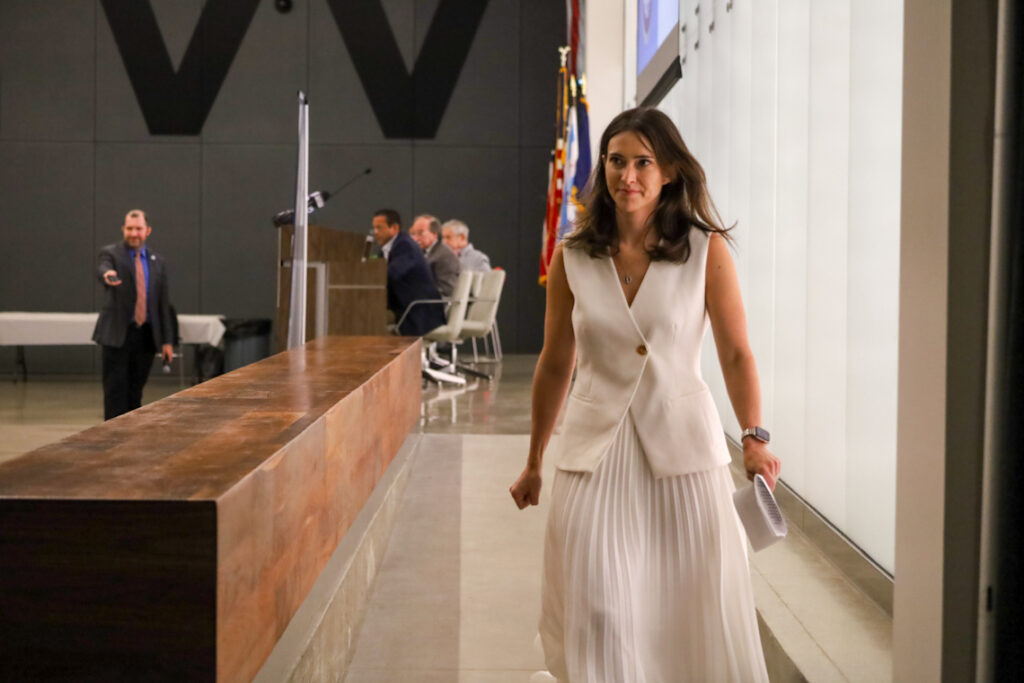
The governor couldn’t make the meeting due to a family commitment. In his stead, Pritzker’s running mate Christian Mitchell addressed the collection of party insiders. In a brief speech, Mitchell echoed many of Pritzker campaign talking points.
Christian Mitchell, who is Gov. JB Pritzker’s running mate, took pointed questions from Cook County Democrats on Friday during a meeting about slating candidates for the 2026 primary. (Capitol News Illinois photo by Andrew Adams)
But when the floor was opened to questions, Mitchell started taking heat.
Mitchell, who oversaw Pritzker’s cannabis legalization efforts early in the governor’s first term, once tweeted that he was “stunned at the level of ignorance” at a Chicago City Council meeting, something that multiple alderpeople in attendance on Friday took exception to.
“I don’t recall using that term, but if I did, I apologize,” Mitchell said when questioned by Chicago Ald. David Moore.
Mitchell also faced heat from Chicago Ald. Raymond Lopez, who pressed him on the administration’s relationship to the Latino community. Several Chicago alderpeople also interrogated Mitchell over the administration’s plans on Chicagoland transit, Chicago Public Schools and the closure of manufacturing plants on Chicago’s South Side.
But Mitchell did have his fans in the audience, with one committee member noting that Mitchell’s appearance at a fundraiser helped increase donations, something Mitchell said he wanted to replicate.
“I want to go everywhere, I want to be everywhere,” he said.
The party voted to endorse the Pritzker-Mitchell ticket, which faces no serious challengers within the Democratic party.
Attorney General Kwame Raoul, Treasurer Michael Frerichs and Secretary of State Alexi Giannoulias also received endorsements.
Capitol News Illinois is a nonprofit, nonpartisan news service that distributes state government coverage to hundreds of news outlets statewide. It is funded primarily by the Illinois Press Foundation and the Robert R. McCormick Foundation.
The post Cook County Dems back Croke for comptroller, no endorsement for Senate race appeared first on Capitol News Illinois.
Trump’s ‘big bill’ takes center stage in Illinois’ U.S. Senate race
Capitol News Illinois
Article summary
The three Democrats running for Illinois’ open Senate seat voiced concerns about the new domestic policy plan at events around Illinois.
Lt. Gov. Juliana Stratton discussed how SNAP cuts will affect Illinois at an event in Chicago.
Rep. Robin Kelly spoke with voters in Peoria about their concerns with federal spending cuts.
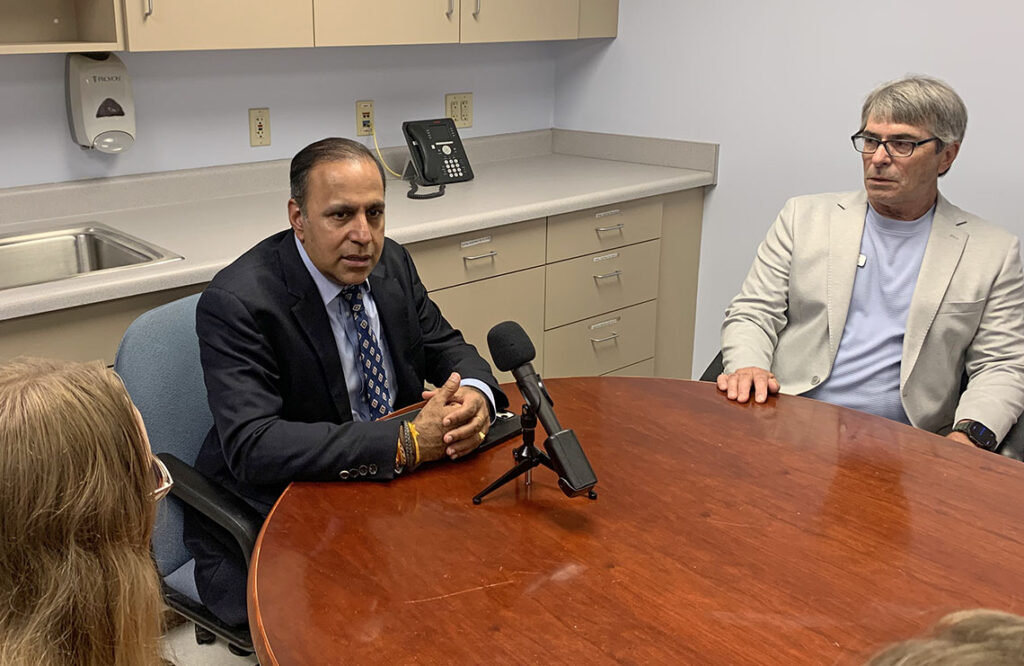
Rep. Raja Krishnamoorthi met with central Illinois independent pharmacist owners to highlight how spending cuts could hurt health care in rural areas.
This summary was written by the reporters and editors who worked on this story.
PEORIA – With major future cuts to social service programs now written into law, Democrats seeking Illinois’ open U.S. Senate seat in 2026 are hitting the campaign trail seeking to position themselves among the law’s most vocal opponents.
“We want Illinoisians throughout our state to understand the ripple effects of the Trump administration’s cruelty and be prepared for what’s to come,” Lt. Gov. Juliana Stratton said during a panel discussion at the Greater Chicago Food Depository Thursday.
The federal policy bill, dubbed the “One Big, Beautiful Bill,” signed by President Donald Trump on July 4 will slash federal spending for health care and other human service programs over the next several years, in many cases leaving states to pick up the tab if they are to continue providing benefits. The bill is expected to cost Illinois more than $700 million for the Supplemental Nutrition Assistance Program, cut Medicaid spending in Illinois by $48 billion over the next 10 years, and potentially force some rural hospitals to close.
As Illinois’ 2026 candidates prepare to begin circulating nominating petitions next month, the three Democrats vying for retiring Sen. Dick Durbin’s Senate seat met with residents around the state to hear about the local impacts of the bill and rally support for their campaigns.
Stratton held an official state event in Chicago to discuss the Pritzker administration’s response to SNAP changes, while U.S. Reps. Robin Kelly and Raja Krishnamoorthi visited downstate communities to discuss the bill.
Kelly gets feedback in Peoria
Kelly, who represents the state’s 2nd Congressional District across parts of Chicago, the south suburbs and rural eastern Illinois, visited with voters in Peoria to hear their concerns about the bill.
The Bradly University graduate said her goal is to make sure Americans are aware of the bill’s effects – even though many of them are slated to begin after the 2026 midterm election.
U.S. Rep. Robin Kelly speaks to voters at an event at the Peoria Public Library on Wednesday, July 9, 2025. (Capitol News Illinois photo by Ben Szalinski)
“In polling and different things that we’ve done, half of the population doesn’t even realize what’s going on,” Kelly said.
Kelly played up her relationship with U.S. House Minority Leader Hakeem Jeffries, saying she has been part of a coalition of House Democrats that have been traveling the country holding town hall meetings about federal spending cuts.
“Every group that we can speak in front of, we need to speak in front of,” Kelly said. “And so that’s one of the reason’s we’re traveling.”
Krishnamoorthi visits rural pharmacy
Krishnamoorthi, who represents the 8th Congressional District in the northwest suburbs, visited a pharmacy in Petersburg about 30 minutes northwest of Springfield.
He echoed concerns other Illinois Democrats have expressed about the “large, lousy law” cutting Medicaid and that it could limit health care services in rural communities.
Read more: Illinois hospitals fear massive cuts under Trump domestic policy law
“When you have that many people who all of a sudden don’t have a way of paying for their health care, then it hurts all those rural health care providers that depend on Medicaid as a form of payment for so many of their patients,” Krishnamoorthi said.
Krishnamoorthi also worried about domino effects from growing deficits as a result of the bill, which the Congressional Budget Office estimates will increase by more than $3 trillion. According to the nonpartisan health research organization KFF, the growing deficit could trigger automatic spending cuts, which could force Medicare cuts even though it was not reduced in the bill.
“We’re also talking about seniors who could be affected by Medicare cuts,” Krishnamoorthi said. “And so at the end of the day, however, everybody’s going to be affected because if, God forbid, one of these hospitals in these areas in the rural parts of Illinois are closed, then everyone, regardless of how their health care is paid for, would be affected negatively.”
SNAP cuts worry candidates
Stratton did not hit the campaign trail with any public events this week, but the Pritzker administration must now decide how it will proceed with new spending requirements signed by the president and the effects of fewer residents receiving social service benefits.
Lt. Gov. Juliana Stratton speaks at a panel discussion on SNAP benefits at the Greater Chicago Food Depository in Chicago on Thursday, July 10, 2025. (Screenshot from Illinois.gov live feed)
Stratton and other top Pritzker administration officials discussed the impact of cuts to the SNAP program during a panel discussion at the Greater Chicago Food Depository as the state seeks more immediate solutions that lawmakers could approve before the 2026 election. The lieutenant governor, who resides on Chicago’s South Side, said reducing eligibility for a food program exacerbates other issues such as crime, economic productivity and learning in schools.
“Hunger is not a problem that stays isolated,” Stratton said. “The repercussions seep out, harming everyone and everything in its path until something changes.”
Kelly told voters in Peoria that SNAP cuts aren’t just a problem for low-income recipients.
“If you cannot buy food, then you’re not shopping at Kroger or wherever you shop,” Kelly said. “And so then Kroger is not buying as much food from the farmers and then they won’t need as many people to work there.”
The Republican field in the Senate race has yet to take shape. Republican Rep. Darin LaHood from the Peoria area held a virtual townhall with 16th Congressional District voters to discuss why he believes the bill will benefit Illinois.
Capitol News Illinois is a nonprofit, nonpartisan news service that distributes state government coverage to hundreds of news outlets statewide. It is funded primarily by the Illinois Press Foundation and the Robert R. McCormick Foundation.
The post Trump’s ‘big bill’ takes center stage in Illinois’ U.S. Senate race appeared first on Capitol News Illinois.
Pritzker defends Illinois’ immigration laws in theatrical congressional hearing
Capitol News Illinois
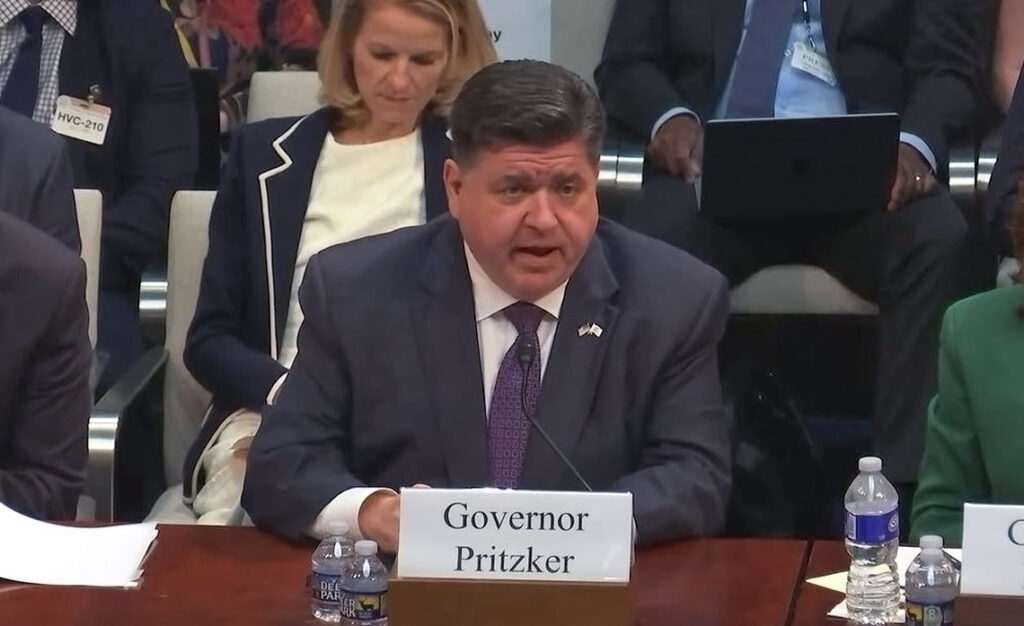
Gov. JB Pritzker spent hours Thursday defending his governing record and Illinois’ immigration policies as he was peppered with questions from members of the U.S. House Oversight Committee.
Pritzker and Democratic governors Kathy Hochul of New York and Tim Walz of Minnesota were summoned to Washington, D.C., by committee Chair James Comer, R-Ky., to answer questions about “sanctuary states.” The hearing mostly involved lectures from Republican members arguing immigration policies like Illinois’ diminish public safety while Democratic members blasted the Trump administration’s deportation raids.
“I invited these governors here today because as the chief executives of their states, they willfully ignore federal law, shield illegal aliens and pass the cost of free services onto their hardworking taxpayers,” Comer said. “It’s hard to figure out whose side these governors are on. They shield criminals while their own citizens pay the price.”
Pritzker countered by reiterating a point he has made publicly in Illinois several times since November’s election.
“As I have consistently said, violent criminals have no place on our streets, and if they are undocumented, I want them out of Illinois and out of our country,” Pritzker said. “And as we are reminded in Los Angeles this week, we can all agree that violence of any kind, whomever it is directed at, is unacceptable.”
Pritzker’s appearance before the committee came as nationwide protests grew over the Trump administration’s deportation tactics and increasing arrest numbers by Immigration and Customs Enforcement, especially in Los Angeles.
After protests and violence in that city last weekend prompted President Donald Trump to deploy hundreds of troops, thousands of people marched through the streets of Chicago this week protesting immigration raids. Some protestors briefly clashed with police, and 17 people were arrested, according to Chicago Police.
Dozens more protests are planned in Chicago and around Illinois on Saturday. Dubbed as “No King” protests, the gatherings are designed to contrast with a military parade planned by Trump in Washington on Saturday celebrating the U.S. Army’s 250th birthday. Saturday is also Trump’s 79th birthday.
Pritzker said if the Illinois National Guard ever needs to be activated to quell civil unrest, it’s done in coordination with local law enforcement. He criticized Trump’s deployment of the Guard in Los Angeles.
“It’s wrong to deploy the National Guard and active-duty Marines into an American city over the objection of local law enforcement just to inflame a situation and create a crisis,” Pritzker said.
Republicans on the committee alleged “sanctuary state” laws violate federal immigration laws. Illinois’ 2017 TRUST Act, signed by Republican Gov. Bruce Rauner, prohibits Illinois law enforcement from detaining people based on their immigration status and assisting in civil immigration enforcement. Law enforcement cannot hold people based on federal immigration warrants in most cases, but they can make arrests for federal criminal warrants.
Rep. Gary Palmer, R-Ala., suggested the three governors be criminally charged with obstruction because of their states’ laws. His comments follow Trump’s suggestion that California Gov. Gavin Newsom should be arrested.
“I have the highest duty to protect the people of my state, and indeed if Tom Homan were to come to my state and try to arrest us, me rather, I can say first of all that he can try,” Pritzker said of Trump’s border czar. “I can also tell you I will stand in the way of Tom Homan going after people who don’t deserve to be frightened in their community.”
Homan told CNN earlier this week Newsom hasn’t done anything to require an arrest.
Controversy over Illinois’ immigration policies
Pritzker blamed decades of federal government inaction on immigration and border security for exacerbating issues in the U.S. He also acknowledged to Comer that President Joe Biden inadequately handled immigration, particularly as 50,000 migrants were sent to Illinois mostly by the governor of Texas.
“We’re not in charge of the border in Illinois, I can tell you that,” Pritzker later told Rep. Pete Sessions, R-Texas. “We don’t have a border with a foreign country. … We had 50,000 people who came from Texas because they were shipped to us. And let me tell you, I was in favor of helping them.”
Read more: Pritzker to tell Congress ‘both parties are to blame’ for broken immigration system
Pritzker occasionally butted heads with Republicans throughout the hearing. Comer questioned the governor about the death of Katie Abraham in an Urbana car crash. She was killed in January by a suspected drunken driver illegally in the United States, according to WCIA. The GOP members mentioned several crime victims by name throughout the hearing.
Rep. Mary Miller, a Republican from Hindsboro, accused Pritzker of “rolling out the red carpet for illegal aliens,” adding “illegal aliens in our state have overwhelmed our communities.”
“I am not going to be lectured to by someone who extolled the virtues of Adolf Hitler,” Pritzker said, alluding to comments Miller made on Jan. 6, 2021.
Given multiple scenarios about what should happen to people who commit crimes while illegally in the country, Pritzker reiterated he supports deporting violent people but emphasized that must happen with due process. Democrats have argued Trump’s administration is deporting people without due process.
Republicans also criticized Illinois’ recent budgets for providing more than $1 billion of state health care benefits to people without documentation along with other programs for noncitizens. However, Pritzker is expected to sign a new state budget this month that eliminates a $330 million health care program for immigrants between ages 42 and 64.
“You do not keep track of any public service dollars in the state of Illinois that goes to illegal immigrants?” Rep. Byron Donalds, R-Fla., asked Pritzker after the governor didn’t offer specifics about exactly how much Illinois spends on “illegal immigration.”
And while Pritzker cast some blame on Republican-led border states for making Illinois part of recent waves of millions of migrants, Rep. Andy Biggs, R-Ariz., remarked that while “Illinois didn’t ask for this crisis” as Pritzker said in his opening remarks, “neither did Yuma, Arizona.”
The hearing’s message
The hearing veered off topic several times. Rep. Raja Krishnamoorthi, a Schaumburg Democrat, praised Pritzker’s work on the economy and spent time discussing Pope Leo XIV’s White Sox loyalty while Texas Republican Rep. Brandon Gill asked Pritzker whether he’s ever used a woman’s restroom.
“You’re admitting that this is just a political circus,” Pritzker responded to Gill.
Aside from Gill’s question about bathrooms, Pritzker largely avoided any immigration-related viral moments. The most intense grilling was reserved for Walz as the Democrat’s 2024 vice presidential nominee and Hochul over high-profile murders in New York.
Rep. Nancy Mace, R-S.C., remarked the hearing featured a possible preview of the 2028 Democratic presidential primary. Pritzker and Walz are both viewed as possible candidates in the next presidential election.
Pritzker’s appearance at the committee hearing is the latest opportunity to grow his national profile. His schedule throughout 2025 has been dotted with national media interviews and out-of-state speaking engagements where he has often called for more protests of the Trump administration.
Read more: Trump’s 100 days: Pritzker calls for mass mobilization as he grows his national profile
He echoed that message again Thursday.
“I encourage people to peacefully protest, and I have said that many times,” he said.
Pritzker said Trump “has created a situation where people are afraid.”
“They’re afraid they’re going to get targeted because that is what’s happening under this administration. People are getting individually targeted when they stand up and speak out,” Pritzker said.
Capitol News Illinois is a nonprofit, nonpartisan news service that distributes state government coverage to hundreds of news outlets statewide. It is funded primarily by the Illinois Press Foundation and the Robert R. McCormick Foundation.
The post Pritzker defends Illinois’ immigration laws in theatrical congressional hearing appeared first on Capitol News Illinois.