Posts Tagged ‘Mary Miller’
Pritzker calls Texas GOP’s remap effort ‘cheating,’ doesn’t rule out Illinois response
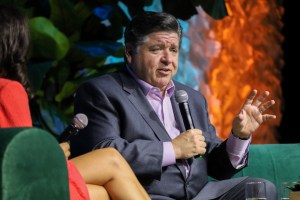
Gov. JB Pritzker speaks during a forum on climate change at the Aspen Ideas conference in Chicago on Monday, July 21, 2025. (Capitol News Illinois photo by Andrew Adams)
A spokesperson for a General Assembly leader says Democrats are not considering redrawing Illinois’ maps.
The post Pritzker calls Texas GOP’s remap effort ‘cheating,’ doesn’t rule out Illinois response appeared first on Capitol News Illinois
Pritzker warns 330,000 Illinoisans could lose Medicaid under Trump’s budget plan
Capitol News Illinois
Article Summary
The U.S. House gave final passage Thursday to a bill that will cut federal Medicaid spending in Illinois by an estimated 20%, or $48 billion, over 10 years.
Medicaid pays for about 40% of all childbirths in Illinois as well as 69% of all nursing home care, according to an independent analysis.
State officials estimate 330,000 Illinoisans could lose Medicaid coverage if President Donald Trump signs the bill into law.
The Illinois Department of Public Health said nine rural hospitals in Illinois would face closure or severe service reductions due to the cuts.
This summary was written by the reporters and editors who worked on this story.
SPRINGFIELD — The U.S. House gave final passage Thursday to a budget bill that will cut federal Medicaid spending by an estimated $1 trillion over 10 years.
All three Republican members of the Illinois congressional delegation voted in favor of the bill, despite a last-minute plea from Democratic Gov. JB Pritzker who warned the bill will result more than 330,000 Illinoisans losing Medicaid coverage and have a devastating effect on some rural hospitals.
“As those who are entrusted with protecting the health of all your constituents, I urge you to oppose these harmful Medicaid provisions and work to protect healthcare access for rural Illinois families, workers, and veterans,” Pritzker wrote in the letter addressed to GOP Reps. Mike Bost, Darin LaHood and Mary Miller.
The cuts would translate to about $48 billion in Illinois over that period, or about 20% of what the state would otherwise receive, according to an analysis by KFF, a nonpartisan health policy research organization.
That would be one of the largest percentage reductions in any state in the nation, according to KFF, a nonpartisan health policy research organization formerly known as the Kaiser Family Foundation. Louisiana and Virginia would each see cuts of about 21%, KFF said.
The state-level analysis is based largely on Congressional Budget Office estimates showing the bill would reduce federal Medicaid spending by $1 trillion nationwide over the next decade.
The KFF analysis does not include estimates of the number of people who would lose Medicaid coverage under the bill, noting how that will depend on how individual states respond to the policy changes contained in the bill. But overall, it estimates the number of uninsured Americans will grow by 11.8 million.
The bill, which includes many of President Donald Trump’s domestic policy priorities – including tax cuts and increased spending on border security – passed the Senate on Tuesday by a vote of 51-50, with Vice President J.D. Vance casting the tie-breaking vote. Both senators from Illinois, Democrats Dick Durbin and Tammy Duckworth, voted no.
The final vote in the House was 218-214.
“The One Big, Beautiful Bill is a once-in-a-generation victory for the American people,” Miller said in a statement after the House vote. “It delivers on President Trump’s America First agenda with bold, decisive, and immediate action. This is the most pro-worker, pro-family, pro-America legislation I have voted for during my time in Congress, and I was proud to help get it across the finish line for the hardworking Americans across my district.”
Medicaid and the health care marketplace
Medicaid, which is jointly funded by states and the federal government, provides health coverage for lower-income individuals and families. It was established in 1965 alongside Medicare, the federally funded health coverage program for people over 65.
Today, according to the Illinois Department of Healthcare and Family Services, the program covers about 3.4 million people in Illinois, or a fourth of the state’s population. At a total cost of $33.7 billion a year, it is one of the largest single categories of expenditures in the state’s budget. It pays for about 40% of all childbirths in the state, according to KFF, as well as 69% of all nursing home care.
But questions about its future loomed over the Illinois General Assembly during the just-completed legislative session as both Congress and the General Assembly were crafting their respective budgets for their upcoming fiscal years.
“This was a difficult year because of the unprecedented changes and cuts that are looming on the horizon in Washington,” state Rep. Anna Moeller, D-Elgin, said on the floor of the Illinois House during debate over a Medicaid bill on the final day of the session.
Read more: Amid uncertainty in Washington, Illinois lawmakers pass slimmed-down Medicaid package
Speaking with reporters at an unrelated event Tuesday, Pritzker predicted “hundreds of thousands” of people in Illinois will lose Medicaid coverage if the Senate bill is signed into law.
“This is shameful, if you ask me, and it’s going to be very hard to recover,” Pritzker said. “The state of Illinois can’t cover the cost – no state in the country can cover the cost of reinstating that health insurance that is today paid for mostly by the federal government, partly by state government.”
Policy changes under the bill
According to KFF, most of the reductions in Medicaid spending would result from just a few policy changes contained in the bill
Those include imposing a work requirement on adults enrolled in Medicaid through the Affordable Care Act, also known as “Obamacare.” That law expanded eligibility for Medicaid to working-age adults with incomes up to 138% of the federal poverty level. About 772,000 people in Illinois are enrolled under that program.
The bill also calls for requiring people enrolled through the ACA expansion to verify their continued eligibility for Medicaid twice a year instead of annually. That is expected to filter out enrollees whose incomes rise above the eligibility limit as well as those who simply fail to complete the verification process.
Another provision would limit the ability of states to finance their share of the cost of Medicaid by levying taxes on health care providers. Illinois imposes such taxes on hospitals, nursing facilities and managed care organizations that administer the program. Revenue from those taxes is used to draw down federal matching funds that are then used to fund higher reimbursement rates to health care providers.
The final version of the bill does not, however, include a provision penalizing states like Illinois that also provide state-funded health care to noncitizens who do not have lawful status to be in the United States. That provision, which was included in the earlier House version, was not included in the Senate bill, according to KFF.
Capitol News Illinois is a nonprofit, nonpartisan news service that distributes state government coverage to hundreds of news outlets statewide. It is funded primarily by the Illinois Press Foundation and the Robert R. McCormick Foundation.
The post Pritzker warns 330,000 Illinoisans could lose Medicaid under Trump’s budget plan appeared first on Capitol News Illinois.
Pritzker defends Illinois’ immigration laws in theatrical congressional hearing
Capitol News Illinois
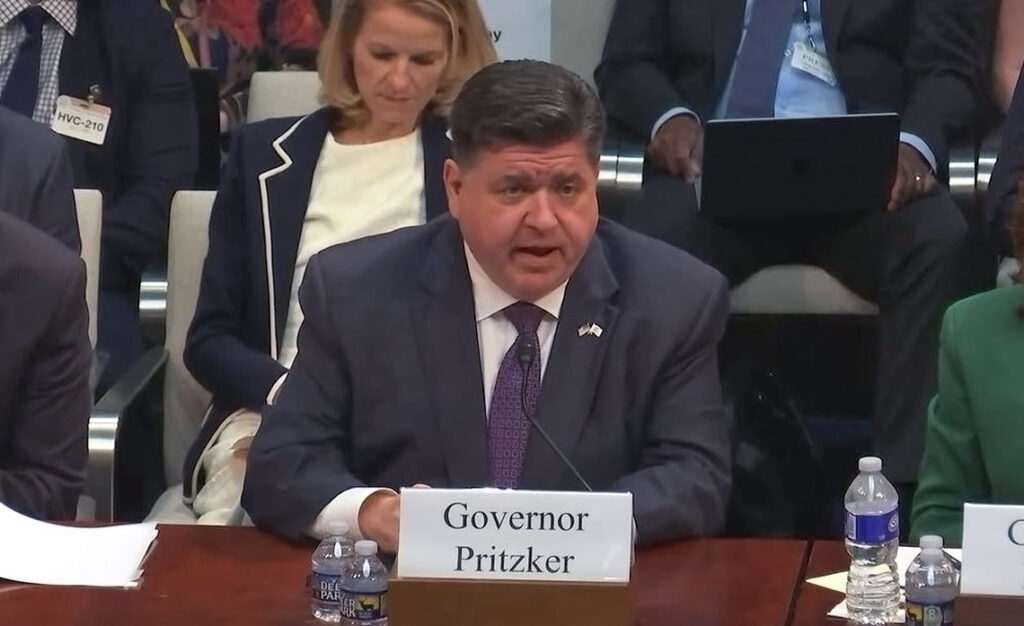
Gov. JB Pritzker spent hours Thursday defending his governing record and Illinois’ immigration policies as he was peppered with questions from members of the U.S. House Oversight Committee.
Pritzker and Democratic governors Kathy Hochul of New York and Tim Walz of Minnesota were summoned to Washington, D.C., by committee Chair James Comer, R-Ky., to answer questions about “sanctuary states.” The hearing mostly involved lectures from Republican members arguing immigration policies like Illinois’ diminish public safety while Democratic members blasted the Trump administration’s deportation raids.
“I invited these governors here today because as the chief executives of their states, they willfully ignore federal law, shield illegal aliens and pass the cost of free services onto their hardworking taxpayers,” Comer said. “It’s hard to figure out whose side these governors are on. They shield criminals while their own citizens pay the price.”
Pritzker countered by reiterating a point he has made publicly in Illinois several times since November’s election.
“As I have consistently said, violent criminals have no place on our streets, and if they are undocumented, I want them out of Illinois and out of our country,” Pritzker said. “And as we are reminded in Los Angeles this week, we can all agree that violence of any kind, whomever it is directed at, is unacceptable.”
Pritzker’s appearance before the committee came as nationwide protests grew over the Trump administration’s deportation tactics and increasing arrest numbers by Immigration and Customs Enforcement, especially in Los Angeles.
After protests and violence in that city last weekend prompted President Donald Trump to deploy hundreds of troops, thousands of people marched through the streets of Chicago this week protesting immigration raids. Some protestors briefly clashed with police, and 17 people were arrested, according to Chicago Police.
Dozens more protests are planned in Chicago and around Illinois on Saturday. Dubbed as “No King” protests, the gatherings are designed to contrast with a military parade planned by Trump in Washington on Saturday celebrating the U.S. Army’s 250th birthday. Saturday is also Trump’s 79th birthday.
Pritzker said if the Illinois National Guard ever needs to be activated to quell civil unrest, it’s done in coordination with local law enforcement. He criticized Trump’s deployment of the Guard in Los Angeles.
“It’s wrong to deploy the National Guard and active-duty Marines into an American city over the objection of local law enforcement just to inflame a situation and create a crisis,” Pritzker said.
Republicans on the committee alleged “sanctuary state” laws violate federal immigration laws. Illinois’ 2017 TRUST Act, signed by Republican Gov. Bruce Rauner, prohibits Illinois law enforcement from detaining people based on their immigration status and assisting in civil immigration enforcement. Law enforcement cannot hold people based on federal immigration warrants in most cases, but they can make arrests for federal criminal warrants.
Rep. Gary Palmer, R-Ala., suggested the three governors be criminally charged with obstruction because of their states’ laws. His comments follow Trump’s suggestion that California Gov. Gavin Newsom should be arrested.
“I have the highest duty to protect the people of my state, and indeed if Tom Homan were to come to my state and try to arrest us, me rather, I can say first of all that he can try,” Pritzker said of Trump’s border czar. “I can also tell you I will stand in the way of Tom Homan going after people who don’t deserve to be frightened in their community.”
Homan told CNN earlier this week Newsom hasn’t done anything to require an arrest.
Controversy over Illinois’ immigration policies
Pritzker blamed decades of federal government inaction on immigration and border security for exacerbating issues in the U.S. He also acknowledged to Comer that President Joe Biden inadequately handled immigration, particularly as 50,000 migrants were sent to Illinois mostly by the governor of Texas.
“We’re not in charge of the border in Illinois, I can tell you that,” Pritzker later told Rep. Pete Sessions, R-Texas. “We don’t have a border with a foreign country. … We had 50,000 people who came from Texas because they were shipped to us. And let me tell you, I was in favor of helping them.”
Read more: Pritzker to tell Congress ‘both parties are to blame’ for broken immigration system
Pritzker occasionally butted heads with Republicans throughout the hearing. Comer questioned the governor about the death of Katie Abraham in an Urbana car crash. She was killed in January by a suspected drunken driver illegally in the United States, according to WCIA. The GOP members mentioned several crime victims by name throughout the hearing.
Rep. Mary Miller, a Republican from Hindsboro, accused Pritzker of “rolling out the red carpet for illegal aliens,” adding “illegal aliens in our state have overwhelmed our communities.”
“I am not going to be lectured to by someone who extolled the virtues of Adolf Hitler,” Pritzker said, alluding to comments Miller made on Jan. 6, 2021.
Given multiple scenarios about what should happen to people who commit crimes while illegally in the country, Pritzker reiterated he supports deporting violent people but emphasized that must happen with due process. Democrats have argued Trump’s administration is deporting people without due process.
Republicans also criticized Illinois’ recent budgets for providing more than $1 billion of state health care benefits to people without documentation along with other programs for noncitizens. However, Pritzker is expected to sign a new state budget this month that eliminates a $330 million health care program for immigrants between ages 42 and 64.
“You do not keep track of any public service dollars in the state of Illinois that goes to illegal immigrants?” Rep. Byron Donalds, R-Fla., asked Pritzker after the governor didn’t offer specifics about exactly how much Illinois spends on “illegal immigration.”
And while Pritzker cast some blame on Republican-led border states for making Illinois part of recent waves of millions of migrants, Rep. Andy Biggs, R-Ariz., remarked that while “Illinois didn’t ask for this crisis” as Pritzker said in his opening remarks, “neither did Yuma, Arizona.”
The hearing’s message
The hearing veered off topic several times. Rep. Raja Krishnamoorthi, a Schaumburg Democrat, praised Pritzker’s work on the economy and spent time discussing Pope Leo XIV’s White Sox loyalty while Texas Republican Rep. Brandon Gill asked Pritzker whether he’s ever used a woman’s restroom.
“You’re admitting that this is just a political circus,” Pritzker responded to Gill.
Aside from Gill’s question about bathrooms, Pritzker largely avoided any immigration-related viral moments. The most intense grilling was reserved for Walz as the Democrat’s 2024 vice presidential nominee and Hochul over high-profile murders in New York.
Rep. Nancy Mace, R-S.C., remarked the hearing featured a possible preview of the 2028 Democratic presidential primary. Pritzker and Walz are both viewed as possible candidates in the next presidential election.
Pritzker’s appearance at the committee hearing is the latest opportunity to grow his national profile. His schedule throughout 2025 has been dotted with national media interviews and out-of-state speaking engagements where he has often called for more protests of the Trump administration.
Read more: Trump’s 100 days: Pritzker calls for mass mobilization as he grows his national profile
He echoed that message again Thursday.
“I encourage people to peacefully protest, and I have said that many times,” he said.
Pritzker said Trump “has created a situation where people are afraid.”
“They’re afraid they’re going to get targeted because that is what’s happening under this administration. People are getting individually targeted when they stand up and speak out,” Pritzker said.
Capitol News Illinois is a nonprofit, nonpartisan news service that distributes state government coverage to hundreds of news outlets statewide. It is funded primarily by the Illinois Press Foundation and the Robert R. McCormick Foundation.
The post Pritzker defends Illinois’ immigration laws in theatrical congressional hearing appeared first on Capitol News Illinois.