Posts Tagged ‘Juliana Stratton’
Mapping Juliana Stratton’s U.S. Senate Democratic primary win
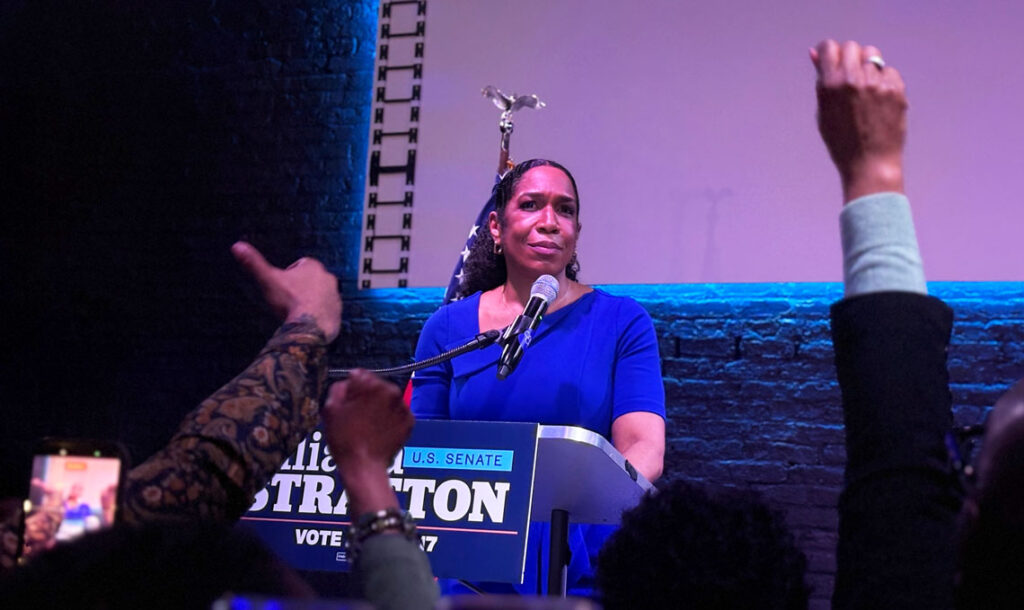
The foundation of Lt. Gov. Juliana Stratton’s larger-than-expected victory in the Democratic primary for Illinois’ open U.S. Senate was laid with a dominant performance in Chicago but padded by a surprisingly strong performance downstate. She also kept up with Rep. Raja Krishnamoorthi in the Chicago suburbs.
Read MoreMoore: How ‘Strattmentum’ upended Krishnamoorthi’s once-seemingly inevitable Senate path
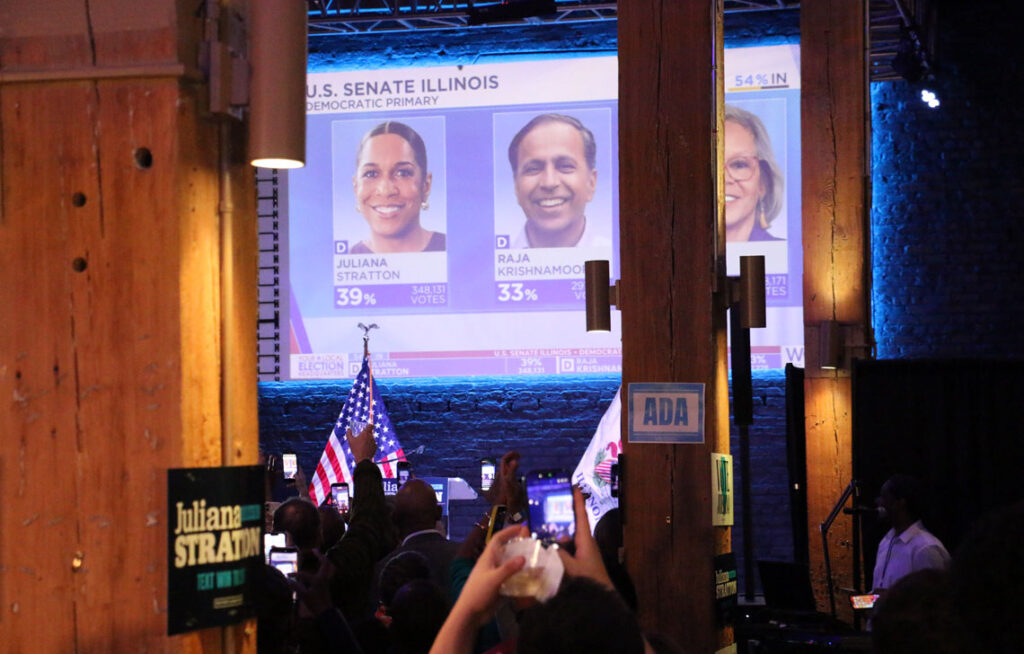
Everyone has a take on the impact the flood of money had on the Democratic U.S. Senate primary. Brenden Moore’s? Money was obviously a factor. The leading candidates needed it to communicate with voters. But money isn’t worth anything without a winning message and an effective messenger to deliver it.
Read MoreChristian Mitchell sizes up the Pritzker vs. Bailey rematch
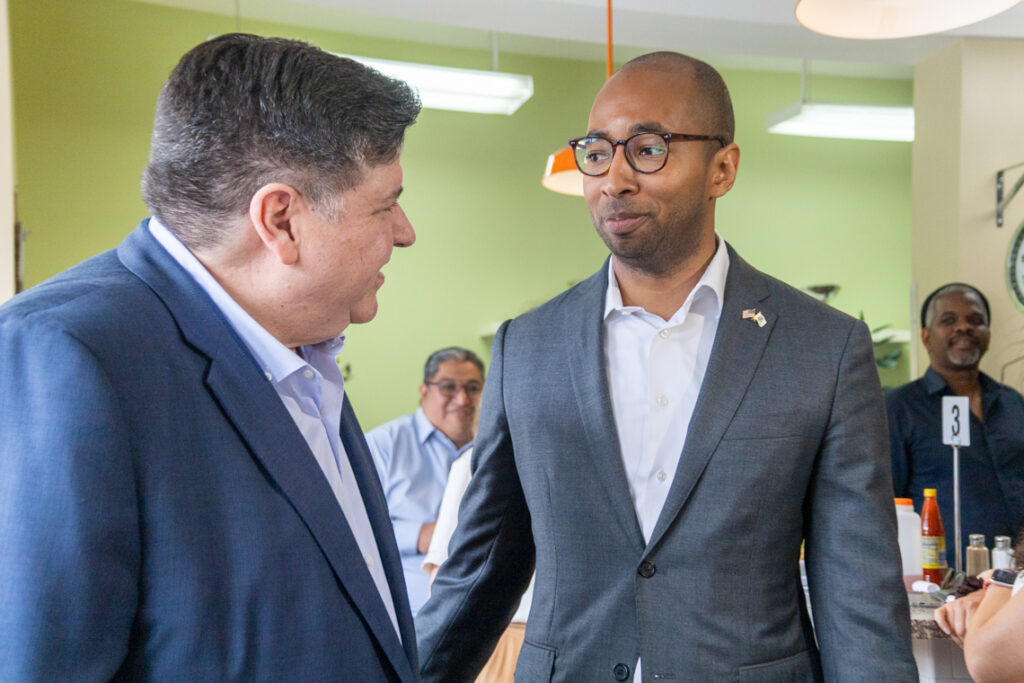
Gov. JB Pritzker’s running mate, Christian Mitchell says the Pritzker campaign is taking Republican Darren Bailey’s candidacy seriously, looking to make things more affordable for Illinoisans and keeping an eye on progress toward clean energy goals.
Read MoreHow Illinois’ Democratic U.S. Senate candidates plan to address economic issues
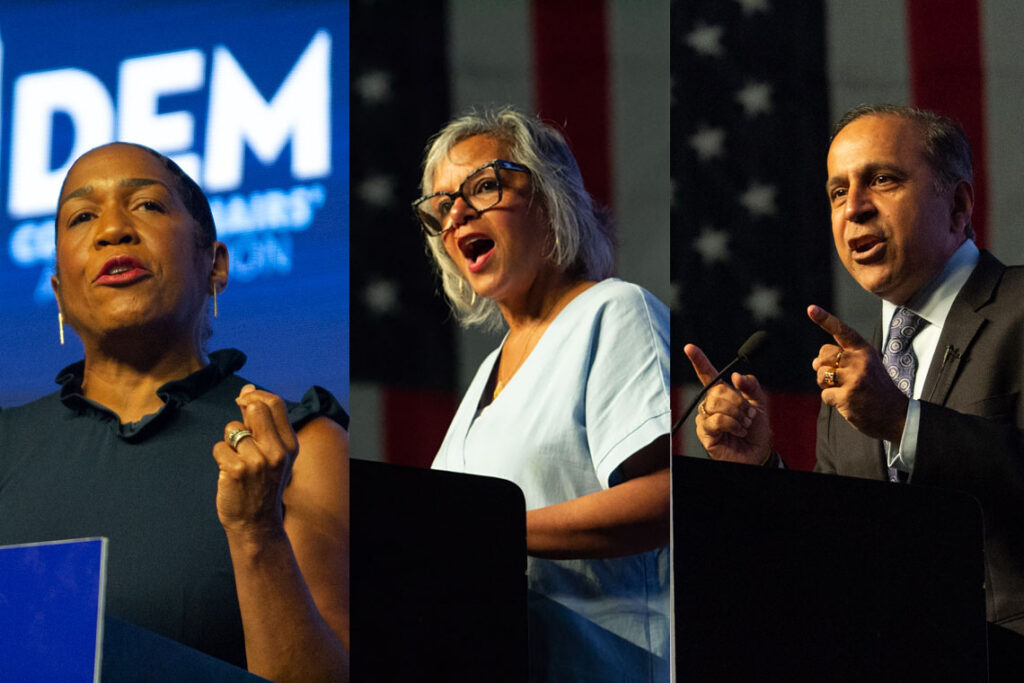
The top three Democrats running for U.S. Senate have released economic plans.
Read MoreKelly leans on experience in Illinois’ Democratic Senate primary
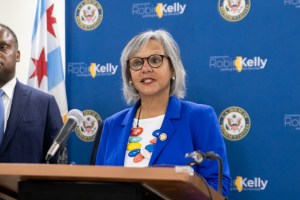
U.S. Rep. Robin Kelly, D-Matteson, speaks at an event on March 18, 2025. (Capitol News Illinois photo by Andrew Adams)
U.S. Rep. Robin Kelly is one of three high-profile Democrats hoping to join the U.S. Senate after the 2026 election.
The post Kelly leans on experience in Illinois’ Democratic Senate primary appeared first on Capitol News Illinois
Cook County Dems back Croke for comptroller, no endorsement for Senate race
Capitol News Illinois
Article Summary
The Cook County Democratic Party, one of the most powerful political organizations in the state, chose to back Rep. Margaret Croke, D-Chicago, in her bid to be the next state comptroller.
The comptroller endorsement sparked an intraparty fight, with House Speaker Chris Welch on one side and Senate President Don Harmon on the other.
The party made no endorsement in the race for U.S. Senate.
This summary was written by the reporters and editors who worked on this story.
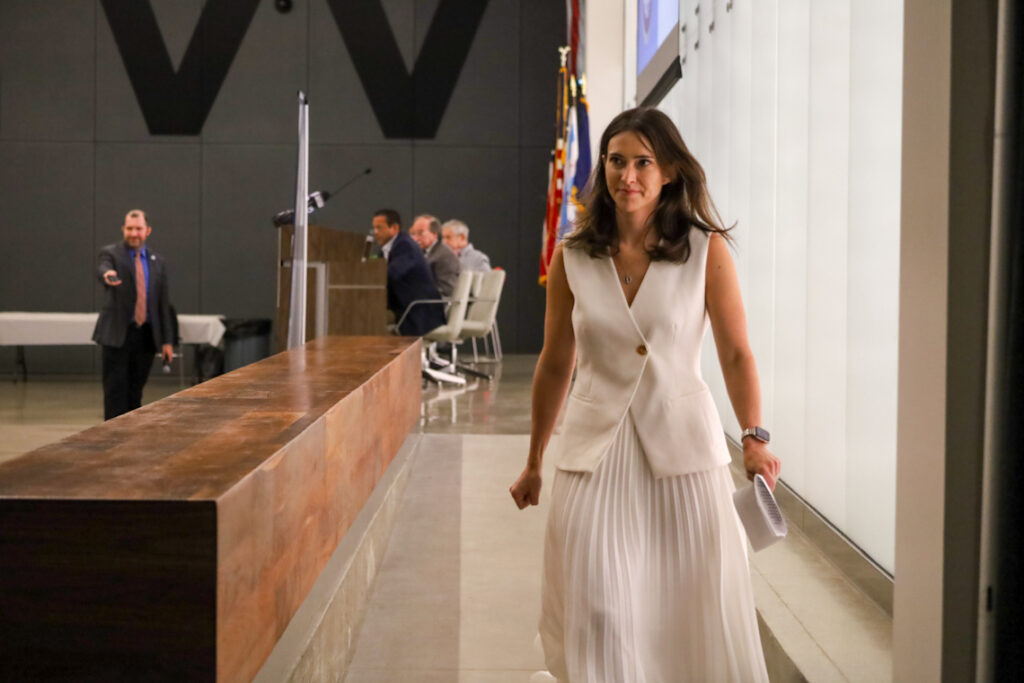
CHICAGO — At a union hall on Chicago’s South Side, a powerful Democratic Party organization decided who to endorse in the March 17 primary in one key statewide race.
The Cook County Democratic Party Central Committee decided Friday to back Rep. Margaret Croke, D-Chicago, in her bid for Illinois comptroller, the state’s chief financial officer.
That decision sparked conflict between Illinois House Speaker Emanuel “Chris” Welch and Senate President Don Harmon, who backed different candidates.
In the race for U.S. senate however, the party declined to endorse. It’s the first open Senate election in the state since 2010.
“I think the party made the correct decision in making no endorsement in the U.S. Senate race,” Harmon told Capitol News Illinois. “It’s a marquee race with terrific candidates and I’m sure the voters will be able to make an informed decision without an endorsement.”
House Speaker Emanuel “Chris” Welch speaks in favor of slating state Rep. Margaret Croke as the Cook County Democratic Party’s choice for comptroller in the 2026 primary at a meeting Friday in Chicago. (Capitol News Illinois photo by Andrew Adams)
But Harmon objected to the party’s endorsement in the comptroller’s race, sparking a protracted closed-door debate.
Ultimately, Croke bested a list of competitors that included state Sen. Karina Villa, a member of Harmon’s caucus in Springfield.
While an endorsement from the Cook County Democrats does not guarantee a win, it is a major step for a campaign in Illinois.
Cook County has about 40% of the state’s population, and its Democratic Party has been a dominant political force for decades. Beyond the potential for turning out votes in the state’s most populous county, an endorsement from the Cook County Democrats can be a litmus test for support from state-level Democrats.
The group of party insiders considering who to endorse includes Welch and Harmon — both from suburban Cook County — and the committee that oversees statewide endorsements is chaired by state Rep. Bob Rita, D-Blue Island.
Additionally, influential Democrats in the General Assembly, like Rep. Kam Buckner, D-Chicago; Sen. Laura Murphy, D-Des Planes, and Sen. Elgie Sims, D-Chicago, were all present for the meeting.
Party backs Croke for comptroller
The race for comptroller, which opened up this week after sitting comptroller Susana Mendoza announced she was not seeking reelection, sparked a clash between several of the state’s most powerful politicians.
Five candidates asked for the party’s backing. Croke, Lake County Treasurer Holly Kim and Villa, D-West Chicago, were the favored candidates going into the meeting. Champaign County Auditor George Danos and former state Sen. Rickey Hendon also presented at the meeting.
Welch photo
Welch spoke at length in favor of Croke during the slating meeting, adding that he was “very happy to support” Croke. Croke is close to Gov. JB Pritzker, having worked in the Department of Commerce and Economic Opportunity and on his first campaign.
Meanwhile, Harmon backed Villa.
During discussions over comptroller candidates, Cook County Board President Toni Preckwinkle also noted she believed it is “really important for this party to support a Latino for statewide office.”
Read more: Comptroller Mendoza won’t run for reelection, opening up statewide office
In a private session and on a very narrow vote, the subcommittee that recommends statewide endorsements backed Croke. Back in the public session, Harmon fought to try and reject the recommendation.
“We have a slate that does not have any representation from the Latino Caucus, no representation from the Asian Caucus, no one from outside the city of Chicago. I think this is the problem,” Harmon said.
Senate President Don Harmon watches during presentations from comptroller candidates at a meeting to decide who the Cook County Democratic Party will support. Harmon said he had concerns about diversity on the ticket and had backed Sen. Karina Villa. The party ultimately slated Croke. (Capitol News Illinois photo by Andrew Adams)
This sparked another closed-door debate after which Croke emerged with the ultimate endorsement, something that “disappointed” Harmon.
“I worry that the party was more divided than evidenced by the final outcome,” he said. “But it’ll be up to the voters.”
No endorsement for U.S. Senate
After Dick Durbin, Illinois’ current senior U.S. senator, announced his retirement, several candidates quickly popped up to replace him at the end of his final term.
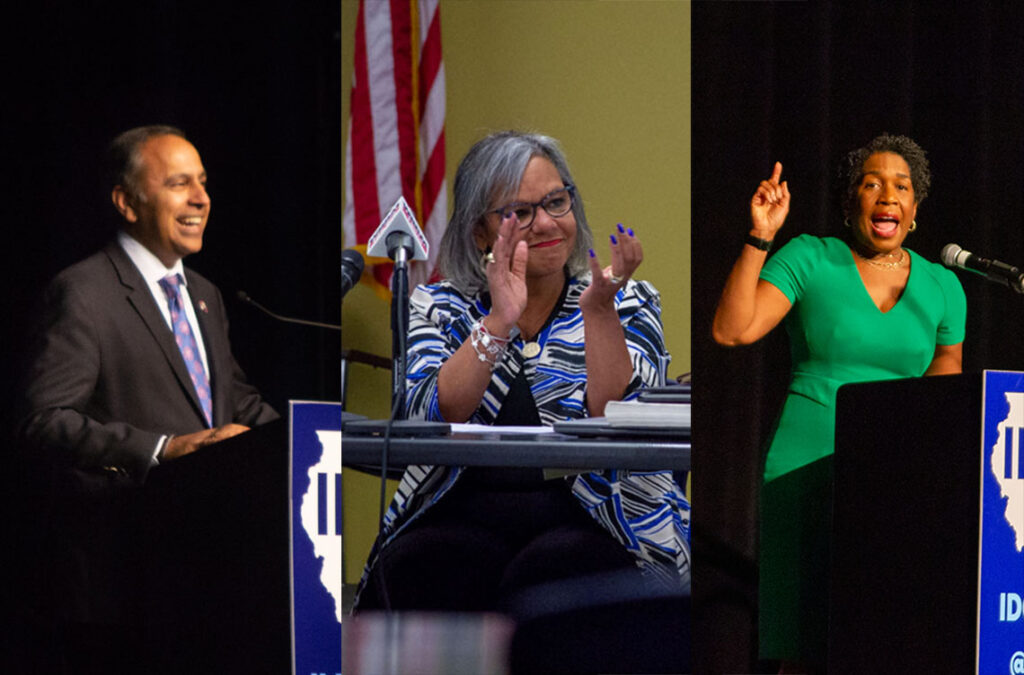
The three frontrunners so far are Lt. Gov. Juliana Stratton, U.S. Rep. Raja Krishnamoorthi and U.S. Rep. Robin Kelly.
Read more: Who is contributing to Illinois’ U.S. Senate candidates?
Several other candidates are in the race and three spoke to party insiders Friday: Christopher Swan, Kevin Ryan and Jump Shepherd. Kelly did not appear at Friday’s meeting, instead having an ally speak on her behalf following travel issues after a late night of voting in Washington.
In the end, the Cook County Democrats didn’t endorse any of them, setting up a contentious primary fight between a current statewide office holder, the one-time state party chair and a man who has nearly 10-to-1 funding advantage.
Durbin, meanwhile, plans on mostly staying out of the race. The retiring senator said Friday that there are three good candidates in the race. While he said he hasn’t “ruled out completely” endorsing someone, he probably won’t.
“I’m not likely to endorse in the race,” Durbin said. “I may in some other races but not that one.”
Governor, other endorsements
The governor couldn’t make the meeting due to a family commitment. In his stead, Pritzker’s running mate Christian Mitchell addressed the collection of party insiders. In a brief speech, Mitchell echoed many of Pritzker campaign talking points.
Christian Mitchell, who is Gov. JB Pritzker’s running mate, took pointed questions from Cook County Democrats on Friday during a meeting about slating candidates for the 2026 primary. (Capitol News Illinois photo by Andrew Adams)
But when the floor was opened to questions, Mitchell started taking heat.
Mitchell, who oversaw Pritzker’s cannabis legalization efforts early in the governor’s first term, once tweeted that he was “stunned at the level of ignorance” at a Chicago City Council meeting, something that multiple alderpeople in attendance on Friday took exception to.
“I don’t recall using that term, but if I did, I apologize,” Mitchell said when questioned by Chicago Ald. David Moore.
Mitchell also faced heat from Chicago Ald. Raymond Lopez, who pressed him on the administration’s relationship to the Latino community. Several Chicago alderpeople also interrogated Mitchell over the administration’s plans on Chicagoland transit, Chicago Public Schools and the closure of manufacturing plants on Chicago’s South Side.
But Mitchell did have his fans in the audience, with one committee member noting that Mitchell’s appearance at a fundraiser helped increase donations, something Mitchell said he wanted to replicate.
“I want to go everywhere, I want to be everywhere,” he said.
The party voted to endorse the Pritzker-Mitchell ticket, which faces no serious challengers within the Democratic party.
Attorney General Kwame Raoul, Treasurer Michael Frerichs and Secretary of State Alexi Giannoulias also received endorsements.
Capitol News Illinois is a nonprofit, nonpartisan news service that distributes state government coverage to hundreds of news outlets statewide. It is funded primarily by the Illinois Press Foundation and the Robert R. McCormick Foundation.
The post Cook County Dems back Croke for comptroller, no endorsement for Senate race appeared first on Capitol News Illinois.
Who is contributing to Illinois’ U.S. Senate candidates?
Capitol News Illinois
Article Summary
U.S. Rep. Raja Krishnamoorthi raised the most money in the first quarter of fundraising for the 2026 Illinois Democratic primary for U.S. Senate and has already launched a TV ad.
Lt. Gov. Juliana Stratton received money from some of the most politically connected donors in state politics, from Gov. JB Pritzker to lobbyists and owners of Chicago sports teams.
U.S. Rep. Robin Kelly had the lowest fundraising total but has more than $2 million available.
Ten other candidates in both parties have also filed federal campaign committees but did not report substantial contributions.
This summary was written by the reporters and editors who worked on this story.
TV advertising has already begun in Illinois’ 2026 Democrat primary for U.S. Senate, and new fundraising numbers released Tuesday show the race is shaping up to be expensive.
The quarterly reports submitted to the Federal Elections Commission shed light on how candidates are spending money as well as who is contributing to them. Donations are pouring in for U.S. Rep. Raja Krishnamoorthi, U.S. Rep. Robin Kelly and Lt. Gov. Juliana Stratton — the three most high-profile Democrats so far to launch their campaign.
Gov. JB Pritzker has already put his thumb on the scale of the race, endorsing Stratton a day after she launched her campaign in April. But the billionaire governor has a financial stake in the contest as well.
Pritzker contributed $3,500 to Stratton’s primary campaign, and another $3,500 earmarked for the general election. It’s the maximum amount allowed in an election cycle for an individual contribution under federal rules, meaning he can’t contribute anything close to the $300 million he’s dumped into his own campaigns for governor.
Pritzker can still find other avenues to financially support Stratton later, such as through a dark money political action committee he launched in 2023. And he wasn’t the only Pritzker to donate to Stratton. His wife, MK, his two adult children, and his cousins Adam, John, Gigi and Jennifer, all contributed the maximum $7,000. Jennifer Pritzker is a former supporter of President Donald Trump who has more recently supported Democratic candidates.
Kelly vs. Pritzker round 3
The race has also set a third battle between a Pritzker ally and Kelly.
Underlying the contest is Kelly’s past history as chair of the Democratic Party of Illinois. She was elected party chair in 2021 against Pritzker backed candidate and Chicago Ald. Michelle Harris to replace Mike Madigan who bowed out of the job after losing the speakership that year. But the following year, Kelly ended her bid for reelection as party chair after it became clear she would not have enough support to beat State Rep. Lisa Hernandez, D-Cicero, for the leadership role. Hernandez was also backed by Pritzker.
Read more: Democratic Party chair bows out in re-election bid, paving way for state Rep. Lisa Hernandez
Kelly, of Matteson, argued a lot of people on the party’s state central committee “were sad to see me go.”
“The people in the party, they know me, they know the work that I’ve done,” Kelly told Capitol News Illinois last week. “Despite what happened, I’ve still been an effective leader. I’m the only one that’s been an effective leader on every level of government and has delivered on every level.”
Kelly says money isn’t going to decide the race.
“They have a lot of money, but you know what, I’m just using every opportunity to tell my story and I don’t feel like I need the most money in the race to win the race because I feel like I have an excellent story to tell,” Kelly said.
Between her two campaign committees for her U.S. House seat and a new committee for her Senate bid, Kelly raised $565,775 from April 1 through June 30 and has $2 million in her campaign accounts.
Her donors include a lengthy list of corporate political action committees, many local officials in her 2nd Congressional District, and some notable names in Illinois government. They include former state Sen. Jacqueline Collins, Chicago Fire Department Commissioner Annette Nance-Holt and Cook County Clerk Monica Gordon. Gordon also contributed to Stratton’s campaign.
Stratton’s contributions
Stratton’s cash balance of $666,416 is the smallest in the race, as it is her first time running for federal office and first time running for office alone since she was a state representative in 2016. She raised just over $1 million since launching her campaign in late April.
Stratton has pledged not to take any money from corporate political action committees, though Krishnamoorthi and Kelly have received such donations. She returned a contribution from the central Illinois energy company Marquis Energy’s PAC, although accepted contributions from several Marquis family members who hold top leadership positions at the company, according to FEC filings.
The rest of her list of donors is a “who’s who” of Illinois Democrats.
Stratton has touted many endorsements from members of the General Assembly in recent days and 12 have contributed to her campaign. The list also includes many Lake County Democrats, including State’s Attorney Eric Rinehart, Highland Park Mayor Nancy Rotering, and county party chair Lauren Beth Gash.
Stratton also received support from owners of most of the city’s sports teams: Cubs co-owner Laura Ricketts and her wife; White Sox and Bulls owner Jerry Reinsdorf, along with his son and Bulls President Michael Reinsdorf; and Blackhawks CEO Danny Wirtz.
Other donors come from all sectors of state politics, including Sen. Tammy Duckworth, former legislators, high-profile lobbyists and consultants, Pritzker’s top political advisor, business executives, and lawyers at Chicago’s top law firms.
Some donors also hold positions in state government, including Department of Human Rights Director Jim Bennett and the Department of Labor’s top attorney, Deborah Baker.
Stratton has also formed her own political action committee called “Level Up.” Fundraising numbers for the committee have not yet been released as political action committees follow a different reporting schedule than campaigns.
Krishnamoorthi continues strong fundraising
Krishnamoorthi, of Schaumburg, has been one of the most prolific fundraisers in Congress, reporting millions of dollars in contributions every quarter. His first months running for Senate were no different.
Krishnamoorthi raised just shy of $3 million between his House campaign account and new Senate campaign account. Candidates running for a new federal office are generally allowed to transfer funds from their old campaign to their new campaign. In total, Krishnamoorthi has $21 million on hand.
“I’m just blessed to have a lot of individual donors throughout Illinois and elsewhere who believe in my mission,” Krishnamoorthi told Capitol News Illinois.
The March 17, 2026, primary is still eight months away, but Krishnamoorthi launched the election cycle’s first TV ad on Tuesday, which cost $500,000 for the first week, according to his campaign. It’s airing in TV markets around the state and on digital platforms.
Open interactive chart in new tab
The 30-second segment serves as an introduction of Krishnamoorthi, who currently represents the 8th Congressional District in the northwest suburbs. It portrays him as a fighter against “bullies,” which is how he describes Trump.
“When I see underdogs hurt by a rigged system, I fight back … Bullies like Trump can call us names, but you can just call me Raja,” Krishnamoorthi says in the ad, playing off his “just call me Raja” slogan that has been a hallmark of his TV advertisements since he first ran for Congress in 2016.
Most of Krishnamoorthi’s fundraising came from individual donors and less than $200,000 was from political action committees. But unlike his opponents, he had very few donors who are involved in state politics. One of the most notable names contributing to his campaign was Vinai Thummalapally, a former ambassador to Belize.
Other candidates
Six Republicans have filed as candidates with the Federal Elections Commission but did not raise substantial amounts of money. They include Casey Chlebek, a former IT professional who is active in Polish-American civic groups; Douglas Bennett, who ran unsuccessfully in the 10th Congressional District in 2018; Air Force veteran John Goodman; Pamela Denise Long, an occupational therapist and former political commentator for Newsweek; former Illinois International Port District board member Cary Capparelli, and Westchester resident Panagioti Bartzis.
On the Democrat side, four other candidates have filed with the FEC: Kevin Ryan, a Marine veteran and diplomat; Christopher Swann, a program manager for Feeding America; Carmi resident Stan Leavell, and Awisi Bustos, CEO of the Illinois Alliance of Boys and Girls Clubs.
Bustos is daughter-in-law of former U.S. Rep. Cheri Bustos, who represented the 17th Congressional District for 10 years. Cheri Bustos is not supporting Awisi Bustos’ campaign amid an ongoing divorce case, the D.C. insider newsletter Punchbowl reported.
Capitol News Illinois is a nonprofit, nonpartisan news service that distributes state government coverage to hundreds of news outlets statewide. It is funded primarily by the Illinois Press Foundation and the Robert R. McCormick Foundation.
The post Who is contributing to Illinois’ U.S. Senate candidates? appeared first on Capitol News Illinois.
Trump’s ‘big bill’ takes center stage in Illinois’ U.S. Senate race
Capitol News Illinois
Article summary
The three Democrats running for Illinois’ open Senate seat voiced concerns about the new domestic policy plan at events around Illinois.
Lt. Gov. Juliana Stratton discussed how SNAP cuts will affect Illinois at an event in Chicago.
Rep. Robin Kelly spoke with voters in Peoria about their concerns with federal spending cuts.
Rep. Raja Krishnamoorthi met with central Illinois independent pharmacist owners to highlight how spending cuts could hurt health care in rural areas.
This summary was written by the reporters and editors who worked on this story.
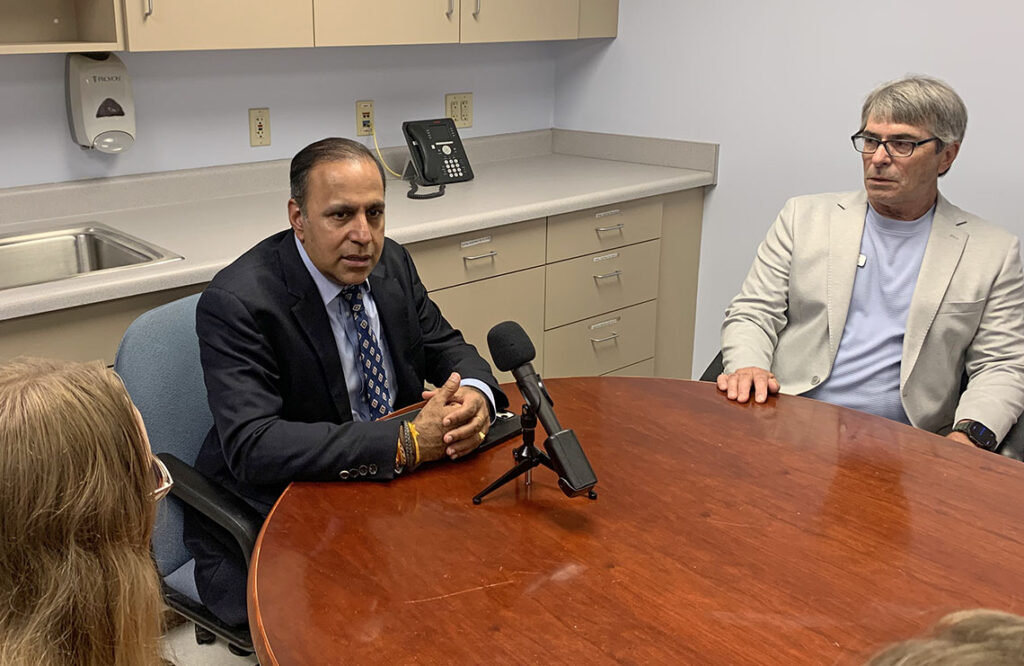
PEORIA – With major future cuts to social service programs now written into law, Democrats seeking Illinois’ open U.S. Senate seat in 2026 are hitting the campaign trail seeking to position themselves among the law’s most vocal opponents.
“We want Illinoisians throughout our state to understand the ripple effects of the Trump administration’s cruelty and be prepared for what’s to come,” Lt. Gov. Juliana Stratton said during a panel discussion at the Greater Chicago Food Depository Thursday.
The federal policy bill, dubbed the “One Big, Beautiful Bill,” signed by President Donald Trump on July 4 will slash federal spending for health care and other human service programs over the next several years, in many cases leaving states to pick up the tab if they are to continue providing benefits. The bill is expected to cost Illinois more than $700 million for the Supplemental Nutrition Assistance Program, cut Medicaid spending in Illinois by $48 billion over the next 10 years, and potentially force some rural hospitals to close.
As Illinois’ 2026 candidates prepare to begin circulating nominating petitions next month, the three Democrats vying for retiring Sen. Dick Durbin’s Senate seat met with residents around the state to hear about the local impacts of the bill and rally support for their campaigns.
Stratton held an official state event in Chicago to discuss the Pritzker administration’s response to SNAP changes, while U.S. Reps. Robin Kelly and Raja Krishnamoorthi visited downstate communities to discuss the bill.
Kelly gets feedback in Peoria
Kelly, who represents the state’s 2nd Congressional District across parts of Chicago, the south suburbs and rural eastern Illinois, visited with voters in Peoria to hear their concerns about the bill.
The Bradly University graduate said her goal is to make sure Americans are aware of the bill’s effects – even though many of them are slated to begin after the 2026 midterm election.
U.S. Rep. Robin Kelly speaks to voters at an event at the Peoria Public Library on Wednesday, July 9, 2025. (Capitol News Illinois photo by Ben Szalinski)
“In polling and different things that we’ve done, half of the population doesn’t even realize what’s going on,” Kelly said.
Kelly played up her relationship with U.S. House Minority Leader Hakeem Jeffries, saying she has been part of a coalition of House Democrats that have been traveling the country holding town hall meetings about federal spending cuts.
“Every group that we can speak in front of, we need to speak in front of,” Kelly said. “And so that’s one of the reason’s we’re traveling.”
Krishnamoorthi visits rural pharmacy
Krishnamoorthi, who represents the 8th Congressional District in the northwest suburbs, visited a pharmacy in Petersburg about 30 minutes northwest of Springfield.
He echoed concerns other Illinois Democrats have expressed about the “large, lousy law” cutting Medicaid and that it could limit health care services in rural communities.
Read more: Illinois hospitals fear massive cuts under Trump domestic policy law
“When you have that many people who all of a sudden don’t have a way of paying for their health care, then it hurts all those rural health care providers that depend on Medicaid as a form of payment for so many of their patients,” Krishnamoorthi said.
Krishnamoorthi also worried about domino effects from growing deficits as a result of the bill, which the Congressional Budget Office estimates will increase by more than $3 trillion. According to the nonpartisan health research organization KFF, the growing deficit could trigger automatic spending cuts, which could force Medicare cuts even though it was not reduced in the bill.
“We’re also talking about seniors who could be affected by Medicare cuts,” Krishnamoorthi said. “And so at the end of the day, however, everybody’s going to be affected because if, God forbid, one of these hospitals in these areas in the rural parts of Illinois are closed, then everyone, regardless of how their health care is paid for, would be affected negatively.”
SNAP cuts worry candidates
Stratton did not hit the campaign trail with any public events this week, but the Pritzker administration must now decide how it will proceed with new spending requirements signed by the president and the effects of fewer residents receiving social service benefits.
Lt. Gov. Juliana Stratton speaks at a panel discussion on SNAP benefits at the Greater Chicago Food Depository in Chicago on Thursday, July 10, 2025. (Screenshot from Illinois.gov live feed)
Stratton and other top Pritzker administration officials discussed the impact of cuts to the SNAP program during a panel discussion at the Greater Chicago Food Depository as the state seeks more immediate solutions that lawmakers could approve before the 2026 election. The lieutenant governor, who resides on Chicago’s South Side, said reducing eligibility for a food program exacerbates other issues such as crime, economic productivity and learning in schools.
“Hunger is not a problem that stays isolated,” Stratton said. “The repercussions seep out, harming everyone and everything in its path until something changes.”
Kelly told voters in Peoria that SNAP cuts aren’t just a problem for low-income recipients.
“If you cannot buy food, then you’re not shopping at Kroger or wherever you shop,” Kelly said. “And so then Kroger is not buying as much food from the farmers and then they won’t need as many people to work there.”
The Republican field in the Senate race has yet to take shape. Republican Rep. Darin LaHood from the Peoria area held a virtual townhall with 16th Congressional District voters to discuss why he believes the bill will benefit Illinois.
Capitol News Illinois is a nonprofit, nonpartisan news service that distributes state government coverage to hundreds of news outlets statewide. It is funded primarily by the Illinois Press Foundation and the Robert R. McCormick Foundation.
The post Trump’s ‘big bill’ takes center stage in Illinois’ U.S. Senate race appeared first on Capitol News Illinois.
Pritzker selects former Deputy Gov. Christian Mitchell as running mate
Capitol News Illinois
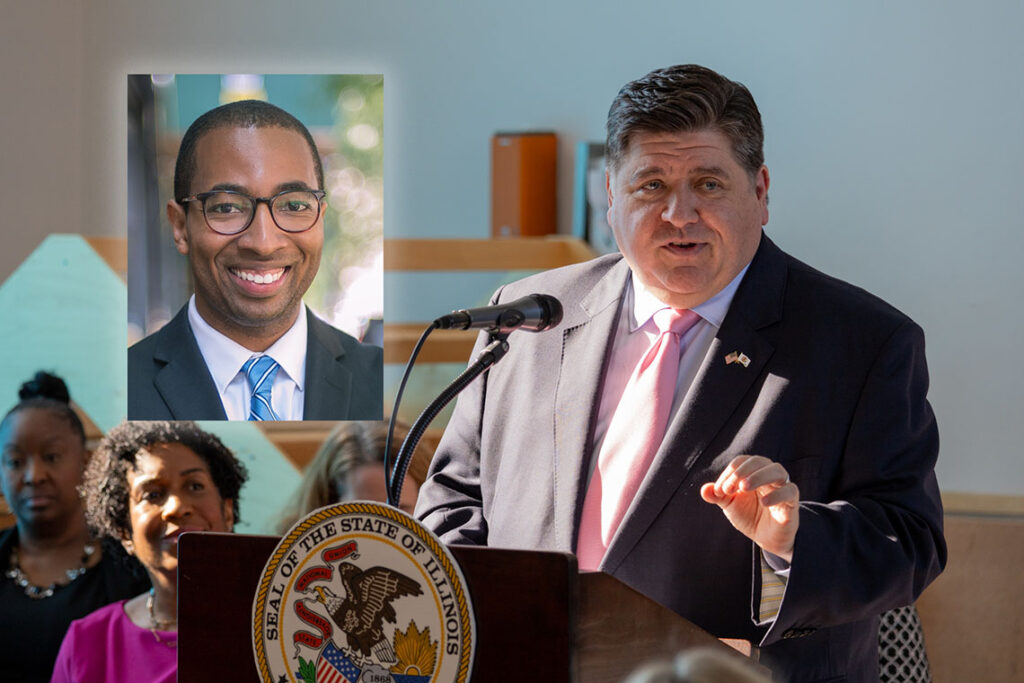
Gov. JB Pritzker announced Tuesday that former Deputy Gov. Christian Mitchell will be his running mate for the 2026 campaign.
Pritzker’s selection, made just days after announcing a third campaign for governor, comes from a close circle of trust in Pritzker’s administration. Mitchell previously served in the governor’s office as one of four deputy governors overseeing key projects in Pritzker’s first term.
“Christian Mitchell is a proven leader with deep experience, steady judgment, and an unshakable commitment to the working families of Illinois,” Pritzker said in a statement. “Whether it’s transforming our clean energy future, rebuilding our infrastructure, or keeping our communities safe, Christian has been a force behind so much of our progress. I couldn’t ask for a better partner to continue delivering results for the people of Illinois.”
Mitchell, 38, will replace Lt. Gov. Juliana Stratton on the ticket as she seeks the Democratic nomination for U.S. Senate.
Mitchell comes in with hefty experience in state government and public policy. A resident of Chicago’s Hyde Park neighborhood, Mitchell served three terms in the Illinois House beginning in 2013 and was executive director of the Democratic Party of Illinois in 2018 before joining the governor’s office in 2019.
Lieutenant governor role
Mitchell left Pritzker’s administration in early 2023 to become vice president for civic engagement at the University of Chicago where he oversees government relations. Mitchell was appointed by Pritzker last year to an unpaid seat on the Metropolitan Pier and Exposition Authority board, which oversees Navy Pier and McCormick Place. He is also a first lieutenant in the Illinois Air National Guard.
“The governor has led with courage and compassion, and together we’ve built a foundation that’s moving Illinois forward,” Mitchell said in a statement. “I’m ready to build on that progress — lowering costs, expanding opportunity, and making sure every community has the resources and opportunities they deserve. This is about delivering real results for the people of Illinois, and I’m excited to get to work.”
Read more: ‘I have work to do,’ Pritzker says in launching third-term reelection bid
Though the lieutenant governor has few constitutional responsibilities in Illinois, Pritzker has leveraged the position to task Stratton with leading key legislative initiatives and overseeing the implementation of some of his administration’s top priorities at state agencies.
If Pritzker is elected to another term, the role will hold greater importance as Pritzker considers running for president in 2028. Pritzker’s election to the presidency would require Mitchell to serve the final two years of his term.
Read more: National speculation ‘helps get more for the people of Illinois,’ Pritzker says
While keeping Mitchell’s selection under wraps, Pritzker told reporters in recent days he was looking for a running mate who was ready to immediately step into the governorship if required.
“The number one qualification is, ‘can you do the job of being governor because if you’re lieutenant governor, that may come to you,’” Pritzker said Monday.
“The second thing I think about is person who I might choose for lieutenant governor somebody who has a heart for all the people of Illinois, not just some or some specific segment of the population because we have a big, diverse state,” he said.
Deputy governor role
Deputy governors in Pritzker’s administration have a chief of staff-like role, overseeing specific policy areas and state agencies. Mitchell was in charge of environmental policy, infrastructure and public safety.
In 2020 and 2021, Mitchell oversaw the negotiations of Pritzker’s marquee climate policy — the Climate and Equitable Jobs Act. It massively reformed the utility and energy industry and requires all fossil fuel power plants to close by 2045.
Mitchell was responsible for representing the governor in negotiations around the bill and was the face of the Pritzker administration as it went through the legislature.
That law, passed in the wake of a bribery scandal with Chicago’s electric utility that forced former House Speaker Michael Madigan to resign, cemented Pritzker’s reputation as a progressive on climate issues.
In the years since, energy experts and some lawmakers involved in passing the law have raised concerns that the state is at risk of missing the clean energy targets that Mitchell helped codify.
Mitchell also oversaw the implementation of the 2019 Rebuild Illinois capital plan – a $45 billion construction project to rebuild roads, bridges and other infrastructure across the state.
Recreational cannabis regulation was also Mitchell’s responsibility. Pritzker signed legislation in his first year legalizing cannabis for recreational use and setting up a series of regulations for dispensaries and new social equity requirements.
Other experience
As a state lawmaker, Mitchell was chair of the House Economic Opportunity Committee.
Mitchell also brings heavy political experience to the ticket. Democrats swept races for statewide offices in 2018 and won supermajorities in the Statehouse with Mitchell serving in a top leadership role under former party Chair Mike Madigan. He took over for Tim Mapes, Madigan’s former chief of staff who was accused of sexual harassment and is now serving time in prison for a perjury conviction.
He has also worked as an advisor on several political campaigns in Illinois, including leading Midwest polling for former President Barack Obama’s 2012 campaign.
Andrew Adams contributed.
Capitol News Illinois is a nonprofit, nonpartisan news service that distributes state government coverage to hundreds of news outlets statewide. It is funded primarily by the Illinois Press Foundation and the Robert R. McCormick Foundation.
The post Pritzker selects former Deputy Gov. Christian Mitchell as running mate appeared first on Capitol News Illinois.
National speculation helps ‘get more for the people of Illinois,’ Pritzker says
Capitol News Illinois
SPRINGFIELD — Gov. JB Pritzker began his third campaign for governor on Thursday, but much of the buzz around his 2026 campaign announcement focused on 2028.
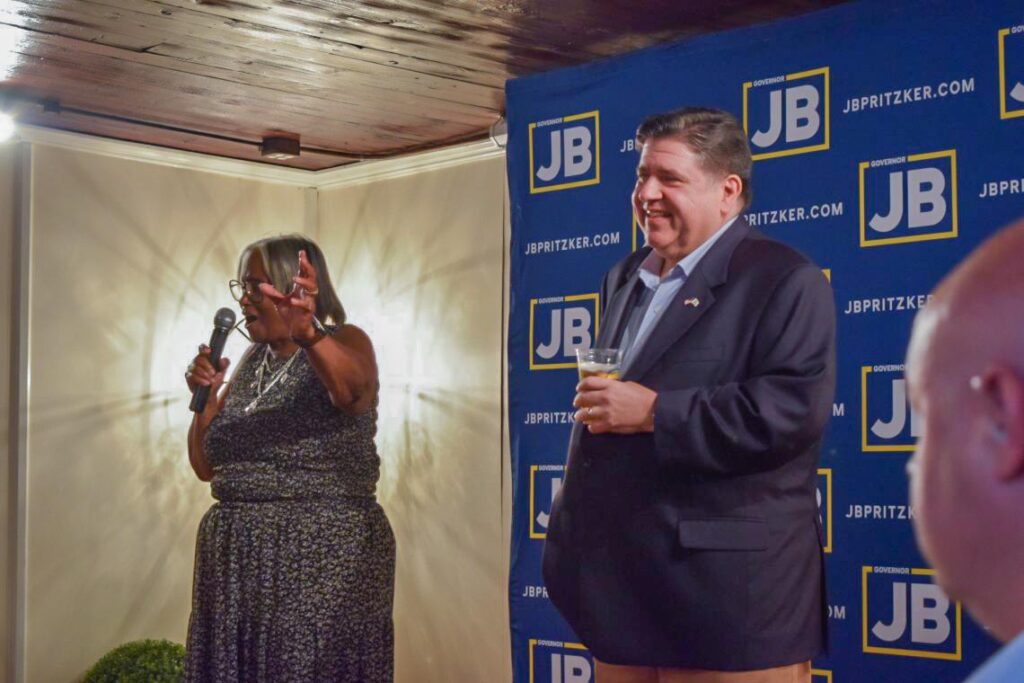
Pritzker made four stops around the state to launch his campaign, fielding questions about any future interest in the presidency and what is driving him to run for what would be a historic third term. In his final stop in Springfield on Thursday evening, he was toasting personally branded “JBeers” – his own craft beer product he unveiled at least year’s Democratic National Convention – with a group of about 100 people at a small event venue just outside the Capitol and talking about his motivations.
“Every day I’m going to wake up going forward thinking about what I am going to do that’s going to help the people of Illinois,” Pritzker told reporters in Springfield when asked how many years of a third term he would serve. “So that’s the reason I’m running for reelection, it’s why I announced today, it’s what I’m going to do every day going forward no matter what decision I make.”
The 60-year-old Democrat’s national profile has grown significantly over the last year. He was a finalist to be former Vice President Kamala Harris’ running mate last July, and weeks later, introduced himself to the country on the stage of the Democratic National Convention in Chicago. In the months since President Donald Trump took office, Pritzker has emerged as one of his most vocal critics.
At news conferences throughout the state, Pritzker did not directly commit to serving a full four-year term if he is reelected and sidestepped questions about his rumored White House ambitions.
Read more: Pritzker calls for mass mobilization as he grows his national profile
But while staying tight-lipped about what he thinks about his prospects in the 2028 presidential election, he said any decision he makes about his future would be Illinois-centric.
Speculation shows Pritzker ‘capable and competent’
In the meantime, Pritzker said he believed his inclusion in the national conversation is good for Illinois.
“When I ran for governor in the first place in 2017 and 2018, never, never could I have imagined that anybody would talk about me as the potential vice-presidential nominee or as a candidate for president of the United States,” Pritzker said.
While Republicans have frequently criticized the governor for his tendencies to criticize Trump rather than work with him to Illinois’ benefit, the governor spun his rising national profile as a positive.
Gov. JB Pritzker takes a picture with Mike Lopez, mayor of nearby Jerome, after announcing his reelection campaign in Springfield on Thursday, June 26. (Capitol News Illinois photo by Jade Aubrey)
“Having the state of Illinois’ leaders viewed as capable and competent and potentially able to run the entire country and being talked about in that way, allows us, I think, to get more for the people of Illinois because there’s an understanding that, you know, maybe in Illinois we’re doing the right things,” he said. “Maybe in Illinois we have leaders that can competently execute on what states really need.”
Pritzker said his experience last summer being vetted for the vice presidency has not played any role in the decisions he has made about his political career.
Should Pritzker decide to run for president, an announcement would likely come at some point in 2027 during what would be the first year of his third term if he’s reelected.
Pritzker’s goal: ‘Protect’ Illinois and his legacy
Pritzker said at his announcement Thursday that his goal in 2026 is to preserve his legacy and “protect” the story of Illinois that’s been written under his leadership. Pritzker didn’t outline a bold vision for his third term but rather pledged to build off what he has already accomplished.
Read more: ‘I have work to do,’ Pritzker says in launching third-term reelection bid
He said his third term would focus on grappling with artificial intelligence, addressing the rising cost of living, continued spending on infrastructure and growing the state’s economy.
Pritzker reflected on his decision to seek reelection despite growing challenges facing the state.
“I don’t shy away from a fight, and we’re going to have to protect the people of Illinois,” Pritzker told reporters in Springfield. “And I feel like we’re in a moment when backing away from public service when things are hard doesn’t feel right. So that’s one of the reasons I chose to run for reelection.”
Gov. JB Pritzker speaks with reporters after his campaign announcement in Springfield on Thursday. (Capitol News Illinois photo by Jade Aubrey)
Pritzker was asked whether he would have run had Trump not been elected last year.
“I think I would, but I have to say that in this moment, it feels like walking away is the wrong thing to do given who is in the White House and given how this administration is attacking people all across this country,” Pritzker said.
The governor must also choose a new running mate as Lt. Gov. Juliana Stratton has decided to run for U.S. Senate. Pritzker said he will choose one by the end of July so his campaign can start circulating nominating petitions in early August. Pritzker said in Chicago that he is looking for someone with enough experience to take over as governor if required.
Rep. Jehan Gordon-Booth, D-Peoria, may be an early front-runner for the job. Pritzker specifically referred to Gordon-Booth as qualified at a stop in East Peoria on Thursday when asked about potential running mates, WGLT reported. The assistant House majority leader has been in the General Assembly since 2009.
Capitol News Illinois is a nonprofit, nonpartisan news service that distributes state government coverage to hundreds of news outlets statewide. It is funded primarily by the Illinois Press Foundation and the Robert R. McCormick Foundation.
The post National speculation helps ‘get more for the people of Illinois,’ Pritzker says appeared first on Capitol News Illinois.