Posts Tagged ‘Jehan Gordon-Booth’
National speculation helps ‘get more for the people of Illinois,’ Pritzker says
Capitol News Illinois
SPRINGFIELD — Gov. JB Pritzker began his third campaign for governor on Thursday, but much of the buzz around his 2026 campaign announcement focused on 2028.
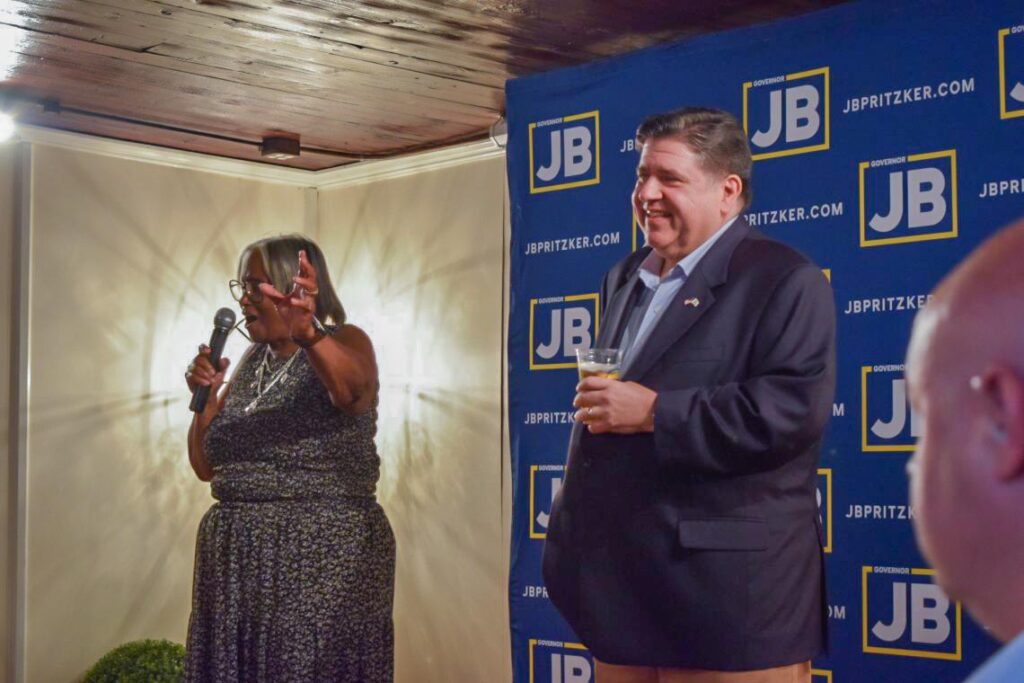
Pritzker made four stops around the state to launch his campaign, fielding questions about any future interest in the presidency and what is driving him to run for what would be a historic third term. In his final stop in Springfield on Thursday evening, he was toasting personally branded “JBeers” – his own craft beer product he unveiled at least year’s Democratic National Convention – with a group of about 100 people at a small event venue just outside the Capitol and talking about his motivations.
“Every day I’m going to wake up going forward thinking about what I am going to do that’s going to help the people of Illinois,” Pritzker told reporters in Springfield when asked how many years of a third term he would serve. “So that’s the reason I’m running for reelection, it’s why I announced today, it’s what I’m going to do every day going forward no matter what decision I make.”
The 60-year-old Democrat’s national profile has grown significantly over the last year. He was a finalist to be former Vice President Kamala Harris’ running mate last July, and weeks later, introduced himself to the country on the stage of the Democratic National Convention in Chicago. In the months since President Donald Trump took office, Pritzker has emerged as one of his most vocal critics.
At news conferences throughout the state, Pritzker did not directly commit to serving a full four-year term if he is reelected and sidestepped questions about his rumored White House ambitions.
Read more: Pritzker calls for mass mobilization as he grows his national profile
But while staying tight-lipped about what he thinks about his prospects in the 2028 presidential election, he said any decision he makes about his future would be Illinois-centric.
Speculation shows Pritzker ‘capable and competent’
In the meantime, Pritzker said he believed his inclusion in the national conversation is good for Illinois.
“When I ran for governor in the first place in 2017 and 2018, never, never could I have imagined that anybody would talk about me as the potential vice-presidential nominee or as a candidate for president of the United States,” Pritzker said.
While Republicans have frequently criticized the governor for his tendencies to criticize Trump rather than work with him to Illinois’ benefit, the governor spun his rising national profile as a positive.
Gov. JB Pritzker takes a picture with Mike Lopez, mayor of nearby Jerome, after announcing his reelection campaign in Springfield on Thursday, June 26. (Capitol News Illinois photo by Jade Aubrey)
“Having the state of Illinois’ leaders viewed as capable and competent and potentially able to run the entire country and being talked about in that way, allows us, I think, to get more for the people of Illinois because there’s an understanding that, you know, maybe in Illinois we’re doing the right things,” he said. “Maybe in Illinois we have leaders that can competently execute on what states really need.”
Pritzker said his experience last summer being vetted for the vice presidency has not played any role in the decisions he has made about his political career.
Should Pritzker decide to run for president, an announcement would likely come at some point in 2027 during what would be the first year of his third term if he’s reelected.
Pritzker’s goal: ‘Protect’ Illinois and his legacy
Pritzker said at his announcement Thursday that his goal in 2026 is to preserve his legacy and “protect” the story of Illinois that’s been written under his leadership. Pritzker didn’t outline a bold vision for his third term but rather pledged to build off what he has already accomplished.
Read more: ‘I have work to do,’ Pritzker says in launching third-term reelection bid
He said his third term would focus on grappling with artificial intelligence, addressing the rising cost of living, continued spending on infrastructure and growing the state’s economy.
Pritzker reflected on his decision to seek reelection despite growing challenges facing the state.
“I don’t shy away from a fight, and we’re going to have to protect the people of Illinois,” Pritzker told reporters in Springfield. “And I feel like we’re in a moment when backing away from public service when things are hard doesn’t feel right. So that’s one of the reasons I chose to run for reelection.”
Gov. JB Pritzker speaks with reporters after his campaign announcement in Springfield on Thursday. (Capitol News Illinois photo by Jade Aubrey)
Pritzker was asked whether he would have run had Trump not been elected last year.
“I think I would, but I have to say that in this moment, it feels like walking away is the wrong thing to do given who is in the White House and given how this administration is attacking people all across this country,” Pritzker said.
The governor must also choose a new running mate as Lt. Gov. Juliana Stratton has decided to run for U.S. Senate. Pritzker said he will choose one by the end of July so his campaign can start circulating nominating petitions in early August. Pritzker said in Chicago that he is looking for someone with enough experience to take over as governor if required.
Rep. Jehan Gordon-Booth, D-Peoria, may be an early front-runner for the job. Pritzker specifically referred to Gordon-Booth as qualified at a stop in East Peoria on Thursday when asked about potential running mates, WGLT reported. The assistant House majority leader has been in the General Assembly since 2009.
Capitol News Illinois is a nonprofit, nonpartisan news service that distributes state government coverage to hundreds of news outlets statewide. It is funded primarily by the Illinois Press Foundation and the Robert R. McCormick Foundation.
The post National speculation helps ‘get more for the people of Illinois,’ Pritzker says appeared first on Capitol News Illinois.
Illinois criminal justice advocates tout ‘Clean Slate’ legislation as ‘economic boon’
Capitol News Illinois
SPRINGFIELD — Criminal justice reform advocates say legislation to seal criminal records for certain nonviolent crimes, which passed Friday in the House, would unlock economic opportunity for thousands of Illinoisans.
The so-called Clean Slate Act has failed twice before, but activists see renewed fiscal messaging as the key to reinvigorating the campaign. This time, the bill’s sponsor points to a “diverse coalition of stakeholders” and backing from business groups as signs Illinois could become the 13th state to enact similar legislation.
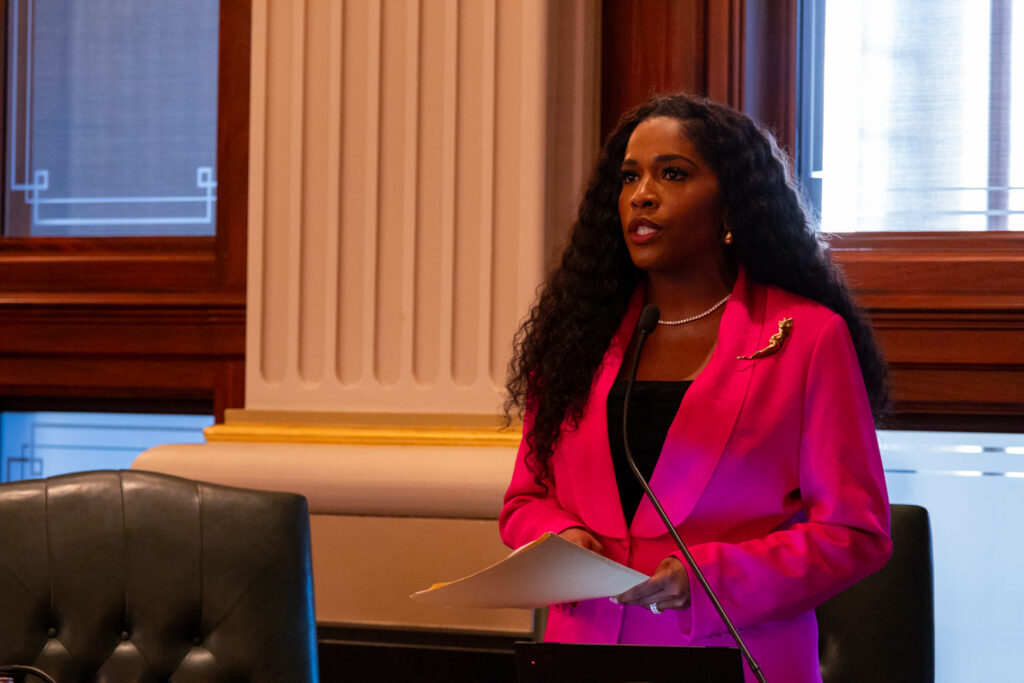
“This is something I’ve worked on for six long years, and now we have law enforcement and the business community — folks like the Illinois Retail Merchants Association, the Illinois Manufacturers Association — all on board,” Rep. Jehan Gordon-Booth, D-Peoria, said in an interview. “Not as a neutral party, but they are proponents. They want to see this bill passed.”
Like earlier proposals, Senate Bill 1784 would require law enforcement agencies to automatically seal records for nonviolent criminal convictions twice a year — Jan. 1 and July 1. The records would no longer be public, although law enforcement and state’s attorneys would retain access.
Gordon-Booth has sponsored Clean Slate legislation twice before — once in 2021 and again in 2023 — but neither bill progressed past committee.
Just a few days before the 2025 legislative session concludes, she filed it again. Within two days, it passed the House mostly along partisan lines, and is headed for debate on the Senate floor.
The session ends at midnight Saturday, although the bill could still pass after that deadline.
People convicted of certain violent offenses — including sex crimes against minors, DUI, reckless driving and violent offenses that require sex offender registration — would be ineligible to have their records sealed.
“I want to make this very, very clear: Serious criminal records are not eligible for automated sealing,” Gordon-Booth said during floor debate.
Gordon-Booth argued that conviction records trap formerly incarcerated individuals in a state of perpetual punishment, eclipsing access to employment, housing and educational opportunities. She said Clean Slate would remove these barriers, helping system-impacted people reintegrate into society instead of recidivating.
Paul Rothschild, managing director of operations for the Illinois Coalition to End Permanent Punishment — a group that advocates for the rights of people with criminal records — said he agrees. He said the justice system fails to follow through on its own promise: Once someone has served their time, they are entitled to a second chance.
“We believe that people should be accountable for the crimes that they commit. But we also believe there is an implied covenant that when they finish, they’re supposed to be returned to the world made whole, and that covenant is not being kept by society. They’re being forever subjugated in that lower caste, that lower class,” Rothschild said.
More than 3 million Illinoisans have arrest or conviction records, and an estimated 921,000 people are eligible for “sealing relief” — but only about 10% actually petition to have their records cleared, according to statistics from Live Free Illinois, a grassroots organization aimed at reforming the state criminal justice system and part of the Clean Slate Illinois steering committee, which coordinates the campaign’s messaging and advocacy efforts.
The bill would automate the process for individuals with nonviolent convictions to have their records sealed, once they have served their sentences, completed probation, and remained crime-free.
Many eligible individuals are deterred by steep fines, complex paperwork and long waiting periods, Gordon-Booth said. The “burdensome” process has contributed to massive court backlogs, according to Clean Slate Illinois.
“It’s going to automate the process, so this way we don’t have to go through that whole trying to get the paperwork, trying to go through all the rigmarole,” said Chauncy Stockdale, who was formerly incarcerated and is now a member of the Live Free Illinois Fellowship, a reentry program that supports returning citizens.
The measure passed the House 81-28, with five Republicans joining Democrats in support of the measure. No Democrats voted against the bill.
During debate on the House floor, Minority Floor Leader Rep. Patrick Windhorst, R-Metropolis, voiced concerns about the tentative $18 million price tag, and whether the state is capable of fully funding the policy in the years ahead, leaving counties to cover the cost.
“If this isn’t funded, we’re either going to be sending a large unfunded mandate to our counties, or we’re making a promise to 2.1 million people that will not be fulfilled without any funding,” he said.
Gordon-Booth detailed a three year “implementation ramp,” which would give the state time to identify funding sources for the local circuit clerks. She also said the Illinois State Police would absorb the initial costs and emphasized the state’s commitment to supporting circuit clerks in the rollout phase.
“It is our full intention to provide clerks with all that they need to implement this,” she said. “We are not going to send an unfunded mandate to our local governments.”
‘Workforce and economic policy’
On April 10, nearly 300 members, supporters and advocates from Live Free Illinois chapters gathered in front of the Abraham Lincoln monument in Springfield for Advocacy Day, calling on lawmakers to introduce the Clean Slate Act.
Live Free Illinois — a faith-based nonprofit focused on ending gun violence and mass incarceration — organizes Black congregations to push for systemic change. The organization is involved in the broad-based Clean Slate steering committee, which also includes the Fully Free Campaign, the Illinois Coalition to End Permanent Punishments, and Impact for Equity.
The day before, Muslim leaders also advocated for Clean Slate legislation at Illinois Muslim Action Day.
Beyond criminal justice reform, advocates pushed a new messaging angle this year to usher the legislation across the finish line: Clean Slate could boost Illinois’ economy.
As of April, Illinois has one of the highest unemployment rates in the country, at 4.8% — above the national average of 4.2%, according to the data from the U.S. Bureau of Labor Statistics.
Jerika Richardson, senior vice president for equitable justice and strategic initiatives at the National Urban League, said the act would open doors for thousands of people who have been barred from work because of background checks.
“There are so many employers and businesses across this country who are struggling to find the workers that they need, and part of the reason is because these records are barriers,” Richardson said. “If Illinois passes the Clean Slate Act, you won’t have to worry about businesses going to another state or leaving the country.”
An amendment to the Illinois Human Rights Act, signed by Gov. JB Pritzker in 2021, expanded legal protections for state workers by prohibiting discrimination based on criminal convictions, in addition to arrest records. Yet many say they continue to face employment hurdles despite the law.
People with conviction histories earn an average of 25% less than those with clean records — a gap the National Urban League says costs the state billions of dollars in lost wages. According to a news release from the National Urban League, the Clean Slate Act could generate more than $4.7 billion in lost wages for Illinois, easing economic disparities and addressing labor shortages.
Gordon-Booth echoed Richardson’s point, adding that her office frequently hears from constituents who are missing out on life-changing chances.
“I get calls from people saying, ‘I had an opportunity to get my dream job, and it fell through because of something that I did when I was 18 or 19.’ And we’re talking about folks that are in their 30s,” Gordon-Booth said. “They have not gone through the process of hiring a lawyer, going through the court-mandated process, and folks are losing out.”
Reilly Cook is a graduate student in journalism with Northwestern University’s Medill School of Journalism, Media, Integrated Marketing Communications, and a fellow in its Medill Illinois News Bureau working in partnership with Capitol News Illinois.
Capitol News Illinois is a nonprofit, nonpartisan news service that distributes state government coverage to hundreds of news outlets statewide. It is funded primarily by the Illinois Press Foundation and the Robert R. McCormick Foundation.
The post Illinois criminal justice advocates tout ‘Clean Slate’ legislation as ‘economic boon’ appeared first on Capitol News Illinois.