Posts Tagged ‘Illinois Department of Employment Security’
Study: Education still pays, but barriers to upward mobility persist in Illinois
Capitol News Illinois
Article Summary
A new study shows there are barriers to upward mobility in Illinois, especially for women and people of color.
People who grow up in lower-income families tend to earn less as adults than those from wealthier families, even after earning similar degrees and going to work in similar fields.
Educational attainment and career choices are still the biggest factors that influence future earnings.
This summary was written by the reporters and editors who worked on this story.
For generations, America has been thought of as the land of opportunity, a place where anyone who worked and studied hard could grow up to achieve any goal they set for themselves.
That idea has had especially strong roots in Illinois, the “Land of Lincoln,” where a young man born in a log cabin on America’s frontier rose from rail-splitter to self-taught lawyer and president of the United States.
But a new study suggests that the American dream is still more elusive for some people in Illinois than for others, and that the pathway up the economic ladder is not easily scaled.
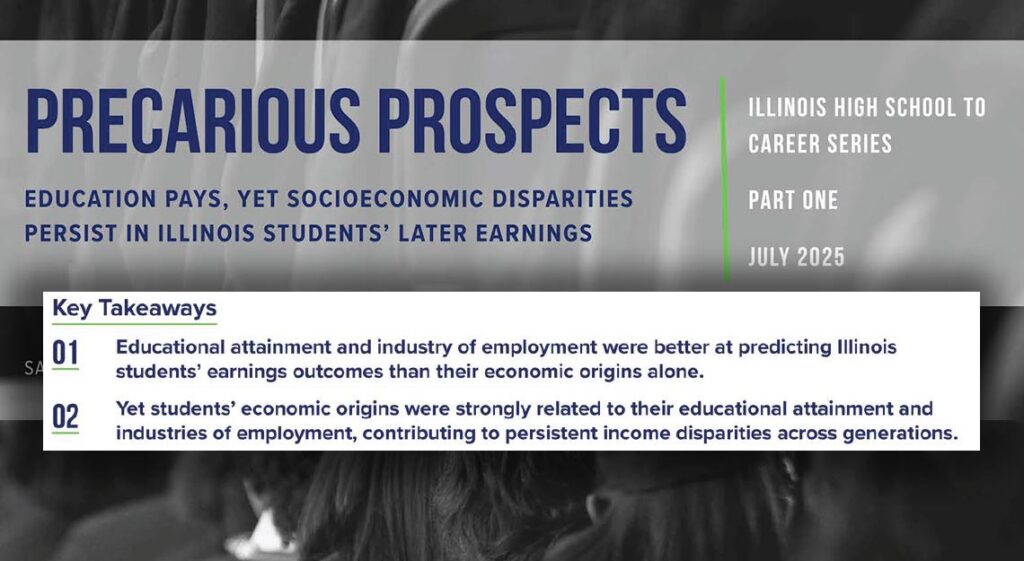
The study, entitled “Precarious Prospects,” tracked a cohort of millennials from Illinois – more than 340,000 students from the senior classes of 2008-2012 – from graduation, through their post-secondary careers and into young adulthood.
The study was a joint project conducted by the Illinois Workforce and Education Research Collaborative, or IWERC, the Discovery Partners Institute, the University of Illinois, and the University of Chicago Consortium on School Research.
It found that educational attainment is still a strong predicter of a person’s future earnings as an adult. So too is the industry that a person chooses for a career.
Other factors can also influence a person’s ability to complete a higher education degree, including their race, ethnicity and gender.
Capitol News Illinois · Upward mobility in Illinois
Class-based barriers
The study also found that a person’s own economic background – whether they grew up rich or poor – also strongly influences their future earnings. Students who grew up in higher-income households tended to earn more than those who grew up in lower-income families, in part because students from higher-income families were more likely to complete a college degree than lower-income students.
But perhaps most surprisingly, the study found that even among those who earn similar degrees and go to work in similar industries, a student’s own economic background influenced their future earnings. That is, students from lower-income families tend to earn less than those from wealthier families, even after they went on to earn similar credentials.
Further, the study found, among students from lower-income families, Black and Latino students and women tended to earn less than their white and male counterparts.
“The racial and gender disparities obviously are real, and there’s a lot of research showing that, but I don’t think it’s all that’s going on,” Sarah Cashdollar, associate director of IWERC and a lead author of the report, said in a podcast interview with Capitol News Illinois.
“One thing is that the same degree, such as a bachelor’s degree, can have a very different payoff depending on the college that the student went to,” she said. “And there’s research that’s found students from higher income families are more likely to go to colleges that have things like many internship opportunities or other work-based learning. More advising, more networking opportunities. And for some fields, those things are essential to landing a good job.”
“There’s also research showing that higher income students have greater access to social networks in general that can provide those connections,” she said.
Education and career choice
Among all the factors the study examined, educational attainment had by far the largest impact on a person’s future earnings. It found there was a gap of nearly $40,000 a year in earnings for someone with an advanced degree compared to someone with only a high school diploma.
The study also found that regardless of what type of degree or credential a person earns, the industry in which they work has a big impact on their future earnings.
“For certificates and associate’s degrees, we see higher earnings for construction, for mechanic and repair technologies,” Cashdollar said. “So these are things like auto mechanics, HVAC techs, electricians, and also precision production. … These are all areas that tend to have unions, and they also have been experiencing higher demand due to lower supply in recent years, and so there’s some upward wage pressure in those in those occupations.”
“And then for the bachelor’s, there are many, many industries that offer higher earnings,” she said. “Two of the highest earnings were engineering and computer and information sciences.”
But the gaps between people with similar degrees from different economic backgrounds was still significant – $3,753 annually for those with less than a bachelor’s degree, and $5,028 for those with a bachelor’s degree or higher.
Still to come
The Precarious Prospects study was the first of a two-part research project made possible through a data sharing partnership between the Illinois Department of Employment Security, the Illinois Student Assistance Commission, the Illinois State Board of Education and Illinois State University.
Cashdollar said the second phase of the project, due to be published later this year, will focus on those students who manage to succeed in climbing the economic ladder, despite the barriers they face.
“To give a preview, we found that there were pathways at all levels of education toward higher earning careers, but they were predominantly concentrated in bachelor’s degree pathways and even higher masters and doctoral and professional (programs).”
Capitol News Illinois is a nonprofit, nonpartisan news service that distributes state government coverage to hundreds of news outlets statewide. It is funded primarily by the Illinois Press Foundation and the Robert R. McCormick Foundation.
The post Study: Education still pays, but barriers to upward mobility persist in Illinois appeared first on Capitol News Illinois.
‘I have work to do,’ Pritzker says in launching third-term reelection bid
Capitol News Illinois
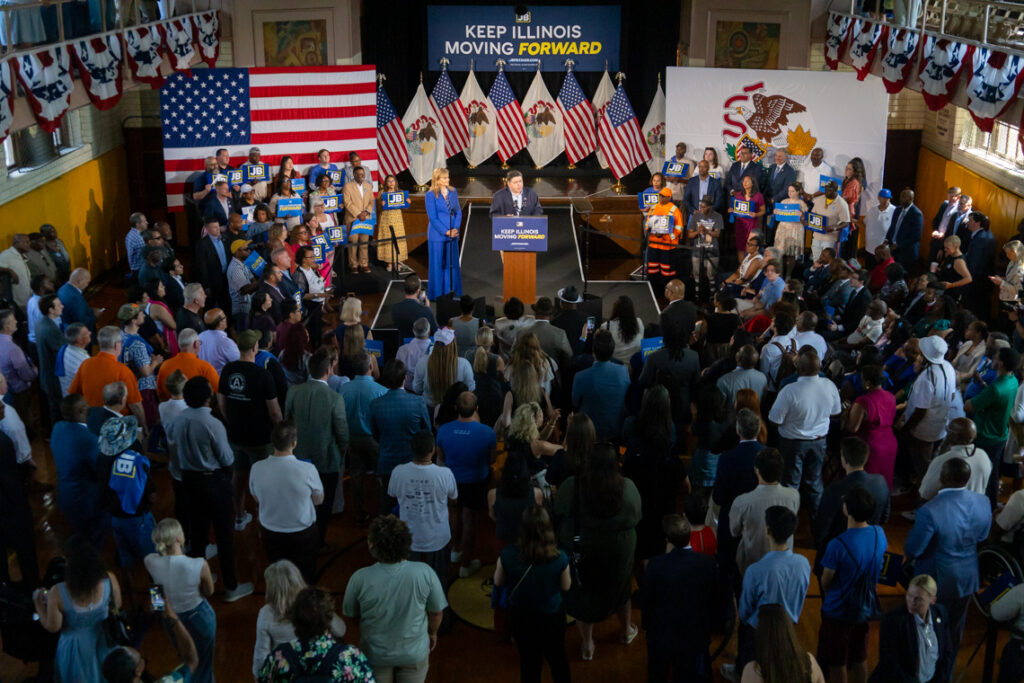
CHICAGO — In a hot gymnasium on Chicago’s South Side, Gov. JB Pritzker announced Thursday morning he’s running for a potentially historic third term as governor.
In his announcement speech, Pritzker said he is running to “protect” the story he’s been telling about Illinois — one that has been built largely in opposition to the politics of President Donald Trump.
Pritzker said his third term would focus on grappling with artificial intelligence, addressing the rising cost of living, continued spending on infrastructure and growing the state’s economy.
The field house at Grand Crossing Park where Pritzker launched his first campaign hosted a crowd of Pritzker’s invited supporters, including Democratic party officials, campaign operatives and long-time Pritzker supporters.
Read more: Pritzker calls for mass mobilization as he grows his national profile
Pritzker’s message has often focused on what Democrats need to do to win and push back on Trump, including addressing economic issues for the middle class and being outspoken against Trump’s policies.
“While it is certainly tempting to lay all of this at the feet of the megalomaniac narcissist in the White House and his malignant clown car in Congress, the hard truth is, we all share some of the blame,” Pritzker said.
The governor said “we must reckon with the fact that everything is too damned expensive,” but taking a shot at Republicans, said enacting budget cuts to key government programs like Medicaid that make life more affordable for people shouldn’t be the solution.
Gov. JB Pritzker and his wife, MK Pritzker, wave to supporters at a June 26 rally to launch JB’s third gubernatorial campaign. (Capitol News Illinois photo by Andrew Adams)
The governor also said a third term would continue his past efforts to protect abortion rights, diversity programming in the private sector and teachers’ ability to teach “uncensored history.”
Pritzker’s progressive stances on hot-button national issues are part of what has grown his national profile since President Donald Trump took office in January.
The governor has been one of the president’s most vocal Democratic critics and his schedule has been loaded with national media interviews and campaign speeches around the country.
From reelection to presidential election?
A successful reelection could set the stage for a bigger one: Pritzker’s speculated 2028 presidential campaign.
Pritzker on Thursday downplayed the possibility when speaking to reporters but didn’t explicitly rule it out.
“Everything that I do, truly everything that I do, in my job and every day when I wake up is about improving the lot of the people who live in the state of Illinois, lifting up the working families of Illinois,” Pritzker said. “Whatever I do going forward is going to be about that.”
He had a small taste of presidential campaigning last year when he was considered as a running mate for former Vice President Kamala Harris, then served as a surrogate.
“You don’t get on that list unless they think you actually could be president of the United States and do the job if you had to,” Pritzker told reporters last year.
As some Democrats have tried finding a centrist message, Pritzker has stayed in the left lane. He condemned politicians, without mentioning specific names, who abandon their core beliefs for political gain.
“Of all the unbecoming qualities that Americans hate in their politicians – they hate cowardice the most,” Pritzker said. “I’d rather lose standing up for what I believe in than win by selling out those who believed in me.”
Read more: Pritzker balances messaging as some Dems encourage party to avoid LGBTQ issues
As Pritzker rattled off a list of accomplishments in his more than six years as governor, his message remained the same as it has since he launched his first campaign in 2017 to unseat an unpopular Republican incumbent: fight.
“Let me be clear: There is no Mission Accomplished banner to stand under today,” Pritzker said alluding to a premature victory declaration former President George W. Bush made in a 2003 speech regarding military action in Iraq. “Yes, we have addressed so many of our old problems – but new ones always arise. History is an endless relay race. Our job is not to look for the finish line but to protect the baton as we run our assigned leg. But we have work to do. I have work to do.”
Gov. JB Pritzker speaks to supporters at a campaign launch rally in Chicago on June 26, telling them in his speech “I have work to do.” (Capitol News Illinois photo by Andrew Adams)
Pritzker argued his success has come through embracing his role as a cheerleader for the state, recalling the negative perceptions of Illinois, such as the prevalence of corruption and unbalanced budgets, that had consumed state politics.
“When I was first elected, I told you I was prepared to be a happy warrior on behalf of our state, even if it meant going it alone,” Pritzker said. “I suited up to face the carnival barkers and misery spelunkers and doom grifters. I handed out optimism like a shot of Malört – as a swift jolt to the heart.”
First three-term Democrat?
The 60-year-old Democrat enters the race as the favorite, having received more than 54% of the vote in the 2018 and 2022 elections.
An heir to a fortune built on the Hyatt Hotel chain, Pritzker’s net worth sits at $3.7 billion as of Thursday, according to Forbes. His vast personal wealth makes him one of the richest politicians in American history and gives him a significant leg up on competitors. Pritzker dumped $350 million into his first two campaigns and has never taken outside contributions.
Separately, Pritzker has used an undisclosed amount of his personal fortune to fund a political action committee, Think Big America, to support abortion rights in other states.
Pritzker is also entering unchartered territory for Illinois governors. If he completes his current term, he would be the first Democrat to serve two full terms in modern state history. If he wins reelection, he would be the only governor to serve more than two terms since Republican Gov. Jim Thompson served four terms from 1977 until 1991.
Pritzker will need a new running mate first, however, as Lt. Gov. Juliana Stratton is running for U.S. Senate. Pritzker did not announce a running mate Thursday.
Pritzker’s governing record
The governor’s top priority for his second term was to eliminate child care deserts and make preschool more accessible. Since he was sworn in in January 2023, the state has implemented Pritzker’s Smart Start initiative to expand preschool offerings around the state and has begun to phase in a new Department of Early Childhood.
When asked about those goals after his speech Thursday, Pritzker said there were an “awful lot of things” that his administration still needed to accomplish.
“We still need to get to universal preschool. We’re on our way. It’ll happen probably in 2027,” Pritzker said.
But Pritzker pointed to several of his progressive policy wins Thursday, in his speech and when speaking to reporters.
He has signed legislation raising the minimum wage to $15, legalizing recreational cannabis, banning assault weapons and numerous new protections of abortion rights since Roe v. Wade was overturned three years ago. Pritzker also passed landmark legislation to phase out fossil fuels in the electricity sector.
Pritzker repeatedly brought up cleaning up Illinois’ fiscal house. The state has recorded budget surpluses in recent years and has received nine credit upgrades since he took office.
But challenges are also growing. The budget has gotten tighter, and lawmakers have resorted to more than $1 billion in targeted tax increases over the last two years to balance the budget. The fiscal year 26 budget Pritzker signed this month increased discretionary spending by less than 1%.
Gov. JB Pritzker highlights his progressive wins and criticizes Republicans in a speech to supporters in Chicago on June 26. (Capitol News Illinois photo by Andrew Adams)
There’s also been headaches over legislative priorities. Labor unions are frustrated Pritzker didn’t embrace their proposal for pension reform this spring. And many parts of the governor’s legislative agenda hit roadblocks with concerned lawmakers. There’s also ongoing discussions about achieving Pritzker’s bold clean energy goals as prices rise and energy supply is strained.
The governor has taken pride in growing state agencies decimated by the two-year budget impasse that began a decade ago. But problems at those agencies have caused trouble for Pritzker.
An audit revealed the Department of Public Health failed to intervene to stop deaths from COVID-19 at the LaSalle Veterans’ Home in 2020, though Pritzker blamed and fired leaders at the Department of Veterans’ Affairs. Billions of pandemic relief dollars at the Department of Employment Security went to fraudsters, while the Department of Children and Family Services faced years of scrutiny over deaths and the its failure to properly house children in its care while Pritzker maintained support for the department’s director.
GOP criticizes ‘stepping stone’ approach
As problems have mounted at the Statehouse, Senate Republicans have encouraged Pritzker to “think Illinois.” As he announced his campaign Thursday, Illinois Republicans continue to believe his focus is elsewhere.
“These last nearly eight years under his governance merits firing not rehiring,” Illinois GOP Chair Kathy Salvi said in a statement. “While businesses and families flee, Pritzker sees Illinois as nothing more than a stepping stone for the White House.”
A field of Republican challengers is still taking shape. So far, DuPage County Sheriff James Mendrick, Posen Park District Commissioner Phil Perez and Lake Forest businessman Joe Severino have announced they will run in the Republican primary.
Capitol News Illinois is a nonprofit, nonpartisan news service that distributes state government coverage to hundreds of news outlets statewide. It is funded primarily by the Illinois Press Foundation and the Robert R. McCormick Foundation.
The post ‘I have work to do,’ Pritzker says in launching third-term reelection bid appeared first on Capitol News Illinois.
Attorney General Raoul joins lawsuit challenging Trump’s termination of federal grants
Capitol News Illinois
SPRINGFIELD – Attorney General Kwame Raoul announced this week he has joined another multistate lawsuit challenging the Trump administration’s decision to withhold billions of dollars in federal funds that had previously been approved for states and other grantees.
The complaint, filed Tuesday in U.S. District Court in Massachusetts, challenges several actions the administration has taken since Trump returned to office Jan. 20 that involved terminating federal grants that had previously been approved by various agencies.
Each of those actions, the lawsuit argues, were based on a misuse of a single clause in one regulation under the federal Office of Management and Budget. That clause allows agencies to terminate a grant if the agency determines the award “no longer effectuates the program goals or agency priorities.”
“The Trump Administration has claimed that five words in this Clause — ‘no longer effectuates . . . agency priorities’ — provide federal agencies with virtually unfettered authority to withhold federal funding any time they no longer wish to support the programs for which Congress has appropriated funding,” the lawsuit alleges.
The suit is one of more than a dozen Raoul has joined as part of a coalition of Democratic attorneys general who have been battling the administration since Trump’s second inauguration in January.
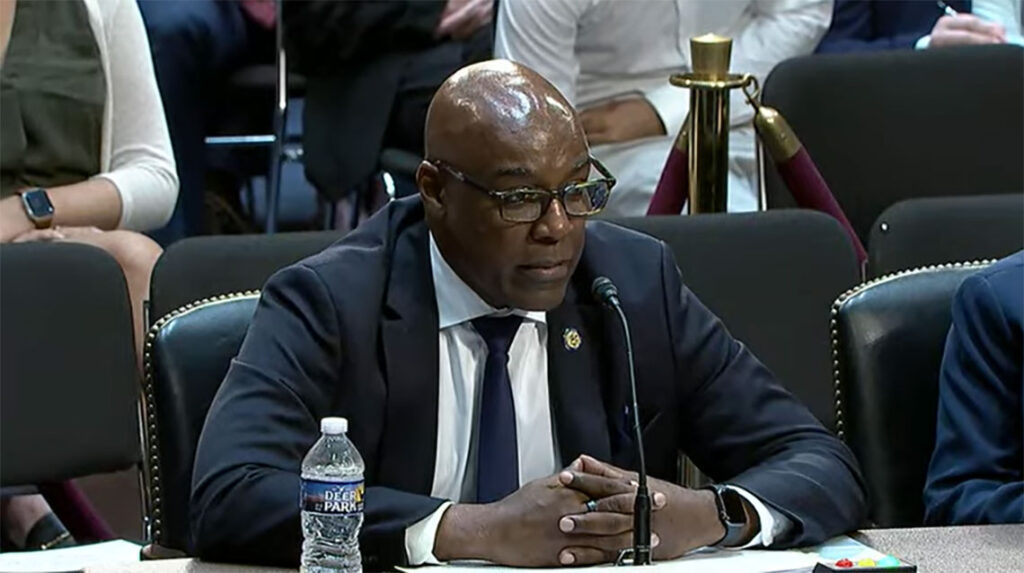
Speaking Monday to a congressional panel made up of Democratic members of the U.S. House and Senate judiciary committees, Raoul joined three other members of that coalition to explain their litigation campaign.
“Whether or not I disagree with President Trump on his policy agenda, he must act in a lawful way that is consistent with the Constitution and the laws that Congress has enacted,” Raoul said. “Unfortunately, the president and his administration have chosen, with many of their actions, to ignore the Constitution and federal law. And when constitutional guarantees are ignored, all Americans are at risk.”
Grants affected by cuts
The lawsuit challenges three specific funding cuts that have directly affected the state of Illinois. Those include:
The U.S. Department of Agriculture’s decision in March to halt reimbursements under the Local Food Purchase Assistance Program, which provided funding for nonprofit organizations to buy locally grown food products from farmers for free distribution to vulnerable communities.
A decision by the Federal Emergency Management Agency to terminate two Shelter and Services Program Grant awards to the Illinois Department of Human Services totaling $29 million. The money was intended to reimburse Illinois for the cost of providing food, shelter and medical care to migrants whom the U.S. Department of Homeland Security had released to relieve overcrowding at federal detention facilities.
And a decision in May by the U.S. Department of Labor to terminate grants totaling $28.8 million to the Illinois Department of Employment Security for modernization of the state’s unemployment insurance system.
According to the lawsuit, OMB first adopted the regulation in 2020, near the end of the first Trump administration. At the time, according to the Federal Register, the agency said the clause was intended to allow agencies to end a grant program under specific conditions, but that it was not intended to let them terminate grants “arbitrarily.”
The clause was later updated to include its current wording in 2024, near the end of Joe Biden’s administration. However, according to the complaint, “OMB never suggested, in either the 2020 or 2024 rulemaking, that a grant could be terminated even though the grant was continuing to serve the very goals for which the monies had initially been awarded, merely because the agency’s priorities shifted midway during the use of the grant—let alone with no advance notice.”
As of Wednesday, the case had not yet been scheduled for a hearing.
Capitol News Illinois is a nonprofit, nonpartisan news service that distributes state government coverage to hundreds of news outlets statewide. It is funded primarily by the Illinois Press Foundation and the Robert R. McCormick Foundation.
The post Attorney General Raoul joins lawsuit challenging Trump’s termination of federal grants appeared first on Capitol News Illinois.