Posts Tagged ‘Illinois Answers Project’
Wasted waters: How Southern Illinois is coping with decades of sewage flooding

Capitol News Illinois
by Janelle O’Dea for the Illinois Answers Project
CAHOKIA HEIGHTS — Arianna Norris, 63, paid cash for her home in Cahokia Heights. For as long as she’s lived there, during intense rainstorms, water surrounds her property and last year her basement started flooding.
Norris was around four years ago when residents in Alorton, Cahokia, and Centreville voted for the merger that created Cahokia Heights and disbanded the Commonfields of Cahokia Public Water District. The merger was an effort to address the sewage overflows that have plagued the area for decades, thanks to leaky pipes and broken equipment in the aging system that allow raw sewage to escape, flooding homes, streets and businesses.
But given her experience with months-long floods last summer, Norris is skeptical that the city’s sewer system will ever be fixed, even with the merger’s promise— that combining the three cities would give Cahokia Heights a larger population and a shot at multi-million dollar federal grants for repairs.
She knows the city has applied for grants, received some of them, and completed some work. She sees crews making repairs, but she also still experiences flooding.
Kyle Pyatt for Illinois Answers Project
“They might as well have just taken a match to it,” Norris said, of the grant money “I know they spent it, but I don’t know where.”
Like other smaller communities, the city’s still relatively small tax base and fewer resources hinder its ability to pay for the kind of multimillion dollar projects that could resolve overflows.
It is among five dozen communities in Southern Illinois and the Metro East that account for a third of sanitary sewer overflows reported to the state of Illinois within the last decade, according to data from the Illinois Environmental Protection Agency. Unless authorized by a permit, sewer overflows into U.S. waters are violations of the U.S. Clean Water Act, which the Illinois EPA enforces.
Explainer: What is a sanitary sewer overflow?
Sanitary sewer overflows, SSOs, are a release of untreated or partially treated waste from a city sewer. Sanitary sewer overflows are illegal. But when normal systems become overloaded through heavy rain or a larger load from an increasing population, SSOs occur. When they occur, they must be reported to the Illinois EPA. SSOs can be caused by blockages, line breaks, sewer defects, power failures, improper sewer design, vandalism, or groundwater overloading the system, as is often the case during heavy rainfall. Learn more.
Cahokia Heights tried the 2021 merger and applications for numerous grants to remedy the problem with mixed results. Other communities with overflow issues have tried approaches like selling parts of their sewer systems.
Yet for Norris and others in Southern Illinois, the overflows persist.
While these residents wait for relief they continue to endure property damage, fear and distrust of the drinking water and damaging health impacts.
Surrounded by sewer water
As of 2020 when an engineering report on sewer repairs was completed, Cahokia Heights needed to repair or replace at least 800 feet of sewer pipes, six sections of water main, 19 fire hydrants, eight lift stations, and more than 50 pump stations according to grant applications submitted the following year.
The estimated cost: more than $24 million.
This map shows where various repairs are needed throughout Cahokia Heights’ sewer system. (Cori Lin/Onibaba Studios for Illinois Answers Project)
A third of the majority-Black population of Cahokia Heights lives below the poverty line. The community’s median household income is $37,975 — less than half of the state’s median. As of publication, Illinois Answers had not received a requested copy of the city’s most recent budget.
Poorer areas and communities of color often face the greatest risk when it comes to sewage backups, flooding, and access to clean drinking water. Decades of infrastructure disinvestment and neglect can exacerbate problems with old sewer systems, and expensive home repairs from flooding damage or cleanup are tough to make on a limited income.
Two out of the three former cities that make up present-day Cahokia Heights had wastewater collection and transport systems built in the 1980s that have been poorly maintained, according to the Illinois EPA. The newly merged city sits in the Mississippi River floodplain, located about 30 minutes east of St. Louis.
Water rises in the streets outside Patricia Greenwood’s house in the Piat Place neighborhood. (Kyle Pyatt for Illinois Answers Project)
Between 2014 and 2024, the city accounted for a quarter of all sanitary sewer overflow reports submitted to the Illinois EPA by permittees not regulated by the National Pollutant Discharge Elimination System program, according to data obtained from the agency. Those with NPDES permits are allowed to discharge into waterways so long as contaminants are below a certain level.
But a lag in enforcing SSO reporting from more rural communities until recent years may contribute to the issue.
“Historically any time a new requirement comes down the pipeline, it seems like larger communities are the first ones tested for compliance,” said Cody Moake, chief of staff to the Marion mayor.
The sewer system in Cahokia Heights as a whole is still broken and the overflows happen despite repairs. Attorneys with Equity Legal Services, who represent citizens of Cahokia Heights in multiple lawsuits, said residents report that repairs are made but fail within weeks or months.
Other repairs made flooding worse in some residents’ yards and houses.
Last summer during a storm, Norris’ house was surrounded by water for six weeks, and another resident was without hot water for over two weeks after the flood destroyed her hot water tank, according to the complaint filed by attorneys. Within a week, St. Clair County, where Cahokia Heights is located, was declared a disaster zone by the U.S. government.
Solution: A merger to secure more funds
Since the 2021 merger, more than $35 million in grants have been awarded to Cahokia Heights, according to Illinois EPA data. The data indicates an estimated $200 million would be needed for flood mitigation and to repair or replace sanitary sewer and drinking water systems.
The agency aggregates this data from multiple sources, and a disclaimer attached to the data states that there is “no assumed review of accuracy or completeness by EPA.”
Almost $12 million in awarded grants comes from federal agencies including the federal Environmental Protection Agency, the U.S. Army Corps of Engineers, the U.S. Department of Housing and Urban Development, funds earmarked by U.S. Senators Dick Durbin and Tammy Duckworth and from the American Rescue Plan Act.
But securing the funds is only part of the battle.
To use these funds, Cahokia Heights has to apply to the various agencies that control the money for approval on how it’s spent.
When applying for a grant, cities have to provide information about how the money will be spent and preparing those plans isn’t cheap. For example, preliminary engineering on two parts of the sewer system over the last two years cost the city more than $400,000, according to invoices from Hurst-Roche, a Hillsboro-based engineering firm.
The ditch surrounding William McNeal’s house flows with smelly water every time there is significant rain. The overflows by McNeal’s house made up more than a third of the 107 sanitary sewer overflows in Cahokia Heights. (Kyle Pyatt for Illinois Answers Project)
In Johnston City, about two hours south of Cahokia Heights, officials secured a $68,000 grant from the Delta Regional Authority to map out the sewer system in anticipation of applying for a larger grant, Mayor Doug Dobbins said. The DRA is a federal-state collaboration established 25 years ago to invest in basic public infrastructure in eight states along the Mississippi River.
Dobbins said getting the grant would have been impossible without help from a pro bono grant writer.
An overflow complaint from Johnston City was reported to the Illinois EPA in November of last year citing “dead fish, black water” and “a foul odor.” When EPA staff investigated, they didn’t find dead fish, but noted in a report that repairs were needed to prevent future basement backups. In response to a records request, the Illinois EPA found no Johnston City sewer overflow reports from the last five years.
Dobbins said the November break was an equipment malfunction and “could happen with an old or a new valve.” The break came about a week after record rainfall once again hit the region.
Prior to the overflow, Dobbins said, city staff were developing a replacement plan for the city’s wastewater treatment plant, which began providing service in the early 1980s with an estimated 25-year lifespan. It’s nearly 50 years old.
Keeping an older plant running can cost cities money, too, he said — when equipment would break, sometimes they’d find that the parts needed were no longer made, and they had to pay for a custom fabrication.
Without the no-cost grant writer, Dobbins said he doesn’t think the city would be considered for most grants.
“What takes [a grant writer] three hours would take us three weeks,” Dobbins said. He’s still unsure if the entire plant needs replacing, or just parts of it, but he anticipates a request from state officials in the near future for a plan.
Even if the preparation to make repairs gets done, a small tax base means some funding is out of reach. Grants can require a 50/50 split, meaning a municipality has to pay for half of the project and the agency providing the grant pays for the other half.
“And there’s no doubt in my mind that this project starts with an ‘M,’” he said, referring to the millions he thinks it’ll take to repair or replace the wastewater plant in Johnston City.
“We’re a retirement community,” Dobbins said. “We can’t afford that.”
In Carterville, about two hours south of Cahokia Heights, Mayor Bradley Robinson said the city has spent $1 million just on engineering for the city’s proposed new wastewater treatment plant.
State and federal intervention has had little effect.
Related local coverage of Cahokia Heights’ sewer overflows
Timeline of Belleville News-Democrat coverage, Jan. 16, 2023 — Staff at the Belleville News-Democrat have covered developments in the Cahokia Heights story for years. Here’s a timeline of their coverage through 2022.
Only a fraction of the money sought for Cahokia Heights projects has been spent. Why? May 30, 2024 — The Belleville News-Democrat follows the money and asks questions about why it’s taking a while for the city to receive and spend the money it’s been awarded in multiple grants.
How aging water systems are pushing sewage into U.S. homes Oct. 25, 2024 — The nonprofit organization Science Friday features Cahokia Heights and explores how aging infrastructure can result in sewage backups and flooding.
Plan calls for $30 million in Cahokia Heights sewer repairs. Residents say it’s not enough Dec. 10, 2024 — After authorities announced the proposed settlement agreement for the sewage and flooding issues in Cahokia Heights, residents expressed their misgivings about it.
In December, five years after the sewage overflows and severe flooding began getting widespread attention in the press, the Illinois Attorney General Kwame Raoul joined a lawsuit, along with the U.S. Department of Justice and the state and federal environmental protection agencies on behalf of Cahokia Heights residents.
As a part of the enforcement, the agencies filed a consent decree that, according to a release from Raoul’s office, “requires Cahokia Heights to pay a $30,000 civil penalty and invest approximately $30 million in extensive sewer improvement projects, conduct system-wide repairs and ensure the community is updated with its progress on upgrades.”
But “the 15 years doesn’t even include [a requirement for] the system being fully functional,” said Nicole Nelson, an attorney for Equity Legal Services, which represents Cahokia Heights residents in a separate lawsuit.
A sign by William McNeal’s house warns that there is a sanitary sewer overflow and warns residents of potential health risks if exposed to the contaminated water. (Kyle Pyatt for Illinois Answers Project)
The decree also provides a caveat: If Cahokia Heights “demonstrates that an SSO would not have occurred but for the conditions in the City of East St. Louis sewer system,” the city won’t be obligated to fix the source of the overflow. The two cities’ systems are connected.
In overflow reports from East St. Louis, none blamed Cahokia Heights, but in the last 10 years, eight Cahokia Heights reports cited the East St. Louis system as the cause. A wastewater treatment plant in the nearby village of Sauget also cites East St. Louis in reports as a contributor to overflows there.
Precipitation and equipment failures were cited as causes of overflows in East St. Louis.
But Dawayne Stewart, assistant finance director for East St. Louis, said “there’s never been a comprehensive study” of where sewer problems are located in the city. On April 10, the East St. Louis City Council considered an agreement with an engineering group to complete a sewer study, but it died without any votes.
“We’re still having a ton of problems,” Stewart said. In June, the Illinois Department of Natural Resources announced a $2.6 million plan to buy out flood-damaged properties in East St. Louis citing “stronger and more frequent storms.” In December, state and federal authorities filed suit against overflows in the city of East St. Louis.
Robert Betts, city manager of East St. Louis, declined to comment, but said the “proper functioning of the sanitary and storm water sewer system is of paramount importance.
The ditch surrounding William McNeal’s house flows with smelly water every time there is significant rain. The overflows by McNeal’s house made up more than a third of the 107 sanitary sewer overflows in Cahokia Heights. (Kyle Pyatt for Illinois Answers Project)
Meanwhile, with slashes to federal funding targeting environmental projects, federal support for these fixes is at risk.
The main sources of funding for drinking water and wastewater infrastructure are the U.S. EPA, the Department of Agriculture and U.S. Department of Housing and Urban Development through programs like the Safe Drinking Water and Clean Water state revolving funds. The Associated General Contractors of America, a construction association, calls these federal funds “highly successful but chronically underfunded.”
U.S. Representative Nikki Budzinski, whose district includes Cahokia Heights, is worried after she said she learned that the Trump administration had plans to cut staff from the U.S. Department of Housing and Urban Development, potentially including those who manage natural disaster response.
In April, Budzinski visited Granite City, about 20 minutes north of Cahokia Heights, to meet with residents and criticized Republicans for federal cuts. The cut funding included over $1 million for part of the project in Cahokia Heights. The city’s engineer said the cut funding would have gone toward separating the Cahokia Heights and East St. Louis systems — they will now have to start the appropriations process again.
In early June, the Illinois EPA announced nearly $10 million in combined grant programs for sewer overflows and watershed management. This comes months after the Illinois Answers Project began requesting records and asking the agency about sanitary sewer overflows.
The state of Illinois also provides funding for sewer infrastructure projects through community development block grants and other grant programs, like the unsewered communities planning grant program announced by the Illinois EPA at the end of last year.
Solution: Fix the Harding Ditch
Despite the consent decree mandating system-wide repairs, a lawyer for Cahokia Heights has attributed the city’s sewage problem to homeowner mismanagement in past court filings.
But an Illinois Answers review of the Illinois EPA overflow reports found only a sixth of the reports made by the city attribute overflows to equipment failures, from line breaks to pumps failing. Three quarters of the reports cite heavy rain or snow melt — or stormwater — as causes.
Stormwater and lack of maintenance of the infrastructure meant to contain it — such as canals or ditches designed to prevent flooding by allowing surface water to drain into them — adds to the overflow problem.
The ditch surrounding William McNeal’s house flows with smelly water every time there is significant rain. The overflows by McNeal’s house made up more than a third of the 107 sanitary sewer overflows in Cahokia Heights. (Kyle Pyatt for Illinois Answers Project)
In Cahokia Heights, stormwater eventually flows to several larger ditches, including the Harding Ditch, an 11-mile-long drainage ditch that runs through several Metro East communities. Two years ago, the mayors of Cahokia Heights and East St. Louis said solving the flooding problems would be tough without remediating the Harding Ditch.
The Harding Ditch is maintained by the Metro East Sanitary District, and is the “primary drainage path” for the southern part of the Metro East levee system, with multiple tributaries that empty into the ditch, according to the U.S. Army Corps of Engineers.
“The ditch network is supposed to channel water from the ditches into the levee system,” said Kalila Jackson, one of the Equity Legal Services attorneys. “But because the ditches are not clean, they’re not dredged, they’re not properly maintained. They’re dammed up.”
Fixing the stormwater issues will cost millions, according to lawsuit documents. Patricia Greenwood, 75, has lived her entire life in her home in the Piat Place neighborhood. In that neighborhood alone, the current estimate is $12 million or more.
Patricia Greenwood, 75, has lived in the Piat Place neighborhood in Cahokia Heights her whole life. It is currently estimated to cost $12 million or more to fix stormwater issues in Greenwood’s neighborhood. (Kyle Pyatt for the Illinois Answers Project)
“Yet the city has only applied for two grants to address the stormwater infrastructure across all neighborhoods, one of which was rejected and the other still pending,” according to court filings.
Fixing the Harding Ditch alone could cost hundreds of millions of dollars and take longer than a decade, according to local engineering firms.
At a November MESD board meeting, Tom Schooley, the attorney representing the board, said “By being proactive and cleaning the Harding Ditch, it helps our position in the litigation,” referring to the suit brought by Centreville Citizens for Change against the city of Cahokia Heights and MESD.
In the same meeting, Schooley announced the closing of a $8.4 million deal with Illinois American Water which provided MESD with funding to begin work on the Harding Ditch.
The deal transferred the responsibilities for two MESD-run sewer systems to Illinois American Water, a private water company that has increased its sewer footprint in the Metro East in recent years. MESD no longer owns or operates any sewer systems.
It would have cost too much to fix the systems, said former board president Scott Oney. The board tried to apply for a grant to do so several years ago, but if the grant had been secured, it would have meant an increase on customers’ bills, Oney said. The board decided the best course of action, then, was to sell the two systems to Illinois American Water.
Solution: Selling to Private Water
When repairing and replacing old systems to prevent sewer overflows becomes too expensive, they can become business opportunities for private water companies like Illinois American Water.
Such companies benefit when there is less federal funding for water systems, said Bryan McDaniel, executive director of the Citizens Utility Board, a consumer rights advocacy group. When systems are in disrepair, they are more likely to be sold to private companies.
In 2013, Illinois passed a law allowing private water companies to purchase public water systems and pass costs on to consumers. An amendment to the law in 2018 extended it for another decade and also removed a limit on the size of water systems that private companies can buy, according to the Chicago Tribune.
Illinois American Water has pledged that it can and does make repairs and investments that “would not be feasible for a single community to take care of on its own,” according to an email from company spokesman Terry Mackin. In two systems purchased by the company since 2019, hourslong sanitary sewer overflows were reported years after the purchases were completed.
In Cahokia Heights, Illinois American Water doesn’t own any of the sewage system, but the company owns about 20% of the drinking water system in former Alorton and Centreville, which it owned prior to the city merger.
Illinois American Water raised rates twice, in 2023 and this year, on customers in Cahokia Heights. In the first increase, bills rose by almost $7 per month, and in the latest hike, bills increased by $15 per month. Both were attributed to “infrastructure projects statewide,” according to an email from Illinois American Water spokesman Terry Mackin.
Since 2010, the company put $10 million into the portion of Cahokia Heights’ drinking water system that it owns, Mackin’s email said, and another $139 million in “replacements and updates” at the regional East St. Louis water treatment plant, which provides drinking water to Cahokia Heights and other Metro East communities.
The remaining 80% of the drinking water system there is owned by Cahokia Heights, Mackin confirmed. The city purchases water wholesale from Illinois American Water, and owns and operates the water distribution and delivery system, including customer service and all infrastructure.
Illinois American Water announced two years ago that it met requirements of a U.S. EPA order to improve drinking water safety in Cahokia Heights. It applies only to the part of the system the company owns.
“Our actions showed that the issues in Cahokia Heights are about wastewater and flooding and not drinking water service from Illinois American Water,” Mackin’s email said.
Still, William McNeal, 73, a Cahokia Heights resident and a customer of the company, said he doesn’t trust the water that comes out of his faucet. Greenwood, also an Illinois American Water customer, doesn’t trust hers, either. They both use bottled water. In the email, Mackin wrote that the company works with customers “individually and directly” when they’re contacted regarding water quality issues.
Using bottled water is a “consumer’s decision,” he wrote, and “for Illinois American Water customers, it is not necessary for health and/or safety reasons.”
“Heavy rain in recent years in the River Bend has presented challenges in wastewater overflows,” Mackin wrote. “Community wastewater systems, in general, are not built to handle the high volume of rain in recent years in this area.” Mackin also wrote that the company has invested approximately $58 million in Alton since acquisition and $10.8 million in Jerseyville, the two systems that had hourslong overflows after the company purchased them.
“It takes time to analyze, review, design, build and implement improvements,” Mackin wrote.
Solution: Generating funds locally by raising the bills
In Murphysboro and Marion, located about two hours south of Cahokia Heights, where locally generated funds are having some impact, former city officials put service fees on wastewater bills years ago in anticipation of future repairs.
“We only have sanitary sewer overflows when we have an extremely heavy downpour,” said Will Stephens, Murphysboro mayor since 2013. The city of 7,000 is about ten minutes west of Carbondale.
Stephens credits the former Murphysboro mayor for putting a $10 assessment on water bills in the late 2000s to prepare for future infrastructure needs. That money effectively helped finance a loan through the Illinois EPA to build a new wastewater treatment plant completed almost a decade ago.
Within the last few years, Murphysboro also began replacing sewer lines using cured-in-place pipe, he said, and the city financed that work with ARPA funds. This method of pipe repair inserts new material into the pipe to replicate its shape, where it hardens in place.
In Marion, sewer lines were replaced with the same cured-in-place method, Moake said. Those repairs, plus drier weather, have helped bring the number of sewer overflows reported to the Illinois EPA down in Marion from more than 100 three years ago to 24 last year.
Construction on Marion’s sewer lines (provided by Cody Moake)
Marion is financing the repairs with a debt-forgiveness loan from the Illinois EPA and there’s been a debt service fee built into customers’ sewer bills, now $12.31, for decades, Moake said.
The median household income in Marion is $57,281 — almost $20,000 more than the median income in Cahokia Heights. Greenwood showed Illinois Answers copies of three bills totaling $100 that she pays each month for water treatment, water service and sewer service.
Even a $10 per month increase would be a hardship.
“We would have to cut some things out at the grocery store, or gas in the car, or going places,” Greenwood said. “That’s extra money.”
Murphysboro residents expressed similar sentiments in 2005 after sewer bills saw a $10 increase.
Yet the overflows persist
While some communities, like Murphysboro, have found promising solutions, residents in Cahokia Heights and other cities in Southern Illinois and the Metro East are trying to find ways to cope while they wait for solutions they fear may never come.
Represented by Equity Legal Services and environmental justice organization EarthJustice, Cahokia Heights residents are embroiled in two separate lawsuits regarding the sewer overflows. The lawsuits were filed in 2020 and 2021 and are separate from the federal and state agencies’ actions against the city.
The Equity Legal Services team provides McNeal, and dozens of other households with multiple cases of bottled water each month. McNeal said he uses it to cook, drink and brush his teeth.
It’s enough water for him, he said. But he just wants to be able to turn on his tap and trust what comes out.
When there’s substantial rainfall, like there was in April, a sewage overflow next to McNeal’s house turns into a smelly river.
It’s a mix of wastewater and stormwater, and McNeal never knows exactly how contaminated the water is; just that somewhere in the flow, there’s raw sewage. The overflow spills out of the pipe and runs alongside his house, bordering his backyard where he tends a small garden of greens.
William McNeal, 73, says he doesn’t trust the water at his home in Cahokia Heights, where a ditch surrounding his house flows with smelly water every time there is significant rain. (Kyle Pyatt for Illinois Answers Project)
His kids want him to sell the house and move, or leave without selling it, he said, but McNeal’s not planning on doing either.
“I worked for this,” said McNeal, whose home is paid off. He shared the same sentiment with the St. Louis Post-Dispatch five years ago when the situation in Cahokia Heights received a flurry of media coverage. Little has changed since then.
The river that springs up next to his house during pounding rain frustrates him. But the water bills bother him even more.
“The killing part is they steady send you bills, and they said the water was treated and I could drink it,” McNeal said.
McNeal said repairs made near his house earlier this year stopped bathtub and toilet backups. But the pipe in his yard still spews water when it rains.
Authorities acknowledge relief may still be years away. In an update last September on the two remaining lawsuits against Cahokia Heights, lawyers for the U.S. DOJ and the Illinois Attorney General’s Office wrote “due to the long-term nature of sewer infrastructure upgrades, some SSOs [sanitary sewer overflows] will likely continue to occur.”
The federal and state attorneys are not party to the lawsuit but were “willing to aid the court in its understanding of this matter.”
In response to emailed questions from Illinois Answers about enforcement in Cahokia Heights and East St. Louis, Illinois EPA spokeswoman Kim Biggs said because the municipalities are in joint enforcement with the Illinois EPA, U.S. EPA and the DOJ, she could not comment further.
Multiple attempts to reach Cahokia Heights officials were unsuccessful.
The continued overflows with no end in sight are not news to residents who live with them. They wait in their flood-prone homes, anticipating another soggy Illinois wet season.
Patricia Greenwood, 75, has lived in the Piat Place neighborhood in Cahokia Heights her whole life. It is currently estimated to cost $12 million or more to fix stormwater issues in Greenwood’s neighborhood. (Kyle Pyatt for Illinois Answers Project)
At the home of Cornelius Bennett, one of the residents who originally sued the city in 2020, a new backflow preventer, which prevents contaminated water from flowing back into the clean water supply, ended up causing more issues.
“When it rains hard and/or consistently, the top of his backflow preventer pops off due to the pressure of the system and raw sewage sprays everywhere. He keeps bricks on top of the preventer to stem the flow of sewage that escapes,” a November court filing said.
Norris said her basement flooded for the first time last July after a repair was made nearby. Flooding surrounding her home was common during rainstorms.
Norris feels like giving up, some days, though she thought she’d retire peacefully in Cahokia Heights.
She spends her time working part-time at the Cahokia library and pushing for relief from the overflows. Though she’s exhausted, and she didn’t think she’d “have to go back into fighting mode” in retirement, she’s digging her heels in and is determined to stay. Others, she says, may be running out of steam.
Norris has been to several town hall meetings on the water and sewer projects held by city officials over the years. Attendance at the meetings was once robust, she said, but waned as time went on. The meetings were “minimally advertised,” attorneys said, and they did not see much community engagement.
“It is heartbreaking and sometimes it can be almost soul crushing because you feel like you’re up against it,” Norris said. “That’s the worst part is the feeling that nobody cares.”
Methodology: How we reported this story
Illinois Answers examined a decade’s worth (2014-2024) of sewer overflow data and reports obtained from the Illinois EPA. In response to a Freedom of Information Act seeking sanitary sewer overflow data for the time period, two spreadsheets were provided.
Reports are submitted to the agency by governments when an overflow occurs. For some entities — those not permitted under the National Pollutant Discharge Elimination System — Illinois EPA staff enter the data from the reports into a spreadsheet for internal tracking purposes. The reports are entered manually by Illinois EPA staff within one week of receipt, said Illinois EPA spokeswoman Kim Biggs. The internal tracking spreadsheet is not public.
Another spreadsheet represents overflows reported by NPDES permittees. SSO reports from NPDES permitted facilities, which are those that discharge to waters of the U.S., are entered into the U.S. EPA’s Integrated Compliance Information System (ICIS) database. That database is public, and is where the spreadsheet provided to the Illinois Answers Project came from.
The PDF reports submitted by government agencies, including cities, villages, and sewer districts, were obtained through a series of separate Freedom of Information Act requests. The reports were used to corroborate information in the spreadsheets provided by the Illinois EPA and fill in gaps of time where reports of overflows did not appear in the spreadsheet.
For example, years 2016, 2017, 2018 and 2019 were missing entirely from one spreadsheet.
“Our staff did do additional checking and unfortunately could not find any spreadsheets with those years for your request,” Biggs said. For localities named in Illinois Answers Project stories, PDF reports were requested for the missing years and manually entered by Illinois Answers Project staff into a copy of the spreadsheet.
The reports are handwritten and provide the authors some latitude to describe conditions. If there are ranges provided — for example, if “8 to 24 hours” is provided for duration of overflow — the lower end, 8, was entered into the spreadsheet.
If “unknown” was entered on the form in a space, that value is shown in the spreadsheet. If it was left blank, it is blank in the spreadsheet. When dates were not correct in the spreadsheet or the report showed a different date, they were corrected with the date shown on the report.
When multiple overflows were reported for the same day, even if the rows of data for each overflow were identical and no PDF reports were returned for those records, the rows were not dropped from the spreadsheet because a permittee can have multiple overflows in different locations in one day. In several of those cases, the date of the overflow was the same, but location of the overflow or other important details — amount discharged, what happened to water discharged — differed.
For records in both spreadsheets:
Some rows in the spreadsheets — each row represents one report — matched the reports provided exactly.
Other rows in the spreadsheet existed but efforts to obtain PDF reports for that overflow record were unsuccessful. For some — including ten reports submitted in Cahokia Heights — reports were returned in a Freedom of Information Act request but corresponding rows were not in the spreadsheet. In that case, rows were added to the spreadsheet for data analysis purposes. Reports with no corresponding rows were found more often for overflows occurring in earlier years, prior to 2020, when cases in Cahokia Heights were filed and began to make news.
The form to submit a Sanitary Sewer Overflow to the Illinois EPA can be found here.
This article first appeared on Illinois Answers Project and is republished here under a Creative Commons Attribution-NoDerivatives 4.0 International License. PARSELY = { autotrack: false, onload: function() { PARSELY.beacon.trackPageView({ url: “https://illinoisanswers.org/2025/06/17/wasted-waters-how-southern-illinois-is-coping-with-decades-of-sewage-flooding/”, urlref: window.location.href }); } }
The post Wasted waters: How Southern Illinois is coping with decades of sewage flooding appeared first on Capitol News Illinois.
‘Granny flats’ may be the answer to affordable housing in Chicago — but they’re illegal
Capitol News Illinois
by Alex Nitkin for ILLINOIS ANSWERS PROJECT
CHICAGO — For most new parents, finding last-minute child care usually means an afternoon of frantic phone calls and around $100 dropped on a trusted babysitter.
For Brian and Fiona Peterman, it means walking across their backyard.
In 2021, Fiona’s mother, Louise D’Agostino, was scanning pricey apartments near Brian and Fiona’s Lakeview home so she could live closer to them after she retired — until Brian learned about a new city program that would let the family build a second, smaller house on their own property.
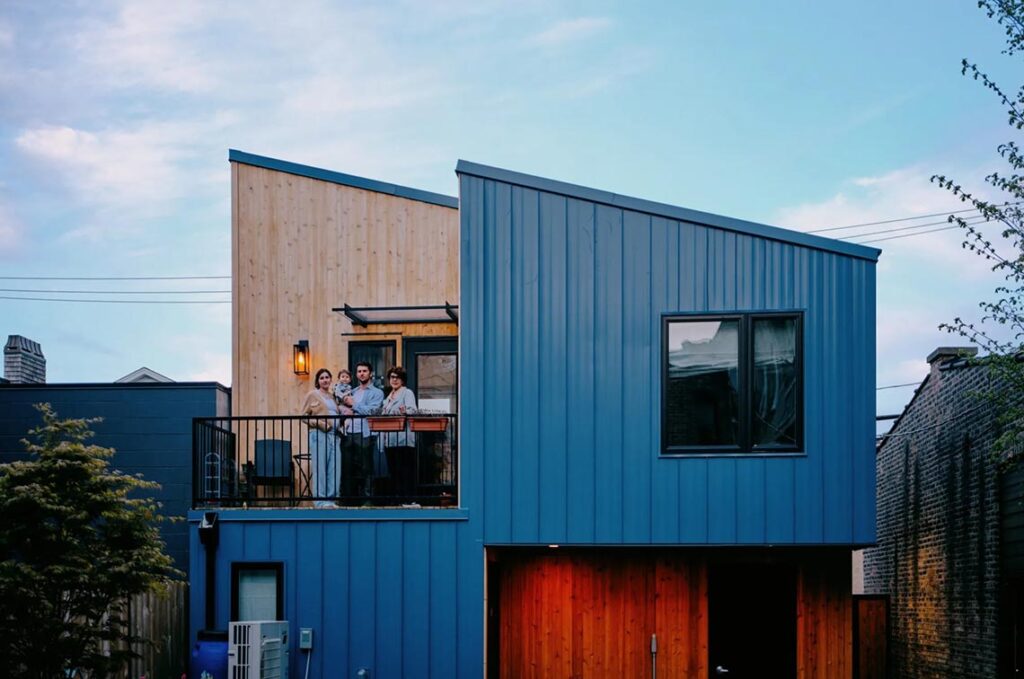
After nearly two years of navigating regulatory red tape and approximately $300,000 in construction costs, D’Agostino was able to move into a 700-square-foot, two-bedroom house on top of Peterman’s garage in 2023.
After nearly two years of navigating regulatory red tape and approximately $300,000 in construction costs, Brian Peterman was able to build a “granny flat” on his property, allowing his mother-in-law to move in. “‘Life-changing’ is probably the cleanest way of saying it,” he said. (Akilah Townsend for Illinois Answers Project)
Nowadays, D’Agostino goes on walks with her 18-month-old granddaughter nearly every day. D’Agostino cooks the toddler recipes from her native Malta that she learned from her own mother, and she’s teaching her to speak Maltese.
D’Agostino pays rent to her daughter, Fiona, and son-in-law, Brian — much less than the cost of the mortgage at her previous home, but still a steady and meaningful source of income for the Petermans to supplement the salaries from their day jobs.
“‘Life-changing’ is probably the cleanest way of saying it,” Brian Peterman said. “By having her there, we always have that backup plan in case something goes awry in our normal lives.”
Homes like D’Agostino’s, typically called coach houses, carriage houses or “granny flats,” are illegal to build in most of Chicago. Their construction was banned in 1957 by city leaders who feared residential overcrowding. Chicago has since lost approximately 800,000 residents.
City officials under three mayors have been pushing for at least six years to unravel the prohibition of so-called accessory dwelling units, or ADUs — a term used to describe both coach houses and unused basement or attic spaces that are converted into apartments. In the legalization campaign, bureaucrats and policy researchers consistently highlight ADUs as a low-risk tool, free to taxpayers, that’s been proven to provide a limited but effective release valve for other cities’ affordable housing crises.
For D’Agostino, it meant finding an affordable home in an affluent neighborhood while providing extra income to offset child care costs for her daughter and son-in-law while keeping her granddaughter close.
A three-year pilot program that legalized the units in some areas showed that outcomes like the Petermans’ are widely replicable, opening up more housing options in neighborhoods where cheap apartments have become increasingly rare. But the burst of construction seen so far is a pittance compared to the more than 100,000 affordable units experts say it would take to satisfy demand.
“ADUs are our path to economic mobility,” said state Rep. Kam Buckner (D-Chicago), who sponsored legislation that would prohibit Illinois cities from banning the units. “They turn under-utilized space into income-generating property, which is a big deal.”
Many City Council members remain skeptical of ADU legalization, wary of any move that would limit their ability to guide new development in their wards.
That’s one reason why a proposal to legalize the units citywide has been sitting on the shelf for more than a year.
In the meantime, property owners inside the pilot zones, like the Petermans, are straining to build ADUs amid daunting costs and regulatory barriers.
City Hall discussions on how to expand and ease construction are clouded by a political stalemate over how far the program should reach, and by a little-understood federal complaint targeting Chicago’s housing segregation. And policymakers have struggled to craft an ordinance that would encourage ADU construction across the city — not just in wealthy, dense areas, where they’ve overwhelmingly been added during the pilot.
As Chicago leaders sit on their hands, proposals to permit ADU construction across Illinois are gaining support in Springfield, where lawmakers are pushing their own measures. Adding to the momentum is Gov. JB Pritzker, who recently endorsed ADUs as a tool to increase the state’s stock of affordable housing.
“Think about carriage houses,” Pritzker said in an April 30 episode of the Volts podcast after an interviewer asked the governor about his housing agenda. “We’ve got neighborhoods where people are not allowed to have those as separate dwellings — or just the idea that we can, if we make a few tweaks here and there, we can significantly increase the amount of housing with the existing housing stock.”
A pilot program to test the waters
Chicago planning officials under former Mayor Rahm Emanuel first promoted the idea of legalizing accessory dwelling units in 2018, saying they “can offer relatively affordable housing for tenants and can help moderate income families become homeowners with the additional income.” Researchers had taken note of new construction in Portland following the legalization of ADUs there years earlier, and a 2016 California law had already unlocked an explosion in construction of the relatively low-cost units across that state.
A 2019 study by the AARP found that in seven U.S. cities, ADU rents were hundreds of dollars lower than the rents of comparable one-bedroom apartments and could provide “a substitute for nursing home care, a means to age in community, an opportunity to live with other family members in multi-generational living arrangements, as well as a source of earning extra income to supplement fixed incomes in their retirement years.”
In 2019, the newly reconstituted Chicago Department of Housing recruited the Chicago-based Urban Land Institute to lead a task force with dozens of developers, architects, affordable housing advocates and lenders to draw up a list of recommendations for how Chicago could legalize ADUs.
The result was a 44-page report, published in May 2020, detailing the challenges of ADU legalization in other cities and ways Chicago could overcome them.
Within a month of the report’s publication, Chicago Mayor Lori Lightfoot had introduced an ordinance legalizing coach house construction and basement unit conversions in Chicago, incorporating some of the task force’s recommendations.
It got a chilly reception in the City Council.
“This will be a blanket approval … it will allow two-flats to become three-flats, three to become four and four to become five,” said then-Ald. Patrick Daley Thompson (11th), who represented the city’s Bridgeport and Chinatown neighborhoods. “If someone wants to change a two-flat to a three-flat, in my ward, we do a community meeting. All of my neighbors — the community comes out and has participation. Not a bureaucrat at City Hall making a decision for my community.”
South Side Ald. David Moore (17th) was more direct.
“I want some aldermanic control over this,” Moore said.
After months of negotiations, the council approved a test ordinance that legalized accessory dwelling ordinance in five “pilot zones” — two on the city’s North Side, one on the West Side and two on the South Side — all in areas represented by alderpeople who supported the initiative. However, the West and South Side zones were established with additional restrictions at local council members’ request, including a requirement that the new units could be built only on owner-occupied properties.
In May 2021, the Chicago Department of Housing began accepting applications for coach houses and basement unit conversions. The ordinance called on city officials to report back to the City Council three years later with data and insights.
Peterman, who had been following the ordinance closely, was among the first in line to apply.
It was a year before his coach house project would break ground.
Peterman became tangled in a weeks-long back-and-forth with zoning officials in the city planning department over the dimensions of his porch. Because the city requires homes like his to have at least one parking space, he needed to figure out how to build the coach house on top of his garage. And even after housing and planning officials gave him the go-ahead, he had to get a fresh approval from the Chicago Department of Buildings, which regulates all construction in the city.
After nearly two years of navigating regulatory red tape and approximately $300,000 in construction costs, Brian Peterman was able to build a “granny flat” on his property, allowing his mother-in-law to move in. “‘Life-changing’ is probably the cleanest way of saying it,” he said. (Akilah Townsend for Illinois Answers Project)
“It took us a very long time compared to a normal [housing] permit, which would have been one-tenth of the time if [the ADU] was already part of the zoning code,” he said.
Just as difficult, Peterman said, was financing. It typically takes between $50,000 and $100,000 to build a new unit in a basement or attic, but building a new coach house can run upwards of $250,000. Peterman and his wife had so much difficulty finding a loan package that they ultimately took out a new line of credit on their existing home to pay for the project, he said.
Despite the hurdles, more than 300 accessory dwelling units have been permitted for construction across the five pilot zones since 2021. They overwhelmingly comprised basement unit conversions, as opposed to coach houses — not surprising, observers said, considering how much cheaper it is to renovate than to build a new free-standing structure.
Open interactive graphic in new tab
More than 90% of the new units were located in one of the two North Side zones. City officials chalked up the disparity to the overwhelming demand for new housing in wealthier parts of the city — and to the added barriers placed on construction in the South and West Side zones.
‘We need them in our neighborhoods’
A May 31, 2024 memo sent to the City Council by commissioners of the Chicago planning and housing departments recommended expanding the pilot citywide. A review of data found that most of the new construction in the pilot program added garden units below existing walk-up apartment buildings. The below-grade units are typically less costly to rent.
Cook County faces a shortage of more than 150,000 affordable homes — in large part due to the disappearance of apartments in two- to four-unit apartment buildings that have either been demolished or converted into lavish single-family homes in recent years, according to the DePaul University Institute for Housing Studies.
As a result, a renter who earns the median income in Chicago today has sharply fewer housing options than they would have had 25 years ago, a WBEZ investigation found earlier this year.
Chicago’s ADU pilot has seen hundreds of units crop up in neighborhoods made up of squat two- and three-story apartment buildings, showing that their legalization has been “spurring investment in exactly the kind of neighborhood type where added housing options are most badly needed,” city commissioners wrote in their memo to the City Council.
The results of the ADU pilot were promising, but they were also underwhelming in the context of the city’s mammoth affordable housing crisis, said Daniel Hertz, who served as director of policy, research and legislative affairs for the Chicago Department of Housing from 2019 to 2024.
“It hasn’t completely transformed the face of any neighborhood,” Hertz said. “But I think 300 additional units that by and large are going to be moderately priced for the neighborhoods that they’re in … and having done that without basically any subsidy from the city — that’s a good thing.”
Ald. Daniel La Spata (1st), whose ward is inside the Northwest Side pilot zone, was an early supporter of accessory dwelling unit legalization. What he’s seen during the pilot has been “fantastic,” solidifying his position on the policy, he said.
Ald. Daniel La Spata (1st) at Chicago City Hall on Tuesday, June 20, 2023 (Victor Hilitski, for Illinois Answers Project)
“I’ve been in these units. They’re great. We need them in our neighborhoods,” La Spata said. “They’ve allowed families to develop and stay together intergenerationally.”
AARP Illinois, which supported Chicago’s ADU pilot ordinance, has since thrown its weight behind efforts to allow construction of the units statewide. A spokesperson for the seniors’ advocacy group said the housing type can provide an ideal option for older Illinoisans who want to live independently while downsizing to a smaller, more affordable home.
AARP found in its 2019 study that the average ADU in Seattle rented for $1,500, compared to nearly $1,900 for a comparable one-bedroom apartment in the same city. The price difference was even sharper in Oakland, Calif. and Washington, D.C.
Proponents argue the financial benefits of ADUs also apply to Chicago.
La Spata noted that the city spends millions of dollars each year to subsidize housing for people with low incomes. Legalizing basement unit conversions, assuming a $100,000-per-unit cost by private developers, represents an easy and efficient way to bring more affordable units into the market without spending taxpayer money, La Spata said.
“If I told someone tomorrow that we could develop 50 units of affordable housing for all of a $5 million investment, that would be the most efficient affordable housing development in the city,” he said.
La Spata supports a proposal from Ald. Bennett Lawson (44th), whose Lakeview ward straddles a pilot zone, to legalize the units across the city.
The addition of new ADUs in Lawson’s ward has “really worked out well,” Lawson said. The new units haven’t drawn any complaints from neighbors or worsened traffic or parking.
“A lot of them are legalizing spaces that were never properly permitted … and making that housing legal and safe for more people in my neighborhood,” the North Side alderperson added.
Lawson met some resistance to the proposal among his colleagues, but he tweaked the ordinance in April 2024 with a compromise that would add an additional hurdle to approval in low-density residential neighborhoods on the city’s outskirts.
Lawson said he believed the amended ordinance had ample support in the City Council and could pass easily if taken to the floor.
A year later, the ordinance remains on the shelf.
Delays and disputes gum up legislation
Lawson’s proposal can’t move forward until Ald. Walter Burnett (27th), who chairs the City Council Committee on Zoning, brings it to a vote.
Burnett is holding the proposal back. But not because he’s against the policy.
He said the hold-up is coming from Mayor Brandon Johnson’s administration.
The housing and planning departments under the mayor rejected Lawson’s proposal, saying its built-in hurdles for construction in less dense neighborhoods make it too restrictive. Instead, the Johnson Administration is pushing for zoning that allows ADU construction in every corner of the city.
“Allowing ADUs by right is essential to meaningfully addressing Chicago’s housing shortage and building on the success of the pilot program,” Chicago Department of Housing spokesperson Felicia Bolton wrote in a statement.
Burnett also blamed the delay on an obscure legal snag.
In 2019, a coalition of fair housing groups led by the Shriver Center on Poverty Law filed a legal complaint with the U.S. Department of Housing and Urban Development alleging that “aldermanic prerogative,” the unwritten rule that gives Chicago alderpeople vast power to dictate zoning changes and other approvals in their own wards, stymies proposals for new affordable housing in well-to-do neighborhoods. The case led federal officials in 2023 to send Chicago leaders a letter ruling that local aldermanic veto power violates federal civil rights law because it “perpetuates segregation” and “effectuates opposition to affordable housing based on racial animus.”
Nearly two years later, the plaintiff groups and city officials all declined to comment on the status of the legal complaint, saying they agreed to stay quiet while the parties negotiate a mutual resolution to the complaint.
Burnett blamed the grinding legal talks for freezing progress on citywide legalization of accessory dwelling units. City attorneys told the zoning committee chair that Lawson’s compromise ordinance, with its added regulations for low-density neighborhoods, would complicate the path to a legal resolution by opening a new avenue for the “aldermanic prerogative” that the plaintiffs are seeking to roll back.
“The law department were the ones that said, ‘hold off until we get past this lawsuit,’” Burnett said.
Chicago Department of Law spokesperson Kristen Cabanban wrote in a statement that city and federal officials are “negotiating a resolution to a complaint regarding the distribution of affordable housing throughout the city.” She declined to comment on the status of the negotiations or on Burnett’s characterization of them.
If city leaders delay on the ordinance much longer, their efforts could be eclipsed by pending state legislation that aims to allow coach houses and basement units across Illinois.
Buckner’s proposal, which would pair a ban on local prohibition of accessory dwelling units with a list of measures designed to boost their construction, missed a key deadline for consideration in the spring 2025 legislative session. But the legislator is also supporting a parallel legalization bill, backed by the powerful trade association Illinois Realtors, that cleared a key committee vote and remains in contention.
“I just hope we can put a little fire under them,” Buckner said of his counterparts on the Chicago City Council. “I want the city to lead this conversation — I really don’t want the state to have to do this. But we will, if we need to.”
After nearly two years of navigating regulatory red tape and approximately $300,000 in construction costs, Brian Peterman was able to build a “granny flat” on his property, allowing his mother-in-law to move in. “‘Life-changing’ is probably the cleanest way of saying it,” he said. (Akilah Townsend for Illinois Answers Project)
Peterman has become a vocal advocate for the legislation, even opening up his home to show Buckner and other state representatives how an ADU can work. He hopes statewide legalization of coach houses helps more families move closer together into affordable homes just like his mother-in-law did.
Legalizing the units in some parts of Chicago “has not changed the character of these neighborhoods,” Peterman said. “All it has done is given people more options for the property that they already own.”
This is a developing story. Check back for updates.
Making it in Chicago
The path toward upward economic mobility is increasingly out of reach for many in Chicago and Illinois. This series by Illinois Answers — the journalism arm of the Better Government Association — examines some of the obstacles, including child-care costs, skyrocketing student loan debt, medical costs and affordable housing. Stories on those topics are being reprinted here with permission from Illinois Answers. Visit Illinois Answers Project to read the entire eight-part series.
This article first appeared on Illinois Answers Project and is republished here under a Creative Commons Attribution-NoDerivatives 4.0 International License. PARSELY = { autotrack: false, onload: function() { PARSELY.beacon.trackPageView({ url: “https://illinoisanswers.org/2025/05/27/granny-flats-are-illegal-to-build-in-most-of-chicago-and-political-gridlock-is-keeping-it-that-way/”, urlref: window.location.href }); } }
The post ‘Granny flats’ may be the answer to affordable housing in Chicago — but they’re illegal appeared first on Capitol News Illinois.