Posts Tagged ‘healthcare’
Amid uncertainty in Washington, Illinois lawmakers pass slimmed-down Medicaid package
Capitol News Illinois
SPRINGFIELD — Nearly every year, Illinois lawmakers pass a package of measures dealing with the state’s Medicaid program, the joint federal and state health care program that covers low-income individuals.
Known as the Medicaid omnibus bill, it sometimes includes bold components, like a 2021 initiative that made millions of dollars available to local communities to help them plan and design their own health care delivery systems. Other packages have focused on smaller changes like guaranteeing coverage for specific conditions and medications or adjusting reimbursement rates for different categories of health care providers.
And moThe Illinois General Assembly passed a scaled-back Medicaid package on the last day of the session Saturday.st years, the packages receive bipartisan support because they are negotiated, largely behind closed doors, by an unofficial, bipartisan Medicaid Working Group.
This year, however, lawmakers passed one of the narrowest packages in recent memory, due mainly to the Trump administration’s vows to make sweeping cuts in federal funding for the program while state lawmakers faced their own set of budget constraints.
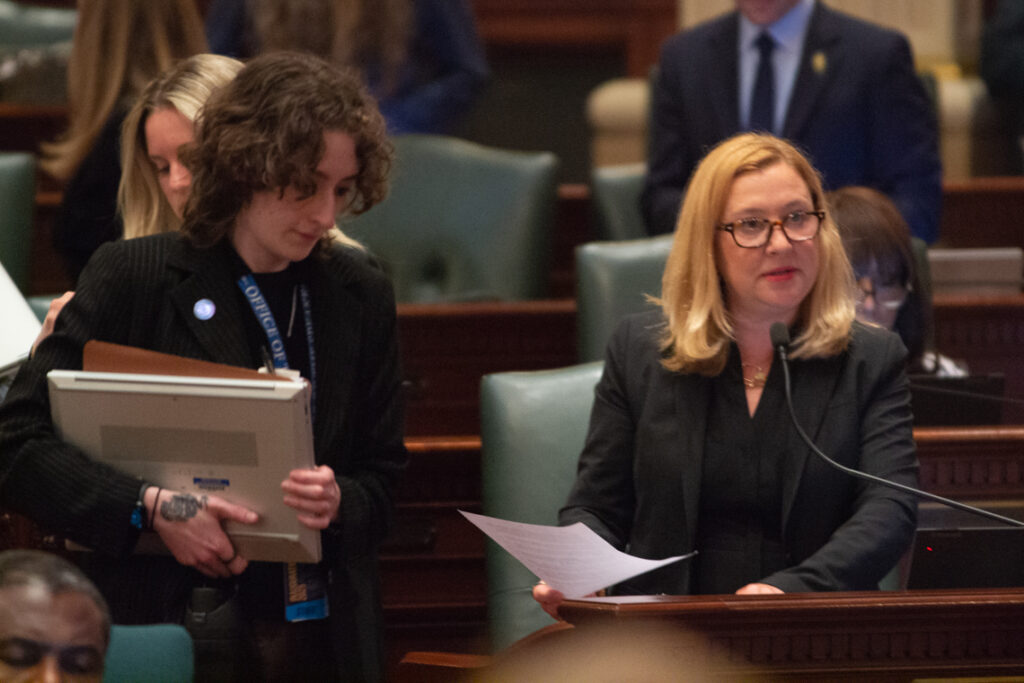
“There were many, many, very worthy program expansions, rate increases that we considered during this process that we were unable to include because of the uncertainty in Washington,” Rep. Anna Moeller, D-Elgin, the current chair of the Medicaid Working Group, said on the House floor Saturday.
The Illinois Medicaid program currently costs about $33.7 billion a year, according to the Department of Healthcare and Family Services. Of that, $20.9 billion, or about 62%, comes from the federal government while much of the state’s share comes from taxes levied on hospitals, nursing homes and managed care organizations – money the state uses to draw down federal matching funds.
The program covers nearly 3.5 million people in Illinois, or about a quarter of the state’s population. According to the nonpartisan health policy think tank KFF, the program pays for 40% of all child births in Illinois while covering 69% of all nursing home residents.
This year’s Medicaid omnibus bill, a 231-page amendment inserted into Senate Bill 2437, contains items that could be hugely beneficial to many Medicaid enrollees, but which don’t carry large price tags. In fact, the entire package is estimated to cost just under $1 million.
One of this year’s additions would make it easier for family members of medically fragile children who qualify for in-home nursing care to receive training to become certified family health aides, a designation that would enable them to administer medications, help with feeding and perform many of the same tasks as a certified nursing assistant.
Another provision would require all hospitals with licensed obstetric beds and birthing centers to adopt written policies that permit patients to have an Illinois Medicaid certified doula of their choosing to accompany them and provide support before, during and after labor and delivery.
Although those provisions enjoyed bipartisan support, another provision that extends coverage to certain categories of noncitizens drew Republican opposition Saturday, resulting in a partisan roll call vote.
The program covers noncitizens who meet the income requirements for Medicaid and have pending applications for asylum in the United States or for special visas as victims of trafficking, torture or other serious crimes. Those individuals can receive coverage for up to 24 months, provided they continue to meet the eligibility requirements.
Moeller said the language was not a new extension of health care benefits to noncitizens, but instead a “technical and administrative fix” to an existing program that had been requested by the Department of Healthcare and Family Services.
But for Republicans, the programs sounded too similar to the more controversial programs, Health Benefits for Immigrant Seniors and Health Benefits for Immigrant Adults, that extend health care to a large category of people who are not U.S. citizens, including some who are in the country illegally.
“For us on this side of the aisle, that is the poison pill,” said Rep. Noreen Hammond, R-Macomb, the deputy House minority leader. “So in spite of the fact that we have article after article in here, that is very worthy of a yes vote, I would urge a no vote.”
At Gov. JB Pritzker’s request, the budget bill lawmakers passed Saturday night cancels the program for immigrant adults, which had covered about 31,000 noncitizens age 42-64. But it provides $110 million over the next year, all in state funds, for the immigrant seniors program, which covers about 8,900 noncitizens age 65 and over.
The Medicaid bill passed the House late Saturday night, 76-39. It then passed the Senate shortly after midnight, 36-19.
It next goes to Pritzker’s desk for his consideration.
Capitol News Illinois is a nonprofit, nonpartisan news service that distributes state government coverage to hundreds of news outlets statewide. It is funded primarily by the Illinois Press Foundation and the Robert R. McCormick Foundation.
The post Amid uncertainty in Washington, Illinois lawmakers pass slimmed-down Medicaid package appeared first on Capitol News Illinois.
Lawmakers unveil $55B spending plan with just 1 day left to pass it
Capitol News Illinois
SPRINGFIELD — Illinois Democrats introduced what a leading budgeteer described as a $55 billion budget Friday evening ahead of a Saturday deadline to pass the fiscal year 2026 spending plan.
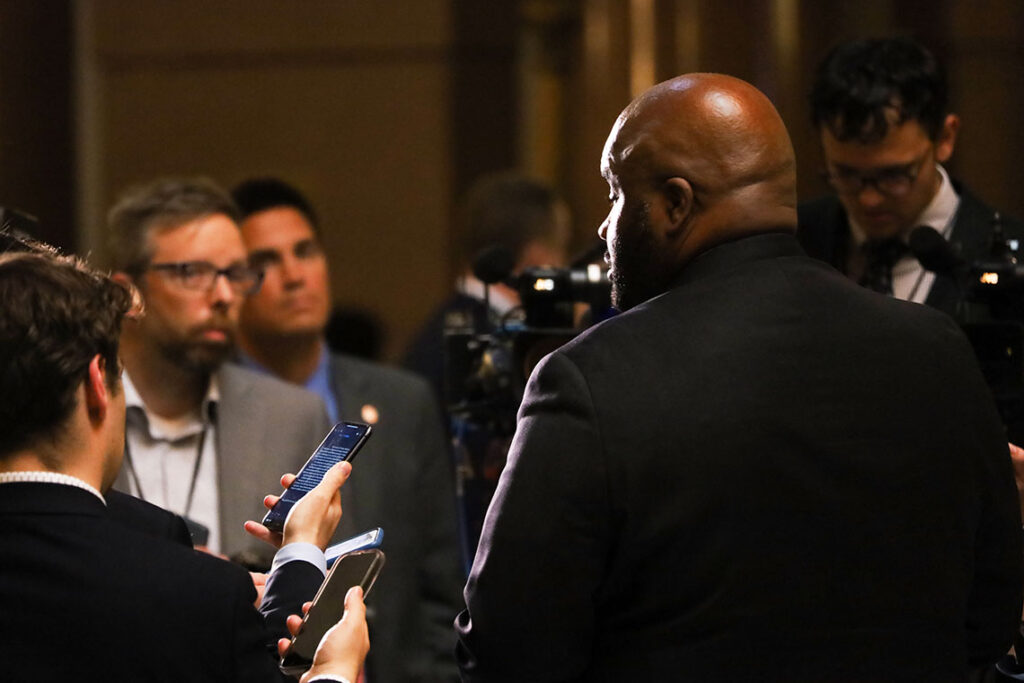
The 3,363-page spending proposal was unveiled after 6 p.m. At the time the Senate’s lead budget negotiator, Sen. Elgie Sims, D-Chicago, briefed reporters on the plan; an exact proposal for raising about $1 billion in revenue to pay for it had not been made publicly available.
But Sims said lawmakers are not using broad tax hikes to balance the budget, although the plan does call for specific tax increases in certain areas. Sims said the proposal includes new taxes on gambling as well as tobacco and vape products. He also hinted that some businesses will pay more under the plan – though Illinois’ constitution mandates that the state corporate income tax remain a flat rate.
“We’re trying to make sure that individuals pay their fair share, and corporations, who are the most prosperous are most profitable, also pay their fair share,” Sims said.
Later, in a House hearing on the spending plan, Democratic Rep. Robyn Gabel, D-Evanston, said it relies upon $55.4 billion in revenue with $55.2 billion in spending. But at several points the chamber’s budget leaders declined to talk about revenue, noting that proposal will come before the committee later, likely on Saturday.
The plan is roughly in line with what Gov. JB Pritzker proposed in his February budget address as budget talks in Congress have injected uncertainty in state finances.
“This budget recognizes that there are significant challenges that we have, that we will face, and it makes sure that the chaos that is coming out of Washington, we’re prepared for it,” Sims told reporters Friday night. “We’re not running away from our responsibility. We’re running towards it.”
A health care program that provides benefits to undocumented immigrants in Illinois between ages 42 and 64 also appears to be eliminated. Pritzker proposed eliminating the program to save the state $330 million.
“He did not include the HBIA (Health Benefits for Immigrant Adults) program in the budget,” Sims said. “But again, that’s in recognition of the challenges that we’re seeing coming out of Washington and the devastating effects that those proposals are having on our state and states across the country.”
Pritzker proposed a $55.2 billion spending plan in February, but revenue forecasts have declined since then. The latest estimate in early May from the governor’s office pegged FY26 revenue at $54.9 billion while the General Assembly’s independent Commission on Government Forecasting and Accountability projected revenue would come in at $54.5 billion – $1 billion below Pritzker’s February revenue estimate.
Expected declines in federal funding and a diminishing economic outlook have caused the downward revisions.
But the yet-to-be-filed revenue plan would make up a little over $1 billion in revenue, according to Sims.
Read more: Pritzker calls $55.2 billion budget ‘responsible and balanced’ | Governor’s office cuts revenue projection by $500 million
Another source of new revenue in the budget proposal is a delinquent tax payment incentive program. The program is designed to help the state recuperate overdue tax payments. The program was proposed by Pritzker and is estimated to generate about $198 million in revenue.
With Medicaid funding cuts possible from Congress, Sims said the budget makes “significant” increases for the state’s hospital systems, in particular safety-net hospitals. He said the plan also builds in wage increases for direct service providers.
The state’s evidence-based funding model for K-12 schools calls for $350 million in additional funding each year, with a portion of that going to a property tax relief fund and the rest directly to schools. The proposed budget fully funds the K-12 education portion at $307 million but does not add $43 million in property tax relief funds, according to House Democratic leaders.
Republicans prodding House Democratic budget leaders for details during a late-night hearing said pausing the grant fails to deliver benefits to property owners.
“The taxpayers are begging and pleading for tax relief and then we put a program on pause?” Rep. John Cabello, R-Machesney Park, said. “Maybe we should look at all the different programs going to Democratic districts and stop those for a little bit instead of telling the taxpayers that there’s not going to be property tax relief.”
Republicans pressed on why House Democrats are set to get $1.5 million of spending for their districts while Senate Democrats are expecting $3 million of spending on districting projects – although Democrats wouldn’t confirm or deny those numbers.
Lawmakers will also see their salaries rise as part of the budget, going to a $98,304 base salary from roughly $92,000. That’s an annualized rate of increase that is set by law.
Editor’s note: This story was updated with more information on the budget from an evening House committee hearing.
Capitol News Illinois is a nonprofit, nonpartisan news service that distributes state government coverage to hundreds of news outlets statewide. It is funded primarily by the Illinois Press Foundation and the Robert R. McCormick Foundation.
The post Lawmakers unveil $55B spending plan with just 1 day left to pass it appeared first on Capitol News Illinois.