Posts Tagged ‘federal funding’
Trump’s ‘big bill’ takes center stage in Illinois’ U.S. Senate race
Capitol News Illinois
Article summary
The three Democrats running for Illinois’ open Senate seat voiced concerns about the new domestic policy plan at events around Illinois.
Lt. Gov. Juliana Stratton discussed how SNAP cuts will affect Illinois at an event in Chicago.
Rep. Robin Kelly spoke with voters in Peoria about their concerns with federal spending cuts.
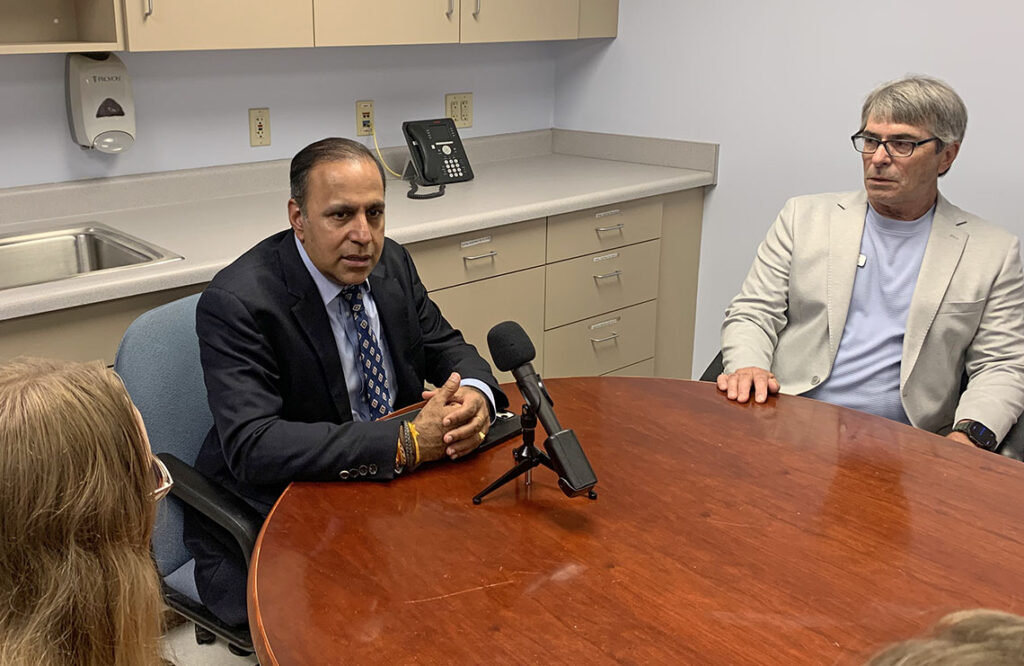
Rep. Raja Krishnamoorthi met with central Illinois independent pharmacist owners to highlight how spending cuts could hurt health care in rural areas.
This summary was written by the reporters and editors who worked on this story.
PEORIA – With major future cuts to social service programs now written into law, Democrats seeking Illinois’ open U.S. Senate seat in 2026 are hitting the campaign trail seeking to position themselves among the law’s most vocal opponents.
“We want Illinoisians throughout our state to understand the ripple effects of the Trump administration’s cruelty and be prepared for what’s to come,” Lt. Gov. Juliana Stratton said during a panel discussion at the Greater Chicago Food Depository Thursday.
The federal policy bill, dubbed the “One Big, Beautiful Bill,” signed by President Donald Trump on July 4 will slash federal spending for health care and other human service programs over the next several years, in many cases leaving states to pick up the tab if they are to continue providing benefits. The bill is expected to cost Illinois more than $700 million for the Supplemental Nutrition Assistance Program, cut Medicaid spending in Illinois by $48 billion over the next 10 years, and potentially force some rural hospitals to close.
As Illinois’ 2026 candidates prepare to begin circulating nominating petitions next month, the three Democrats vying for retiring Sen. Dick Durbin’s Senate seat met with residents around the state to hear about the local impacts of the bill and rally support for their campaigns.
Stratton held an official state event in Chicago to discuss the Pritzker administration’s response to SNAP changes, while U.S. Reps. Robin Kelly and Raja Krishnamoorthi visited downstate communities to discuss the bill.
Kelly gets feedback in Peoria
Kelly, who represents the state’s 2nd Congressional District across parts of Chicago, the south suburbs and rural eastern Illinois, visited with voters in Peoria to hear their concerns about the bill.
The Bradly University graduate said her goal is to make sure Americans are aware of the bill’s effects – even though many of them are slated to begin after the 2026 midterm election.
U.S. Rep. Robin Kelly speaks to voters at an event at the Peoria Public Library on Wednesday, July 9, 2025. (Capitol News Illinois photo by Ben Szalinski)
“In polling and different things that we’ve done, half of the population doesn’t even realize what’s going on,” Kelly said.
Kelly played up her relationship with U.S. House Minority Leader Hakeem Jeffries, saying she has been part of a coalition of House Democrats that have been traveling the country holding town hall meetings about federal spending cuts.
“Every group that we can speak in front of, we need to speak in front of,” Kelly said. “And so that’s one of the reason’s we’re traveling.”
Krishnamoorthi visits rural pharmacy
Krishnamoorthi, who represents the 8th Congressional District in the northwest suburbs, visited a pharmacy in Petersburg about 30 minutes northwest of Springfield.
He echoed concerns other Illinois Democrats have expressed about the “large, lousy law” cutting Medicaid and that it could limit health care services in rural communities.
Read more: Illinois hospitals fear massive cuts under Trump domestic policy law
“When you have that many people who all of a sudden don’t have a way of paying for their health care, then it hurts all those rural health care providers that depend on Medicaid as a form of payment for so many of their patients,” Krishnamoorthi said.
Krishnamoorthi also worried about domino effects from growing deficits as a result of the bill, which the Congressional Budget Office estimates will increase by more than $3 trillion. According to the nonpartisan health research organization KFF, the growing deficit could trigger automatic spending cuts, which could force Medicare cuts even though it was not reduced in the bill.
“We’re also talking about seniors who could be affected by Medicare cuts,” Krishnamoorthi said. “And so at the end of the day, however, everybody’s going to be affected because if, God forbid, one of these hospitals in these areas in the rural parts of Illinois are closed, then everyone, regardless of how their health care is paid for, would be affected negatively.”
SNAP cuts worry candidates
Stratton did not hit the campaign trail with any public events this week, but the Pritzker administration must now decide how it will proceed with new spending requirements signed by the president and the effects of fewer residents receiving social service benefits.
Lt. Gov. Juliana Stratton speaks at a panel discussion on SNAP benefits at the Greater Chicago Food Depository in Chicago on Thursday, July 10, 2025. (Screenshot from Illinois.gov live feed)
Stratton and other top Pritzker administration officials discussed the impact of cuts to the SNAP program during a panel discussion at the Greater Chicago Food Depository as the state seeks more immediate solutions that lawmakers could approve before the 2026 election. The lieutenant governor, who resides on Chicago’s South Side, said reducing eligibility for a food program exacerbates other issues such as crime, economic productivity and learning in schools.
“Hunger is not a problem that stays isolated,” Stratton said. “The repercussions seep out, harming everyone and everything in its path until something changes.”
Kelly told voters in Peoria that SNAP cuts aren’t just a problem for low-income recipients.
“If you cannot buy food, then you’re not shopping at Kroger or wherever you shop,” Kelly said. “And so then Kroger is not buying as much food from the farmers and then they won’t need as many people to work there.”
The Republican field in the Senate race has yet to take shape. Republican Rep. Darin LaHood from the Peoria area held a virtual townhall with 16th Congressional District voters to discuss why he believes the bill will benefit Illinois.
Capitol News Illinois is a nonprofit, nonpartisan news service that distributes state government coverage to hundreds of news outlets statewide. It is funded primarily by the Illinois Press Foundation and the Robert R. McCormick Foundation.
The post Trump’s ‘big bill’ takes center stage in Illinois’ U.S. Senate race appeared first on Capitol News Illinois.
Illinois hospitals fear massive cuts under Trump domestic policy law
Capitol News Illinois
Article summary
President Trump’s domestic policy bill contains massive cuts in federal Medicaid spending over the next 10 years.
One analysis predicts $48 billion in spending reductions in Illinois over a decade.
The cuts limit states’ ability to raise money through provider taxes to fund their share of Medicaid costs.
The cuts also limit the way states use Medicaid to direct additional payments to hospitals.
SPRINGFIELD — Hospital officials in Illinois say they will have to make some difficult decisions in the next few years that could involve laying off staff, cutting back services and even closing some facilities entirely.
That’s the expected result of federal funding cuts built into the recently passed domestic policy bill that President Donald Trump signed into law July 4, a law that will cut federal spending on Medicaid by more than $1 trillion over the next 10 years.
A.J. Wilhelmi, CEO of the Illinois Health and Hospital Association said in an interview with Capitol News Illinois that the financial pressures will fall heaviest on hospitals that serve rural areas, where a larger share of the population is covered by Medicaid.
“The hospitals in these communities are already on the brink, based on some of the increases in labor, drug and supply costs coming out of COVID, a continuation of claim denials by payers and relatively flat reimbursement rates,” Wilhelmi said. “So, all of that is creating significant pressures. And when you add these Medicaid cuts to an already challenging situation, we know that there are several hospitals that close because of these changes.”
Enrollment, reimbursement reductions
The new law contains provisions that are expected to reduce the number of people enrolled in Medicaid, particularly in states like Illinois that expanded eligibility for the program under the Affordable Care Act, the 2010 law commonly known as Obamacare.
Those include work requirements for people who enrolled through the expansion as well as requirements that they verify their continued eligibility for the program twice a year instead of annually.
But the law also includes changes in aspects of the program that most people outside the health care industry never see. Those mechanisms – known as provider taxes and directed payments – affect the way states finance their share of the cost of Medicaid and the way they direct additional payments to certain health care providers such as hospitals.
Like many states, Illinois levies special taxes on certain health care providers, including hospitals. The money those taxes generate is used to draw down additional federal matching funds, then is paid back to the providers in the form of directed payments to increase their overall reimbursement rate and to reward them if they meet certain performance or quality standards.
Currently, IHA estimates the hospital tax generates about $2 billion a year in revenue. This past session, lawmakers passed a bill to increase the assessment in order to fund a 54% increase in hospital payments, subject to federal approval of the state’s plan. But state lawmakers passed that bill before Congress passed Trump’s domestic policy bill, dubbed the “One Big Beautiful Bill Act.”
Prior to passage of the new federal law, the tax rate states could levy was effectively capped at 6% of a hospital’s net patient revenue. But under the new law, for states like Illinois that expanded Medicaid under the ACA, that cap will gradually be lowered by half a percentage point each year starting in 2028 until it reaches 3.5% in 2032.
In addition, Wilhelmi said, the new law imposes a cap on the directed payments that expansion states like Illinois can send to hospitals so that the total does not exceed the maximum allowed under Medicare – the federal health insurance program for seniors, which has a lower reimbursement rate than Medicaid.
“And that will result in a significant reduction in Medicaid reimbursements for hospitals,” Wilhelmi said. “It means literally hundreds of millions of dollars in less reimbursement to hospitals.”
$48 billion impact over 10 years
According to the nonpartisan health policy research organization KFF, federal Medicaid spending in Illinois is expected to be reduced by about $48 billion over 10 years under the new legislation. That includes an estimated $6.73 billion in spending cuts in rural parts of the state.
Democratic Gov. JB Pritzker has been harshly critical of the new law, and particularly the Medicaid cuts contained in it.
“Donald Trump isn’t just cutting health care — he’s also closing hospitals in Illinois and across the country with his latest scheme,” Pritzker said in one social media post while the bill was moving through Congress. “Hard-working Illinoisans will spend more time in overcrowded waiting rooms and lose access to life-saving care.”
Wilhelmi, meanwhile, said there is still time before the cuts begin to take effect, and he is urging state officials to begin work immediately to develop strategies to adapt to the changes.
“I think the state will need to work with stakeholders like IHA and our hospitals, other provider groups, to identify creative options to ensure that the Medicaid program can continue to be that lifeline for vulnerable patients and communities,” he said. “And that will include identifying options to fortify those programs and services, as well as identify working with our congressional delegation on ways to mitigate or further delay these changes.”
Capitol News Illinois is a nonprofit, nonpartisan news service that distributes state government coverage to hundreds of news outlets statewide. It is funded primarily by the Illinois Press Foundation and the Robert R. McCormick Foundation.
The post Illinois hospitals fear massive cuts under Trump domestic policy law appeared first on Capitol News Illinois.
Housing funding cut in Illinois budget as homelessness increases

Capitol News Illinois
Article Summary
Illinois’ fiscal year 2026 budget reduced funding for programs serving homeless people by more than $14 million from the previous year.
JB Pritzker’s “Home Illinois” initiative aimed at reaching “functional zero” homelessness saw a $26.6 million cut.
That program was launched in 2022 and had previously been on a steady upward funding trend.
Advocates worry the reductions and potential federal cuts will exacerbate homelessness in Illinois, which increased 116% in 2024, according to state data.
This summary was written by the reporters and editors who worked on this story.
The number of homeless people in Illinois is rising, but the state’s spending on homeless prevention and other housing programs is headed in the other direction.
Facing a tight budget year with constrained spending and limited natural revenue growth, the $55.1 billion fiscal year 2026 budget that took effect July 1 reduces total funding for housing programs by more than $14 million, including Pritzker’s signature initiative designed to eliminate homelessness in Illinois.
“Last year homelessness increased 116% in the state of Illinois,” Doug Kenshol, co-founder of the Illinois Shelter Alliance, told Capitol News Illinois. “To be in the midst of this crisis and then have the state cut funding was beyond disappointing.”
Discretionary spending rose by less than 1% in the FY26 budget, according to the governor’s office, despite total spending increasing by $2 billion. That minimal spending growth led lawmakers to reduce several programs.
“Is it enough? No, it isn’t … we know that homelessness is an existential crisis, and the state of Illinois takes this seriously,” Sen. Adriane Johnson, D-Buffalo Grove, who serves on a state homeless prevention task force, told Capitol News Illinois. “We have a really bold vision for ending homelessness and we’re going to continue down that path.”
Spending reductions
Pritzker first established a task force by executive order in 2021 that would create a plan for “Home Illinois” to reduce homelessness in the state to “functional zero” — where homelessness is temporary and people without housing can quickly obtain housing resources. The executive order did not set a date for the state to reach functional zero, and funding for the Home Illinois is declining by $26.6 million in FY26.
Pritzker’s administration had previously targeted housing programs for substantial increases in recent years. The FY26 budget appropriated $263.7 million for Home Illinois, down from $290.3 million in FY25. That was a $90 million increase from FY24, when the program received $200.3 million in its first year after Pritzker signed legislation in 2023 codifying the task force and Home Illinois program.
Read more: Pritzker signs $55.1B state budget reliant on $700 million of new taxes
Among the decreased spending in Home Illinois is a $25 million reduction to the Court-Based Rental Assistance Program that provides financial aid to people facing evictions. Other programs saw steady or increased funding, including shelters, which rose to fund Chicago’s One System Initiative that integrates migrants into the city’s typical shelter system.
Spending on housing programs is also down overall, according to the advocacy group Housing Action Illinois. While some housing programs saw increases that offset reductions to Home Illinois, total spending on housing programs is down by $14.6 million in the FY26 budget, to $354 million. Pritzker’s proposed budget had called for a $7.6 million decrease.
“FY26 is largely a maintenance year for the state budget,” an Illinois Department of Human Services spokesperson said in a statement. “We remain as committed as ever to advancing strategies that prevent and end homelessness across Illinois.”
Johnson said the spending reduction is “temporary” and the state is still working toward long-term goals that would require more funding.
“The state is trying to do the best it can with limited resources,” Housing Action Illinois Policy Director Bob Palmer said in an interview.
Some of the avenues lawmakers used to fund programs also divert funding away from one area in favor of another, Palmer said. For example, the Affordable Housing Trust Fund is supposed to provide funding for new permanent rental housing, but money in the fund is also being used to increase funding for emergency or transitional housing.
“We were in a way glad to see that increase but also feeling conflicted because it’s taking money from another important housing resource,” Palmer said. “We had been advocating for that increase to come from general revenue funds.”
Read more: Illinois Shelter Alliance calls for $100M state funding boost to fight homelessness
Funding for the emergency and transitional housing program increased by $7 million, a small win for advocates, but nowhere near the $40 million increase sought by the Illinois Shelter Alliance. The group wanted lawmakers to increase funding by $100 million overall for housing programs.
Palmer also worried proposed federal cuts to rental assistance programs will put additional strain on the state’s budget.
Homelessness continues to grow
The spending reductions come as homelessness in Illinois continues to rise despite the new program.
The latest data on homelessness in Illinois from an October report by a Department of Human Services task force shows the state had 25,787 unhoused people on the night of the annual “point in time” count in January 2024 — a 116% increase from 2023.
The increase is largely driven by migrants who have been sent to Illinois by other states such as Texas. Of those without housing in January 2024, 13,891 were new arrivals. However, non-migrant homelessness is still on the rise, increasing 22% in 2024.
Homelessness is also increasing throughout the state. It’s up 207% since 2020 in Chicago, while DuPage and St. Clair counties were the only places in Illinois to see a decline over that time.
“You can argue that we can always do better, but Illinois is on the right path,” Johnson said.
Despite homelessness increasing since Home Illinois was established, Kenshol said the program is making a difference.
“They’ve created some great programs and they’ve gotten funds distributed and a lot of housing and a lot of shelter has been created, but we have to sustain that effort and we need to keep making incremental increases because we’re not there yet,” he said.
Data backs that up, according to IDHS. The Court-Based Rental Assistance Program, which received a substantial cut this year, has helped 7,500 households. And more than 18,000 people were served by Home Illinois in the first half of FY25 — 10,000 more than IDHS’ prior homelessness prevention program helped in FY22.
The problem, according to advocates and IDHS, is rapidly growing housing costs that make finding permanent housing and affording rent more unreachable for more people. A report last month from the Illinois Economic Policy Institute found Illinois needs 142,000 more housing units to meet the current demand for homes.
Finding more resources
Data in the task force’s annual report that provides a road map for Home Illinois shows service providers still need substantial resources to make a dent in homelessness. The state has more than 23,000 beds and housing units for homeless people, but needs about 27,000 more.
The task force, which includes advocates, lawmakers and top leaders in state agencies, says the problem will continue to grow if these resources aren’t addressed.
“The longer it takes to meet these targets, the more resources will be needed to reach functional zero as homelessness is a dynamic systems problem, or, in other words, annual unmet need for shelter and housing can be expected to increase each year that the need is unmet,” the report said.
Palmer agreed.
“If we’re taking the plan to prevent and end homelessness in Illinois seriously, we need to be providing the increased resources to eliminate that shortage … otherwise we’re just managing homelessness at its current level,” he said.
Palmer said lawmakers should be increasing funding for housing no matter what the state’s budget situation is because housing insecurity can be a root cause for other issues that cost the state more money, such as health problems.
Increasing funding for shelters alone also isn’t enough, said Kenshol, the Shelter Aliance co-founder. A lack of funding for affordable permanent housing leaves people stuck in the shelter system, which means growing rental assistance programs to help prevent people from being forced into shelters should be a budget priority, he said.
In a $55.1 billion budget, Kenshol argued the state should be able to find the money to increase funding each year for housing programs.
“As a society, as voters, as elected officials, we make different choices. We turn our backs on the people who are desperate and at risk of perishing and instead we invest in other things,” Kenshol said. “My values suggest that we should put caring for the least of these first.”
Capitol News Illinois is a nonprofit, nonpartisan news service that distributes state government coverage to hundreds of news outlets statewide. It is funded primarily by the Illinois Press Foundation and the Robert R. McCormick Foundation.
The post Housing funding cut in Illinois budget as homelessness increases appeared first on Capitol News Illinois.
Pritzker warns 330,000 Illinoisans could lose Medicaid under Trump’s budget plan
Capitol News Illinois
Article Summary
The U.S. House gave final passage Thursday to a bill that will cut federal Medicaid spending in Illinois by an estimated 20%, or $48 billion, over 10 years.
Medicaid pays for about 40% of all childbirths in Illinois as well as 69% of all nursing home care, according to an independent analysis.
State officials estimate 330,000 Illinoisans could lose Medicaid coverage if President Donald Trump signs the bill into law.
The Illinois Department of Public Health said nine rural hospitals in Illinois would face closure or severe service reductions due to the cuts.
This summary was written by the reporters and editors who worked on this story.
SPRINGFIELD — The U.S. House gave final passage Thursday to a budget bill that will cut federal Medicaid spending by an estimated $1 trillion over 10 years.
All three Republican members of the Illinois congressional delegation voted in favor of the bill, despite a last-minute plea from Democratic Gov. JB Pritzker who warned the bill will result more than 330,000 Illinoisans losing Medicaid coverage and have a devastating effect on some rural hospitals.
“As those who are entrusted with protecting the health of all your constituents, I urge you to oppose these harmful Medicaid provisions and work to protect healthcare access for rural Illinois families, workers, and veterans,” Pritzker wrote in the letter addressed to GOP Reps. Mike Bost, Darin LaHood and Mary Miller.
The cuts would translate to about $48 billion in Illinois over that period, or about 20% of what the state would otherwise receive, according to an analysis by KFF, a nonpartisan health policy research organization.
That would be one of the largest percentage reductions in any state in the nation, according to KFF, a nonpartisan health policy research organization formerly known as the Kaiser Family Foundation. Louisiana and Virginia would each see cuts of about 21%, KFF said.
The state-level analysis is based largely on Congressional Budget Office estimates showing the bill would reduce federal Medicaid spending by $1 trillion nationwide over the next decade.
The KFF analysis does not include estimates of the number of people who would lose Medicaid coverage under the bill, noting how that will depend on how individual states respond to the policy changes contained in the bill. But overall, it estimates the number of uninsured Americans will grow by 11.8 million.
The bill, which includes many of President Donald Trump’s domestic policy priorities – including tax cuts and increased spending on border security – passed the Senate on Tuesday by a vote of 51-50, with Vice President J.D. Vance casting the tie-breaking vote. Both senators from Illinois, Democrats Dick Durbin and Tammy Duckworth, voted no.
The final vote in the House was 218-214.
“The One Big, Beautiful Bill is a once-in-a-generation victory for the American people,” Miller said in a statement after the House vote. “It delivers on President Trump’s America First agenda with bold, decisive, and immediate action. This is the most pro-worker, pro-family, pro-America legislation I have voted for during my time in Congress, and I was proud to help get it across the finish line for the hardworking Americans across my district.”
Medicaid and the health care marketplace
Medicaid, which is jointly funded by states and the federal government, provides health coverage for lower-income individuals and families. It was established in 1965 alongside Medicare, the federally funded health coverage program for people over 65.
Today, according to the Illinois Department of Healthcare and Family Services, the program covers about 3.4 million people in Illinois, or a fourth of the state’s population. At a total cost of $33.7 billion a year, it is one of the largest single categories of expenditures in the state’s budget. It pays for about 40% of all childbirths in the state, according to KFF, as well as 69% of all nursing home care.
But questions about its future loomed over the Illinois General Assembly during the just-completed legislative session as both Congress and the General Assembly were crafting their respective budgets for their upcoming fiscal years.
“This was a difficult year because of the unprecedented changes and cuts that are looming on the horizon in Washington,” state Rep. Anna Moeller, D-Elgin, said on the floor of the Illinois House during debate over a Medicaid bill on the final day of the session.
Read more: Amid uncertainty in Washington, Illinois lawmakers pass slimmed-down Medicaid package
Speaking with reporters at an unrelated event Tuesday, Pritzker predicted “hundreds of thousands” of people in Illinois will lose Medicaid coverage if the Senate bill is signed into law.
“This is shameful, if you ask me, and it’s going to be very hard to recover,” Pritzker said. “The state of Illinois can’t cover the cost – no state in the country can cover the cost of reinstating that health insurance that is today paid for mostly by the federal government, partly by state government.”
Policy changes under the bill
According to KFF, most of the reductions in Medicaid spending would result from just a few policy changes contained in the bill
Those include imposing a work requirement on adults enrolled in Medicaid through the Affordable Care Act, also known as “Obamacare.” That law expanded eligibility for Medicaid to working-age adults with incomes up to 138% of the federal poverty level. About 772,000 people in Illinois are enrolled under that program.
The bill also calls for requiring people enrolled through the ACA expansion to verify their continued eligibility for Medicaid twice a year instead of annually. That is expected to filter out enrollees whose incomes rise above the eligibility limit as well as those who simply fail to complete the verification process.
Another provision would limit the ability of states to finance their share of the cost of Medicaid by levying taxes on health care providers. Illinois imposes such taxes on hospitals, nursing facilities and managed care organizations that administer the program. Revenue from those taxes is used to draw down federal matching funds that are then used to fund higher reimbursement rates to health care providers.
The final version of the bill does not, however, include a provision penalizing states like Illinois that also provide state-funded health care to noncitizens who do not have lawful status to be in the United States. That provision, which was included in the earlier House version, was not included in the Senate bill, according to KFF.
Capitol News Illinois is a nonprofit, nonpartisan news service that distributes state government coverage to hundreds of news outlets statewide. It is funded primarily by the Illinois Press Foundation and the Robert R. McCormick Foundation.
The post Pritzker warns 330,000 Illinoisans could lose Medicaid under Trump’s budget plan appeared first on Capitol News Illinois.
New taxes on sports bets, nicotine products as Democrats pass $55.2B budget
Capitol News Illinois
SPRINGFIELD – Giving almost no time for public review, Illinois Democrats pushed through a $55.2 billion budget for next fiscal year late Saturday, bolstering coffers with new taxes on sports bets, nicotine products and businesses.
The $55.2 billion spending plan is supported by $55.3 billion of revenue, including just over $1 billion in new taxes and revenue changes.
The four bills making up the budget and capital spending plan, were part of a flurry of thousands of pages of legislation that went from introduction to passage in the final 48 hours of the legislative session.
The budget marked a roughly 3.9% spending increase from the current year, while Republicans criticized it for containing few cuts. It raises about $500 million more in new revenue than what Gov. JB Pritzker proposed in February to make up for declining base revenues.
The minority party also aired frustration with supermajority Democrats for providing next to no time for public review of the massive spending plan and other major bills.
“We’re rushing this process like we always do. ‘Let’s hide this stuff. Let’s hide it so that the public doesn’t see it until it’s too late,’” Rep. John Cabello, R-Machesney Park, said.
Democrats said it was the best budget they could manage in a difficult year. To address potential uncertainties stemming from federal policy changes, they gave the governor authority over a new $100 million “emergency” fund. And they frequently lobbed criticisms at President Donald Trump and Republicans in Congress.
“I am very pleased to be able to present a balanced budget crafted to be fiscally and socially responsible, because we see the decisions made in Washington right now are neither,” House Majority Leader Robyn Gabel, D-Evanston said. “Erratic leadership in Washington has affected our economic outlook, our revenue projections, and even threatened federal funding for our most crucial services.”
The GOP also took issue with the tax increases, although the measure did not raise or create new sales, income or service taxes.
Instead, the measures expand state taxes on foreign and out-of-state income for businesses, raise tax rates on tobacco, vapes and sports gambling, and sweep fund balances from several lesser-known and utilized state funds.
The spending measure, Senate Bill 2510, passed the House 75-41 just before 10 p.m. The Senate followed around 11:30 p.m. with a 34-23 vote. The revenue and tax changes, House Bill 2755, and the budget implementation bill, House Bill 1075, both passed with relative ease before the constitution’s midnight deadline and only Democratic votes as well. Gov. JB Pritzker issued a statement saying he would sign it.
Another spate of tax increases included in a transit governance overhaul bill surfaced late but sputtered. The failed measure would have added a $1.50 fee on food and package deliveries and taxed electric vehicle charging statewide among other changes. Talks on that bill could resume later this year.
New taxes on vaping, gaming, deliveries
The revenue bill creates a tax of 25 cents per wager for a sports betting licensee’s first 20,000 wagers accepted, and 50 cents per wager after that.
Consumers will also see new taxes on tobacco products. The tax rate will rise to 45% from 36%. Vape products and nicotine pouches would also now be included under the tax.
The revenue plan amends state law to tax sales from all businesses that transact in the state, rather than only businesses with a physical presence in Illinois. The plan also eliminates a “safe harbor” exemption for businesses that move money outside the state.
Businesses that move profits to other countries would also be subject to the state’s corporate income tax. The federal government currently taxes half of income moved offshore and Illinois would tax the other half under the revenue plan.
Businesses outside Illinois that sell $100,000 or more to people in the state must also collect Illinois sales taxes even if the business doesn’t have a physical location in Illinois. This would apply to businesses like Amazon.
“I will not support this betrayal of hard-working Illinoisans,” Sen. Don DeWitte, R-St. Charles, said. “And if you care about the people who sent you here, if you truly represent them, you’ll vote no too. Enough is enough. It’s time for this body to stand with taxpayers, not stand up against them.”
Another source of new revenue is a delinquent tax payment incentive program designed to help the state recuperate overdue tax payments. It will generate $228 million, Rep. Will Guzzardi, D-Chicago, said.
The state would also pause the final transfer of motor fuel sales tax revenue to the road fund in order to free up $171 million, according to the governor’s office’s estimate.
A separate bill designed to lower prescription drug prices calls for levying a fee on pharmacy benefit managers based on the number of patients they insure. Money from that fee would go into a fund for the Department of Commerce and Economic Opportunity to award up to $25 million a year in grants to independent pharmacies and pharmacies located in rural counties. The remaining money would go to the state’s general revenue fund.
The measure also extends the state’s Hotel Operators’ Occupation Tax to short-term rentals like Airbnb and Vrbo.
Immigrant health cuts
A controversial program that provides health insurance to more than 30,000 noncitizens between ages 42 and 64 will be cut in FY26. The program’s elimination saves the state $330 million, but a $110 million program for seniors will remain in place.
Together, the two programs have cost the state at least $1.6 billion, according to an audit released in February, far exceeding budgeted costs for the program.
“We had to make some tough decisions here. That program grew at greater rates, financially, than we thought it would, and we had to make some hard decisions,” Gabel said.
Federally Qualified Health Centers are set to receive $40 million in the budget. The centers provide health services to low-income and uninsured people. Democrats touted that increase to provide care for immigrants who would have qualified for the health care program.
Illinois still risks losing some Medicaid funding under a proposal in Congress that threatens to slash reimbursements for states that provide health insurance to people illegally in the United States. But Gabel noted it’s possible those reductions won’t take place until 2027.
The budget also increases funding for safety-net hospitals with federal Medicaid funding cuts possible.
Education spending
The state’s evidence-based funding model for K-12 schools calls for $350 million in additional funding each year, with a portion of that going to a property tax relief fund and the rest directly to schools. The proposed budget fully funds the K-12 education portion at $307 million but does not add $43 million in property tax relief funds, according to Democratic leaders.
Funding for the Illinois Community College Board would also decrease by $24 million, mostly because lawmakers reduced spending on a workforce development grant that Democrat leaders said was not being fully utilized.
Funding for state universities would only increase by 1%. Pritzker proposed a 3% increase for higher education even as most other areas of his budget would’ve increased by 1%. Senate Democrats’ budget leader Sen. Elgie Sims, D-Chicago, said the budget allows for an additional 2% increase in FY26 if the federal government eliminates substantial funding.
Pensions
Despite more than a year of discussions, Illinois lawmakers did not tackle pension reform this spring. Illinois’ Tier 2 pension system is likely out of compliance with Social Security’s “safe harbor” law that requires pension benefits to be at least equal to Social Security.
Part of the budget package created a new Tier 2 reserve fund that can be accessed if there are violations of the “safe harbor” law. Lawmakers appropriated $75 million for the fund this year, in line with Pritzker’s proposal.
‘Emergency’ fund, raises, more
Notably not in this year’s budget is an increase to the “rainy day” fund. Pritzker has taken pride in the fund’s increases in recent years, as it’s grown to a balance of $2.3 billion, up from less than $60,000 when Pritzker took office. The FY26 budget would suspend the monthly transfer for one year, freeing up $45 million for general fund use.
The budget package also establishes a new $100 million fund that the governor can tap into “in the event of unanticipated delays in or failures of revenues.” The measure, an apparent nod to the uncertainty of federal funding amid ongoing congressional budget negotiations, will come from money swept from other funds.
“That will allow us to respond to actions by the federal government and challenges that present themselves and costs that have been diverted from the federal government to the state government,” Sims said in a committee hearing.
The attorney general’s office would get $116 million from the general fund. Attorney General Kwame Raoul asked lawmakers to boost funding for his office as he engages in a growing number of lawsuits against the Trump administration. Raoul was hoping to receive $120 million in funding.
Direct service providers are in line for an 80-cent per hour wage increase, but Republicans said calling it a funding increase is “sleight of hand,” because the measure would also reduce work hours for DSPs by the hundreds of thousands. That makes the increase negligible, Sen. Chapin Rose, R-Mahomet, said in committee.
“It’s not a great budget, but it is a good budget and it is the budget we need for this very difficult moment,” Rep. Lindsey LaPointe, D-Chicago, said.
Lawmakers will see their salaries rise as part of the budget, going to a $98,304 base salary from roughly $92,000. That’s an annualized rate of increase that is set by law.
“You raised our pay, you gave yourselves hundreds of millions of dollars of our taxpayers funds to spend on your pet projects,” Rep. Amy Elik, R-Godfrey, said. “So I simply don’t believe you anymore that you ever intended to be fiscally careful.”
No Bears stadium funding
Lawmakers did not appropriate funding for the Chicago Bears to build a new stadium. But NASCAR would be the recipient of a $5 million grant ahead of the sport’s third downtown Chicago race in July, and the PGA Tour would receive a $1 million grant as part of hosting the 2026 President’s Cup in DuPage County. Those were two economic development measures criticized by Republicans during the Senate committee hearing.
The budget also contains $200 million to prepare unused state properties to be repurposed for development, Sims said. Lawmakers removed another $300 million that Pritzker had sought in spending aimed at offloading surplus property.
Gabel said the state’s employee management department has negotiated more than $100 million in health care cost savings as well.
Any remaining federal pandemic relief funding would also be sent to recipients that have not received payments in previous years before the funding expires in 2026.
Jade Aubrey contributed.
Capitol News Illinois is a nonprofit, nonpartisan news service that distributes state government coverage to hundreds of news outlets statewide. It is funded primarily by the Illinois Press Foundation and the Robert R. McCormick Foundation.
The post New taxes on sports bets, nicotine products as Democrats pass $55.2B budget appeared first on Capitol News Illinois.
Illinois regains access to $77M in federal education funds following judge’s order
Capitol News Illinois
A federal judge in New York issued a preliminary order Tuesday blocking the Trump administration from cutting off states’ access to hundreds of millions of dollars in pandemic relief funds for public schools, including more than $77 million for Illinois.
U.S. District Judge Edgardo Ramos, of the Southern District of New York, issued a preliminary injunction blocking enforcement of an order that Education Secretary Linda McMahon issued on Friday, March 28. That order reversed earlier decisions to grant the states additional time to spend funds they had been allocated.
The effect of McMahon’s order was to immediately cut off access to funds that states said they had already committed to spend but not yet made the actual expenditures.
Illinois Attorney General Kwame Raoul joined a coalition of 17 states in suing the federal government to block McMahon’s order.
“The Trump administration’s shortsighted and illegal decision to attempt to rescind already-appropriated education funding would hurt vulnerable students the most and could wreak havoc on the budgets of school districts throughout Illinois and the nation,” Raoul said in a statement Tuesday.
The lawsuit over pandemic-related education money is one of more than a dozen multistate suits Raoul has joined, in combination with other Democratic state attorneys general, challenging actions Trump has taken since being sworn in for a second term Jan. 20.
In 2020 and 2021, Congress passed several relief and economic stimulus packages totaling trillions of dollars to help individuals, businesses and state and local governments deal with the financial consequences of the pandemic. For schools, that included costs associated with preparing for the safe return to in-person learning, addressing the learning loss students suffered during the extended period of school closures, and addressing some of the unique needs of homeless children that were exacerbated by the pandemic.
According to the complaint, Illinois was awarded just over $5 billion in “education stabilization” funds under the American Rescue Plan Act, or ARPA, which was enacted in March 2021. Of that, $77.2 million remained obligated but not yet spent as of the end of March 2025.
Those funds had been earmarked for such things as teacher mentoring, statewide instructional coaching, new principal mentoring, trauma response initiatives, the creation of social-emotional learning hubs and contracts for technology infrastructure upgrades, according to the complaint.
Under ARPA, those funds were intended to cover expenses incurred through Sept. 30, 2023. Subsequent legislation gave states an additional year, to Sept. 30, 2024, to “obligate” their funds. And under agency regulations, they had another 120 days beyond that to draw down the funds, although they were also given the option of requesting further extensions.
In January 2025, Illinois requested, and later received, permission to extend its deadline for drawing down the remainder of its funds to March 28, 2026. Other states involved in the lawsuit also received extensions.
But on Friday, March 28, 2025, the Department of Education issued a memo rescinding those extensions, effectively cutting off the states’ access to any unspent funds.
“Extending deadlines for COVID-related grants, which are in fact taxpayer funds, years after the COVID pandemic ended is not consistent with the Department’s priorities and thus not a worthwhile exercise of its discretion,” McMahon said in a memo to state education agency heads.
The injunction means the Department of Education cannot enforce the order, at least while the case is still being litigated or until the court issues a different order.
Capitol News Illinois is a nonprofit, nonpartisan news service that distributes state government coverage to hundreds of news outlets statewide. It is funded primarily by the Illinois Press Foundation and the Robert R. McCormick Foundation.
The post Illinois regains access to $77M in federal education funds following judge’s order appeared first on Capitol News Illinois.