Posts Tagged ‘Emanuel “Chris” Welch’
Democrats offer muted praise of Pritzker’s speech, Republicans dismiss ‘campaign’ rhetoric
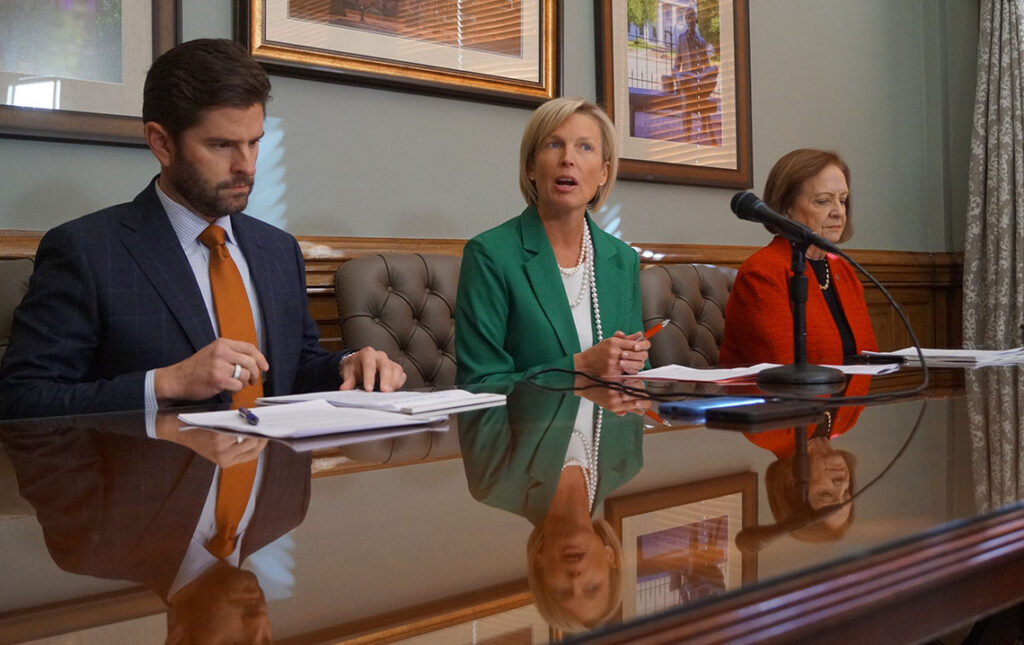
Democrats offered muted praise while Republicans dismissed the governor’s affordability message as campaign-style rhetoric.
Read MoreState leaders seek more transparency from insurance companies

Secretary of State Alexi Giannoulias speaks at an event in Springfield in May 2025. (Capitol News Illinois photo by Jerry Nowicki)
Gov. JB Pritzker and General Assembly leaders claim State Farm is withholding data from the state.
The post State leaders seek more transparency from insurance companies appeared first on Capitol News Illinois
Cook County Dems back Croke for comptroller, no endorsement for Senate race

Capitol News Illinois
Article Summary
The Cook County Democratic Party, one of the most powerful political organizations in the state, chose to back Rep. Margaret Croke, D-Chicago, in her bid to be the next state comptroller.
The comptroller endorsement sparked an intraparty fight, with House Speaker Chris Welch on one side and Senate President Don Harmon on the other.
The party made no endorsement in the race for U.S. Senate.
This summary was written by the reporters and editors who worked on this story.
CHICAGO — At a union hall on Chicago’s South Side, a powerful Democratic Party organization decided who to endorse in the March 17 primary in one key statewide race.
The Cook County Democratic Party Central Committee decided Friday to back Rep. Margaret Croke, D-Chicago, in her bid for Illinois comptroller, the state’s chief financial officer.
That decision sparked conflict between Illinois House Speaker Emanuel “Chris” Welch and Senate President Don Harmon, who backed different candidates.
In the race for U.S. senate however, the party declined to endorse. It’s the first open Senate election in the state since 2010.
“I think the party made the correct decision in making no endorsement in the U.S. Senate race,” Harmon told Capitol News Illinois. “It’s a marquee race with terrific candidates and I’m sure the voters will be able to make an informed decision without an endorsement.”
House Speaker Emanuel “Chris” Welch speaks in favor of slating state Rep. Margaret Croke as the Cook County Democratic Party’s choice for comptroller in the 2026 primary at a meeting Friday in Chicago. (Capitol News Illinois photo by Andrew Adams)
But Harmon objected to the party’s endorsement in the comptroller’s race, sparking a protracted closed-door debate.
Ultimately, Croke bested a list of competitors that included state Sen. Karina Villa, a member of Harmon’s caucus in Springfield.
While an endorsement from the Cook County Democrats does not guarantee a win, it is a major step for a campaign in Illinois.
Cook County has about 40% of the state’s population, and its Democratic Party has been a dominant political force for decades. Beyond the potential for turning out votes in the state’s most populous county, an endorsement from the Cook County Democrats can be a litmus test for support from state-level Democrats.
The group of party insiders considering who to endorse includes Welch and Harmon — both from suburban Cook County — and the committee that oversees statewide endorsements is chaired by state Rep. Bob Rita, D-Blue Island.
Additionally, influential Democrats in the General Assembly, like Rep. Kam Buckner, D-Chicago; Sen. Laura Murphy, D-Des Planes, and Sen. Elgie Sims, D-Chicago, were all present for the meeting.
Party backs Croke for comptroller
The race for comptroller, which opened up this week after sitting comptroller Susana Mendoza announced she was not seeking reelection, sparked a clash between several of the state’s most powerful politicians.
Five candidates asked for the party’s backing. Croke, Lake County Treasurer Holly Kim and Villa, D-West Chicago, were the favored candidates going into the meeting. Champaign County Auditor George Danos and former state Sen. Rickey Hendon also presented at the meeting.
Welch photo
Welch spoke at length in favor of Croke during the slating meeting, adding that he was “very happy to support” Croke. Croke is close to Gov. JB Pritzker, having worked in the Department of Commerce and Economic Opportunity and on his first campaign.
Meanwhile, Harmon backed Villa.
During discussions over comptroller candidates, Cook County Board President Toni Preckwinkle also noted she believed it is “really important for this party to support a Latino for statewide office.”
Read more: Comptroller Mendoza won’t run for reelection, opening up statewide office
In a private session and on a very narrow vote, the subcommittee that recommends statewide endorsements backed Croke. Back in the public session, Harmon fought to try and reject the recommendation.
“We have a slate that does not have any representation from the Latino Caucus, no representation from the Asian Caucus, no one from outside the city of Chicago. I think this is the problem,” Harmon said.
Senate President Don Harmon watches during presentations from comptroller candidates at a meeting to decide who the Cook County Democratic Party will support. Harmon said he had concerns about diversity on the ticket and had backed Sen. Karina Villa. The party ultimately slated Croke. (Capitol News Illinois photo by Andrew Adams)
This sparked another closed-door debate after which Croke emerged with the ultimate endorsement, something that “disappointed” Harmon.
“I worry that the party was more divided than evidenced by the final outcome,” he said. “But it’ll be up to the voters.”
No endorsement for U.S. Senate
After Dick Durbin, Illinois’ current senior U.S. senator, announced his retirement, several candidates quickly popped up to replace him at the end of his final term.
The three frontrunners so far are Lt. Gov. Juliana Stratton, U.S. Rep. Raja Krishnamoorthi and U.S. Rep. Robin Kelly.
Read more: Who is contributing to Illinois’ U.S. Senate candidates?
Several other candidates are in the race and three spoke to party insiders Friday: Christopher Swan, Kevin Ryan and Jump Shepherd. Kelly did not appear at Friday’s meeting, instead having an ally speak on her behalf following travel issues after a late night of voting in Washington.
In the end, the Cook County Democrats didn’t endorse any of them, setting up a contentious primary fight between a current statewide office holder, the one-time state party chair and a man who has nearly 10-to-1 funding advantage.
Durbin, meanwhile, plans on mostly staying out of the race. The retiring senator said Friday that there are three good candidates in the race. While he said he hasn’t “ruled out completely” endorsing someone, he probably won’t.
“I’m not likely to endorse in the race,” Durbin said. “I may in some other races but not that one.”
Governor, other endorsements
The governor couldn’t make the meeting due to a family commitment. In his stead, Pritzker’s running mate Christian Mitchell addressed the collection of party insiders. In a brief speech, Mitchell echoed many of Pritzker campaign talking points.
Christian Mitchell, who is Gov. JB Pritzker’s running mate, took pointed questions from Cook County Democrats on Friday during a meeting about slating candidates for the 2026 primary. (Capitol News Illinois photo by Andrew Adams)
But when the floor was opened to questions, Mitchell started taking heat.
Mitchell, who oversaw Pritzker’s cannabis legalization efforts early in the governor’s first term, once tweeted that he was “stunned at the level of ignorance” at a Chicago City Council meeting, something that multiple alderpeople in attendance on Friday took exception to.
“I don’t recall using that term, but if I did, I apologize,” Mitchell said when questioned by Chicago Ald. David Moore.
Mitchell also faced heat from Chicago Ald. Raymond Lopez, who pressed him on the administration’s relationship to the Latino community. Several Chicago alderpeople also interrogated Mitchell over the administration’s plans on Chicagoland transit, Chicago Public Schools and the closure of manufacturing plants on Chicago’s South Side.
But Mitchell did have his fans in the audience, with one committee member noting that Mitchell’s appearance at a fundraiser helped increase donations, something Mitchell said he wanted to replicate.
“I want to go everywhere, I want to be everywhere,” he said.
The party voted to endorse the Pritzker-Mitchell ticket, which faces no serious challengers within the Democratic party.
Attorney General Kwame Raoul, Treasurer Michael Frerichs and Secretary of State Alexi Giannoulias also received endorsements.
Capitol News Illinois is a nonprofit, nonpartisan news service that distributes state government coverage to hundreds of news outlets statewide. It is funded primarily by the Illinois Press Foundation and the Robert R. McCormick Foundation.
The post Cook County Dems back Croke for comptroller, no endorsement for Senate race appeared first on Capitol News Illinois.
Intoxicating hemp remains unregulated in Illinois following legislative inaction

Capitol News Illinois
Article Summary
Industrial hemp production was legalized in the U.S. and in Illinois in 2018. The industry was largely expected to produce items like industrial textiles and non-intoxicating CBD products.
Since then, a legal “gray area” has allowed for hemp to be used in the production of unregulated, intoxicating and synthetic THC products.
Stakeholders including the governor say this undercuts the state’s legal cannabis market and puts consumers at risk.
For the past three years, legislation to more strictly regulate the industry has failed in the General Assembly.
The legislative fight largely pits the state’s legalized cannabis industry against its industrial hemp growers.
This summary was written by the reporters and editors who worked on this story.
RUSHVILLE, Ill. — Justin and Anna Ward of Stoney Branch Farms were anxiously awaiting action on legislation to regulate intoxicating hemp products this spring in Illinois, which would have determined the future of their family-run hemp business in Rushville. But it never came.
Hemp farming has been legal and regulated in Illinois since 2018, when lawmakers passed the Industrial Hemp Act following federal action that legalized hemp production. The legislation anticipated it would again be used to make industrial products, but also for the production of CBD oils that can be extracted from the plant and are marketed as having therapeutic, but not intoxicating, properties.
But hemp has since become the subject of heated debate in Illinois and other states as the plant has been increasingly used to create synthetic products with intoxicating compounds that are not regulated by the federal government. Those products, known as delta-8 THC, are permissible due to what some describe as a “loophole” in the 2018 Farm Bill that legalized hemp production.
Gov. JB Pritzker has been a vocal opponent of intoxicating hemp, saying it undercuts the state’s legal cannabis industry and puts children and teens in harm’s way. He’s advocated – thus far to no avail – for regulating intoxicating hemp products similarly to the state’s legalized cannabis industry.
“This regulatory gray area has created a loophole that put Illinois consumers of all ages, but particularly children, in danger while an underground market flourished—the exact opposite of what Illinois has done by regulating our cannabis industry,” Pritzker said in a December 2024 news release.
But lawmakers failed again to pass legislation regulating intoxicating hemp this year, leaving the industry in limbo until either the state acts or the federal government intervenes first. It marked the third consecutive year that a regulatory bill failed, the latest front in a legislative fight that largely pits the state’s legalized cannabis industry against its industrial hemp growers.
Stoney Branch Farms co-founder Anna Ward looks at a hemp plants in its late growing stages before it gets harvested, after which it will get processed, packaged and sold directly from the farm. (Isabella Schoonover, Medill Illinois News Bureau)
Hemp vs. cannabis: What’s the difference?
Both hemp and cannabis come from the same plant and contain a level of THC that can cause a high if ingested. The most important difference, however, is in the concentration of THC. Compared to cannabis, hemp has a much lower amount of naturally occurring THC.
By federal law, if a plant has a concentration of 0.3% THC or less by dry weight, it is legally considered hemp. If it has any more than 0.3% THC, it is considered cannabis.
Both substances were strictly regulated as “Schedule 1” drugs under the federal Controlled Substances Act of 1970 until the passage of the 2018 Farm Bill, which removed hemp from the legal definition of cannabis, thus creating a fully legal hemp market.
But the farm bill only established a threshold for delta-9 THC, the primary cannabinoid found in cannabis. There is no explicit threshold for hemp-derived delta-8, which is created through additional chemical processing after hemp is harvested.
Unlike cannabis products containing THC, which must meet strict regulatory requirements in Illinois and other states that have legalized recreational and medical cannabis, the intoxicating hemp market is currently unregulated and lacks oversight at both the state and federal level to ensure products are responsibly produced, marketed and sold to consumers.
For example, there is no minimum age required to purchase hemp products, making it relatively easy for young consumers to access intoxicating hemp compared to cannabis.
A recent study from the University of Illinois System Institute of Government and Public Affairs released in May found credible evidence that hemp-derived THC products are intentionally marketed and readily available to teens and young adults through online sales and convenience stores.
At least 32 states have responded by passing legislation to increase regulations, or in California’s case, ban intoxicating hemp altogether.
Should it be regulated or banned?
The Wards have grown hemp on their sixth-generation farm since it was legalized in 2018. They’re in the camp that would like to see the intoxicating hemp industry more strictly regulated but not outright banned.
As president of the Illinois Healthy Alternatives Association, a trade association and lobbying group for hemp farmers, Justin Ward has made regular trips to Springfield to advocate for increased hemp regulation.
According to Ward, new regulations should include state-mandated testing to ensure hemp products are compliant with federal regulations and free of toxic contaminants, sold in child-safe packaging and labeling, and have a minimum age requirement at point-of-sale.
“Everything we grow meets that standard,” Ward said. At Stoney Branch Farms, the Wards sell both non-intoxicating and intoxicating forms of hemp, including delta-8. They said the cultivation, processing, packaging and marketing of their products is all done in-house.
Every crop at Stoney Branch goes through a pre-harvest THC potency test by a federal sampling agent, in addition to a post-processing test by a third party to ensure the final products are free of contaminants. The products are then sold online in child-safe packaging to consumers 21 years old or above.
A team of packagers turn hemp into finished products on Justin and Anna Ward’s farm, most of which is sold over the internet. (Isabella Schoonover, Medill Illinois News Bureau)
A bill to make these standards law in Illinois, House Bill 1, was proposed this year with the support of hemp lobbyists, but continued disagreement among stakeholders over the details of licensing, taxation and the legal potency threshold of delta-8 THC caused the bill to stall without being called for a vote, according to the bill’s sponsor Rep. La Shawn Ford, D-Chicago.
Municipalities are free to ban the sale of hemp-derived products as they see fit, and many have; in Chicago, the City Council has approved bans specific to some wards.
The state’s legalized cannabis industry, which saw its first sales in January 2020, has at times called for an outright ban on delta-8. The industry maintains it’s willing to work toward a solution.
Tiffany Chappell Ingram, executive director of the Cannabis Business Association of Illinois, said in a recent statement that regulations are needed to “rein in” intoxicating hemp. She argues that the hemp industry unfairly undercuts licensed cannabis operators, evades health and safety regulations and generates little revenue for state programs due to its low tax rate.
“We’ve been at this for years at this point, but we’ve got a lot of great allies in the legislature.” Ward said. “This hasn’t been banned yet because they’ve listened to us.”
Opposition from cannabis crowd
The state’s cannabis industry argues intoxicating hemp is not distinct enough from cannabis to have its own license category and far fewer barriers to entry and operation.
For example, while a three-year license for hemp only costs $1,100, including initial licensing fees, a license for cannabis costs $100,000 just to apply for a large adult-use cultivation license, then another $100,000 when the license is granted and each time it’s renewed. The state caps large-scale adult-use cultivation centers to 21 licenses, and has issued fewer than 100 smaller-scale “craft grow” licenses at a cost of $40,000.
When hemp was legalized, many who couldn’t gain entry to the cannabis industry took it as an opportunity to produce a similar product without all the red tape.
“Part of the reason we were drawn to hemp is the lower barriers of entry to get into this in comparison to the cannabis industry,” Ward said.
Hemp is also taxed at a much lower rate than cannabis, allowing the industry to price its products more competitively. Cannabis revenues, by comparison, are hurt by stricter taxation and regulatory compliance, according to the University of Illinois report.
Stoney Branch Farms co-founders Justin and Anna Ward say that while the hemp industry is booming, regulating it the same as cannabis would be a massive blow to their farm. “If we could just get some sensible regulation, I think that it would help a lot of business owners feel confident enough to really put their whole weight behind their business,” Anna Ward said. (Isabella Schoonover, Medill Illinois News Bureau)
Social equity cannabis licenses are available at lower costs to those who have been impacted by the state’s prior criminalization of cannabis, including those previously convicted of cannabis related offenses, but the industry is still far from accessible.
Ford, who spearheads the issue of hemp and cannabis regulation each year, said it’s important to balance promises made to current social equity cannabis license holders with any concessions made for hemp.
Ward said he supports easing regulations on cannabis to make the industry more accessible in Illinois, while also keeping hemp accessible through “sensible” regulations.
“We want regulations to protect consumers and weed out bad actors, but we don’t want to see this thing regulated to death,” Ward said.
Legislature divided on regulation
The state legislature hasn’t been able to settle the question of whether to regulate hemp-derived products containing delta-8 THC as distinct from medicinal and recreational cannabis, or to treat them as virtually the same substance.
The issue caused a rift among House Democrats earlier this year, and despite continued discussions during the spring legislative session, lawmakers have still not come to a consensus.
A proposal backed by Pritzker in the 2024 session, House Bill 4293, to legally define hemp as cannabis, would have made it illegal to sell hemp without a cannabis license. Hemp lobbyists strongly opposed that measure, fearing it would shut them out and give cannabis license holders a monopoly over the cannabinoid market.
Pritzker ultimately blamed House Speaker Chris Welch for killing that bill in January. Despite bipartisan support, Welch said at the time the measure didn’t have enough votes within his Democratic ranks to pass. A spokesperson for Welch promised at the time that he would continue to work toward hemp regulation throughout the legislative session.
A spokesperson for the speaker declined to comment on why hemp regulations still didn’t advance. Both hemp and cannabis lobbies have donated tens of thousands of dollars to Welch’s campaign, Ford’s and others over the last several years in the legislative blitz surrounding the various regulatory bills.
Ward said Ford has been one of the hemp lobby’s biggest allies. Ford conducted meetings all session among lawmakers, the governor’s office and industry stakeholders in an effort to find common ground.
In many convenience stores that sell hemp, the products are behind the counter, even though it’s not illegal to sell hemp products to minors. These packages are also labeled “21+” and “keep out of reach of children.” Critics say the design, modeled after Sour Patch Kids, is intentionally designed to appeal to children. (Simon Carr, Medill Illinois News Bureau)
“We have two competing industries, and we already have existing businesses, and existing businesses are not interested in just losing their operations,” Ford said.
While closed-door conversations surrounding hemp regulations have continued, there has yet to be a public hearing on hemp. Rep. Sonya Harper, D-Chicago, who chairs the House agriculture committee, said the speaker had not responded to her requests for such a hearing.
“I just want to actually make sure that the voices of those most impacted are heard,” Harper said.
Likelihood of future hemp regulation
Though there’s been significant pressure from Pritzker and some advocacy groups to regulate hemp in Illinois, Ford said he’s not inclined to rush the process, arguing it needs broader bipartisan support.
“We had a problem when we regulated cannabis: we sort of rushed it, and we didn’t have stakeholders all at the table,” Ford said. “Some Republicans would say that they were not a part of it.”
A number of Republicans have recently joined negotiations over hemp legislation. But a compromise still seems far off. Rep. C.D. Davidsmeyer, R-Murrayville, who’s been leading that effort, said Republicans are unlikely to support anything but closing the intoxicating hemp loophole.
Davidsmeyer said he opposes the double standard for cannabis license holders versus hemp.
“If you’re going to have a standard, you have everybody in the same industry going by the same rules,” he said.
A row of mature hemp plants grows in one of the greenhouses at Stoney Branch Farms in Rushville, Illinois. (Isabella Schoonover, Medill Illinois News Bureau)
A spokesperson from the governor’s office said his position has not changed since he called for greater regulation.
“I think that it’s agreed that, from the speaker of the House, the governor and the Republicans and myself, and the industry, everyone agrees that we should regulate this,” Ford said. “Over the months, we should be able to get something. It’s a priority.”
Federal changes coming?
A bill that would end this hemp loophole at the federal level passed through the U.S. Senate Appropriations Committee on Thursday, July 10. If that bill becomes law, the cultivation and sale of hemp products containing “quantifiable amounts” of THC would once again be prohibited under federal law, rolling back the previous allowance of 0.3%.
This would deal a devastating blow to the more than $400 million U.S. hemp industry.
One of the most common forms of hemp sold in the U.S. is cannabidiol, or CBD, a non-intoxicating cannabinoid which is marketed as a therapeutic alternative for the treatment of conditions like insomnia, inflammation and seizure disorders.
“That’s a big focus of our business still, is people who are looking for some of the therapeutic benefits that cannabis can provide without a high,” Ward said.
Because CBD almost always still has trace amounts of THC, proposals to ban any “quantifiable amount” of THC could result in the prohibition of CBD products. “I think we really do a disservice to a great number of consumers in Illinois by doing that,” Ward said.
Simon Carr is a student in journalism with Northwestern University’s Medill School of Journalism, Media, Integrated Marketing Communications, and a fellow in its Medill Illinois News Bureau working in partnership with Capitol News Illinois.
Isabella Schoonover is a graduate student in journalism with Northwestern University’s Medill School of Journalism, Media, Integrated Marketing Communications, and a fellow in its Medill Illinois News Bureau working in partnership with Capitol News Illinois.
Capitol News Illinois is a nonprofit, nonpartisan news service that distributes state government coverage to hundreds of news outlets statewide. It is funded primarily by the Illinois Press Foundation and the Robert R. McCormick Foundation.
The post Intoxicating hemp remains unregulated in Illinois following legislative inaction appeared first on Capitol News Illinois.
GOP lawsuit seeks to end ‘gut-and-replace’ legislation
Capitol News Illinois
SPRINGFIELD — A group of Republican lawmakers filed a lawsuit this week that seeks to nullify legislation they say would indelibly alter both the business and legal landscape of Illinois.
Senate Bill 328 would amend a key provision of Illinois civil law by allowing, in certain kinds of cases, any company authorized to do business in the state to be sued in Illinois courts, even if the underlying claims and the parties have no connection to the state.
As written, the bill would apply only in cases filed under the Uniform Hazardous Substances Act in which the plaintiff claims an injury or illness resulting from exposure to a toxic substance.
What is unique about the GOP lawsuit, however, is that it doesn’t just seek to nullify the legislation before Gov. JB Pritzker signs it. It also asks the court to bar the legislature from using a procedure that has become common in the General Assembly known as “gut-and-replace.” This effectively allows lawmakers to sidestep the Illinois Constitution’s requirement that every bill be read, by title, three times on three different days in each chamber before it is passed because amendments are not required to be read on three different days in each chamber.
That procedure is used frequently for major legislation passed in the final days of a legislative session, including budget bills.
“Illinois’ reputation as one of the most corrupt states in the nation and one of the worst states in the nation for business go hand in hand,” Senate Republican Leader John Curran, R-Downers Grove, said during a virtual news conference Wednesday. “Allowing legislators to disregard the Constitution and good government transparency processes to make laws that are bad for our state is the root cause of both narratives.”
The proposal stems from a 2022 U.S. Supreme Court case, Mallory v. Norfolk Southern Railway Co., in which the court upheld a Pennsylvania law that requires out-of-state corporations to agree to allow Pennsylvania courts to exercise “general personal jurisdiction” over them, just as those courts exercise over domestic corporations.
“This is legalized litigation tourism,” said Sen. Jason Plummer, R-Edwardsville. “And it further damages Illinois’ reputation as a state that’s hostile to businesses and job creators.”
SB 328 began as what’s known in the General Assembly as a “shell bill” — one that has a title and a bill number but no substantive content. In this case, the original language called for making a technical change in one sentence in the Code of Civil Procedure, deleting the word “and” and replacing it with the word “and.”
Each session, lawmakers in both chambers introduce hundreds of such bills, most of which are never acted upon. But they are often amended into substantive legislation later in the session, especially after deadlines for introducing new bills or passing bills out of committees have passed.
That is what happened with SB 328, which began as a shell bill but was amended in the Senate to make a technical change to the way court clerks handle electronically filed documents. It passed out of the Senate on April 10 by a vote of 56-0 and was sent to the House.
In the House, it was read for the first time on April 11 and was assigned to a committee, which voted April 30 to recommend it be passed. It was read a second time on May 13.
On May 30, the next-to-last day of the session, Rep. Jay Hoffman, D-Swansea, introduced a “gut-and-replace” amendment that removed the language about electronic court filings and replaced it with the new language allowing out-of-state corporations to be sued in Illinois courts over acts that may have occurred elsewhere.
House Republican Leader Tony McCombie, left, and Senate GOP Leader John Curran speak to reporters about their lawsuit challenging passage of a controversial bill regarding corporate liability during a virtual news conference Wednesday, June 18. (Credit: Zoom.us)
That amendment was never sent to a substantive committee but instead was debated on the floor of the House where it passed the night of May 31 by a partisan vote of 77-40. That vote also counted as the third reading of the bill in the House, meaning the bill number had now been read on three different days in each chamber. It was then sent back to the Senate, which voted 37-19 shortly after midnight on June 1 to concur in the House amendment.
“We have long discussed with our partners, members and constituents filing suit on this issue, even prior to me being in leadership this year,” House Republican Leader Tony McCombie, of Savanna, said during the news conference. “The caucus members brought forward this egregious example of SB 328, and said let’s move forward.”
The lawsuit was filed in circuit court in Sangamon County. It lists 47 Republican lawmakers as plaintiffs. House Speaker Emanuel “Chris” Welch and Senate President Don Harmon are named as defendants.
Harmon, D-Oak Park, who sponsored the amended bill in the Senate, did not immediately respond Wednesday to a request for comment.
Separately, the Illinois Freedom Caucus has also filed a lawsuit in Sangamon County alleging the state’s budget bill did not satisfy the three readings requirement for similar reasons. A hearing in the case is scheduled for July 3.
Capitol News Illinois is a nonprofit, nonpartisan news service that distributes state government coverage to hundreds of news outlets statewide. It is funded primarily by the Illinois Press Foundation and the Robert R. McCormick Foundation.
The post GOP lawsuit seeks to end ‘gut-and-replace’ legislation appeared first on Capitol News Illinois.
Pritzker signs $55.1B state budget reliant on $700M of new taxes
Capitol News Illinois
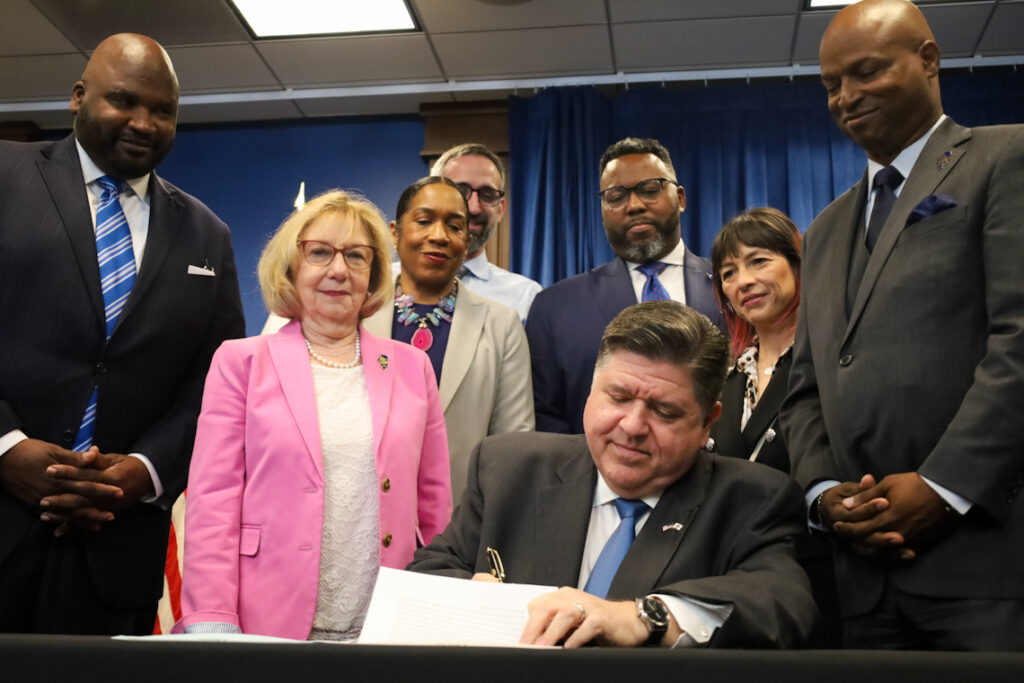
Gov. JB Pritzker signed Illinois’ fiscal year 2026 budget into law Monday, taking shots at President Donald Trump’s budget management to defend hard choices state lawmakers were forced to make this year.
The $55.1 billion spending plan set to take effect July 1 is the largest in state history and is supported by $55.3 billion in anticipated revenue, including more than $700 million in new taxes and more than $500 million in one-time revenues.
Democrats approved the budget shortly before midnight on May 31 with only a handful of Democrats opposing it and all Republicans unanimously voting against it.
The budget’s passage came after months of discussion about closing an initially projected $3 billion deficit and growing concerns about Trump’s treatment of state funding in Washington. Pritzker, a possible 2028 presidential candidate, used Monday’s budget signing ceremony in Chicago as an opportunity to draw a contrast between his and Trump’s budgets.
“While the Trump administration goes on Fox News lying about being fiscally responsible, Illinois is showing a better way: Balancing the budget while maintaining the programs that most people rely on,” Pritzker said.
“Congress is about to pass a federal budget that has one of the largest budget deficits ever in a year without a war or a pandemic. By contrast, Illinois is balancing its budget and prudently improving its fiscal condition,” he said.
Pritzker and other Democratic leaders acknowledged that crafting the FY26 budget was challenging but continues to make investments Democrats believe are priorities. Discretionary spending will increase by less than 1% in FY26, Pritzker said. Despite the minimal increase, the FY26 budget still spends about $2 billion more than FY25.
Democrats “ace the challenges and uncertainty head on, and the result is a budget that is truly balanced with no gimmicks,” House Speaker Chris Welch, D-Hillside, said.
But that’s not how Republicans view the budget’s fund sweeps and delayed transfers that free up hundreds of millions of dollars that can be used in FY26.
“This approach sets Illinois up for failure by FY27 and continues a pattern of short-term thinking,” House Minority Leader Tony McCombie, R-Savanna, said in a statement.
Senate Minority Leader John Curran, R-Downers Grove, condemned lawmakers for failing to deliver significant tax cuts since Pritzker took office in 2019 when Illinois’ budget totaled about $40 billion.
“You know it’s a bad budget when it’s based on nearly $1 billion in tax increases and enhancements,” he said in a statement.
The governor also used his broad authority to reduce a pair of technical errors in the budget. The changes lower spending by $161.2 million from what lawmakers passed.
Tax increases on tobacco and vape products, businesses
The tax plan will raise $709 million in new revenue through what House Majority Leader Robyn Gabel, D-Evanston, characterized as “smart new sources of revenue.” They include new taxes on businesses, sports betting and tobacco and vape products, according to a list provided by the Senate Democratic caucus.
The budget will not raise personal income, corporate income or sales taxes after Pritzker told reporters that he will veto any budget containing “broad-based” tax increases just days before the bill passed.
Sen. Elgie Sims, D-Chicago, discusses the state budget at a June 16 signing ceremony. Sims is the chief budget negotiator in the Senate. (Capitol News Illinois photo by Andrew Adams)
The largest sum of new taxes – $336 million – are on businesses outside of Illinois that lawmakers call “leveling the playing field” and will require businesses to pay more income tax to the state on their profits.
Consumers will face new taxes on specific items, including taxes on tobacco, vaping and other nicotine products, which are increasing to 45% to raise $50 million. An existing telecommunications tax will also rise from 7% to 8.65% and raise $49 million to fund the statewide 988 hotline.
A new tax on sports bets will charge betting sites 25 cents for the first 20 million wagers and 50 cents for each bet following that. It’s projected to raise $36 million. Sports betting sites FanDuel and DraftKings have both announced they will implement 50-cent transaction fees on Illinois customers in response to the tax.
Short-term rentals will have to begin paying the state’s hotel operator’s tax. The charge is already applied to hotels in the state, and Airbnb already pays it voluntarily, but more companies like Vrbo will now be required to pay the tax expected to raise an additional $10 million.
A pair of tax amnesty programs are expected to raise $228 million. Those programs are meant to incentivize taxpayers to pay overdue taxes.
Fund sweeps, delayed transfers free up more for spending
The budget deploys a series of tactics designed to free up more money for spending in the general fund in FY26 without repeating as a revenue source for the following year’s budget.
It suspends the monthly transfer to the “rainy day” fund for one year, freeing up $45 million for general fund use. Pritzker has taken pride in the fund’s increase in recent years as it’s grown to a balance of $2.3 billion, up from less than $60,000 when he took office. The fund is still estimated to grow by $161 million from interest and contributions from other funds in FY26.
Read more: Illinois’ $55.2B budget ‘incomplete,’ Civic Federation president says
The state will also pause the final transfer of motor fuel sales tax revenue to the road fund in order to free up $171 million. That scheduled transfer was set in motion by the state’s 2019 infrastructure plan, with the sales tax supporting bond debt taken out to complete road and bridge projects. This year was to be the final year of incremental transfers that took place over the past five years.
Gov. JB Pritzker speaks before signing Illinois’ fiscal year 2026 budget on June 16. Also pictured, from left to right: Sen. Elgie Sims, D-Chicago; Rep. Will Guzzardi, D-Chicago; Lt. Gov. Juliana Stratton; Rep. Kam Buckner, D-Chicago; House Speaker Emanuel “Chris” Welch, D-Hillside. Rep. Eva-Dina Delgado, D-Chicago, is not shown.
The budget package also establishes a new $100 million BRIDGE fund that the governor can tap into “in the event of unanticipated delays in or failures of revenues.” The measure, an apparent nod to the uncertainty of federal funding amid ongoing congressional budget negotiations, will come from money swept from 57 different funds.
When combined with the tax amnesty program, the fund sweeps and delayed transfers add up to at least $544 million of one-time revenue in this year’s state budget that will not be available in FY27.
Health and Human Services
The most notable change to health care funding is the elimination of the Health Benefits for Immigrant Adults, or HBIA, program that provided certain low-income noncitizens between ages 42 and 64 with state health care benefits akin to Medicaid. Eliminating the program saves the state $330 million, but the $110 million Health Benefits for Immigrant Seniors, or HBIS, remains in place.
“This was part of the challenge that we had to address,” Pritzker said. “It was a program that had been growing significantly in cost. I do believe that everybody should have health care. I also know that we have to live within our means in the state of Illinois.”
HBIA’s elimination comes after a recent audit found the two programs have cost the state at least $1.6 billion since their inception, far exceeding original estimates for the program. Last year, the state put new guardrails in place to limit enrollment into the programs and reduce costs through co-pays and other measures.
Read more: Audit finds Illinois’ noncitizen health care programs far outstripped original cost estimates
Gov. JB Pritzker speaks before signing Illinois’ fiscal year 2026 budget on June 16. (Capitol News Illinois photo by Andrew Adams)
HBIA’s elimination also comes as Congress debates a domestic policy plan that could reduce reimbursements to states that provide health care benefits to noncitizens.
In anticipation of broader reductions to health care and Medicaid reimbursements to the state, Illinois lawmakers also increased spending on other health care and social service programs:
$40 million for Federally Qualified Health Centers. These centers could provide care for people who lose coverage under HBIA turn.
$18 million from the General Revenue Fund for five safety-net hospitals in the state’s Medicaid managed care program. Another $100 million from Fund for Illinois’ Future will go to support the Medicaid managed care program at 12 other safety net hospitals.
$60 million for administrative expenses for the Supplemental Nutrition Assistance Program. That’s a $20 million increase from FY25 as Congress has proposed requiring states to cover half of administrative costs.
$263.7 million for HOME Illinois, a program created to reduce homelessness in Illinois. Housing advocates calculated that between Home Illinois and other housing line items, the budget includes $354 million in funding. That’s about a $14.6 million decrease from a year ago, which marks about double of what Pritzker proposed cutting in homelessness funding in February.
An 80-cent hourly wage increase for direct service professionals who service individuals with intellectual and developmental disabilities in community care settings. However, overall flat funding for the program means 305 positions in the program will be eliminated, according to the They Deserve More coalition. Community Care Program workers at the Illinois Department on Aging will receive a 75-cent hourly wage increase.
A new $25 million Prescription Drug Affordability Fund to support certain pharmacies in Illinois in competition against larger pharmacy benefit managers.
$15 million for the Medical Debt Relief Pilot Program that purchases medical debt from patients at a fraction of the total debt.
A $4 million increase for the Department of Children and Family Services aimed at hiring 100 additional staff members.
A child tax credit created in 2024 at 20% of the Earned Income Tax Credit will double to 40%.
Education
The state’s evidence-based funding model for K-12 schools calls for $350 million in additional funding each year, with a portion of that going to a property tax relief fund and the rest directly to schools. The proposed budget fully funds the K-12 education increase at $307 million but does not add $43 million in property tax relief funds.
Funding for higher education operational expenses is only going up 1%. Pritzker had proposed 3%. Democrat budget leaders have said the spending plan includes ways to increase funding by an additional 2% if there are significant cuts in federal funding for higher education, however.
Read more: Despite victories, major higher education policy bills stall in General Assembly
The budget also includes:
A $10 million increase to the Monetary Award Program grants for lower-income college students.
$8 million for a minority teacher scholarship program.
$2.9 million for the state’s Common App initiative to make it easier for high school students to apply to Illinois colleges and universities at one time.
$212 million for Pritzker’s Smart Start early childhood education program.
$21.7 million for the newly created Department of Early Childhood
Others spending areas
Part of the budget package created a new Tier 2 reserve fund that can be accessed if there are violations of what’s known as the federal “safe harbor” law. Lawmakers appropriated $75 million for the fund this year, in line with Pritzker’s proposal. Broader reform to Tier 2 was not considered this spring.
“With this fix going into effect, we’re protecting our taxpayers and state workers from future shortfalls that could cost the state much more,” Pritzker said.
Read more: ‘This issue isn’t going away’: Illinois lawmakers delay pension reform again
Lt. Gov. Juliana Statton, who is also running for U.S. Senate, speaks at a June 16 signing ceremony where Gov. JB Pritzker formally approved the state’s fiscal year 2026 budget. (Capitol News Illinois photo by Andrew Adams)
Attorney General Kwame Raoul is receiving a $15.7 million general fund increase as his office engages in a growing number of lawsuits against the Trump administration. Raoul told lawmakers he needs more attorneys to handle the cases and a generally growing workload in his office. However, because of declining revenue in other funds, total funding for the office largely remains flat in FY26.
Read more: Raoul’s office to receive $15.7M budget increase for operations
The budget sent to Pritzker included a 5% pay raise for state lawmakers, to $98,304. State law sets the pay for legislators to increase annually with inflation, and lawmakers took no action to stop it from occurring in FY26.
The budget also includes:
$500 million for the Department of Central Management Services and Department of Commerce and Economic Opportunity for the Surplus to Success program to prepare idle state properties for economic development.
$17.9 million for the Department of Financial and Professional Regulation to implement a new licensing system
$40 million for immigrant Welcoming Centers
$6.2 billion for Department of Transportation construction projects, including $4.5 billion for roads and bridges.
Capitol News Illinois is a nonprofit, nonpartisan news service that distributes state government coverage to hundreds of news outlets statewide. It is funded primarily by the Illinois Press Foundation and the Robert R. McCormick Foundation.
The post Pritzker signs $55.1B state budget reliant on $700M of new taxes appeared first on Capitol News Illinois.
Public transit agencies begin planning for ‘doomsday’ funding scenario
Capitol News Illinois
CHICAGO — Transit agency officials in Chicagoland met this week and formally began the process of planning for next year’s budget, including drawing up plans for major service cuts and potential layoffs.
It’s the latest chapter in an ongoing fight between public transit officials and state lawmakers over funding. Public transportation agencies’ federal COVID-19 relief funds are set to run out in 2026. Despite the funding, ridership on buses and trains still hasn’t reached prepandemic levels.
Now, transit agencies running buses and trains in northern Illinois are facing a $771 million annual combined budget gap — and lawmakers did not pass funding reform legislation by a critical May 31 deadline.
While House Speaker Emanuel “Chris” Welch told Capitol News Illinois last week that lawmakers “have time” to handle the situation, transit officials told a very different story at two meetings this week.
“We have told everyone they needed to act by May 31st or else,” Regional Transportation Authority board member Tom Kotarac said at a board meeting Thursday. “We are in the ‘or else’ phase.”
Officials at the RTA laid out a plan Thursday to handle the monetary uncertainty: create two budgets. In one scenario, budget planners assume the gap is filled, and agencies can move forward with the rough plan approved late last year.
“But we cannot operate on assumptions and pledges of good faith and promises. We just can’t, legally,” RTA government affairs director Rob Nash said.
Read more: Legislative leaders discuss next steps for failed transit reform push
The RTA board formally asked the agencies it oversees — the Chicago Transit Authority, Metra commuter rail and Pace Suburban Bus — to prepare a budget that assumes no new funding from Springfield before the end of the year. This means a roughly 20% reduction from what the agency expected.
Open interactive graphic in new tab
Multiple RTA officials called it the “doomsday” scenario. RTA Chief Financial Officer Kevin Bueso said it would require “catastrophic” cuts. CTA acting President Nora Leerhsen told the CTA board on Wednesday that it was “severe and sobering for all of us and hard to stomach.”
Under both plans, the RTA would institute fare increases in 2026 and administrative “efficiencies” to reduce costs in 2025. The RTA also plans to create an ad hoc task force to plan cuts and manage the year’s unusual budget process.
The austerity measures are not just a piece of political theater. The RTA, under state law, must tell service boards the amount of revenue that will be available to them by Sept. 15 each year and the boards must submit individual budgets based on that revenue. The oversight agency releases preliminary funding amounts for transit planners to use months earlier in July.
Leerhsen said the CTA will continue to operate with its current 2025 service plan, but that over the summer and into the fall, the agency will hold public hearings to “more specifically consider” the consequences of the fiscal cliff.
The September deadline is three weeks before the General Assembly’s fall session begins — the earliest that lawmakers are scheduled to meet.
But even if lawmakers meet in October and pass funding reform, officials said that missing their spring deadline has already guaranteed harmful effects.
“I don’t want to give anyone false hope that there is still any way to avoid some of these negative impacts,” RTA Executive Director Leanne Redden said. “The negative impacts are here, and now we’re going to have to all work together to mitigate the worst of those impacts for as long as possible while the legislature continues to do their work.”
Even if lawmakers pass a new funding mechanism, because of the time it takes to implement new policies, that money might not become available to transit agencies until next summer, either due to far off effective dates on any new laws or the delays of implementing new policies.
Delays in funding would, according to Nash, impose “costs, financial and otherwise, to the system and to riders.”
“We are likely to face a challenge in the first part of 2026 no matter what the General Assembly does at this point,” Nash said during the Thursday RTA board meeting.
What’s next in Springfield
Over the past year, several proposals have been pitched in Springfield to address problems in Chicagoland transit agencies.
Two major proposals came from a coalition of environmentalists and labor unions. On Thursday, representatives of the Illinois Clean Jobs Coalition and Labor Alliance for Public Transportation, two groups that have occasionally disagreed on how to address transit agencies’ woes, released a joint statement.
The groups said the RTA’s Thursday meeting “unveiled the disastrous consequences of Springfield’s inaction” and called for lawmakers to meet this summer to address the problem.
“We cannot wait any longer — the General Assembly needs to avert further disaster and address the transit fiscal cliff with reforms and dedicated revenue, while working with existing agencies to ensure that we are investing in the future of our transit systems. The time to act is now,” the groups said.
Read more: Senate’s transit funding, delivery tax proposal stalls in House
While no proposal received close to the support it needed this spring, one bill made it through the Senate in the final hours of lawmakers’ legislative session.
That bill would have instituted several reforms that had been broadly agreed on, although not unanimous. Certain provisions laying out the balance of power on various boards were opposed by local governments.
Its funding mechanism, however, ignited quick controversy. The provision that sparked the greatest opposition would have instituted a $1.50 tax on package deliveries except on orders of groceries and medicine.
That provision drew near-immediate opposition from businesses and interest groups with influential networks of lobbyists. The major tech lobbying group TechNet, along with Uber, Instacart, DoorDash, Chicagoland Chamber of Commerce and several retail industry groups, registered their opposition.
That bill was not considered in the House, and no bill with a similar funding mechanism was proposed in that chamber.
Paula Worthington, an economist and senior lecturer at the University of Chicago, told Capitol News Illinois that imposing a new tax like the delivery fee would be difficult.
“That is a heavy lift, procedurally, legally,” Worthington said. “You can’t just wave a magic wand.”
Worthington pointed to other states’ systems of transit funding that typically include “some elements of shared burden.” Other states have implemented a “commuter transportation mobility” tax on certain businesses, taxes on road users, or expanding taxes on ride sharing companies. Worthington said Illinois could consider those or other taxes during discussions over the summer to identify a solution.
“But those discussions now need to be out in the public,” Worthington said.
Capitol News Illinois is a nonprofit, nonpartisan news service that distributes state government coverage to hundreds of news outlets statewide. It is funded primarily by the Illinois Press Foundation and the Robert R. McCormick Foundation.
The post Public transit agencies begin planning for ‘doomsday’ funding scenario appeared first on Capitol News Illinois.