Posts Tagged ‘Elgie Sims’
Democrats offer muted praise of Pritzker’s speech, Republicans dismiss ‘campaign’ rhetoric
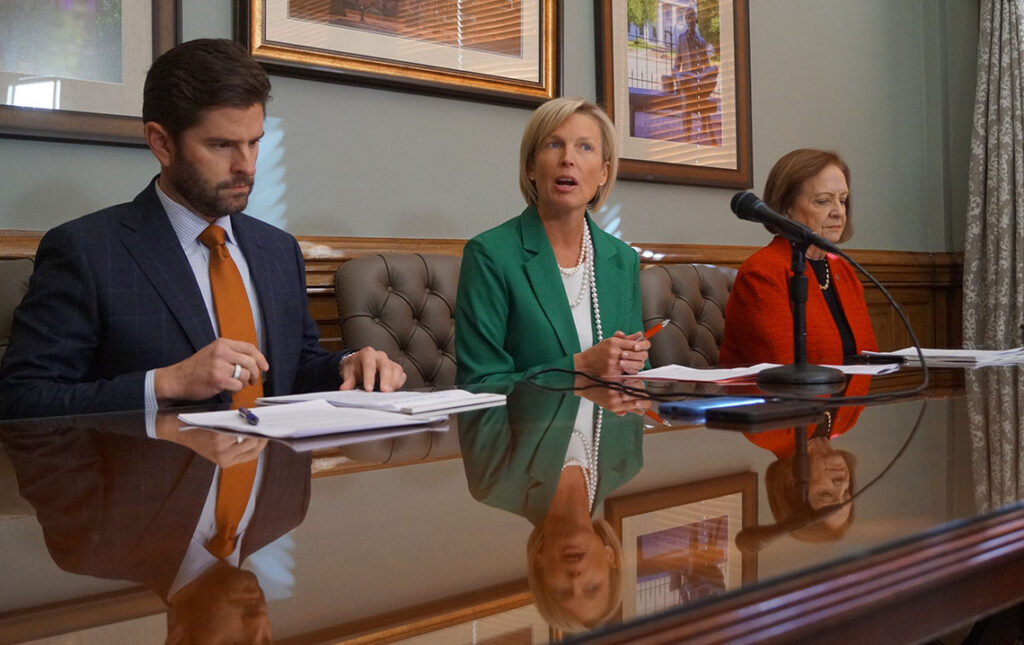
Democrats offered muted praise while Republicans dismissed the governor’s affordability message as campaign-style rhetoric.
Read MoreCook County Dems back Croke for comptroller, no endorsement for Senate race
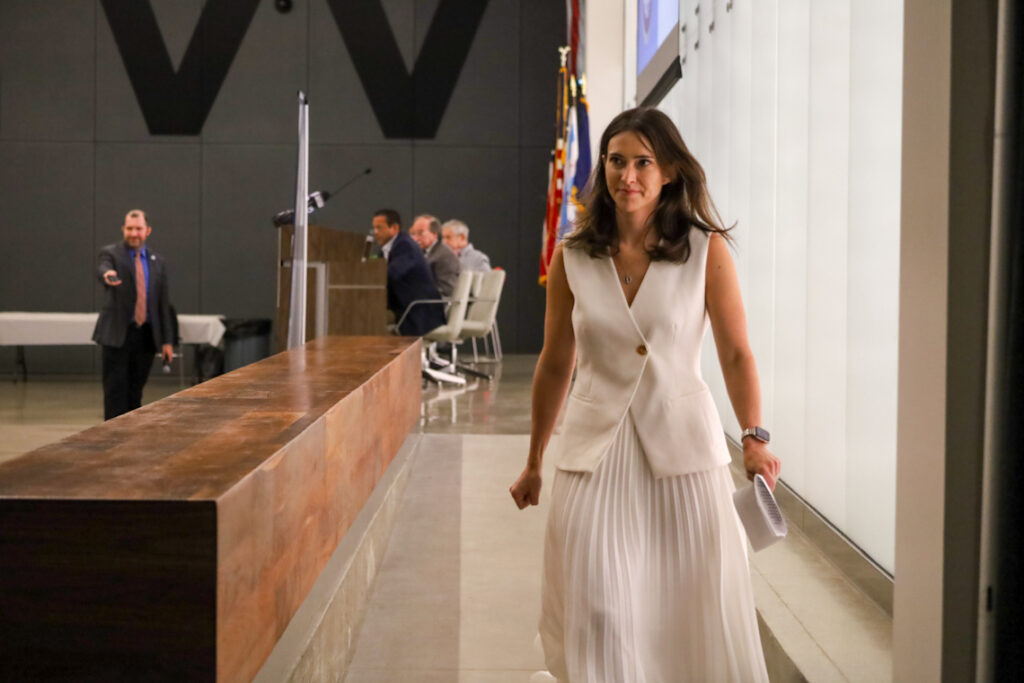
Capitol News Illinois
Article Summary
The Cook County Democratic Party, one of the most powerful political organizations in the state, chose to back Rep. Margaret Croke, D-Chicago, in her bid to be the next state comptroller.
The comptroller endorsement sparked an intraparty fight, with House Speaker Chris Welch on one side and Senate President Don Harmon on the other.
The party made no endorsement in the race for U.S. Senate.
This summary was written by the reporters and editors who worked on this story.
CHICAGO — At a union hall on Chicago’s South Side, a powerful Democratic Party organization decided who to endorse in the March 17 primary in one key statewide race.
The Cook County Democratic Party Central Committee decided Friday to back Rep. Margaret Croke, D-Chicago, in her bid for Illinois comptroller, the state’s chief financial officer.
That decision sparked conflict between Illinois House Speaker Emanuel “Chris” Welch and Senate President Don Harmon, who backed different candidates.
In the race for U.S. senate however, the party declined to endorse. It’s the first open Senate election in the state since 2010.
“I think the party made the correct decision in making no endorsement in the U.S. Senate race,” Harmon told Capitol News Illinois. “It’s a marquee race with terrific candidates and I’m sure the voters will be able to make an informed decision without an endorsement.”
House Speaker Emanuel “Chris” Welch speaks in favor of slating state Rep. Margaret Croke as the Cook County Democratic Party’s choice for comptroller in the 2026 primary at a meeting Friday in Chicago. (Capitol News Illinois photo by Andrew Adams)
But Harmon objected to the party’s endorsement in the comptroller’s race, sparking a protracted closed-door debate.
Ultimately, Croke bested a list of competitors that included state Sen. Karina Villa, a member of Harmon’s caucus in Springfield.
While an endorsement from the Cook County Democrats does not guarantee a win, it is a major step for a campaign in Illinois.
Cook County has about 40% of the state’s population, and its Democratic Party has been a dominant political force for decades. Beyond the potential for turning out votes in the state’s most populous county, an endorsement from the Cook County Democrats can be a litmus test for support from state-level Democrats.
The group of party insiders considering who to endorse includes Welch and Harmon — both from suburban Cook County — and the committee that oversees statewide endorsements is chaired by state Rep. Bob Rita, D-Blue Island.
Additionally, influential Democrats in the General Assembly, like Rep. Kam Buckner, D-Chicago; Sen. Laura Murphy, D-Des Planes, and Sen. Elgie Sims, D-Chicago, were all present for the meeting.
Party backs Croke for comptroller
The race for comptroller, which opened up this week after sitting comptroller Susana Mendoza announced she was not seeking reelection, sparked a clash between several of the state’s most powerful politicians.
Five candidates asked for the party’s backing. Croke, Lake County Treasurer Holly Kim and Villa, D-West Chicago, were the favored candidates going into the meeting. Champaign County Auditor George Danos and former state Sen. Rickey Hendon also presented at the meeting.
Welch photo
Welch spoke at length in favor of Croke during the slating meeting, adding that he was “very happy to support” Croke. Croke is close to Gov. JB Pritzker, having worked in the Department of Commerce and Economic Opportunity and on his first campaign.
Meanwhile, Harmon backed Villa.
During discussions over comptroller candidates, Cook County Board President Toni Preckwinkle also noted she believed it is “really important for this party to support a Latino for statewide office.”
Read more: Comptroller Mendoza won’t run for reelection, opening up statewide office
In a private session and on a very narrow vote, the subcommittee that recommends statewide endorsements backed Croke. Back in the public session, Harmon fought to try and reject the recommendation.
“We have a slate that does not have any representation from the Latino Caucus, no representation from the Asian Caucus, no one from outside the city of Chicago. I think this is the problem,” Harmon said.
Senate President Don Harmon watches during presentations from comptroller candidates at a meeting to decide who the Cook County Democratic Party will support. Harmon said he had concerns about diversity on the ticket and had backed Sen. Karina Villa. The party ultimately slated Croke. (Capitol News Illinois photo by Andrew Adams)
This sparked another closed-door debate after which Croke emerged with the ultimate endorsement, something that “disappointed” Harmon.
“I worry that the party was more divided than evidenced by the final outcome,” he said. “But it’ll be up to the voters.”
No endorsement for U.S. Senate
After Dick Durbin, Illinois’ current senior U.S. senator, announced his retirement, several candidates quickly popped up to replace him at the end of his final term.
The three frontrunners so far are Lt. Gov. Juliana Stratton, U.S. Rep. Raja Krishnamoorthi and U.S. Rep. Robin Kelly.
Read more: Who is contributing to Illinois’ U.S. Senate candidates?
Several other candidates are in the race and three spoke to party insiders Friday: Christopher Swan, Kevin Ryan and Jump Shepherd. Kelly did not appear at Friday’s meeting, instead having an ally speak on her behalf following travel issues after a late night of voting in Washington.
In the end, the Cook County Democrats didn’t endorse any of them, setting up a contentious primary fight between a current statewide office holder, the one-time state party chair and a man who has nearly 10-to-1 funding advantage.
Durbin, meanwhile, plans on mostly staying out of the race. The retiring senator said Friday that there are three good candidates in the race. While he said he hasn’t “ruled out completely” endorsing someone, he probably won’t.
“I’m not likely to endorse in the race,” Durbin said. “I may in some other races but not that one.”
Governor, other endorsements
The governor couldn’t make the meeting due to a family commitment. In his stead, Pritzker’s running mate Christian Mitchell addressed the collection of party insiders. In a brief speech, Mitchell echoed many of Pritzker campaign talking points.
Christian Mitchell, who is Gov. JB Pritzker’s running mate, took pointed questions from Cook County Democrats on Friday during a meeting about slating candidates for the 2026 primary. (Capitol News Illinois photo by Andrew Adams)
But when the floor was opened to questions, Mitchell started taking heat.
Mitchell, who oversaw Pritzker’s cannabis legalization efforts early in the governor’s first term, once tweeted that he was “stunned at the level of ignorance” at a Chicago City Council meeting, something that multiple alderpeople in attendance on Friday took exception to.
“I don’t recall using that term, but if I did, I apologize,” Mitchell said when questioned by Chicago Ald. David Moore.
Mitchell also faced heat from Chicago Ald. Raymond Lopez, who pressed him on the administration’s relationship to the Latino community. Several Chicago alderpeople also interrogated Mitchell over the administration’s plans on Chicagoland transit, Chicago Public Schools and the closure of manufacturing plants on Chicago’s South Side.
But Mitchell did have his fans in the audience, with one committee member noting that Mitchell’s appearance at a fundraiser helped increase donations, something Mitchell said he wanted to replicate.
“I want to go everywhere, I want to be everywhere,” he said.
The party voted to endorse the Pritzker-Mitchell ticket, which faces no serious challengers within the Democratic party.
Attorney General Kwame Raoul, Treasurer Michael Frerichs and Secretary of State Alexi Giannoulias also received endorsements.
Capitol News Illinois is a nonprofit, nonpartisan news service that distributes state government coverage to hundreds of news outlets statewide. It is funded primarily by the Illinois Press Foundation and the Robert R. McCormick Foundation.
The post Cook County Dems back Croke for comptroller, no endorsement for Senate race appeared first on Capitol News Illinois.
Pritzker signs $55.1B state budget reliant on $700M of new taxes
Capitol News Illinois
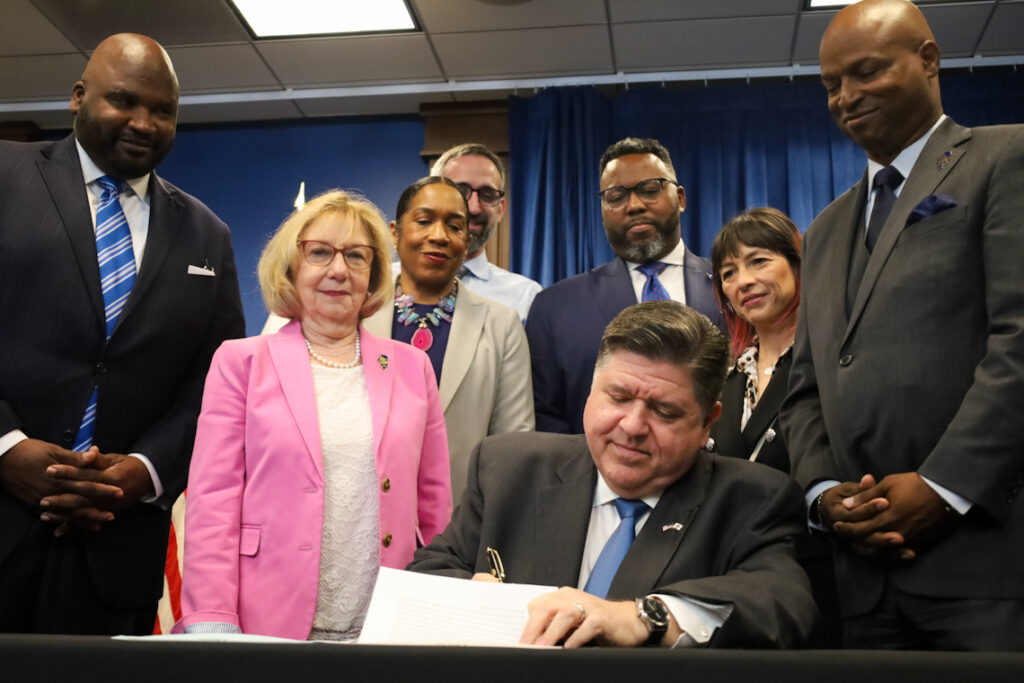
Gov. JB Pritzker signed Illinois’ fiscal year 2026 budget into law Monday, taking shots at President Donald Trump’s budget management to defend hard choices state lawmakers were forced to make this year.
The $55.1 billion spending plan set to take effect July 1 is the largest in state history and is supported by $55.3 billion in anticipated revenue, including more than $700 million in new taxes and more than $500 million in one-time revenues.
Democrats approved the budget shortly before midnight on May 31 with only a handful of Democrats opposing it and all Republicans unanimously voting against it.
The budget’s passage came after months of discussion about closing an initially projected $3 billion deficit and growing concerns about Trump’s treatment of state funding in Washington. Pritzker, a possible 2028 presidential candidate, used Monday’s budget signing ceremony in Chicago as an opportunity to draw a contrast between his and Trump’s budgets.
“While the Trump administration goes on Fox News lying about being fiscally responsible, Illinois is showing a better way: Balancing the budget while maintaining the programs that most people rely on,” Pritzker said.
“Congress is about to pass a federal budget that has one of the largest budget deficits ever in a year without a war or a pandemic. By contrast, Illinois is balancing its budget and prudently improving its fiscal condition,” he said.
Pritzker and other Democratic leaders acknowledged that crafting the FY26 budget was challenging but continues to make investments Democrats believe are priorities. Discretionary spending will increase by less than 1% in FY26, Pritzker said. Despite the minimal increase, the FY26 budget still spends about $2 billion more than FY25.
Democrats “ace the challenges and uncertainty head on, and the result is a budget that is truly balanced with no gimmicks,” House Speaker Chris Welch, D-Hillside, said.
But that’s not how Republicans view the budget’s fund sweeps and delayed transfers that free up hundreds of millions of dollars that can be used in FY26.
“This approach sets Illinois up for failure by FY27 and continues a pattern of short-term thinking,” House Minority Leader Tony McCombie, R-Savanna, said in a statement.
Senate Minority Leader John Curran, R-Downers Grove, condemned lawmakers for failing to deliver significant tax cuts since Pritzker took office in 2019 when Illinois’ budget totaled about $40 billion.
“You know it’s a bad budget when it’s based on nearly $1 billion in tax increases and enhancements,” he said in a statement.
The governor also used his broad authority to reduce a pair of technical errors in the budget. The changes lower spending by $161.2 million from what lawmakers passed.
Tax increases on tobacco and vape products, businesses
The tax plan will raise $709 million in new revenue through what House Majority Leader Robyn Gabel, D-Evanston, characterized as “smart new sources of revenue.” They include new taxes on businesses, sports betting and tobacco and vape products, according to a list provided by the Senate Democratic caucus.
The budget will not raise personal income, corporate income or sales taxes after Pritzker told reporters that he will veto any budget containing “broad-based” tax increases just days before the bill passed.
Sen. Elgie Sims, D-Chicago, discusses the state budget at a June 16 signing ceremony. Sims is the chief budget negotiator in the Senate. (Capitol News Illinois photo by Andrew Adams)
The largest sum of new taxes – $336 million – are on businesses outside of Illinois that lawmakers call “leveling the playing field” and will require businesses to pay more income tax to the state on their profits.
Consumers will face new taxes on specific items, including taxes on tobacco, vaping and other nicotine products, which are increasing to 45% to raise $50 million. An existing telecommunications tax will also rise from 7% to 8.65% and raise $49 million to fund the statewide 988 hotline.
A new tax on sports bets will charge betting sites 25 cents for the first 20 million wagers and 50 cents for each bet following that. It’s projected to raise $36 million. Sports betting sites FanDuel and DraftKings have both announced they will implement 50-cent transaction fees on Illinois customers in response to the tax.
Short-term rentals will have to begin paying the state’s hotel operator’s tax. The charge is already applied to hotels in the state, and Airbnb already pays it voluntarily, but more companies like Vrbo will now be required to pay the tax expected to raise an additional $10 million.
A pair of tax amnesty programs are expected to raise $228 million. Those programs are meant to incentivize taxpayers to pay overdue taxes.
Fund sweeps, delayed transfers free up more for spending
The budget deploys a series of tactics designed to free up more money for spending in the general fund in FY26 without repeating as a revenue source for the following year’s budget.
It suspends the monthly transfer to the “rainy day” fund for one year, freeing up $45 million for general fund use. Pritzker has taken pride in the fund’s increase in recent years as it’s grown to a balance of $2.3 billion, up from less than $60,000 when he took office. The fund is still estimated to grow by $161 million from interest and contributions from other funds in FY26.
Read more: Illinois’ $55.2B budget ‘incomplete,’ Civic Federation president says
The state will also pause the final transfer of motor fuel sales tax revenue to the road fund in order to free up $171 million. That scheduled transfer was set in motion by the state’s 2019 infrastructure plan, with the sales tax supporting bond debt taken out to complete road and bridge projects. This year was to be the final year of incremental transfers that took place over the past five years.
Gov. JB Pritzker speaks before signing Illinois’ fiscal year 2026 budget on June 16. Also pictured, from left to right: Sen. Elgie Sims, D-Chicago; Rep. Will Guzzardi, D-Chicago; Lt. Gov. Juliana Stratton; Rep. Kam Buckner, D-Chicago; House Speaker Emanuel “Chris” Welch, D-Hillside. Rep. Eva-Dina Delgado, D-Chicago, is not shown.
The budget package also establishes a new $100 million BRIDGE fund that the governor can tap into “in the event of unanticipated delays in or failures of revenues.” The measure, an apparent nod to the uncertainty of federal funding amid ongoing congressional budget negotiations, will come from money swept from 57 different funds.
When combined with the tax amnesty program, the fund sweeps and delayed transfers add up to at least $544 million of one-time revenue in this year’s state budget that will not be available in FY27.
Health and Human Services
The most notable change to health care funding is the elimination of the Health Benefits for Immigrant Adults, or HBIA, program that provided certain low-income noncitizens between ages 42 and 64 with state health care benefits akin to Medicaid. Eliminating the program saves the state $330 million, but the $110 million Health Benefits for Immigrant Seniors, or HBIS, remains in place.
“This was part of the challenge that we had to address,” Pritzker said. “It was a program that had been growing significantly in cost. I do believe that everybody should have health care. I also know that we have to live within our means in the state of Illinois.”
HBIA’s elimination comes after a recent audit found the two programs have cost the state at least $1.6 billion since their inception, far exceeding original estimates for the program. Last year, the state put new guardrails in place to limit enrollment into the programs and reduce costs through co-pays and other measures.
Read more: Audit finds Illinois’ noncitizen health care programs far outstripped original cost estimates
Gov. JB Pritzker speaks before signing Illinois’ fiscal year 2026 budget on June 16. (Capitol News Illinois photo by Andrew Adams)
HBIA’s elimination also comes as Congress debates a domestic policy plan that could reduce reimbursements to states that provide health care benefits to noncitizens.
In anticipation of broader reductions to health care and Medicaid reimbursements to the state, Illinois lawmakers also increased spending on other health care and social service programs:
$40 million for Federally Qualified Health Centers. These centers could provide care for people who lose coverage under HBIA turn.
$18 million from the General Revenue Fund for five safety-net hospitals in the state’s Medicaid managed care program. Another $100 million from Fund for Illinois’ Future will go to support the Medicaid managed care program at 12 other safety net hospitals.
$60 million for administrative expenses for the Supplemental Nutrition Assistance Program. That’s a $20 million increase from FY25 as Congress has proposed requiring states to cover half of administrative costs.
$263.7 million for HOME Illinois, a program created to reduce homelessness in Illinois. Housing advocates calculated that between Home Illinois and other housing line items, the budget includes $354 million in funding. That’s about a $14.6 million decrease from a year ago, which marks about double of what Pritzker proposed cutting in homelessness funding in February.
An 80-cent hourly wage increase for direct service professionals who service individuals with intellectual and developmental disabilities in community care settings. However, overall flat funding for the program means 305 positions in the program will be eliminated, according to the They Deserve More coalition. Community Care Program workers at the Illinois Department on Aging will receive a 75-cent hourly wage increase.
A new $25 million Prescription Drug Affordability Fund to support certain pharmacies in Illinois in competition against larger pharmacy benefit managers.
$15 million for the Medical Debt Relief Pilot Program that purchases medical debt from patients at a fraction of the total debt.
A $4 million increase for the Department of Children and Family Services aimed at hiring 100 additional staff members.
A child tax credit created in 2024 at 20% of the Earned Income Tax Credit will double to 40%.
Education
The state’s evidence-based funding model for K-12 schools calls for $350 million in additional funding each year, with a portion of that going to a property tax relief fund and the rest directly to schools. The proposed budget fully funds the K-12 education increase at $307 million but does not add $43 million in property tax relief funds.
Funding for higher education operational expenses is only going up 1%. Pritzker had proposed 3%. Democrat budget leaders have said the spending plan includes ways to increase funding by an additional 2% if there are significant cuts in federal funding for higher education, however.
Read more: Despite victories, major higher education policy bills stall in General Assembly
The budget also includes:
A $10 million increase to the Monetary Award Program grants for lower-income college students.
$8 million for a minority teacher scholarship program.
$2.9 million for the state’s Common App initiative to make it easier for high school students to apply to Illinois colleges and universities at one time.
$212 million for Pritzker’s Smart Start early childhood education program.
$21.7 million for the newly created Department of Early Childhood
Others spending areas
Part of the budget package created a new Tier 2 reserve fund that can be accessed if there are violations of what’s known as the federal “safe harbor” law. Lawmakers appropriated $75 million for the fund this year, in line with Pritzker’s proposal. Broader reform to Tier 2 was not considered this spring.
“With this fix going into effect, we’re protecting our taxpayers and state workers from future shortfalls that could cost the state much more,” Pritzker said.
Read more: ‘This issue isn’t going away’: Illinois lawmakers delay pension reform again
Lt. Gov. Juliana Statton, who is also running for U.S. Senate, speaks at a June 16 signing ceremony where Gov. JB Pritzker formally approved the state’s fiscal year 2026 budget. (Capitol News Illinois photo by Andrew Adams)
Attorney General Kwame Raoul is receiving a $15.7 million general fund increase as his office engages in a growing number of lawsuits against the Trump administration. Raoul told lawmakers he needs more attorneys to handle the cases and a generally growing workload in his office. However, because of declining revenue in other funds, total funding for the office largely remains flat in FY26.
Read more: Raoul’s office to receive $15.7M budget increase for operations
The budget sent to Pritzker included a 5% pay raise for state lawmakers, to $98,304. State law sets the pay for legislators to increase annually with inflation, and lawmakers took no action to stop it from occurring in FY26.
The budget also includes:
$500 million for the Department of Central Management Services and Department of Commerce and Economic Opportunity for the Surplus to Success program to prepare idle state properties for economic development.
$17.9 million for the Department of Financial and Professional Regulation to implement a new licensing system
$40 million for immigrant Welcoming Centers
$6.2 billion for Department of Transportation construction projects, including $4.5 billion for roads and bridges.
Capitol News Illinois is a nonprofit, nonpartisan news service that distributes state government coverage to hundreds of news outlets statewide. It is funded primarily by the Illinois Press Foundation and the Robert R. McCormick Foundation.
The post Pritzker signs $55.1B state budget reliant on $700M of new taxes appeared first on Capitol News Illinois.
New taxes on sports bets, nicotine products as Democrats pass $55.2B budget
Capitol News Illinois
SPRINGFIELD – Giving almost no time for public review, Illinois Democrats pushed through a $55.2 billion budget for next fiscal year late Saturday, bolstering coffers with new taxes on sports bets, nicotine products and businesses.
The $55.2 billion spending plan is supported by $55.3 billion of revenue, including just over $1 billion in new taxes and revenue changes.
The four bills making up the budget and capital spending plan, were part of a flurry of thousands of pages of legislation that went from introduction to passage in the final 48 hours of the legislative session.
The budget marked a roughly 3.9% spending increase from the current year, while Republicans criticized it for containing few cuts. It raises about $500 million more in new revenue than what Gov. JB Pritzker proposed in February to make up for declining base revenues.
The minority party also aired frustration with supermajority Democrats for providing next to no time for public review of the massive spending plan and other major bills.
“We’re rushing this process like we always do. ‘Let’s hide this stuff. Let’s hide it so that the public doesn’t see it until it’s too late,’” Rep. John Cabello, R-Machesney Park, said.
Democrats said it was the best budget they could manage in a difficult year. To address potential uncertainties stemming from federal policy changes, they gave the governor authority over a new $100 million “emergency” fund. And they frequently lobbed criticisms at President Donald Trump and Republicans in Congress.
“I am very pleased to be able to present a balanced budget crafted to be fiscally and socially responsible, because we see the decisions made in Washington right now are neither,” House Majority Leader Robyn Gabel, D-Evanston said. “Erratic leadership in Washington has affected our economic outlook, our revenue projections, and even threatened federal funding for our most crucial services.”
The GOP also took issue with the tax increases, although the measure did not raise or create new sales, income or service taxes.
Instead, the measures expand state taxes on foreign and out-of-state income for businesses, raise tax rates on tobacco, vapes and sports gambling, and sweep fund balances from several lesser-known and utilized state funds.
The spending measure, Senate Bill 2510, passed the House 75-41 just before 10 p.m. The Senate followed around 11:30 p.m. with a 34-23 vote. The revenue and tax changes, House Bill 2755, and the budget implementation bill, House Bill 1075, both passed with relative ease before the constitution’s midnight deadline and only Democratic votes as well. Gov. JB Pritzker issued a statement saying he would sign it.
Another spate of tax increases included in a transit governance overhaul bill surfaced late but sputtered. The failed measure would have added a $1.50 fee on food and package deliveries and taxed electric vehicle charging statewide among other changes. Talks on that bill could resume later this year.
New taxes on vaping, gaming, deliveries
The revenue bill creates a tax of 25 cents per wager for a sports betting licensee’s first 20,000 wagers accepted, and 50 cents per wager after that.
Consumers will also see new taxes on tobacco products. The tax rate will rise to 45% from 36%. Vape products and nicotine pouches would also now be included under the tax.
The revenue plan amends state law to tax sales from all businesses that transact in the state, rather than only businesses with a physical presence in Illinois. The plan also eliminates a “safe harbor” exemption for businesses that move money outside the state.
Businesses that move profits to other countries would also be subject to the state’s corporate income tax. The federal government currently taxes half of income moved offshore and Illinois would tax the other half under the revenue plan.
Businesses outside Illinois that sell $100,000 or more to people in the state must also collect Illinois sales taxes even if the business doesn’t have a physical location in Illinois. This would apply to businesses like Amazon.
“I will not support this betrayal of hard-working Illinoisans,” Sen. Don DeWitte, R-St. Charles, said. “And if you care about the people who sent you here, if you truly represent them, you’ll vote no too. Enough is enough. It’s time for this body to stand with taxpayers, not stand up against them.”
Another source of new revenue is a delinquent tax payment incentive program designed to help the state recuperate overdue tax payments. It will generate $228 million, Rep. Will Guzzardi, D-Chicago, said.
The state would also pause the final transfer of motor fuel sales tax revenue to the road fund in order to free up $171 million, according to the governor’s office’s estimate.
A separate bill designed to lower prescription drug prices calls for levying a fee on pharmacy benefit managers based on the number of patients they insure. Money from that fee would go into a fund for the Department of Commerce and Economic Opportunity to award up to $25 million a year in grants to independent pharmacies and pharmacies located in rural counties. The remaining money would go to the state’s general revenue fund.
The measure also extends the state’s Hotel Operators’ Occupation Tax to short-term rentals like Airbnb and Vrbo.
Immigrant health cuts
A controversial program that provides health insurance to more than 30,000 noncitizens between ages 42 and 64 will be cut in FY26. The program’s elimination saves the state $330 million, but a $110 million program for seniors will remain in place.
Together, the two programs have cost the state at least $1.6 billion, according to an audit released in February, far exceeding budgeted costs for the program.
“We had to make some tough decisions here. That program grew at greater rates, financially, than we thought it would, and we had to make some hard decisions,” Gabel said.
Federally Qualified Health Centers are set to receive $40 million in the budget. The centers provide health services to low-income and uninsured people. Democrats touted that increase to provide care for immigrants who would have qualified for the health care program.
Illinois still risks losing some Medicaid funding under a proposal in Congress that threatens to slash reimbursements for states that provide health insurance to people illegally in the United States. But Gabel noted it’s possible those reductions won’t take place until 2027.
The budget also increases funding for safety-net hospitals with federal Medicaid funding cuts possible.
Education spending
The state’s evidence-based funding model for K-12 schools calls for $350 million in additional funding each year, with a portion of that going to a property tax relief fund and the rest directly to schools. The proposed budget fully funds the K-12 education portion at $307 million but does not add $43 million in property tax relief funds, according to Democratic leaders.
Funding for the Illinois Community College Board would also decrease by $24 million, mostly because lawmakers reduced spending on a workforce development grant that Democrat leaders said was not being fully utilized.
Funding for state universities would only increase by 1%. Pritzker proposed a 3% increase for higher education even as most other areas of his budget would’ve increased by 1%. Senate Democrats’ budget leader Sen. Elgie Sims, D-Chicago, said the budget allows for an additional 2% increase in FY26 if the federal government eliminates substantial funding.
Pensions
Despite more than a year of discussions, Illinois lawmakers did not tackle pension reform this spring. Illinois’ Tier 2 pension system is likely out of compliance with Social Security’s “safe harbor” law that requires pension benefits to be at least equal to Social Security.
Part of the budget package created a new Tier 2 reserve fund that can be accessed if there are violations of the “safe harbor” law. Lawmakers appropriated $75 million for the fund this year, in line with Pritzker’s proposal.
‘Emergency’ fund, raises, more
Notably not in this year’s budget is an increase to the “rainy day” fund. Pritzker has taken pride in the fund’s increases in recent years, as it’s grown to a balance of $2.3 billion, up from less than $60,000 when Pritzker took office. The FY26 budget would suspend the monthly transfer for one year, freeing up $45 million for general fund use.
The budget package also establishes a new $100 million fund that the governor can tap into “in the event of unanticipated delays in or failures of revenues.” The measure, an apparent nod to the uncertainty of federal funding amid ongoing congressional budget negotiations, will come from money swept from other funds.
“That will allow us to respond to actions by the federal government and challenges that present themselves and costs that have been diverted from the federal government to the state government,” Sims said in a committee hearing.
The attorney general’s office would get $116 million from the general fund. Attorney General Kwame Raoul asked lawmakers to boost funding for his office as he engages in a growing number of lawsuits against the Trump administration. Raoul was hoping to receive $120 million in funding.
Direct service providers are in line for an 80-cent per hour wage increase, but Republicans said calling it a funding increase is “sleight of hand,” because the measure would also reduce work hours for DSPs by the hundreds of thousands. That makes the increase negligible, Sen. Chapin Rose, R-Mahomet, said in committee.
“It’s not a great budget, but it is a good budget and it is the budget we need for this very difficult moment,” Rep. Lindsey LaPointe, D-Chicago, said.
Lawmakers will see their salaries rise as part of the budget, going to a $98,304 base salary from roughly $92,000. That’s an annualized rate of increase that is set by law.
“You raised our pay, you gave yourselves hundreds of millions of dollars of our taxpayers funds to spend on your pet projects,” Rep. Amy Elik, R-Godfrey, said. “So I simply don’t believe you anymore that you ever intended to be fiscally careful.”
No Bears stadium funding
Lawmakers did not appropriate funding for the Chicago Bears to build a new stadium. But NASCAR would be the recipient of a $5 million grant ahead of the sport’s third downtown Chicago race in July, and the PGA Tour would receive a $1 million grant as part of hosting the 2026 President’s Cup in DuPage County. Those were two economic development measures criticized by Republicans during the Senate committee hearing.
The budget also contains $200 million to prepare unused state properties to be repurposed for development, Sims said. Lawmakers removed another $300 million that Pritzker had sought in spending aimed at offloading surplus property.
Gabel said the state’s employee management department has negotiated more than $100 million in health care cost savings as well.
Any remaining federal pandemic relief funding would also be sent to recipients that have not received payments in previous years before the funding expires in 2026.
Jade Aubrey contributed.
Capitol News Illinois is a nonprofit, nonpartisan news service that distributes state government coverage to hundreds of news outlets statewide. It is funded primarily by the Illinois Press Foundation and the Robert R. McCormick Foundation.
The post New taxes on sports bets, nicotine products as Democrats pass $55.2B budget appeared first on Capitol News Illinois.
Lawmakers unveil $55B spending plan with just 1 day left to pass it
Capitol News Illinois
SPRINGFIELD — Illinois Democrats introduced what a leading budgeteer described as a $55 billion budget Friday evening ahead of a Saturday deadline to pass the fiscal year 2026 spending plan.
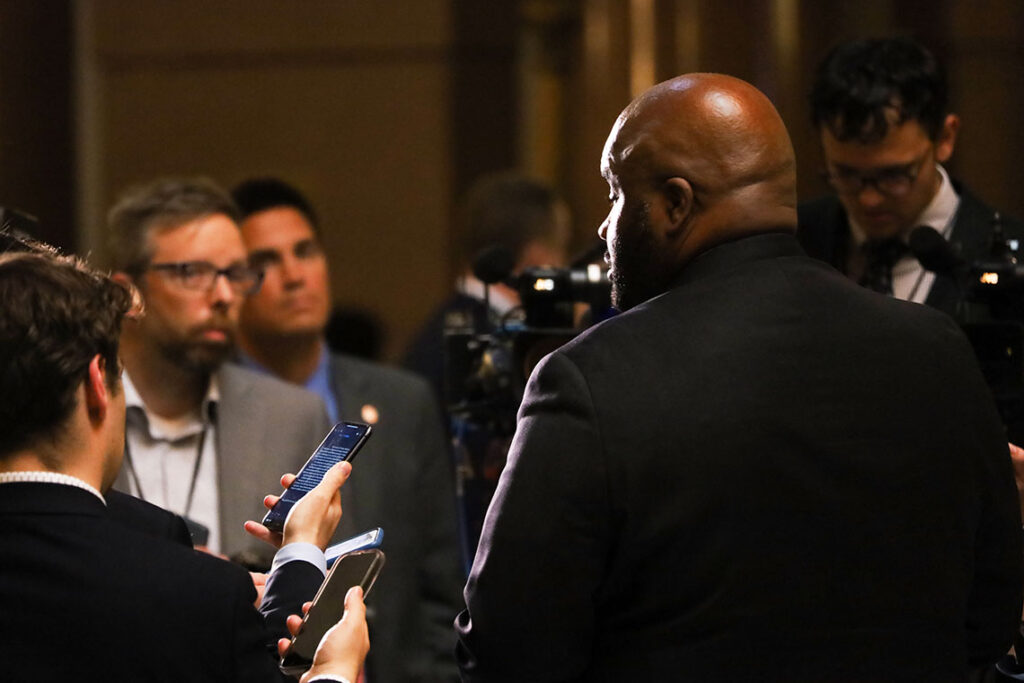
The 3,363-page spending proposal was unveiled after 6 p.m. At the time the Senate’s lead budget negotiator, Sen. Elgie Sims, D-Chicago, briefed reporters on the plan; an exact proposal for raising about $1 billion in revenue to pay for it had not been made publicly available.
But Sims said lawmakers are not using broad tax hikes to balance the budget, although the plan does call for specific tax increases in certain areas. Sims said the proposal includes new taxes on gambling as well as tobacco and vape products. He also hinted that some businesses will pay more under the plan – though Illinois’ constitution mandates that the state corporate income tax remain a flat rate.
“We’re trying to make sure that individuals pay their fair share, and corporations, who are the most prosperous are most profitable, also pay their fair share,” Sims said.
Later, in a House hearing on the spending plan, Democratic Rep. Robyn Gabel, D-Evanston, said it relies upon $55.4 billion in revenue with $55.2 billion in spending. But at several points the chamber’s budget leaders declined to talk about revenue, noting that proposal will come before the committee later, likely on Saturday.
The plan is roughly in line with what Gov. JB Pritzker proposed in his February budget address as budget talks in Congress have injected uncertainty in state finances.
“This budget recognizes that there are significant challenges that we have, that we will face, and it makes sure that the chaos that is coming out of Washington, we’re prepared for it,” Sims told reporters Friday night. “We’re not running away from our responsibility. We’re running towards it.”
A health care program that provides benefits to undocumented immigrants in Illinois between ages 42 and 64 also appears to be eliminated. Pritzker proposed eliminating the program to save the state $330 million.
“He did not include the HBIA (Health Benefits for Immigrant Adults) program in the budget,” Sims said. “But again, that’s in recognition of the challenges that we’re seeing coming out of Washington and the devastating effects that those proposals are having on our state and states across the country.”
Pritzker proposed a $55.2 billion spending plan in February, but revenue forecasts have declined since then. The latest estimate in early May from the governor’s office pegged FY26 revenue at $54.9 billion while the General Assembly’s independent Commission on Government Forecasting and Accountability projected revenue would come in at $54.5 billion – $1 billion below Pritzker’s February revenue estimate.
Expected declines in federal funding and a diminishing economic outlook have caused the downward revisions.
But the yet-to-be-filed revenue plan would make up a little over $1 billion in revenue, according to Sims.
Read more: Pritzker calls $55.2 billion budget ‘responsible and balanced’ | Governor’s office cuts revenue projection by $500 million
Another source of new revenue in the budget proposal is a delinquent tax payment incentive program. The program is designed to help the state recuperate overdue tax payments. The program was proposed by Pritzker and is estimated to generate about $198 million in revenue.
With Medicaid funding cuts possible from Congress, Sims said the budget makes “significant” increases for the state’s hospital systems, in particular safety-net hospitals. He said the plan also builds in wage increases for direct service providers.
The state’s evidence-based funding model for K-12 schools calls for $350 million in additional funding each year, with a portion of that going to a property tax relief fund and the rest directly to schools. The proposed budget fully funds the K-12 education portion at $307 million but does not add $43 million in property tax relief funds, according to House Democratic leaders.
Republicans prodding House Democratic budget leaders for details during a late-night hearing said pausing the grant fails to deliver benefits to property owners.
“The taxpayers are begging and pleading for tax relief and then we put a program on pause?” Rep. John Cabello, R-Machesney Park, said. “Maybe we should look at all the different programs going to Democratic districts and stop those for a little bit instead of telling the taxpayers that there’s not going to be property tax relief.”
Republicans pressed on why House Democrats are set to get $1.5 million of spending for their districts while Senate Democrats are expecting $3 million of spending on districting projects – although Democrats wouldn’t confirm or deny those numbers.
Lawmakers will also see their salaries rise as part of the budget, going to a $98,304 base salary from roughly $92,000. That’s an annualized rate of increase that is set by law.
Editor’s note: This story was updated with more information on the budget from an evening House committee hearing.
Capitol News Illinois is a nonprofit, nonpartisan news service that distributes state government coverage to hundreds of news outlets statewide. It is funded primarily by the Illinois Press Foundation and the Robert R. McCormick Foundation.
The post Lawmakers unveil $55B spending plan with just 1 day left to pass it appeared first on Capitol News Illinois.