Posts Tagged ‘Education’
Illinois Education officials brace for lean fiscal year ahead
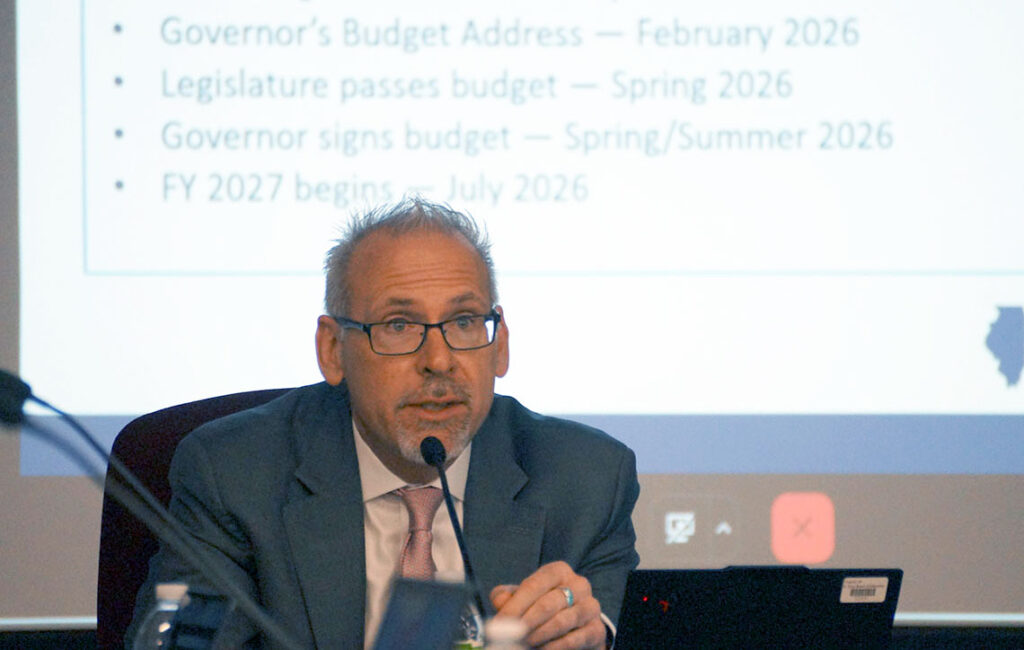
Flat revenue and increasing demands for state funding elsewhere could mean lean times ahead for Illinois schools.
Read MoreIllinois educators hope to tackle thorny issue of math competence

Students in Illinois, like their peers nationwide, tend to score lower in math than they do in reading and writing.
Read MorePritzker signs bill to implement mental health screenings in schools

Students are pictured in a file photo working on laptops at Lanphier High School in Springfield. (Capitol News Illinois photo by Andrew Campbell)
Illinois schools will not have to pay to implement mental health screenings developed by the State Board of Education under a new law.
The post Pritzker signs bill to implement mental health screenings in schools appeared first on Capitol News Illinois
Media literacy education lacks consistency across Illinois

A stack of newspapers is pictured at the Illinois State Capitol. (Capitol News Illinois file photo)
A University of Illinois Springfield study examines implementation of Illinois’ media literacy law.
The post Media literacy education lacks consistency across Illinois appeared first on Capitol News Illinois
Study: Education still pays, but barriers to upward mobility persist in Illinois
Capitol News Illinois
Article Summary
A new study shows there are barriers to upward mobility in Illinois, especially for women and people of color.
People who grow up in lower-income families tend to earn less as adults than those from wealthier families, even after earning similar degrees and going to work in similar fields.
Educational attainment and career choices are still the biggest factors that influence future earnings.
This summary was written by the reporters and editors who worked on this story.
For generations, America has been thought of as the land of opportunity, a place where anyone who worked and studied hard could grow up to achieve any goal they set for themselves.
That idea has had especially strong roots in Illinois, the “Land of Lincoln,” where a young man born in a log cabin on America’s frontier rose from rail-splitter to self-taught lawyer and president of the United States.
But a new study suggests that the American dream is still more elusive for some people in Illinois than for others, and that the pathway up the economic ladder is not easily scaled.
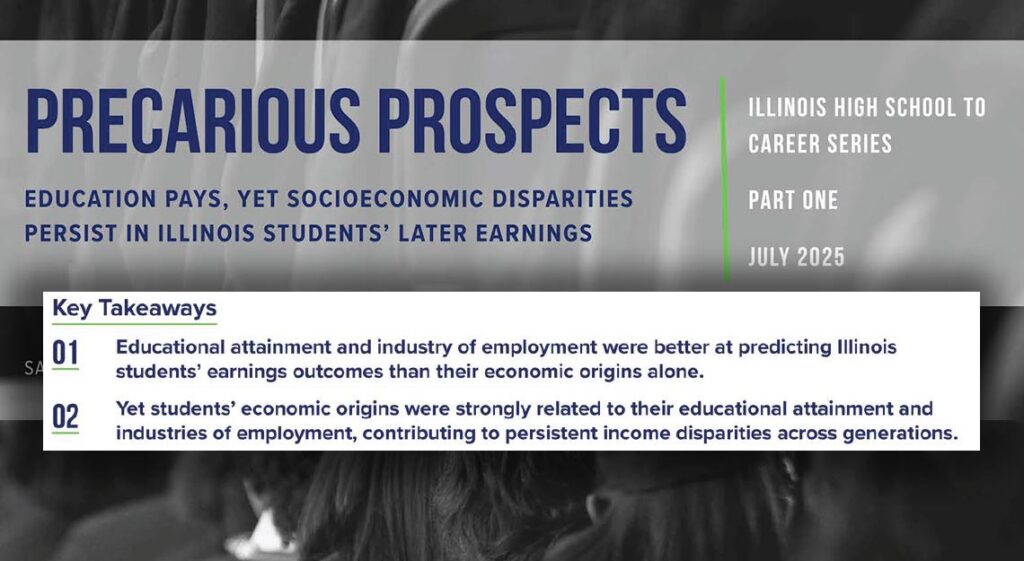
The study, entitled “Precarious Prospects,” tracked a cohort of millennials from Illinois – more than 340,000 students from the senior classes of 2008-2012 – from graduation, through their post-secondary careers and into young adulthood.
The study was a joint project conducted by the Illinois Workforce and Education Research Collaborative, or IWERC, the Discovery Partners Institute, the University of Illinois, and the University of Chicago Consortium on School Research.
It found that educational attainment is still a strong predicter of a person’s future earnings as an adult. So too is the industry that a person chooses for a career.
Other factors can also influence a person’s ability to complete a higher education degree, including their race, ethnicity and gender.
Capitol News Illinois · Upward mobility in Illinois
Class-based barriers
The study also found that a person’s own economic background – whether they grew up rich or poor – also strongly influences their future earnings. Students who grew up in higher-income households tended to earn more than those who grew up in lower-income families, in part because students from higher-income families were more likely to complete a college degree than lower-income students.
But perhaps most surprisingly, the study found that even among those who earn similar degrees and go to work in similar industries, a student’s own economic background influenced their future earnings. That is, students from lower-income families tend to earn less than those from wealthier families, even after they went on to earn similar credentials.
Further, the study found, among students from lower-income families, Black and Latino students and women tended to earn less than their white and male counterparts.
“The racial and gender disparities obviously are real, and there’s a lot of research showing that, but I don’t think it’s all that’s going on,” Sarah Cashdollar, associate director of IWERC and a lead author of the report, said in a podcast interview with Capitol News Illinois.
“One thing is that the same degree, such as a bachelor’s degree, can have a very different payoff depending on the college that the student went to,” she said. “And there’s research that’s found students from higher income families are more likely to go to colleges that have things like many internship opportunities or other work-based learning. More advising, more networking opportunities. And for some fields, those things are essential to landing a good job.”
“There’s also research showing that higher income students have greater access to social networks in general that can provide those connections,” she said.
Education and career choice
Among all the factors the study examined, educational attainment had by far the largest impact on a person’s future earnings. It found there was a gap of nearly $40,000 a year in earnings for someone with an advanced degree compared to someone with only a high school diploma.
The study also found that regardless of what type of degree or credential a person earns, the industry in which they work has a big impact on their future earnings.
“For certificates and associate’s degrees, we see higher earnings for construction, for mechanic and repair technologies,” Cashdollar said. “So these are things like auto mechanics, HVAC techs, electricians, and also precision production. … These are all areas that tend to have unions, and they also have been experiencing higher demand due to lower supply in recent years, and so there’s some upward wage pressure in those in those occupations.”
“And then for the bachelor’s, there are many, many industries that offer higher earnings,” she said. “Two of the highest earnings were engineering and computer and information sciences.”
But the gaps between people with similar degrees from different economic backgrounds was still significant – $3,753 annually for those with less than a bachelor’s degree, and $5,028 for those with a bachelor’s degree or higher.
Still to come
The Precarious Prospects study was the first of a two-part research project made possible through a data sharing partnership between the Illinois Department of Employment Security, the Illinois Student Assistance Commission, the Illinois State Board of Education and Illinois State University.
Cashdollar said the second phase of the project, due to be published later this year, will focus on those students who manage to succeed in climbing the economic ladder, despite the barriers they face.
“To give a preview, we found that there were pathways at all levels of education toward higher earning careers, but they were predominantly concentrated in bachelor’s degree pathways and even higher masters and doctoral and professional (programs).”
Capitol News Illinois is a nonprofit, nonpartisan news service that distributes state government coverage to hundreds of news outlets statewide. It is funded primarily by the Illinois Press Foundation and the Robert R. McCormick Foundation.
The post Study: Education still pays, but barriers to upward mobility persist in Illinois appeared first on Capitol News Illinois.
Illinois to roll out direct admissions program for most state universities
Capitol News Illinois
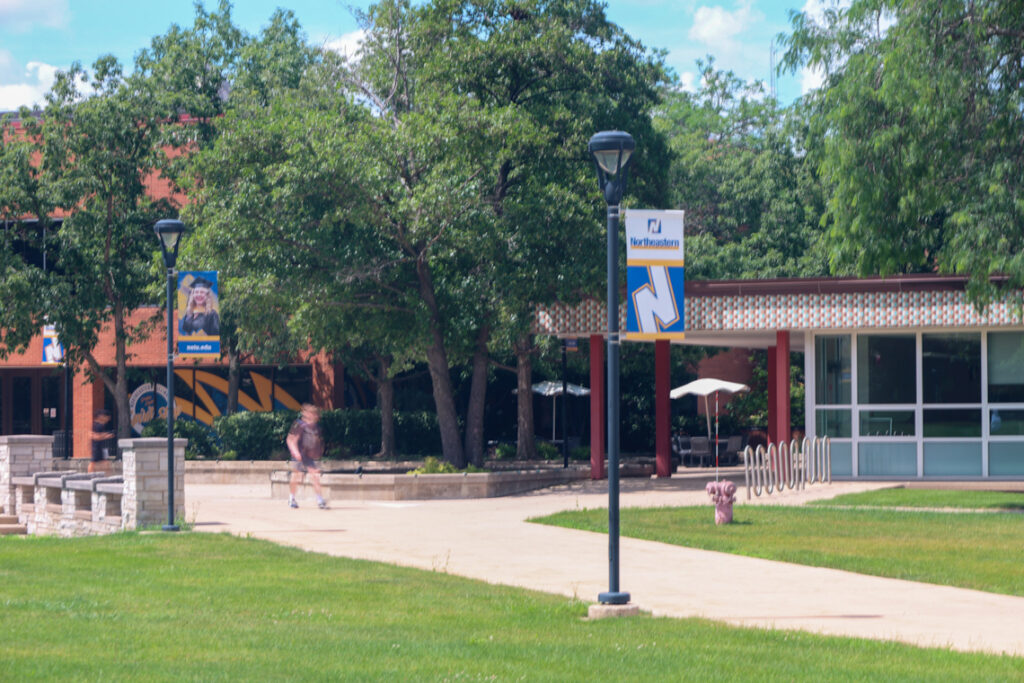
Editor’s note: This story was updated to refer to the correct building on the campus of Northeastern Illinois University in the featured photo caption.
CHICAGO — Illinois students won’t need to fill out applications for most state universities to be admitted — if they have high enough grades.
With his signature, Gov. JB Pritzker on Monday approved a bill creating the direct admissions program. Along with it, he approved bills that implement new state standards for programs offering college credits to high school students, and new requirements for financial aid application assistance.
“These bills streamline the application process for college-bound seniors in Illinois, enhance support for applicants, and open up new horizons for prospective students,” Pritzker said in a statement. “Enacting these laws is what all government work should be about — making life easier for our people.”
Pritzker had said college admissions and higher education accessibility would be a priority of his during this year’s legislative season, which ended May 31. But one of his signature initiatives — allowing community colleges to offer four-year degrees — failed earlier this year.
Direct college admissions
Illinois will implement a direct admissions program so that students hoping to go to a state school will be automatically admitted — if they have a high enough grade point average.
“For eligible seniors and community college transfer students, you will receive offers from the schools that you are admitted to without raising a finger. That’s huge,” Sen. Christopher Belt, D-Swansea, said. “It takes away the anxiety, it takes away the angst of that whole process.”
The bill outlining the direct admissions program, House Bill 3522, passed unanimously in the Senate and with broad bipartisan support in the House in late May.
Read more: House approves new abortion protection, plan to ease college admissions | Senate Democrats champion program to streamline Illinois college applications
The program will begin in the 2027-28 school year, with nine of the state’s 11 public universities participating:
University of Illinois Springfield
Southern Illinois University
Chicago State University
Eastern Illinois University
Governors State University
Illinois State University
Northeastern Illinois University
Northern Illinois University
Western Illinois University
High school students and community college students hoping to transfer to a state school must opt-in to the program to receive offers. Community colleges already admit all students interested in attending but will still participate in the direct admissions program.
The University of Illinois Urbana-Champaign and University of Illinois Chicago will not participate in the direct admission program. The state will, however, provide information about traditional applications to qualifying students through an “access and outreach campaign.”
The criteria for the direct admissions program and outreach campaign will be set by individual schools.
“This new, statewide direct admissions program will make a college degree more accessible for students and will motivate them to continue in their life-changing college journey by ensuring them a spot at their community college or at one of the state’s public universities,” Illinois Board of Higher Education Executive Director Ginger Ostro said in a Monday statement.
Financial aid application assistance
Two more bills signed by Pritzker on Monday, House Bills 3096 and 3097, aim to make it easier for students to navigate the financial aid process.
HB 3096 requires high schools in Illinois to designate at least one staff member as a point-of-contact for information about the Free Application for Federal Student Aid, or FAFSA. HB 3097 requires high schools to offer students time during the school day to fill out FAFSA forms and to receive assistance in doing so.
The new requirements go into effect in the 2025-26 school year.
Information collected through FAFSA is used to determine eligibility for federal loans. Many schools use FAFSA for their own aid programs, and the state offers need-based grants based on information submitted through FAFSA.
“As a father of college students, I just currently went through this fun exercise with my daughter filling out a FAFSA form,” Sen. Javier Cervantes, D-Chicago, said. “I’m being a little sarcastic calling it fun because we had deadlines, we had to make sure we had our documentation together and it wasn’t easy.”
From the 2010 to 2020 school years, an average of 86% of first-time students at four-year schools and 78% of first-time students at two-year schools received federal financial aid, according to data from the U.S. Department of Education.
The Illinois Community College Board offices sits blocks away from the state Capitol. Under a new law, the ICCB and other state agencies are tasked with improving dual credit programs in the state. (Capitol News Illinois photo by Andrew Adams)
Dual credit program
House Bill 2967, another bill approved by Pritzker on Monday, outlines new requirements for high schools and community colleges offering “dual credit” programs, through which students earn high school and college credit for completing a single course.
It requires teachers teaching dual credit classes to have a master’s degree in the subject they’re teaching or a master’s degree and some graduate coursework in the subject. It also requires high schools and community colleges to designate individuals responsible for negotiating what individual dual credit agreements look like.
“HB 2967 reinforces the vital role that strong, robust partnerships between community colleges and high schools play in delivering high quality dual credit programs,” Illinois Community College Board Executive Director Brian Durham said in a statement. “These programs help students get a head start on their college education and a path towards career success.”
The bill also requires schools to consider in-state colleges and universities when setting up dual credit programs over out-of-state institutions.
The bill also creates a committee made up of education officials, representatives from two different statewide teachers’ unions and others to work on improving dual credit programs’ accessibility and quality, as updating a template used by school districts to develop dual credit agreements with community colleges.
Four-year degrees at community college
One key proposal didn’t make the cut this spring — a measure allowing community colleges to offer bachelor’s degrees. Despite being backed by Pritzker in his State of the State address earlier this year, it faced pushback in the General Assembly, which did not pass a bill implementing the policy.
Read more: Pritzker’s community college initiative stalls in House committee
That proposal drew concerns from some lawmakers who worried it could undercut programs to attract local students to state universities. In particular, some lawmakers worried that it could hurt schools like Northeastern Illinois University and Chicago State University, which serve largely minority student populations.
But Pritzker on Monday said he would continue working on a proposal to allow more schools to offer bachelor’s degrees in “very specific, niche areas” like nursing and advanced manufacturing.
“You sometimes have to work two, four, six years, maybe longer to get something done,” Pritzker said.
Capitol News Illinois is a nonprofit, nonpartisan news service that distributes state government coverage to hundreds of news outlets statewide. It is funded primarily by the Illinois Press Foundation and the Robert R. McCormick Foundation.
The post Illinois to roll out direct admissions program for most state universities appeared first on Capitol News Illinois.
Challenges persist for women, minorities breaking into Illinois’ skilled trades
Capitol News Illinois
PEORIA — For 60 years, SkillsUSA Illinois has held workforce development competitions for young people entering the trades. For 60 years, there has never been an all-female team competing in the architecture and construction team competition.
Until now, that is.
This April, students competed at the Peoria Civic Center in a bid to showcase their trades work skills, from barbering and cosmetics to house building and fixing cars. First-place winners in the Illinois competition earned eligibility to travel to Atlanta to compete in the national SkillsUSA Championships this week.
Amid the fanfare and cheer, however, the state competition highlighted some of the persistent challenges facing the Illinois workforce. As employers continue searching for skilled tradespeople to combat national worker shortages, entry into fields like construction remains strikingly low for women and people of color, particularly in higher paying and leadership positions.
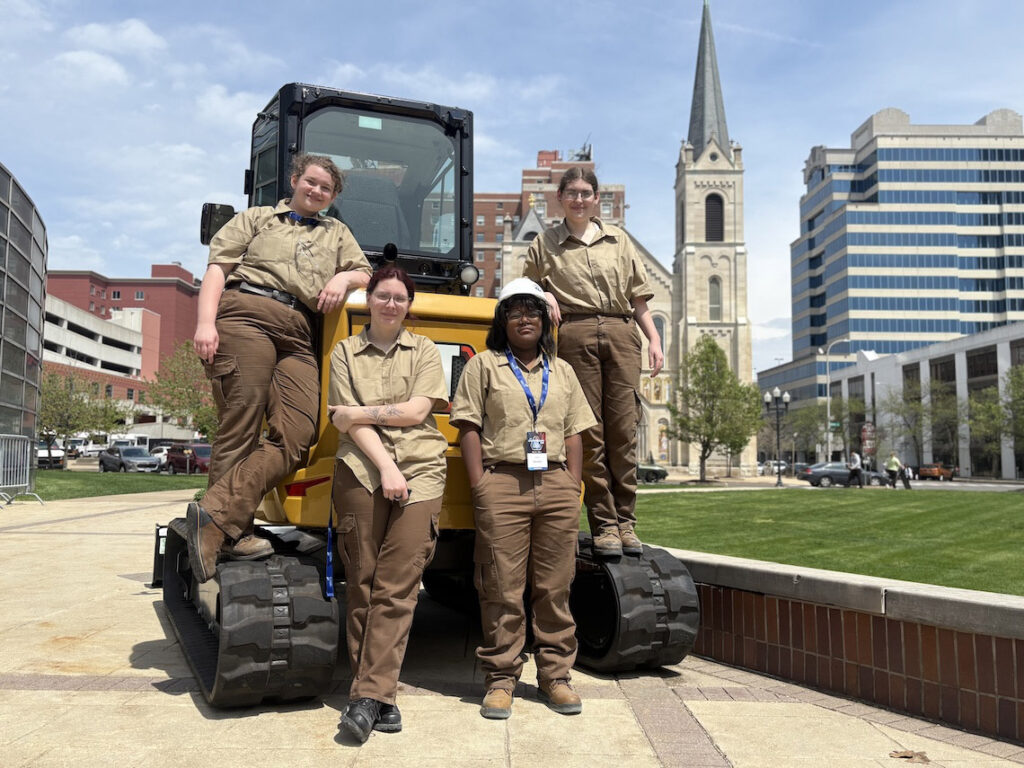
SkillsUSA Illinois’ first all-girls team — Aubrey Levin, Kayhl Miles, Catelin Wesley and team captain Amyla Walls — did not know they were breaking boundaries until after they had finished their competition this spring in Peoria.
The team from the Bloomington Area Career Center reacted to the news with shocked laughter, followed by near immediate dread as they anticipated the heightened expectations and scrutiny of their work this title would bring.
“They’re going to be like, ‘You’re the first all-female team,’ and I’m going to be like, ‘Please don’t look at my electrical,’” Levin said, half laughing.
Although it may seem late for the existence of the first all-female team, it is consistent with the construction industry demographic trends in Illinois. Over the past 10 years, women have held fewer than one in 10 construction jobs. Prior to 2021, fewer than 5% of new construction apprentices in Illinois were women, according to data from the U.S. Department of Labor.
View Chart in New Tab
The problem is a national one. Although 2020 saw the largest number of women working in trades, only one in 20 U.S. construction workers was a woman, according to a report from the Institute for Women’s Policy Research.
Male construction workers were also better compensated than female construction workers in 2024, even for entry-level apprenticeship positions. New male apprentices earned an average wage of $23.76 per hour, 36 cents more than the average pay for their female counterparts.
The discrepancy grew for those who completed their apprenticeships, with an average hourly gender pay gap of $1.41.
Participation rates for workers of color also remained low, with white apprentices accounting for over three quarters of new registered apprenticeships in 2024.
View Chart in New Tab
Apprentices of color earn less on average than white apprentices, both at entry and completion. In 2024, newly registered Black apprentices earned on average 36 cents less in hourly wages than their white counterparts. For those who completed apprenticeships, the gap grew to almost $4 per hour.
As limited as the progress is, much of it has come in the last few years, according to Jayne Vellinga, executive director of the non-profit Chicago Women in Trades.
Vellinga attributes the momentum to “a perfect storm” of an expected construction boom and worker shortage, infrastructure investment and federal leadership on diversity initiatives.
“It did get people to think sort of outside the box in terms of how they were going to recruit a sufficient workforce to meet a large number of projects projected to come to the area and the retirement of experienced workers,” Vellinga said.
Since 2021, the state has invested heavily in the Illinois Works pre-apprenticeship program, which seeks to create a “qualified talent pipeline of diverse candidates in the construction and building trades.” Gov. JB Pritzker’s office announced an additional $19 million funding allocation to the program in April.
However, Vellinga said she is seeing a rollback in progress, pointing to President Donald Trump’s decision to rescind an executive order that had been in place since enacted by President Lyndon B. Johnson in 1965, which prohibited federal contractors from engaging in employment discrimination on the basis of race, color, religion, sex, sexual orientation, gender identity or national origin.
“I don’t know how it’s going to impact opportunities for women, but there is definitely a change in narrative also at the federal level, from ‘we need diversity on publicly funded projects’ to ‘don’t engage in diversity, equity and inclusion activities,’” Vellinga said.
In addition to outright hiring discrimination, Vellinga said many women’s careers are limited by gender stereotypes and harassment on job sites.
“Some women are doing well and are having an opportunity to move up, and other women do face discrimination, are unable to cobble together enough work during the year to make it a viable career, or perhaps the works site is so hostile that they walk away from it,” Vellinga said.
The hostility is something that the team of high schoolers was already familiar with.
House built by the all-girls team during the SkillsUSA Illinois Championships in April. (Medill Illinois News Bureau photo by Maggie Dougherty)
As SkillsUSA Illinois’ first all-girls team spent two days using their carpentry, roofing, electrical and plumbing skills to build a small house, they were subjected to disparaging, gender-based comments, which the team diplomatically referred to as “construction language.”
It is not something unique to this competition, they said. Levin recalled asking women in the construction unions about their advice on entering tradework. They told her she would need to have thick skin.
“Even now?” Levin asked. Especially now, they replied.
The team described their male peers making jokes with double meanings, and then getting irritated if the girls did not laugh.
“You’re like a bad person for not laughing at a really bad joke,” Miles said.
One such joke came at Levin’s expense, while she was standing on a ladder and trying not to cry from pain after being hit in the back by something on site. A team nearby pointed and laughed at her, she said. A teacher walked by and told Levin to let it out if she needed to.
“Not here,” Levin said. “You can’t cry, because then you’re soft.”
On the other hand, if they got mad, Levin said, a male peer would inevitably ask, “What, are you on your period or something?”
The girls said they are held to a higher standard, as any sign of emotion will be used to prove that they are incapable of matching their male peers. If they stop for a second, they will be called lazy or asked whether they broke a nail, the team said. The job requires a strong poker face, Miles added.
And, Walls said, their judgment is constantly called into question. She recounted a male peer repeatedly correcting her and speaking to her like a child, before eventually concluding she was correct all along.
A national survey of women exiting the trades found that the most common reason women left the trades was due to harassment and lack of respect; nearly half of those who left or had strong intentions to leave marked this as their reason for doing so. Over a quarter of women in the study also indicated that they frequently or always saw sexually explicit and racist graffiti; a fifth responded the same for anti-semitic graffiti.
The second most common reason for exiting, selected by over 40% of those with strong intentions to leave, was a lack of prospects for promotion and advancement. The least selected option was that the work was too physically demanding.
Manny Rodriguez looks down the street in front of Revolution Workshop. (Medill Illinois News Bureau photo by Maggie Dougherty)
The perception that women are less competent exacerbates other structural barriers to employment, according to Manny Rodriguez, executive director of the Chicago-based nonprofit Revolution Workshop, which offers workforce development programs targeted at communities of color who have been underrepresented in the trades.
Construction is a tough business for anyone, Rodriguez said. A recent paper by the RAND Corporation found that almost 40% of apprentices drop out of their programs before completion, regardless of race or gender, with almost half of those dropping out in the first six months.
Part of the issue is stability of work, such as making it through the cold season when opportunities for new construction projects dip, according to Rodriguez.
“In the wintertime, you can’t pour concrete. You can’t weld. If the structure is not already up, you pretty much got to wait until spring,” Rodriguez said.
Employer biases mean that women and people of color may be hired for jobs, but not retained for the next one, resulting in more instability for those workers, Rodriguez said. As a result, apprenticeship completion rates for women and people of color are even lower.
In 2023, women accounted for 4.5% of U.S. construction apprentices, but 6% of cancellations, according to U.S. Department of Labor data. A study by The Institute for Construction Employment Research found that over the last two decades, around two-thirds of Black construction apprentices did not complete their programs.
Hispanic workers have maintained a high share of workforce participation in the construction industry, but often in lower paying, physically intensive roles, resulting in higher rates of both fatal and nonfatal injuries on the job.
“Latinos are represented in construction, but where?” Rodriquez asked. “I’m not the electrician, I’m not the plumber, I’m not the heavy equipment operator, I’m not the pipe fitter. So you got no problem breaking my brown body, but you’re not letting me do the other things.”
Many women and people of color who do make it in construction attribute their success, at least in part, to having others who look like them in the field.
A competitor focuses during the SkillsUSA Illinois TeamWorks competition. (Photo courtesy SkillsUSA Illinois)
In the survey of tradeswomen, almost two thirds of respondents identified mentorship from senior tradeswomen as important to their recruitment and advancement. It was something the all-girls team said was valuable as well.
“If we passed a construction site, and they were working, I always got excited when I saw a girl,” said Miles. “I was happy about it, because I’m like, I’m not the only one who actually enjoys this.” Other members of the team agreed.
But Walls, the only Black member of the team, sees fewer women in construction who look like her.
“I don’t see a lot of women, let alone,Black women, doing construction,” Walls said. “I wish I had someone to relate to.”
That is part of the reason why breaking this barrier was important, for the girls on the team and for those who will come after them.
“It doesn’t matter if we win,” Wesley said. “The fact that we have taken a step like this for us, but also for other females in the trades, it’s a huge deal.”
Maggie Dougherty is a graduate student in journalism with Northwestern University’s Medill School of Journalism, Media, Integrated Marketing Communications, and a fellow in its Medill Illinois News Bureau working in partnership with Capitol News Illinois.
Capitol News Illinois is a nonprofit, nonpartisan news service that distributes state government coverage to hundreds of news outlets statewide. It is funded primarily by the Illinois Press Foundation and the Robert R. McCormick Foundation.
The post Challenges persist for women, minorities breaking into Illinois’ skilled trades appeared first on Capitol News Illinois.
Advocates await action on bill protecting rights of immigrant students in Illinois
Capitol News Illinois
SPRINGFIELD — Immigration rights advocates in Illinois are anxiously awaiting the governor’s signature on legislation aimed at protecting K-12 students who may be in the country without legal authorization from being denied access to a free public education.
House Bill 3247, known as the “Safe Schools for All Act,” passed both chambers of the General Assembly in the final days of the spring session. It would prohibit schools from denying any child access to a free public education based on their actual or perceived immigration status, or that of their parents.
It would also prohibit schools from disclosing, or threatening to disclose, information about a student’s immigration status or the status of a person associated with the child. And it would require schools to develop procedures for reviewing and authorizing requests from law enforcement agents attempting to enter a school or school facility.
The bill is intended to buffer K-12 students in Illinois from efforts by the Trump administration to launch mass deportations of noncitizens living in the United States without legal authorization.
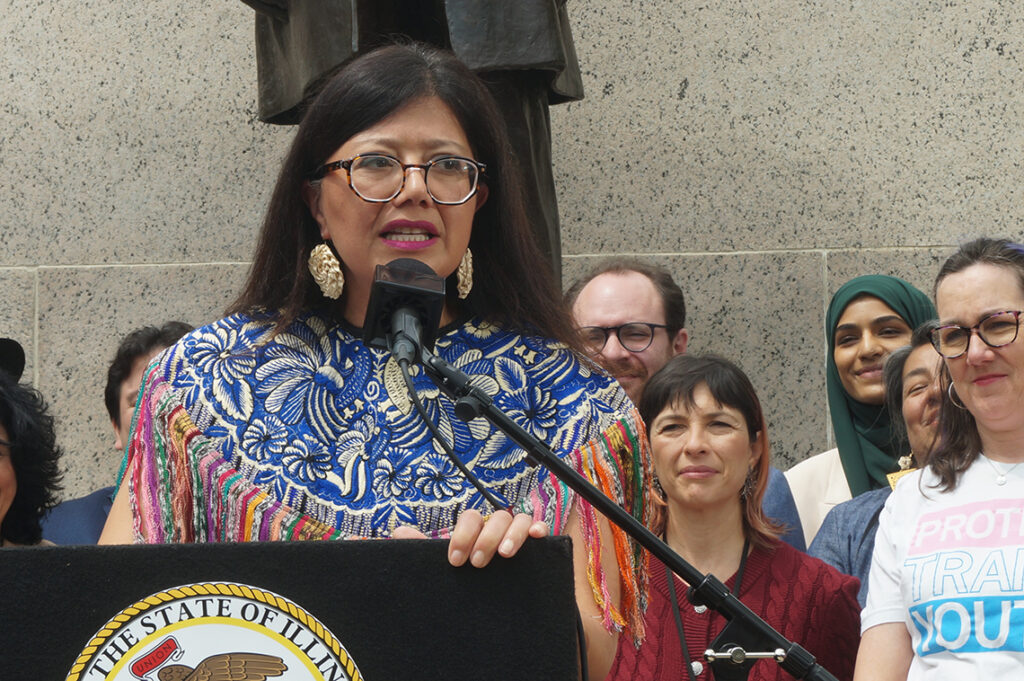
Speaking at a May 7 rally outside the Statehouse, where Democratic lawmakers and immigration rights advocates protested an appearance in Springfield that day of Homeland Security Secretary Kristi Noem, state Sen. Karina Villa, D-West Chicago, the chief Senate sponsor of the bill, vowed that Illinois would remain defiant of Trump’s political agenda.
“We are also going to protect our children,” she told the crowd gathered around a statue of Abraham Lincoln. “We’re going to make them feel safe in our schools by passing HB 3247. We are going to unite and we are going to get that done.”
On Jan. 20, the first day of the new administration, the Department of Homeland Security rescinded a Biden-era policy that prevented federal agents from conducting immigration enforcement actions in certain “sensitive” areas, including schools, churches and hospitals.
Immigrant rights advocates demonstrate outside the Illinois Statehouse for legislation protecting rights of noncitizens, including a bill meant to ensure the right of a free public K-12 education, regardless of a child’s immigration status. (Capitol News Illinois photo by Peter Hancock)
Fred Tsao, an attorney for the Illinois Coalition for Immigrant and Refugee Rights, said during an interview that the policy change has had a chilling effect on the immigrant community, making many afraid to even show up in school.
“We have seen a decline in student participation, particularly among heavily Latino schools after this inauguration,” he said. “So we want to make sure that schools are prepared in the events that federal agents, or for that matter other law enforcement, come to their door in a nonemergency situation.”
Tsao said advocates have also been concerned about possible changes in other legal protections for immigrant students that so far have only been expressed in judicial opinions.
In 1982, the U.S. Supreme Court struck down a Texas statute that authorized local school districts to either deny enrollment to children who had not been “legally admitted” to the United States, or to charge them tuition, holding the law violated the Equal Protection Clause of the 14th amendment.
Tsao, however, said there have been attempts in other state legislatures, including earlier this year in Tennessee, to pass legislation that would challenge that 43-year-old ruling. And while the effort in the Tennessee legislature fell short this year, he said advocates in Illinois wanted to act now to make sure the rights of immigrant students are protected in state law, should the Supreme Court precedent ever be overturned.
“Fortunately, our counterparts in Tennessee, the immigrant advocacy organizations and community leaders, bombarded the General Assembly with advocacy work and were able to persuade a number of legislators to vote against this legislation when it came down to it,” he said. “But you know, that’s not to say that folks in Tennessee or folks in other states won’t try again.”
As of Wednesday, June 18, HB 3247 had not yet been sent to Gov. JB Pritzker.
Capitol News Illinois is a nonprofit, nonpartisan news service that distributes state government coverage to hundreds of news outlets statewide. It is funded primarily by the Illinois Press Foundation and the Robert R. McCormick Foundation.
The post Advocates await action on bill protecting rights of immigrant students in Illinois appeared first on Capitol News Illinois.
New taxes on sports bets, nicotine products as Democrats pass $55.2B budget
Capitol News Illinois
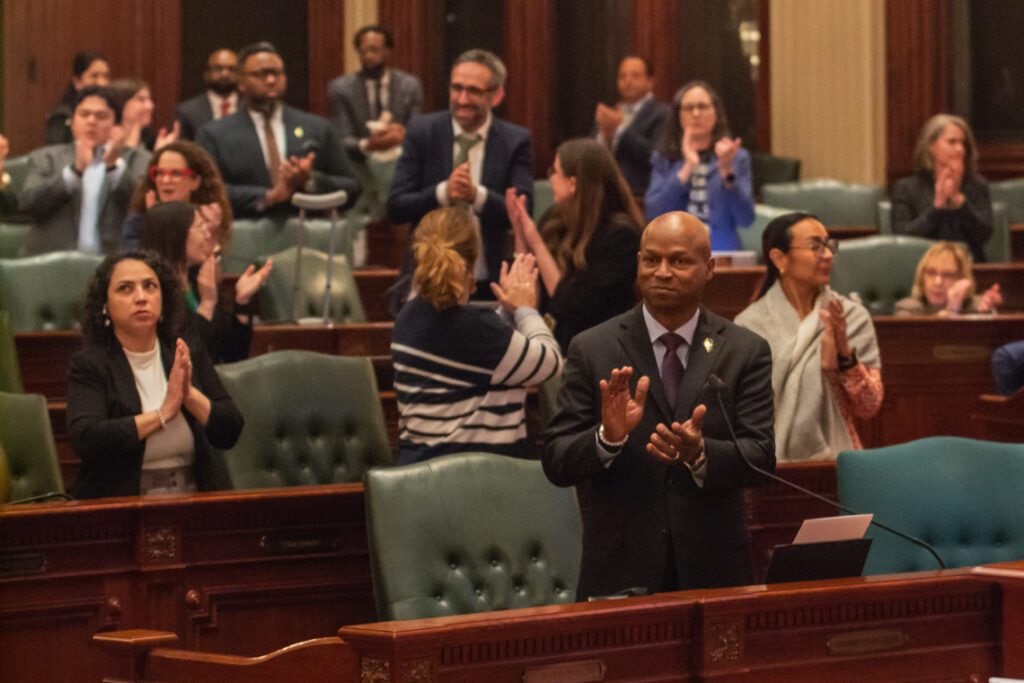
SPRINGFIELD – Giving almost no time for public review, Illinois Democrats pushed through a $55.2 billion budget for next fiscal year late Saturday, bolstering coffers with new taxes on sports bets, nicotine products and businesses.
The $55.2 billion spending plan is supported by $55.3 billion of revenue, including just over $1 billion in new taxes and revenue changes.
The four bills making up the budget and capital spending plan, were part of a flurry of thousands of pages of legislation that went from introduction to passage in the final 48 hours of the legislative session.
The budget marked a roughly 3.9% spending increase from the current year, while Republicans criticized it for containing few cuts. It raises about $500 million more in new revenue than what Gov. JB Pritzker proposed in February to make up for declining base revenues.
The minority party also aired frustration with supermajority Democrats for providing next to no time for public review of the massive spending plan and other major bills.
“We’re rushing this process like we always do. ‘Let’s hide this stuff. Let’s hide it so that the public doesn’t see it until it’s too late,’” Rep. John Cabello, R-Machesney Park, said.
Democrats said it was the best budget they could manage in a difficult year. To address potential uncertainties stemming from federal policy changes, they gave the governor authority over a new $100 million “emergency” fund. And they frequently lobbed criticisms at President Donald Trump and Republicans in Congress.
“I am very pleased to be able to present a balanced budget crafted to be fiscally and socially responsible, because we see the decisions made in Washington right now are neither,” House Majority Leader Robyn Gabel, D-Evanston said. “Erratic leadership in Washington has affected our economic outlook, our revenue projections, and even threatened federal funding for our most crucial services.”
The GOP also took issue with the tax increases, although the measure did not raise or create new sales, income or service taxes.
Instead, the measures expand state taxes on foreign and out-of-state income for businesses, raise tax rates on tobacco, vapes and sports gambling, and sweep fund balances from several lesser-known and utilized state funds.
The spending measure, Senate Bill 2510, passed the House 75-41 just before 10 p.m. The Senate followed around 11:30 p.m. with a 34-23 vote. The revenue and tax changes, House Bill 2755, and the budget implementation bill, House Bill 1075, both passed with relative ease before the constitution’s midnight deadline and only Democratic votes as well. Gov. JB Pritzker issued a statement saying he would sign it.
Another spate of tax increases included in a transit governance overhaul bill surfaced late but sputtered. The failed measure would have added a $1.50 fee on food and package deliveries and taxed electric vehicle charging statewide among other changes. Talks on that bill could resume later this year.
New taxes on vaping, gaming, deliveries
The revenue bill creates a tax of 25 cents per wager for a sports betting licensee’s first 20,000 wagers accepted, and 50 cents per wager after that.
Consumers will also see new taxes on tobacco products. The tax rate will rise to 45% from 36%. Vape products and nicotine pouches would also now be included under the tax.
The revenue plan amends state law to tax sales from all businesses that transact in the state, rather than only businesses with a physical presence in Illinois. The plan also eliminates a “safe harbor” exemption for businesses that move money outside the state.
Businesses that move profits to other countries would also be subject to the state’s corporate income tax. The federal government currently taxes half of income moved offshore and Illinois would tax the other half under the revenue plan.
Businesses outside Illinois that sell $100,000 or more to people in the state must also collect Illinois sales taxes even if the business doesn’t have a physical location in Illinois. This would apply to businesses like Amazon.
“I will not support this betrayal of hard-working Illinoisans,” Sen. Don DeWitte, R-St. Charles, said. “And if you care about the people who sent you here, if you truly represent them, you’ll vote no too. Enough is enough. It’s time for this body to stand with taxpayers, not stand up against them.”
Another source of new revenue is a delinquent tax payment incentive program designed to help the state recuperate overdue tax payments. It will generate $228 million, Rep. Will Guzzardi, D-Chicago, said.
The state would also pause the final transfer of motor fuel sales tax revenue to the road fund in order to free up $171 million, according to the governor’s office’s estimate.
A separate bill designed to lower prescription drug prices calls for levying a fee on pharmacy benefit managers based on the number of patients they insure. Money from that fee would go into a fund for the Department of Commerce and Economic Opportunity to award up to $25 million a year in grants to independent pharmacies and pharmacies located in rural counties. The remaining money would go to the state’s general revenue fund.
The measure also extends the state’s Hotel Operators’ Occupation Tax to short-term rentals like Airbnb and Vrbo.
Immigrant health cuts
A controversial program that provides health insurance to more than 30,000 noncitizens between ages 42 and 64 will be cut in FY26. The program’s elimination saves the state $330 million, but a $110 million program for seniors will remain in place.
Together, the two programs have cost the state at least $1.6 billion, according to an audit released in February, far exceeding budgeted costs for the program.
“We had to make some tough decisions here. That program grew at greater rates, financially, than we thought it would, and we had to make some hard decisions,” Gabel said.
Federally Qualified Health Centers are set to receive $40 million in the budget. The centers provide health services to low-income and uninsured people. Democrats touted that increase to provide care for immigrants who would have qualified for the health care program.
Illinois still risks losing some Medicaid funding under a proposal in Congress that threatens to slash reimbursements for states that provide health insurance to people illegally in the United States. But Gabel noted it’s possible those reductions won’t take place until 2027.
The budget also increases funding for safety-net hospitals with federal Medicaid funding cuts possible.
Education spending
The state’s evidence-based funding model for K-12 schools calls for $350 million in additional funding each year, with a portion of that going to a property tax relief fund and the rest directly to schools. The proposed budget fully funds the K-12 education portion at $307 million but does not add $43 million in property tax relief funds, according to Democratic leaders.
Funding for the Illinois Community College Board would also decrease by $24 million, mostly because lawmakers reduced spending on a workforce development grant that Democrat leaders said was not being fully utilized.
Funding for state universities would only increase by 1%. Pritzker proposed a 3% increase for higher education even as most other areas of his budget would’ve increased by 1%. Senate Democrats’ budget leader Sen. Elgie Sims, D-Chicago, said the budget allows for an additional 2% increase in FY26 if the federal government eliminates substantial funding.
Pensions
Despite more than a year of discussions, Illinois lawmakers did not tackle pension reform this spring. Illinois’ Tier 2 pension system is likely out of compliance with Social Security’s “safe harbor” law that requires pension benefits to be at least equal to Social Security.
Part of the budget package created a new Tier 2 reserve fund that can be accessed if there are violations of the “safe harbor” law. Lawmakers appropriated $75 million for the fund this year, in line with Pritzker’s proposal.
‘Emergency’ fund, raises, more
Notably not in this year’s budget is an increase to the “rainy day” fund. Pritzker has taken pride in the fund’s increases in recent years, as it’s grown to a balance of $2.3 billion, up from less than $60,000 when Pritzker took office. The FY26 budget would suspend the monthly transfer for one year, freeing up $45 million for general fund use.
The budget package also establishes a new $100 million fund that the governor can tap into “in the event of unanticipated delays in or failures of revenues.” The measure, an apparent nod to the uncertainty of federal funding amid ongoing congressional budget negotiations, will come from money swept from other funds.
“That will allow us to respond to actions by the federal government and challenges that present themselves and costs that have been diverted from the federal government to the state government,” Sims said in a committee hearing.
The attorney general’s office would get $116 million from the general fund. Attorney General Kwame Raoul asked lawmakers to boost funding for his office as he engages in a growing number of lawsuits against the Trump administration. Raoul was hoping to receive $120 million in funding.
Direct service providers are in line for an 80-cent per hour wage increase, but Republicans said calling it a funding increase is “sleight of hand,” because the measure would also reduce work hours for DSPs by the hundreds of thousands. That makes the increase negligible, Sen. Chapin Rose, R-Mahomet, said in committee.
“It’s not a great budget, but it is a good budget and it is the budget we need for this very difficult moment,” Rep. Lindsey LaPointe, D-Chicago, said.
Lawmakers will see their salaries rise as part of the budget, going to a $98,304 base salary from roughly $92,000. That’s an annualized rate of increase that is set by law.
“You raised our pay, you gave yourselves hundreds of millions of dollars of our taxpayers funds to spend on your pet projects,” Rep. Amy Elik, R-Godfrey, said. “So I simply don’t believe you anymore that you ever intended to be fiscally careful.”
No Bears stadium funding
Lawmakers did not appropriate funding for the Chicago Bears to build a new stadium. But NASCAR would be the recipient of a $5 million grant ahead of the sport’s third downtown Chicago race in July, and the PGA Tour would receive a $1 million grant as part of hosting the 2026 President’s Cup in DuPage County. Those were two economic development measures criticized by Republicans during the Senate committee hearing.
The budget also contains $200 million to prepare unused state properties to be repurposed for development, Sims said. Lawmakers removed another $300 million that Pritzker had sought in spending aimed at offloading surplus property.
Gabel said the state’s employee management department has negotiated more than $100 million in health care cost savings as well.
Any remaining federal pandemic relief funding would also be sent to recipients that have not received payments in previous years before the funding expires in 2026.
Jade Aubrey contributed.
Capitol News Illinois is a nonprofit, nonpartisan news service that distributes state government coverage to hundreds of news outlets statewide. It is funded primarily by the Illinois Press Foundation and the Robert R. McCormick Foundation.
The post New taxes on sports bets, nicotine products as Democrats pass $55.2B budget appeared first on Capitol News Illinois.
Longtime Chicago friend describes first American pope as ‘very dedicated’

Capitol News Illinois
As the red velvet curtains at the Vatican parted, a priest realized that his college pal from the South Side of Chicago that he knows as “Bob” had been elected the first American pope.
“Oh, dear God,” the Very Rev. Anthony Benedetto Pizzo, the prior provincial of the Augustinian Order in Chicago, said as he heard the news.
Pizzo knew Robert Prevost could be named Pope, but it was an outside chance. Prevost was just named cardinal in 2023. Pope Francis named Prevost the Prefect of the Dicastery for Bishops, whose job it is to vet potential bishops. His name had come up a few times to succeed Pope Francis, Pizzo said, but he wasn’t a named favorite.
“We were waiting with bated breath to see what would happen,” Pizzo said, speaking from Southern Italy, in an interview with Capitol News Illinois.
Pizzo watched as his friend was introduced to the world as Pope Leo XIV. It was the same man he knew in college, seminary and throughout his career — a man dedicated to his faith and his friends.
Pizzo planned to travel to Rome on Friday but was unsure whether he would see his old friend. He had known Prevost since the men were undergraduates studying at Villanova University in Philadelphia.
[caption id="attachment_65931" align="alignleft" width="275"] The Rev. Robert Prevost, a native of Chicago, on Thursday was named the new pope of the Catholic Church, taking the name Pope Leo XIV. (Credit: Frayjhonattan)[/caption]
Prevost was one of three brothers living in Dolton on the far South Side. One brother remains in Chicago. The other lives in Florida. His father, a World War II veteran, was a teacher and school administrator, Pizzo said. His mother was a librarian.
Young Robert Prevost attended St. Mary of the Assumption Church, located on the Chicago-Dolton border, serving as an altar boy and attending the parish school.
“Bob is such a good friend. He was there throughout my life,” Pizzo said. “He was there when I made my vows, the death of my parents and my installation as a pastor.”
The man who would become pope likes to drive and enjoyed long treks, driving back and forth to college with Pizzo, who described him as very open and an excellent companion.
Pizzo said his friend is down to earth, outgoing and well-rounded.
“He was very dedicated and applied himself in all that he did,” Pizzo said.
The two men attended the Catholic Theological Union in Chicago in 1977. The new pope obtained a Master of Divinity degree.
Prevost began doing missionary work in Peru in 1985, serving in various roles including parish pastor, diocesan official, seminary teacher and administrator. He led an Augustinian seminary for a decade.
[caption id="attachment_65926" align="alignright" width="225"] Rev. Anthony Benedetto Pizzo. (Credit: Order of St. Augustine)[/caption]
From 2001-2013, he served as prior general of the Order of Saint Augustine. He was succeeded by his friend, Pizzo, who continues to serve in the role. In 2014, the young man who grew up in Chicago was appointed Bishop of Chiclayo, Peru.
He became a Peruvian citizen in 2015.
Prevost selected his name after Pope Leo XII, who was famous for his 1891 treatise that outlined rights of workers to a fair wage, safe working conditions and the formation of trade unions.
When Prevost became a cardinal in 2023, Sister Barbara Reid, president of the Catholic Theological Union in Chicago, was in attendance. On Thursday, after the announcement, things got hectic at CTU.
Patrick Bittorf, vice president for development at CTU, was fielding calls and requests for media interviews.
“Well, we graduated a pope!” he said.
Pizzo said he hopes his friend receives all the support he needs in his new role and that he continues to be as attentive as he has been, relying on God’s grace.
And does the new pope have a favorite Chicago baseball team? Pizzo said his friend is from the South Side and was likely a White Sox fan, but then demurred.
“I mean, we never went to a game or anything, but I would assume …”
Capitol News Illinois is a nonprofit, nonpartisan news service that distributes state government coverage to hundreds of news outlets statewide. It is funded primarily by the Illinois Press Foundation and the Robert R. McCormick Foundation.
The post Longtime Chicago friend describes first American pope as ‘very dedicated’ appeared first on Capitol News Illinois.