Posts Tagged ‘Darin LaHood’
Pritzker calls Texas GOP’s remap effort ‘cheating,’ doesn’t rule out Illinois response

Gov. JB Pritzker speaks during a forum on climate change at the Aspen Ideas conference in Chicago on Monday, July 21, 2025. (Capitol News Illinois photo by Andrew Adams)
A spokesperson for a General Assembly leader says Democrats are not considering redrawing Illinois’ maps.
The post Pritzker calls Texas GOP’s remap effort ‘cheating,’ doesn’t rule out Illinois response appeared first on Capitol News Illinois
Trump’s ‘big bill’ takes center stage in Illinois’ U.S. Senate race
Capitol News Illinois
Article summary
The three Democrats running for Illinois’ open Senate seat voiced concerns about the new domestic policy plan at events around Illinois.
Lt. Gov. Juliana Stratton discussed how SNAP cuts will affect Illinois at an event in Chicago.
Rep. Robin Kelly spoke with voters in Peoria about their concerns with federal spending cuts.
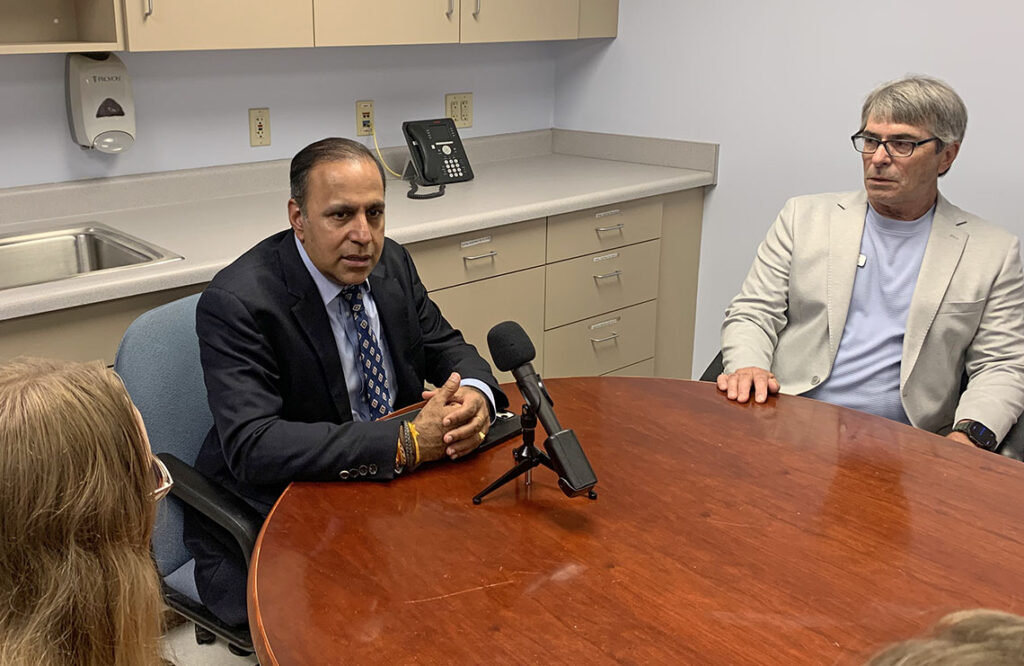
Rep. Raja Krishnamoorthi met with central Illinois independent pharmacist owners to highlight how spending cuts could hurt health care in rural areas.
This summary was written by the reporters and editors who worked on this story.
PEORIA – With major future cuts to social service programs now written into law, Democrats seeking Illinois’ open U.S. Senate seat in 2026 are hitting the campaign trail seeking to position themselves among the law’s most vocal opponents.
“We want Illinoisians throughout our state to understand the ripple effects of the Trump administration’s cruelty and be prepared for what’s to come,” Lt. Gov. Juliana Stratton said during a panel discussion at the Greater Chicago Food Depository Thursday.
The federal policy bill, dubbed the “One Big, Beautiful Bill,” signed by President Donald Trump on July 4 will slash federal spending for health care and other human service programs over the next several years, in many cases leaving states to pick up the tab if they are to continue providing benefits. The bill is expected to cost Illinois more than $700 million for the Supplemental Nutrition Assistance Program, cut Medicaid spending in Illinois by $48 billion over the next 10 years, and potentially force some rural hospitals to close.
As Illinois’ 2026 candidates prepare to begin circulating nominating petitions next month, the three Democrats vying for retiring Sen. Dick Durbin’s Senate seat met with residents around the state to hear about the local impacts of the bill and rally support for their campaigns.
Stratton held an official state event in Chicago to discuss the Pritzker administration’s response to SNAP changes, while U.S. Reps. Robin Kelly and Raja Krishnamoorthi visited downstate communities to discuss the bill.
Kelly gets feedback in Peoria
Kelly, who represents the state’s 2nd Congressional District across parts of Chicago, the south suburbs and rural eastern Illinois, visited with voters in Peoria to hear their concerns about the bill.
The Bradly University graduate said her goal is to make sure Americans are aware of the bill’s effects – even though many of them are slated to begin after the 2026 midterm election.
U.S. Rep. Robin Kelly speaks to voters at an event at the Peoria Public Library on Wednesday, July 9, 2025. (Capitol News Illinois photo by Ben Szalinski)
“In polling and different things that we’ve done, half of the population doesn’t even realize what’s going on,” Kelly said.
Kelly played up her relationship with U.S. House Minority Leader Hakeem Jeffries, saying she has been part of a coalition of House Democrats that have been traveling the country holding town hall meetings about federal spending cuts.
“Every group that we can speak in front of, we need to speak in front of,” Kelly said. “And so that’s one of the reason’s we’re traveling.”
Krishnamoorthi visits rural pharmacy
Krishnamoorthi, who represents the 8th Congressional District in the northwest suburbs, visited a pharmacy in Petersburg about 30 minutes northwest of Springfield.
He echoed concerns other Illinois Democrats have expressed about the “large, lousy law” cutting Medicaid and that it could limit health care services in rural communities.
Read more: Illinois hospitals fear massive cuts under Trump domestic policy law
“When you have that many people who all of a sudden don’t have a way of paying for their health care, then it hurts all those rural health care providers that depend on Medicaid as a form of payment for so many of their patients,” Krishnamoorthi said.
Krishnamoorthi also worried about domino effects from growing deficits as a result of the bill, which the Congressional Budget Office estimates will increase by more than $3 trillion. According to the nonpartisan health research organization KFF, the growing deficit could trigger automatic spending cuts, which could force Medicare cuts even though it was not reduced in the bill.
“We’re also talking about seniors who could be affected by Medicare cuts,” Krishnamoorthi said. “And so at the end of the day, however, everybody’s going to be affected because if, God forbid, one of these hospitals in these areas in the rural parts of Illinois are closed, then everyone, regardless of how their health care is paid for, would be affected negatively.”
SNAP cuts worry candidates
Stratton did not hit the campaign trail with any public events this week, but the Pritzker administration must now decide how it will proceed with new spending requirements signed by the president and the effects of fewer residents receiving social service benefits.
Lt. Gov. Juliana Stratton speaks at a panel discussion on SNAP benefits at the Greater Chicago Food Depository in Chicago on Thursday, July 10, 2025. (Screenshot from Illinois.gov live feed)
Stratton and other top Pritzker administration officials discussed the impact of cuts to the SNAP program during a panel discussion at the Greater Chicago Food Depository as the state seeks more immediate solutions that lawmakers could approve before the 2026 election. The lieutenant governor, who resides on Chicago’s South Side, said reducing eligibility for a food program exacerbates other issues such as crime, economic productivity and learning in schools.
“Hunger is not a problem that stays isolated,” Stratton said. “The repercussions seep out, harming everyone and everything in its path until something changes.”
Kelly told voters in Peoria that SNAP cuts aren’t just a problem for low-income recipients.
“If you cannot buy food, then you’re not shopping at Kroger or wherever you shop,” Kelly said. “And so then Kroger is not buying as much food from the farmers and then they won’t need as many people to work there.”
The Republican field in the Senate race has yet to take shape. Republican Rep. Darin LaHood from the Peoria area held a virtual townhall with 16th Congressional District voters to discuss why he believes the bill will benefit Illinois.
Capitol News Illinois is a nonprofit, nonpartisan news service that distributes state government coverage to hundreds of news outlets statewide. It is funded primarily by the Illinois Press Foundation and the Robert R. McCormick Foundation.
The post Trump’s ‘big bill’ takes center stage in Illinois’ U.S. Senate race appeared first on Capitol News Illinois.
Pritzker warns 330,000 Illinoisans could lose Medicaid under Trump’s budget plan
Capitol News Illinois
Article Summary
The U.S. House gave final passage Thursday to a bill that will cut federal Medicaid spending in Illinois by an estimated 20%, or $48 billion, over 10 years.
Medicaid pays for about 40% of all childbirths in Illinois as well as 69% of all nursing home care, according to an independent analysis.
State officials estimate 330,000 Illinoisans could lose Medicaid coverage if President Donald Trump signs the bill into law.
The Illinois Department of Public Health said nine rural hospitals in Illinois would face closure or severe service reductions due to the cuts.
This summary was written by the reporters and editors who worked on this story.
SPRINGFIELD — The U.S. House gave final passage Thursday to a budget bill that will cut federal Medicaid spending by an estimated $1 trillion over 10 years.
All three Republican members of the Illinois congressional delegation voted in favor of the bill, despite a last-minute plea from Democratic Gov. JB Pritzker who warned the bill will result more than 330,000 Illinoisans losing Medicaid coverage and have a devastating effect on some rural hospitals.
“As those who are entrusted with protecting the health of all your constituents, I urge you to oppose these harmful Medicaid provisions and work to protect healthcare access for rural Illinois families, workers, and veterans,” Pritzker wrote in the letter addressed to GOP Reps. Mike Bost, Darin LaHood and Mary Miller.
The cuts would translate to about $48 billion in Illinois over that period, or about 20% of what the state would otherwise receive, according to an analysis by KFF, a nonpartisan health policy research organization.
That would be one of the largest percentage reductions in any state in the nation, according to KFF, a nonpartisan health policy research organization formerly known as the Kaiser Family Foundation. Louisiana and Virginia would each see cuts of about 21%, KFF said.
The state-level analysis is based largely on Congressional Budget Office estimates showing the bill would reduce federal Medicaid spending by $1 trillion nationwide over the next decade.
The KFF analysis does not include estimates of the number of people who would lose Medicaid coverage under the bill, noting how that will depend on how individual states respond to the policy changes contained in the bill. But overall, it estimates the number of uninsured Americans will grow by 11.8 million.
The bill, which includes many of President Donald Trump’s domestic policy priorities – including tax cuts and increased spending on border security – passed the Senate on Tuesday by a vote of 51-50, with Vice President J.D. Vance casting the tie-breaking vote. Both senators from Illinois, Democrats Dick Durbin and Tammy Duckworth, voted no.
The final vote in the House was 218-214.
“The One Big, Beautiful Bill is a once-in-a-generation victory for the American people,” Miller said in a statement after the House vote. “It delivers on President Trump’s America First agenda with bold, decisive, and immediate action. This is the most pro-worker, pro-family, pro-America legislation I have voted for during my time in Congress, and I was proud to help get it across the finish line for the hardworking Americans across my district.”
Medicaid and the health care marketplace
Medicaid, which is jointly funded by states and the federal government, provides health coverage for lower-income individuals and families. It was established in 1965 alongside Medicare, the federally funded health coverage program for people over 65.
Today, according to the Illinois Department of Healthcare and Family Services, the program covers about 3.4 million people in Illinois, or a fourth of the state’s population. At a total cost of $33.7 billion a year, it is one of the largest single categories of expenditures in the state’s budget. It pays for about 40% of all childbirths in the state, according to KFF, as well as 69% of all nursing home care.
But questions about its future loomed over the Illinois General Assembly during the just-completed legislative session as both Congress and the General Assembly were crafting their respective budgets for their upcoming fiscal years.
“This was a difficult year because of the unprecedented changes and cuts that are looming on the horizon in Washington,” state Rep. Anna Moeller, D-Elgin, said on the floor of the Illinois House during debate over a Medicaid bill on the final day of the session.
Read more: Amid uncertainty in Washington, Illinois lawmakers pass slimmed-down Medicaid package
Speaking with reporters at an unrelated event Tuesday, Pritzker predicted “hundreds of thousands” of people in Illinois will lose Medicaid coverage if the Senate bill is signed into law.
“This is shameful, if you ask me, and it’s going to be very hard to recover,” Pritzker said. “The state of Illinois can’t cover the cost – no state in the country can cover the cost of reinstating that health insurance that is today paid for mostly by the federal government, partly by state government.”
Policy changes under the bill
According to KFF, most of the reductions in Medicaid spending would result from just a few policy changes contained in the bill
Those include imposing a work requirement on adults enrolled in Medicaid through the Affordable Care Act, also known as “Obamacare.” That law expanded eligibility for Medicaid to working-age adults with incomes up to 138% of the federal poverty level. About 772,000 people in Illinois are enrolled under that program.
The bill also calls for requiring people enrolled through the ACA expansion to verify their continued eligibility for Medicaid twice a year instead of annually. That is expected to filter out enrollees whose incomes rise above the eligibility limit as well as those who simply fail to complete the verification process.
Another provision would limit the ability of states to finance their share of the cost of Medicaid by levying taxes on health care providers. Illinois imposes such taxes on hospitals, nursing facilities and managed care organizations that administer the program. Revenue from those taxes is used to draw down federal matching funds that are then used to fund higher reimbursement rates to health care providers.
The final version of the bill does not, however, include a provision penalizing states like Illinois that also provide state-funded health care to noncitizens who do not have lawful status to be in the United States. That provision, which was included in the earlier House version, was not included in the Senate bill, according to KFF.
Capitol News Illinois is a nonprofit, nonpartisan news service that distributes state government coverage to hundreds of news outlets statewide. It is funded primarily by the Illinois Press Foundation and the Robert R. McCormick Foundation.
The post Pritzker warns 330,000 Illinoisans could lose Medicaid under Trump’s budget plan appeared first on Capitol News Illinois.