Posts Tagged ‘Business’
‘Illinois farmers can feed Illinois’: State grant program offers assistance
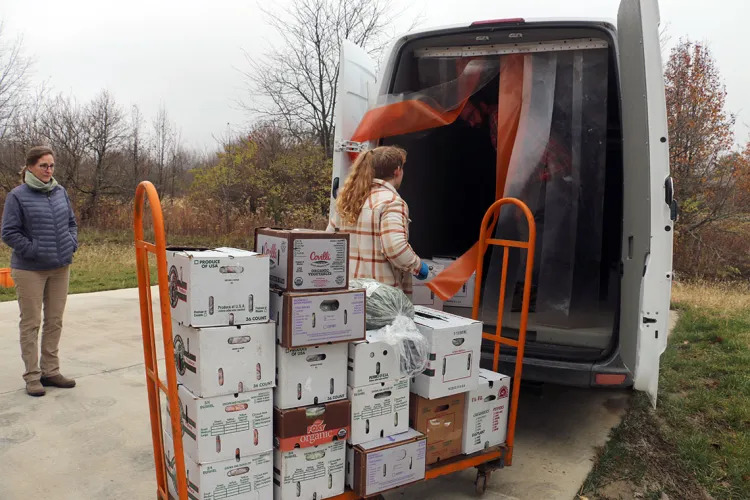
Illinois food producers and businesses can apply for a share of $3.6 million in funding to support local food systems.
Read MorePritzker says Bears’ statement ‘not some confirmation that they’re moving to Indiana’
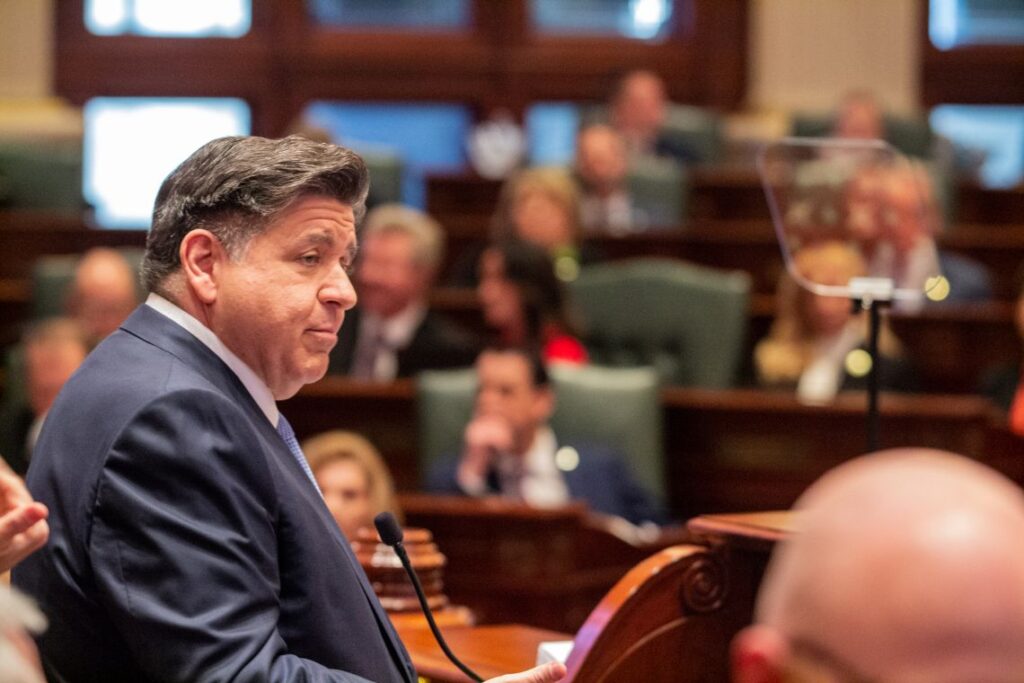
Gov. JB Pritzker says the Bears asked Illinois lawmakers delay a vote on their bill.
Read MoreState leaders seek more transparency from insurance companies

Secretary of State Alexi Giannoulias speaks at an event in Springfield in May 2025. (Capitol News Illinois photo by Jerry Nowicki)
Gov. JB Pritzker and General Assembly leaders claim State Farm is withholding data from the state.
The post State leaders seek more transparency from insurance companies appeared first on Capitol News Illinois
Pritzker seeks more regulatory authority over homeowners insurance business
Capitol News Illinois
Article Summary
Gov. JB Pritzker is asking lawmakers to pass legislation this fall to give the state more control over the rising cost of homeowners insurance.
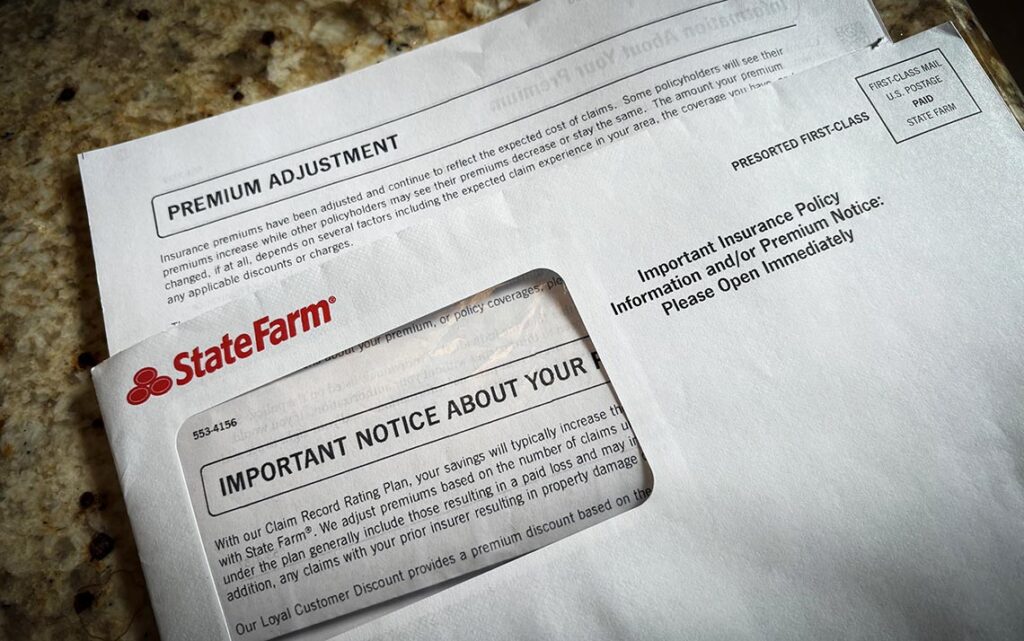
State Farm, based in Bloomington, recently announced it is raising premiums by an average of 27.2%, due mainly to the risk of losses from severe weather.
The Consumer Federation of America describes Illinois’ current regulatory environment as “toothless” and ranks the state second in the nation for having the fastest-rising insurance premiums in the country.
This summary was written by the reporters and editors who worked on this story.
SPRINGFIELD — Gov. JB Pritzker is asking state lawmakers for more authority to regulate the homeowners insurance market in Illinois.
His comments came after the Bloomington-based State Farm Fire and Casualty Company notified the Illinois Department of Insurance that it was raising premiums for residential property casualty insurance in Illinois by an average 27.2%.
In a statement July 10, Pritzker called on lawmakers to pass legislation in the upcoming fall veto session, “that prevents insurance companies from taking advantage of consumers through severe and unnecessary rate hikes like those proposed by State Farm.”
The veto session is scheduled to begin Oct. 14.
“Over the past six years, our state economy has flourished based on transparent markets and fair competition,” Pritzker said. “State Farm’s actions are antithetical to the core principles that the Illinois business community is built on.”
The increase will raise the average cost of a State Farm homeowners’ policy in Illinois to about $2,175 a year, up from $1,700 before the increase, according to State Farm.
The higher rates took effect July 15 for new policies and will go into effect Aug. 15 for renewals of existing policies.
Current regulations
Although Pritzker was not specific about what kind of increased regulatory authority he wants lawmakers to consider, some consumer advocates have called for giving the state Department of Insurance broad authority to review, modify or even reject proposed rate hikes.
Under current state law, companies are required to file their rates with the Department of Insurance, and the agency can review consumer complaints to determine whether the rates being charged are consistent with those filings.
The department also has the authority to conduct examinations to determine whether a company is paying out claims in a timely manner. It can also conduct examinations into a company’s financial condition and solvency.
But currently, according to the agency, Illinois is the only state in the country that does not prohibit rates from being “inadequate, excessive or unfairly discriminatory,” which means it has no authority to reject a rate filing on those grounds.
Douglas Heller, director of insurance for the Washington-based Consumer Federation of America, described Illinois’ law as “among the most toothless in the nation.”
“Almost every state in the country has a law that says for auto, home and most other lines of insurance as well, rates cannot be excessive,” he said in an interview. “Now, it doesn’t mean that the regulators around the country do a great job or even have the tools to enforce that very strictly … but Illinois doesn’t even have the language that prohibits excessive rates for homeowners insurance companies.”
In April, CFA issued a report that said from 2021 to 2024, Illinois ranked second in the nation for having the greatest increases in homeowners insurance premiums. Average premiums in Illinois rose 50% over that period, more than any other state except Utah, where rates went up 59%.
“At a minimum, Illinois should empower the Department of Insurance to reject or modify excessive rate hikes, which would represent a basic consumer protection that residents in almost every other state enjoy,” Abe Scarr, director of the Illinois Public Interest Research Group, said in a statement in response to the report.
Even with those increases, though, the report indicated that rates in Illinois were relatively modest compared to some other states, particularly those that experience more frequent natural disasters. Florida, Louisiana and Oklahoma ranked highest in average premiums.
In recent years, lawmakers have given the Department of Insurance broader authority to regulate premiums in the health insurance market.
Last year, Pritzker signed legislation giving the agency authority to review and reject proposed rate increases in large-group health insurance plans. That law also prohibited companies from engaging in certain “utilization management” practices that steer patients toward cheaper therapies and medications to lower payouts.to lower payouts.
Also last year, Pritzker named a new director of the agency, former state Sen. Ann Gillespie, who had served on the Senate Insurance Committee.
But the agency does not yet have that kind of regulatory authority over property casualty insurance policies for homeowners, renters and condominium owners, a fact that consumer advocates say puts Illinois out of step with the rest of the nation.
Reasons for rate hikes
In his statement, Pritzker accused State Farm of raising rates in Illinois to cover losses the company has suffered in other high-risk states like Florida.
“These increases are predicated on catastrophe loss numbers that are entirely inconsistent with the Illinois Department of Insurance’s own analysis — indicating that State Farm is shifting out-of-state costs onto the homeowners of our state,” he said. “Hard-working Illinoisans should not be paying more to protect beach houses in Florida.”
But State Farm strongly denied that suggestion, saying the increases were directly related to the cost of weather-related disasters in Illinois.
“For example, last year in the state of Illinois alone, we paid out more than $638 million in hail damage claims,” State Farm spokeswoman Gina Morss-Fischer said in an interview. “That was just in Illinois, and it was second only to the state of Texas. And this is the kind of thing that we’ve started to see more frequently.
“And of course, we’re also seeing the increase in replacement costs, longer waits for replacement materials. And these are all things that contribute to the need to make this difficult business decision,” she said.
Capitol News Illinois is a nonprofit, nonpartisan news service that distributes state government coverage to hundreds of news outlets statewide. It is funded primarily by the Illinois Press Foundation and the Robert R. McCormick Foundation.
The post Pritzker seeks more regulatory authority over homeowners insurance business appeared first on Capitol News Illinois.
Intoxicating hemp remains unregulated in Illinois following legislative inaction
Capitol News Illinois
Article Summary
Industrial hemp production was legalized in the U.S. and in Illinois in 2018. The industry was largely expected to produce items like industrial textiles and non-intoxicating CBD products.
Since then, a legal “gray area” has allowed for hemp to be used in the production of unregulated, intoxicating and synthetic THC products.
Stakeholders including the governor say this undercuts the state’s legal cannabis market and puts consumers at risk.
For the past three years, legislation to more strictly regulate the industry has failed in the General Assembly.
The legislative fight largely pits the state’s legalized cannabis industry against its industrial hemp growers.
This summary was written by the reporters and editors who worked on this story.
RUSHVILLE, Ill. — Justin and Anna Ward of Stoney Branch Farms were anxiously awaiting action on legislation to regulate intoxicating hemp products this spring in Illinois, which would have determined the future of their family-run hemp business in Rushville. But it never came.
Hemp farming has been legal and regulated in Illinois since 2018, when lawmakers passed the Industrial Hemp Act following federal action that legalized hemp production. The legislation anticipated it would again be used to make industrial products, but also for the production of CBD oils that can be extracted from the plant and are marketed as having therapeutic, but not intoxicating, properties.
But hemp has since become the subject of heated debate in Illinois and other states as the plant has been increasingly used to create synthetic products with intoxicating compounds that are not regulated by the federal government. Those products, known as delta-8 THC, are permissible due to what some describe as a “loophole” in the 2018 Farm Bill that legalized hemp production.
Gov. JB Pritzker has been a vocal opponent of intoxicating hemp, saying it undercuts the state’s legal cannabis industry and puts children and teens in harm’s way. He’s advocated – thus far to no avail – for regulating intoxicating hemp products similarly to the state’s legalized cannabis industry.
“This regulatory gray area has created a loophole that put Illinois consumers of all ages, but particularly children, in danger while an underground market flourished—the exact opposite of what Illinois has done by regulating our cannabis industry,” Pritzker said in a December 2024 news release.
But lawmakers failed again to pass legislation regulating intoxicating hemp this year, leaving the industry in limbo until either the state acts or the federal government intervenes first. It marked the third consecutive year that a regulatory bill failed, the latest front in a legislative fight that largely pits the state’s legalized cannabis industry against its industrial hemp growers.
Stoney Branch Farms co-founder Anna Ward looks at a hemp plants in its late growing stages before it gets harvested, after which it will get processed, packaged and sold directly from the farm. (Isabella Schoonover, Medill Illinois News Bureau)
Hemp vs. cannabis: What’s the difference?
Both hemp and cannabis come from the same plant and contain a level of THC that can cause a high if ingested. The most important difference, however, is in the concentration of THC. Compared to cannabis, hemp has a much lower amount of naturally occurring THC.
By federal law, if a plant has a concentration of 0.3% THC or less by dry weight, it is legally considered hemp. If it has any more than 0.3% THC, it is considered cannabis.
Both substances were strictly regulated as “Schedule 1” drugs under the federal Controlled Substances Act of 1970 until the passage of the 2018 Farm Bill, which removed hemp from the legal definition of cannabis, thus creating a fully legal hemp market.
But the farm bill only established a threshold for delta-9 THC, the primary cannabinoid found in cannabis. There is no explicit threshold for hemp-derived delta-8, which is created through additional chemical processing after hemp is harvested.
Unlike cannabis products containing THC, which must meet strict regulatory requirements in Illinois and other states that have legalized recreational and medical cannabis, the intoxicating hemp market is currently unregulated and lacks oversight at both the state and federal level to ensure products are responsibly produced, marketed and sold to consumers.
For example, there is no minimum age required to purchase hemp products, making it relatively easy for young consumers to access intoxicating hemp compared to cannabis.
A recent study from the University of Illinois System Institute of Government and Public Affairs released in May found credible evidence that hemp-derived THC products are intentionally marketed and readily available to teens and young adults through online sales and convenience stores.
At least 32 states have responded by passing legislation to increase regulations, or in California’s case, ban intoxicating hemp altogether.
Should it be regulated or banned?
The Wards have grown hemp on their sixth-generation farm since it was legalized in 2018. They’re in the camp that would like to see the intoxicating hemp industry more strictly regulated but not outright banned.
As president of the Illinois Healthy Alternatives Association, a trade association and lobbying group for hemp farmers, Justin Ward has made regular trips to Springfield to advocate for increased hemp regulation.
According to Ward, new regulations should include state-mandated testing to ensure hemp products are compliant with federal regulations and free of toxic contaminants, sold in child-safe packaging and labeling, and have a minimum age requirement at point-of-sale.
“Everything we grow meets that standard,” Ward said. At Stoney Branch Farms, the Wards sell both non-intoxicating and intoxicating forms of hemp, including delta-8. They said the cultivation, processing, packaging and marketing of their products is all done in-house.
Every crop at Stoney Branch goes through a pre-harvest THC potency test by a federal sampling agent, in addition to a post-processing test by a third party to ensure the final products are free of contaminants. The products are then sold online in child-safe packaging to consumers 21 years old or above.
A team of packagers turn hemp into finished products on Justin and Anna Ward’s farm, most of which is sold over the internet. (Isabella Schoonover, Medill Illinois News Bureau)
A bill to make these standards law in Illinois, House Bill 1, was proposed this year with the support of hemp lobbyists, but continued disagreement among stakeholders over the details of licensing, taxation and the legal potency threshold of delta-8 THC caused the bill to stall without being called for a vote, according to the bill’s sponsor Rep. La Shawn Ford, D-Chicago.
Municipalities are free to ban the sale of hemp-derived products as they see fit, and many have; in Chicago, the City Council has approved bans specific to some wards.
The state’s legalized cannabis industry, which saw its first sales in January 2020, has at times called for an outright ban on delta-8. The industry maintains it’s willing to work toward a solution.
Tiffany Chappell Ingram, executive director of the Cannabis Business Association of Illinois, said in a recent statement that regulations are needed to “rein in” intoxicating hemp. She argues that the hemp industry unfairly undercuts licensed cannabis operators, evades health and safety regulations and generates little revenue for state programs due to its low tax rate.
“We’ve been at this for years at this point, but we’ve got a lot of great allies in the legislature.” Ward said. “This hasn’t been banned yet because they’ve listened to us.”
Opposition from cannabis crowd
The state’s cannabis industry argues intoxicating hemp is not distinct enough from cannabis to have its own license category and far fewer barriers to entry and operation.
For example, while a three-year license for hemp only costs $1,100, including initial licensing fees, a license for cannabis costs $100,000 just to apply for a large adult-use cultivation license, then another $100,000 when the license is granted and each time it’s renewed. The state caps large-scale adult-use cultivation centers to 21 licenses, and has issued fewer than 100 smaller-scale “craft grow” licenses at a cost of $40,000.
When hemp was legalized, many who couldn’t gain entry to the cannabis industry took it as an opportunity to produce a similar product without all the red tape.
“Part of the reason we were drawn to hemp is the lower barriers of entry to get into this in comparison to the cannabis industry,” Ward said.
Hemp is also taxed at a much lower rate than cannabis, allowing the industry to price its products more competitively. Cannabis revenues, by comparison, are hurt by stricter taxation and regulatory compliance, according to the University of Illinois report.
Stoney Branch Farms co-founders Justin and Anna Ward say that while the hemp industry is booming, regulating it the same as cannabis would be a massive blow to their farm. “If we could just get some sensible regulation, I think that it would help a lot of business owners feel confident enough to really put their whole weight behind their business,” Anna Ward said. (Isabella Schoonover, Medill Illinois News Bureau)
Social equity cannabis licenses are available at lower costs to those who have been impacted by the state’s prior criminalization of cannabis, including those previously convicted of cannabis related offenses, but the industry is still far from accessible.
Ford, who spearheads the issue of hemp and cannabis regulation each year, said it’s important to balance promises made to current social equity cannabis license holders with any concessions made for hemp.
Ward said he supports easing regulations on cannabis to make the industry more accessible in Illinois, while also keeping hemp accessible through “sensible” regulations.
“We want regulations to protect consumers and weed out bad actors, but we don’t want to see this thing regulated to death,” Ward said.
Legislature divided on regulation
The state legislature hasn’t been able to settle the question of whether to regulate hemp-derived products containing delta-8 THC as distinct from medicinal and recreational cannabis, or to treat them as virtually the same substance.
The issue caused a rift among House Democrats earlier this year, and despite continued discussions during the spring legislative session, lawmakers have still not come to a consensus.
A proposal backed by Pritzker in the 2024 session, House Bill 4293, to legally define hemp as cannabis, would have made it illegal to sell hemp without a cannabis license. Hemp lobbyists strongly opposed that measure, fearing it would shut them out and give cannabis license holders a monopoly over the cannabinoid market.
Pritzker ultimately blamed House Speaker Chris Welch for killing that bill in January. Despite bipartisan support, Welch said at the time the measure didn’t have enough votes within his Democratic ranks to pass. A spokesperson for Welch promised at the time that he would continue to work toward hemp regulation throughout the legislative session.
A spokesperson for the speaker declined to comment on why hemp regulations still didn’t advance. Both hemp and cannabis lobbies have donated tens of thousands of dollars to Welch’s campaign, Ford’s and others over the last several years in the legislative blitz surrounding the various regulatory bills.
Ward said Ford has been one of the hemp lobby’s biggest allies. Ford conducted meetings all session among lawmakers, the governor’s office and industry stakeholders in an effort to find common ground.
In many convenience stores that sell hemp, the products are behind the counter, even though it’s not illegal to sell hemp products to minors. These packages are also labeled “21+” and “keep out of reach of children.” Critics say the design, modeled after Sour Patch Kids, is intentionally designed to appeal to children. (Simon Carr, Medill Illinois News Bureau)
“We have two competing industries, and we already have existing businesses, and existing businesses are not interested in just losing their operations,” Ford said.
While closed-door conversations surrounding hemp regulations have continued, there has yet to be a public hearing on hemp. Rep. Sonya Harper, D-Chicago, who chairs the House agriculture committee, said the speaker had not responded to her requests for such a hearing.
“I just want to actually make sure that the voices of those most impacted are heard,” Harper said.
Likelihood of future hemp regulation
Though there’s been significant pressure from Pritzker and some advocacy groups to regulate hemp in Illinois, Ford said he’s not inclined to rush the process, arguing it needs broader bipartisan support.
“We had a problem when we regulated cannabis: we sort of rushed it, and we didn’t have stakeholders all at the table,” Ford said. “Some Republicans would say that they were not a part of it.”
A number of Republicans have recently joined negotiations over hemp legislation. But a compromise still seems far off. Rep. C.D. Davidsmeyer, R-Murrayville, who’s been leading that effort, said Republicans are unlikely to support anything but closing the intoxicating hemp loophole.
Davidsmeyer said he opposes the double standard for cannabis license holders versus hemp.
“If you’re going to have a standard, you have everybody in the same industry going by the same rules,” he said.
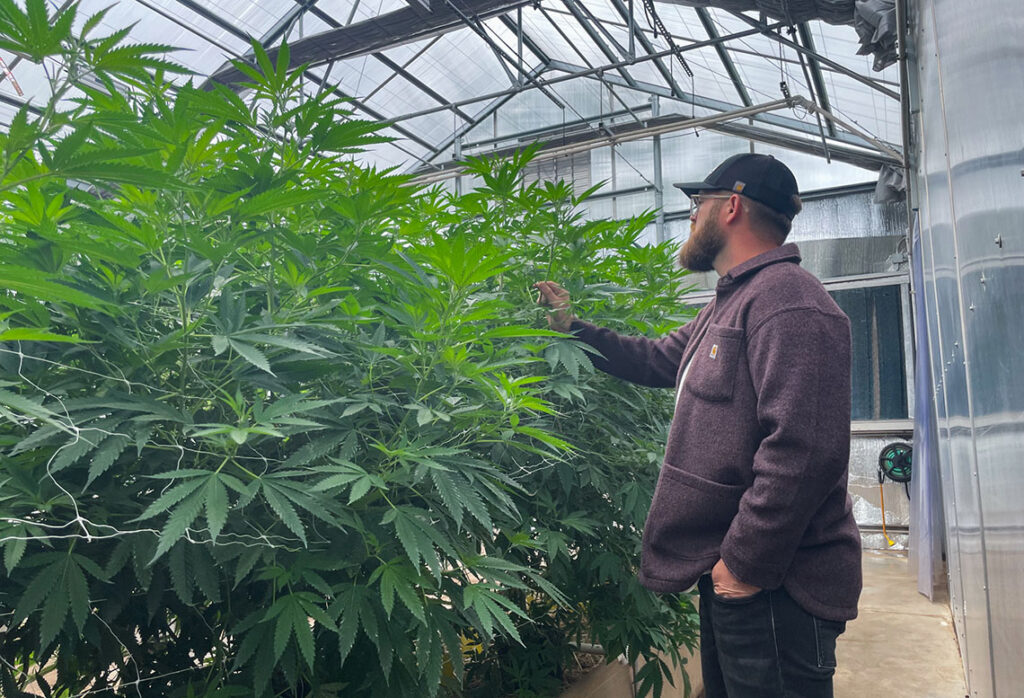
A row of mature hemp plants grows in one of the greenhouses at Stoney Branch Farms in Rushville, Illinois. (Isabella Schoonover, Medill Illinois News Bureau)
A spokesperson from the governor’s office said his position has not changed since he called for greater regulation.
“I think that it’s agreed that, from the speaker of the House, the governor and the Republicans and myself, and the industry, everyone agrees that we should regulate this,” Ford said. “Over the months, we should be able to get something. It’s a priority.”
Federal changes coming?
A bill that would end this hemp loophole at the federal level passed through the U.S. Senate Appropriations Committee on Thursday, July 10. If that bill becomes law, the cultivation and sale of hemp products containing “quantifiable amounts” of THC would once again be prohibited under federal law, rolling back the previous allowance of 0.3%.
This would deal a devastating blow to the more than $400 million U.S. hemp industry.
One of the most common forms of hemp sold in the U.S. is cannabidiol, or CBD, a non-intoxicating cannabinoid which is marketed as a therapeutic alternative for the treatment of conditions like insomnia, inflammation and seizure disorders.
“That’s a big focus of our business still, is people who are looking for some of the therapeutic benefits that cannabis can provide without a high,” Ward said.
Because CBD almost always still has trace amounts of THC, proposals to ban any “quantifiable amount” of THC could result in the prohibition of CBD products. “I think we really do a disservice to a great number of consumers in Illinois by doing that,” Ward said.
Simon Carr is a student in journalism with Northwestern University’s Medill School of Journalism, Media, Integrated Marketing Communications, and a fellow in its Medill Illinois News Bureau working in partnership with Capitol News Illinois.
Isabella Schoonover is a graduate student in journalism with Northwestern University’s Medill School of Journalism, Media, Integrated Marketing Communications, and a fellow in its Medill Illinois News Bureau working in partnership with Capitol News Illinois.
Capitol News Illinois is a nonprofit, nonpartisan news service that distributes state government coverage to hundreds of news outlets statewide. It is funded primarily by the Illinois Press Foundation and the Robert R. McCormick Foundation.
The post Intoxicating hemp remains unregulated in Illinois following legislative inaction appeared first on Capitol News Illinois.
GOP lawsuit seeks to end ‘gut-and-replace’ legislation
Capitol News Illinois
SPRINGFIELD — A group of Republican lawmakers filed a lawsuit this week that seeks to nullify legislation they say would indelibly alter both the business and legal landscape of Illinois.
Senate Bill 328 would amend a key provision of Illinois civil law by allowing, in certain kinds of cases, any company authorized to do business in the state to be sued in Illinois courts, even if the underlying claims and the parties have no connection to the state.
As written, the bill would apply only in cases filed under the Uniform Hazardous Substances Act in which the plaintiff claims an injury or illness resulting from exposure to a toxic substance.
What is unique about the GOP lawsuit, however, is that it doesn’t just seek to nullify the legislation before Gov. JB Pritzker signs it. It also asks the court to bar the legislature from using a procedure that has become common in the General Assembly known as “gut-and-replace.” This effectively allows lawmakers to sidestep the Illinois Constitution’s requirement that every bill be read, by title, three times on three different days in each chamber before it is passed because amendments are not required to be read on three different days in each chamber.
That procedure is used frequently for major legislation passed in the final days of a legislative session, including budget bills.
“Illinois’ reputation as one of the most corrupt states in the nation and one of the worst states in the nation for business go hand in hand,” Senate Republican Leader John Curran, R-Downers Grove, said during a virtual news conference Wednesday. “Allowing legislators to disregard the Constitution and good government transparency processes to make laws that are bad for our state is the root cause of both narratives.”
The proposal stems from a 2022 U.S. Supreme Court case, Mallory v. Norfolk Southern Railway Co., in which the court upheld a Pennsylvania law that requires out-of-state corporations to agree to allow Pennsylvania courts to exercise “general personal jurisdiction” over them, just as those courts exercise over domestic corporations.
“This is legalized litigation tourism,” said Sen. Jason Plummer, R-Edwardsville. “And it further damages Illinois’ reputation as a state that’s hostile to businesses and job creators.”
SB 328 began as what’s known in the General Assembly as a “shell bill” — one that has a title and a bill number but no substantive content. In this case, the original language called for making a technical change in one sentence in the Code of Civil Procedure, deleting the word “and” and replacing it with the word “and.”
Each session, lawmakers in both chambers introduce hundreds of such bills, most of which are never acted upon. But they are often amended into substantive legislation later in the session, especially after deadlines for introducing new bills or passing bills out of committees have passed.
That is what happened with SB 328, which began as a shell bill but was amended in the Senate to make a technical change to the way court clerks handle electronically filed documents. It passed out of the Senate on April 10 by a vote of 56-0 and was sent to the House.
In the House, it was read for the first time on April 11 and was assigned to a committee, which voted April 30 to recommend it be passed. It was read a second time on May 13.
On May 30, the next-to-last day of the session, Rep. Jay Hoffman, D-Swansea, introduced a “gut-and-replace” amendment that removed the language about electronic court filings and replaced it with the new language allowing out-of-state corporations to be sued in Illinois courts over acts that may have occurred elsewhere.
House Republican Leader Tony McCombie, left, and Senate GOP Leader John Curran speak to reporters about their lawsuit challenging passage of a controversial bill regarding corporate liability during a virtual news conference Wednesday, June 18. (Credit: Zoom.us)
That amendment was never sent to a substantive committee but instead was debated on the floor of the House where it passed the night of May 31 by a partisan vote of 77-40. That vote also counted as the third reading of the bill in the House, meaning the bill number had now been read on three different days in each chamber. It was then sent back to the Senate, which voted 37-19 shortly after midnight on June 1 to concur in the House amendment.
“We have long discussed with our partners, members and constituents filing suit on this issue, even prior to me being in leadership this year,” House Republican Leader Tony McCombie, of Savanna, said during the news conference. “The caucus members brought forward this egregious example of SB 328, and said let’s move forward.”
The lawsuit was filed in circuit court in Sangamon County. It lists 47 Republican lawmakers as plaintiffs. House Speaker Emanuel “Chris” Welch and Senate President Don Harmon are named as defendants.
Harmon, D-Oak Park, who sponsored the amended bill in the Senate, did not immediately respond Wednesday to a request for comment.
Separately, the Illinois Freedom Caucus has also filed a lawsuit in Sangamon County alleging the state’s budget bill did not satisfy the three readings requirement for similar reasons. A hearing in the case is scheduled for July 3.
Capitol News Illinois is a nonprofit, nonpartisan news service that distributes state government coverage to hundreds of news outlets statewide. It is funded primarily by the Illinois Press Foundation and the Robert R. McCormick Foundation.
The post GOP lawsuit seeks to end ‘gut-and-replace’ legislation appeared first on Capitol News Illinois.
Inside Illinois’ efforts to court the emerging quantum technology industry

Capitol News Illinois
CHICAGO — Just over one year ago, the Illinois legislature approved spending more than $700 million to attract and support a new industry: quantum technology.
Now, representatives of other countries, federal research labs and a network of private organizations with ties to the state are beginning to ink deals and make agreements to bring specific quantum companies to Illinois — and boost the startups that are already here.
Illinois state officials are interested in attracting the nascent industry because of its potential for economic growth and positioning Illinois as a high-tech leader in the coming decades.
Quantum technology is an emerging field of research and business that creates specialized machinery and computers that use the laws of quantum mechanics to solve problems and behave in ways that would be out of reach for traditional machines.
Last week, two events in Chicagoland offered a glimpse inside the world of quantum businesses and the layers of public and private funding going into the industry.
The Japan External Trade Organization — an economic development organization affiliated with the government of Japan — sponsored a two-day “delegation” of business representatives to Chicago.
At an early meeting of the delegation, representatives of the state and economic development agencies pitched the region — and Illinois’ state backing — as unique in the world.
“This is not a state government that is following trends but really setting the trends,” Intersect Illinois Chief Quantum Officer Preeti Chalsani told the delegation. “When I go to conferences, I hear about other states and countries who are thinking of doing something like Illinois. That really makes me proud.”
Intersect Illinois is a private nonprofit organization with ties to the state. It’s led by Christy George, a former Pritzker administration official who helped plan the Democratic National Convention in Chicago last summer. The organization also plays a prominent role in the state Department of Commerce and Economic Opportunity’s five-year plan for attracting business to Illinois.
“This is a state that is constantly on a mission to constantly build and expand our business environment,” George said at the event.
What is quantum tech?
Researchers and entrepreneurs are developing computers and other systems using the principles of quantum mechanics to achieve things that would be impossible with traditional computers. Current quantum computers can perform benchmark tests more than 1 billion times faster than traditional computers. Quantum technology can also be used to decode encrypted messages, posing serious questions for the cybersecurity industry. Other applications include simulations, sensor technology and communications.
World Business Chicago, an economic development organization backed by the city of Chicago, estimates the industry could generate tens of billions of dollars in Chicagoland and create more than 100,000 jobs.
Representatives of the Department of Commerce and Economic Opportunity, World Business Chicago and the University of Chicago also participated in the event.
The visit mirrored Gov. JB Pritzker’s and Chicago Mayor Brandon Johnson’s visits to Japan where both men, along with sizable entourages of economic development leaders and businesspeople, met with Japanese officials.
Read more: Federal agency opposes new state law; Pritzker to lead trade mission to Japan
Both visits, and especially Pritzker’s in October 2024, built hype in the Asian nation about Illinois’ role in the developing quantum technology sector. Pritzker is a self-professed “quantum geek” and his personal interest in the emerging industry contributes to the state’s interest in it.
Over the two days the Japanese delegation was in Chicago, they toured several local quantum businesses, including qBraid, InfleQtion, and EeroQ among other locations around the city. The DCEO and Intersect Illinois also hosted a reception for the Japanese delegation.
The efforts from state and industry boosters appear to be interesting to at least a few in the cutting-edge industry.
At a pitch and networking event capping off the Japanese visit last week, several Chicago-based and Japan-based companies discussed their business models and strategies.
One of the Japanese delegation members who pitched at the event, Quantumdata founder Yuki Nagasako, told Capitol News Illinois the quantum industry in Chicago is “very hot,” especially compared to artificial intelligence tech hubs in California.
“When I say I work in quantum technology in the Bay area? Nobody knows. Nothing,” Nagasako said. “But in Chicago, here? Everybody.”
Nagasako, whose company has offices in California and is currently in a fundraising round, said he’s seriously considering expanding in Chicago.
That event also featured a closed-door meetings between Japanese companies and officials at PsiQuantum as well as other local companies.
State quantum park
PsiQuantum is one of the jewels of the state’s quantum crown. It is the “anchor tenant” of the Illinois Quantum and Microelectronics Park, or IQMP, a research park set to break ground later this year on Chicago’s South Side.
The California-based quantum computing company was raising $750 million at a $6 billion valuation earlier this year, according to reporting from Reuters. Its last official valuation was $3.1 billion in 2021.
Read more: Quantum business park coming to Chicago, backed by $700M from state of Illinois
That park is being built with $500 million in state funding, on top of $200 million in tax breaks and other incentives going to PsiQuantum directly.
Harley Johnson, the University of Illinois professor who took over as the head of the IQMP late last year, said the “singular focus” of the research facility is to help scale up quantum computing technology.
“In some cases, it takes really specialized, industrial-scale infrastructure,” Johnson said last week.
Johnson was speaking at an event at Argonne National Lab where federal researchers and state-level quantum advocates discussed the state’s future as the “Quantum Prairie” — a riff on California’s Silicon Valley.
There, he also laid the groundwork for what is expected to be a busy few months at the state’s quantum research park.
“There are a lot of exciting announcements,” Johnson said. “We’re going to break ground very soon.”
In addition to PsiQuantum, several other major groups have said they’ll set up shop at the research park. Six months ago, IBM announced it would build a quantum computer and research center at the park. About a year ago, the Defense Advanced Research Projects Agency, or DARPA, announced it would base a quantum testing program at the park.
Two weeks ago, the IQMP also announced that Australian tech and quantum company Diraq intends to open a facility at the park.
“Diraq building and scaling their quantum operation at the IQMP is a testament to Illinois attracting the tech and security sectors,” Pritzker said in a statement at the time. “Diraq’s commitment further cements Illinois’ position as a global quantum leader and reflects the state’s commitment to fostering innovation and economic growth.”
Diraq is one of nearly 20 companies that is participating in the first stage of DARPA’s quantum testing program.
“We’ve got others that will be coming on board soon,” Johnson said in his speech last week.
Capitol News Illinois is a nonprofit, nonpartisan news service that distributes state government coverage to hundreds of news outlets statewide. It is funded primarily by the Illinois Press Foundation and the Robert R. McCormick Foundation.
The post Inside Illinois’ efforts to court the emerging quantum technology industry appeared first on Capitol News Illinois.