Posts Tagged ‘Brandon Johnson’
Pritzker doubles down on influencers, podcasters in January media hits
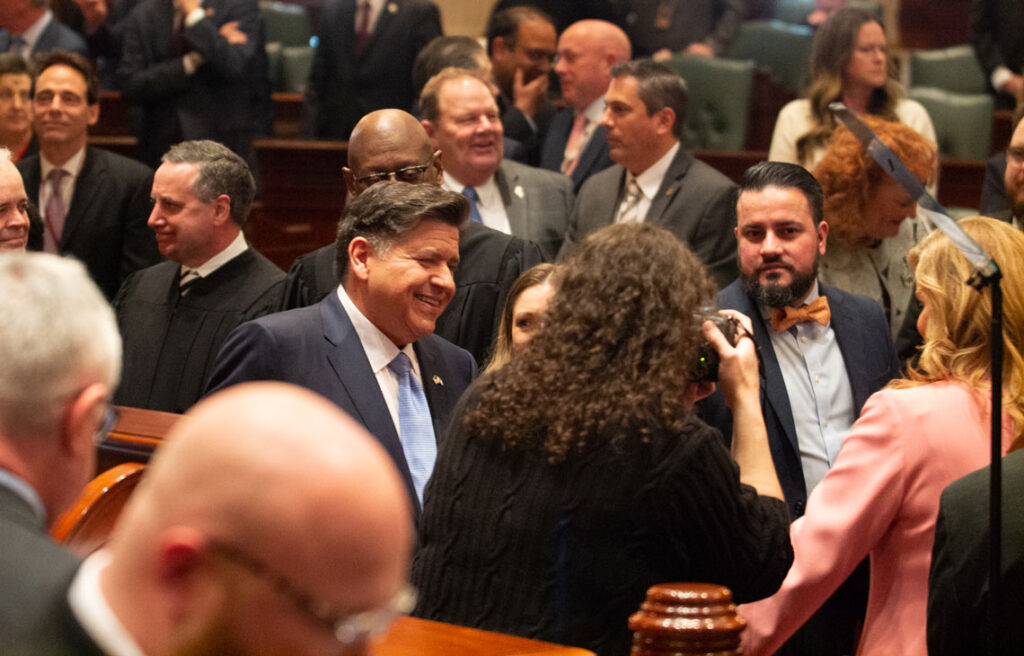
The governor has continued interviewing with influencers and national media.
Read MoreComptroller Mendoza won’t run for reelection, opening up statewide office
Capitol News Illinois
Article Summary
Susana Mendoza will not run for reelection as Illinois comptroller, the state’s chief financial officer. She is rumored to be considering a run for Chicago mayor.
Mendoza held the comptroller’s office during the worst budgetary crisis in state history and through the COVID-19 pandemic.
A key step in how Cook County Democrats choose who to endorse for statewide office is happening this week.
Candidates are expected to announce whether they will run to replace Mendoza in the coming weeks.
This summary was written by the reporters and editors who worked on this story.
Editor’s note: This story has been updated to reflect the latest information regarding candidates seeking to be slated by Cook County Democrats.
CHICAGO — After almost a decade, Illinois State Comptroller Susana Mendoza will not seek another term as the state’s chief financial officer.
Mendoza, who took office in December 2016 after beating an ally of Republican Gov. Bruce Rauner in a special election, has overseen the state’s financial systems through both the COVID-19 pandemic and the worst budget crisis any state has faced in modern history.
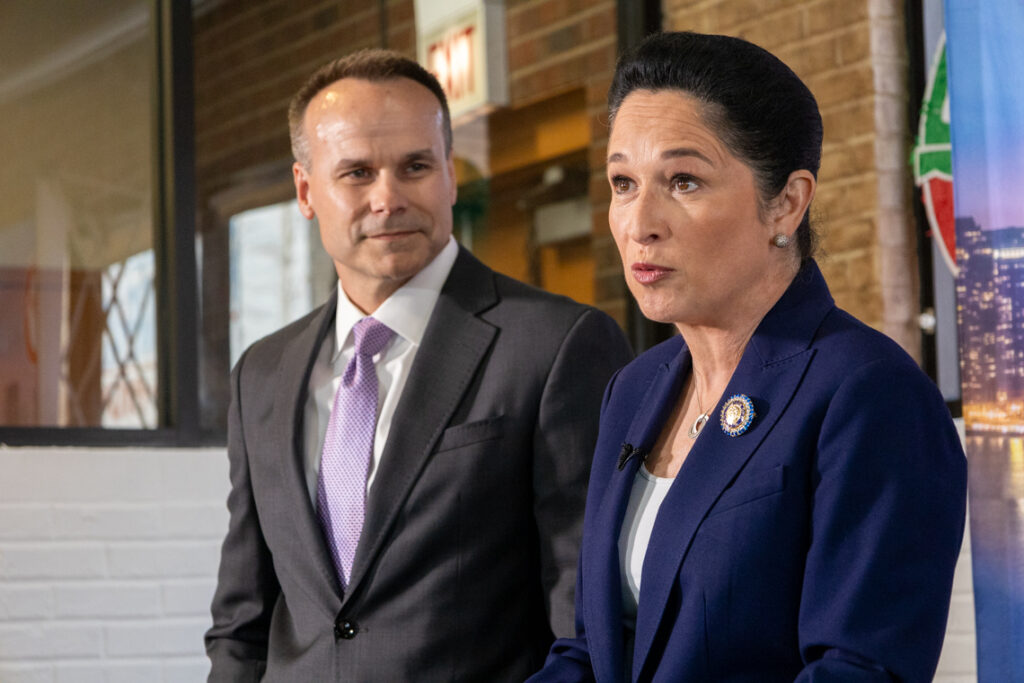
At a news conference Wednesday, Mendoza said she’s not running for reelection in the 2026 comptroller’s race, so she will have time to decide her next career move.
“I’m going to figure out what the right move is for our family, for our city, our state, find out where I’m needed most, that next biggest challenge that I need to take on,” Mendoza said.
Prior to taking statewide office, Mendoza was the first woman to be the Chicago City Clerk. Mendoza previously spent a decade in the Illinois House of Representatives.
It’s been widely speculated that Mendoza, who ran for Chicago mayor in 2019, is eyeing a run to unseat sitting Chicago Mayor Brandon Johnson in 2027.
While she didn’t commit to a run, she said she is “leaving the door open.” Several U.S. House seats are up for grabs, along with Illinois’ first open U.S. Senate seat since 2010.
But when asked whether she was interested in a position in Congress, Mendoza laughed.
“No thank you,” she quickly said Thursday, before moving on to questions about a potential mayoral bid.
Comptroller vacancy
The comptroller’s office, traditionally a low-visibility role, became a high-stakes proxy battle between Democratic and Republican power brokers during the budget impasse of the mid-2010s.
Mendoza became the most vocal and high-profile statewide Democratic foil to Republicans at the height of the more than two-year budget impasse between Rauner and Democrats in the General Assembly. After Comptroller Judy Baar Topinka died in 2014, Rauner appointed Leslie Munger to the position. Mendoza beat Munger with 49.5% of the vote in a special election in 2016.
Mendoza gained statewide visibility for her frequent videos assailing Rauner and highlighting that the state was accruing a massive “bill backlog” driven by ongoing court-mandated expenditures amid dwindling revenue brought on by the impasse.
She won reelection in 2018 and 2022, routinely posting the widest margins of any statewide elected official.
No Republican, meanwhile, has won statewide office since Rauner in 2014, and few have come especially close. This puts the focus for replacing Mendoza on the Democratic primary process. The announcement creates an opportunity for a new Democrat to make a run for an open statewide office for the first time since 2018.
Illinois Comptroller Susana Mendoza answers questions from reporter, curious to know if she will run for Chicago mayor in 2027. (Capitol News Illinois photo by Andrew Adams)
Mendoza said she wanted to make the announcement early enough for people interested in replacing her to “make their pitches” to party officials. The Cook County Democratic Party — a powerhouse in statewide party politics — is holding its “slating” meetings this week to decide which candidates the party will endorse.
Rep. Margaret Croke, D-Chicago, is expected to appear at the slating for statewide candidates and make a formal announcement about her 2026 plans next week, according to sources close to the representative.
“With chaos unfolding at the national level, Illinoisans need steady state leadership and deserve a Comptroller who is prepared to lead with transparency, efficiency, and integrity,” Croke said in a statement after Mendoza’s announcement.
Lake County Treasurer Holly Kim is also expected to appear at the Cook County slating meeting, with an announcement about her plans in the coming weeks.
“Susana Mendoza raised the bar for transparency and accountability, and I intend to build on that legacy,” Kim said.
Sen. Karina Villa, D-Chicago, is also scheduled to appear at the slating meeting to discuss a potential comptroller bid. Sen. Javier Cervantes, D-Chicago, was previously on the agenda, although his name was later removed.
Mendoza said she hopes her replacement is committed to serving the entire state, noting that while she is a Chicagoan, she said she has a “very soft spot in my heart for southern Illinois.”
Mayoral ambitions
While Mendoza did not commit to a run for mayor, she did speak at length about the needs of the city.
“Chicago is in dire need of competency, someone who understands the needs of the city, who understands how important the role of the city is to the good functioning of the whole state,” Mendoza said. “And I think we’ve had two very unsuccessful mayors in a row.”
Mendoza stressed public safety and Chicago’s need for a growth-centered economic policy.
“It’s not just our feathered friends that have flown south, it’s the most important bird in Chicago: the crane,” Mendoza said. “You can look at a city and gauge its financial health by the number of cranes that are in the sky. And, right now, you have an unobstructed, picture-perfect view of this city.”
Illinois Comptroller Susana Mendoza announces she will not seek reelection alongside her husband, David Szostak. (Capitol News Illinois photo by Andrew Adams)
If she runs, Mendoza could be joined by several other prominent Illinois politicians in the race for mayor. Illinois Secretary of State Alexi Giannoulias is also rumored to be considering a run.
Mendoza made her announcement at Los Comales, a restaurant in Chicago’s Little Village neighborhood that specializes in Mexico City-style tacos. Christina Gonzalez, the co-owner of the Los Comales chain and daughter of its founder, noted that Mendoza was from the neighborhood.
“She was always a customer here,” Gonzalez said. “Her parents brought her here and she knew my dad — my dad loved her.”
It’s the same restaurant where she announced her first run for state representative more than 20 years ago and her ill-fated mayoral bid in 2019.
Gonzalez said the restaurant, which was mostly empty aside from Mendoza’s supporters and reporters, has faced a significant slowdown in business recently, thanks to rumors about immigration enforcement.
Capitol News Illinois is a nonprofit, nonpartisan news service that distributes state government coverage to hundreds of news outlets statewide. It is funded primarily by the Illinois Press Foundation and the Robert R. McCormick Foundation.
The post Comptroller Mendoza won’t run for reelection, opening up statewide office appeared first on Capitol News Illinois.
Inside Illinois’ efforts to court the emerging quantum technology industry
Capitol News Illinois
CHICAGO — Just over one year ago, the Illinois legislature approved spending more than $700 million to attract and support a new industry: quantum technology.
Now, representatives of other countries, federal research labs and a network of private organizations with ties to the state are beginning to ink deals and make agreements to bring specific quantum companies to Illinois — and boost the startups that are already here.
Illinois state officials are interested in attracting the nascent industry because of its potential for economic growth and positioning Illinois as a high-tech leader in the coming decades.
Quantum technology is an emerging field of research and business that creates specialized machinery and computers that use the laws of quantum mechanics to solve problems and behave in ways that would be out of reach for traditional machines.
Last week, two events in Chicagoland offered a glimpse inside the world of quantum businesses and the layers of public and private funding going into the industry.
The Japan External Trade Organization — an economic development organization affiliated with the government of Japan — sponsored a two-day “delegation” of business representatives to Chicago.
At an early meeting of the delegation, representatives of the state and economic development agencies pitched the region — and Illinois’ state backing — as unique in the world.
“This is not a state government that is following trends but really setting the trends,” Intersect Illinois Chief Quantum Officer Preeti Chalsani told the delegation. “When I go to conferences, I hear about other states and countries who are thinking of doing something like Illinois. That really makes me proud.”
Intersect Illinois is a private nonprofit organization with ties to the state. It’s led by Christy George, a former Pritzker administration official who helped plan the Democratic National Convention in Chicago last summer. The organization also plays a prominent role in the state Department of Commerce and Economic Opportunity’s five-year plan for attracting business to Illinois.
“This is a state that is constantly on a mission to constantly build and expand our business environment,” George said at the event.
What is quantum tech?
Researchers and entrepreneurs are developing computers and other systems using the principles of quantum mechanics to achieve things that would be impossible with traditional computers. Current quantum computers can perform benchmark tests more than 1 billion times faster than traditional computers. Quantum technology can also be used to decode encrypted messages, posing serious questions for the cybersecurity industry. Other applications include simulations, sensor technology and communications.
World Business Chicago, an economic development organization backed by the city of Chicago, estimates the industry could generate tens of billions of dollars in Chicagoland and create more than 100,000 jobs.
Representatives of the Department of Commerce and Economic Opportunity, World Business Chicago and the University of Chicago also participated in the event.
The visit mirrored Gov. JB Pritzker’s and Chicago Mayor Brandon Johnson’s visits to Japan where both men, along with sizable entourages of economic development leaders and businesspeople, met with Japanese officials.
Read more: Federal agency opposes new state law; Pritzker to lead trade mission to Japan
Both visits, and especially Pritzker’s in October 2024, built hype in the Asian nation about Illinois’ role in the developing quantum technology sector. Pritzker is a self-professed “quantum geek” and his personal interest in the emerging industry contributes to the state’s interest in it.
Over the two days the Japanese delegation was in Chicago, they toured several local quantum businesses, including qBraid, InfleQtion, and EeroQ among other locations around the city. The DCEO and Intersect Illinois also hosted a reception for the Japanese delegation.
The efforts from state and industry boosters appear to be interesting to at least a few in the cutting-edge industry.
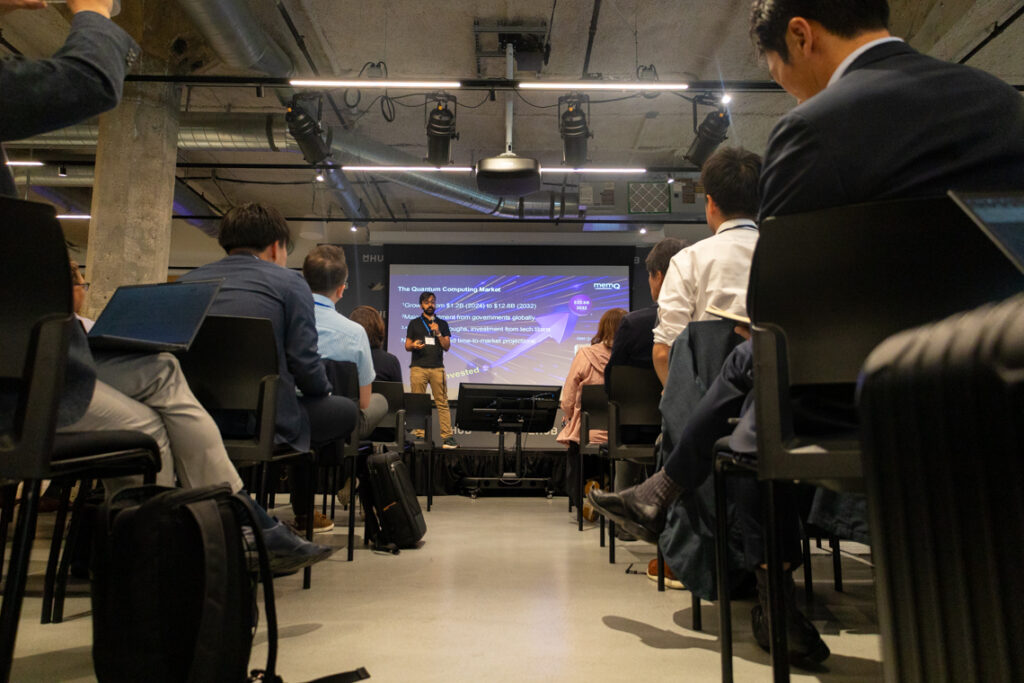
At a pitch and networking event capping off the Japanese visit last week, several Chicago-based and Japan-based companies discussed their business models and strategies.
One of the Japanese delegation members who pitched at the event, Quantumdata founder Yuki Nagasako, told Capitol News Illinois the quantum industry in Chicago is “very hot,” especially compared to artificial intelligence tech hubs in California.
“When I say I work in quantum technology in the Bay area? Nobody knows. Nothing,” Nagasako said. “But in Chicago, here? Everybody.”
Nagasako, whose company has offices in California and is currently in a fundraising round, said he’s seriously considering expanding in Chicago.
That event also featured a closed-door meetings between Japanese companies and officials at PsiQuantum as well as other local companies.
State quantum park
PsiQuantum is one of the jewels of the state’s quantum crown. It is the “anchor tenant” of the Illinois Quantum and Microelectronics Park, or IQMP, a research park set to break ground later this year on Chicago’s South Side.
The California-based quantum computing company was raising $750 million at a $6 billion valuation earlier this year, according to reporting from Reuters. Its last official valuation was $3.1 billion in 2021.
Read more: Quantum business park coming to Chicago, backed by $700M from state of Illinois
That park is being built with $500 million in state funding, on top of $200 million in tax breaks and other incentives going to PsiQuantum directly.
Harley Johnson, the University of Illinois professor who took over as the head of the IQMP late last year, said the “singular focus” of the research facility is to help scale up quantum computing technology.
“In some cases, it takes really specialized, industrial-scale infrastructure,” Johnson said last week.
Johnson was speaking at an event at Argonne National Lab where federal researchers and state-level quantum advocates discussed the state’s future as the “Quantum Prairie” — a riff on California’s Silicon Valley.
There, he also laid the groundwork for what is expected to be a busy few months at the state’s quantum research park.
“There are a lot of exciting announcements,” Johnson said. “We’re going to break ground very soon.”
In addition to PsiQuantum, several other major groups have said they’ll set up shop at the research park. Six months ago, IBM announced it would build a quantum computer and research center at the park. About a year ago, the Defense Advanced Research Projects Agency, or DARPA, announced it would base a quantum testing program at the park.
Two weeks ago, the IQMP also announced that Australian tech and quantum company Diraq intends to open a facility at the park.
“Diraq building and scaling their quantum operation at the IQMP is a testament to Illinois attracting the tech and security sectors,” Pritzker said in a statement at the time. “Diraq’s commitment further cements Illinois’ position as a global quantum leader and reflects the state’s commitment to fostering innovation and economic growth.”
Diraq is one of nearly 20 companies that is participating in the first stage of DARPA’s quantum testing program.
“We’ve got others that will be coming on board soon,” Johnson said in his speech last week.
Capitol News Illinois is a nonprofit, nonpartisan news service that distributes state government coverage to hundreds of news outlets statewide. It is funded primarily by the Illinois Press Foundation and the Robert R. McCormick Foundation.
The post Inside Illinois’ efforts to court the emerging quantum technology industry appeared first on Capitol News Illinois.