Posts Tagged ‘Bloomington’
Mapping Juliana Stratton’s U.S. Senate Democratic primary win
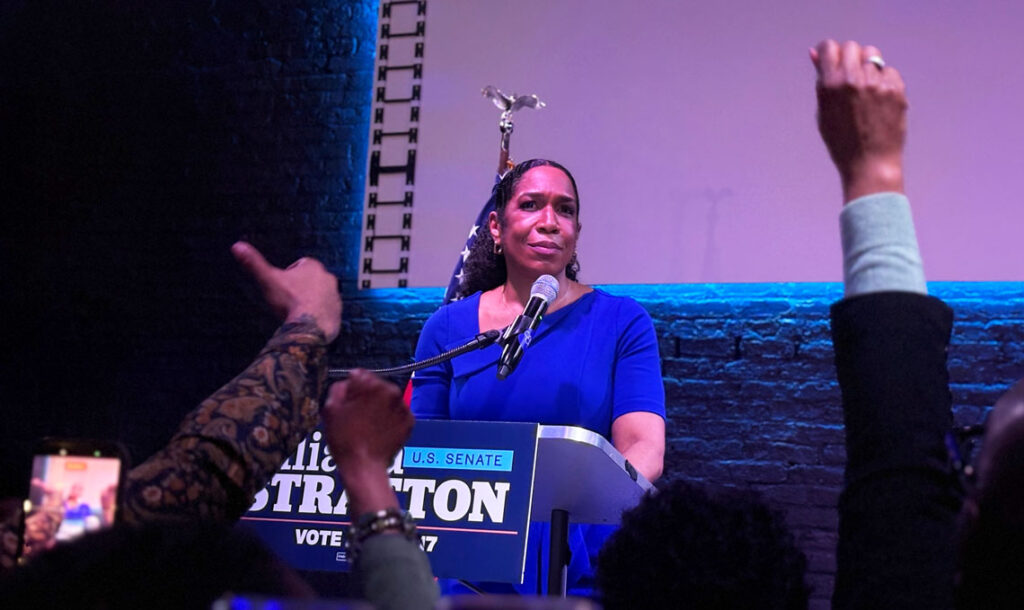
The foundation of Lt. Gov. Juliana Stratton’s larger-than-expected victory in the Democratic primary for Illinois’ open U.S. Senate was laid with a dominant performance in Chicago but padded by a surprisingly strong performance downstate. She also kept up with Rep. Raja Krishnamoorthi in the Chicago suburbs.
Read MorePritzker seeks more regulatory authority over homeowners insurance business

Capitol News Illinois
Article Summary
Gov. JB Pritzker is asking lawmakers to pass legislation this fall to give the state more control over the rising cost of homeowners insurance.
State Farm, based in Bloomington, recently announced it is raising premiums by an average of 27.2%, due mainly to the risk of losses from severe weather.
The Consumer Federation of America describes Illinois’ current regulatory environment as “toothless” and ranks the state second in the nation for having the fastest-rising insurance premiums in the country.
This summary was written by the reporters and editors who worked on this story.
SPRINGFIELD — Gov. JB Pritzker is asking state lawmakers for more authority to regulate the homeowners insurance market in Illinois.
His comments came after the Bloomington-based State Farm Fire and Casualty Company notified the Illinois Department of Insurance that it was raising premiums for residential property casualty insurance in Illinois by an average 27.2%.
In a statement July 10, Pritzker called on lawmakers to pass legislation in the upcoming fall veto session, “that prevents insurance companies from taking advantage of consumers through severe and unnecessary rate hikes like those proposed by State Farm.”
The veto session is scheduled to begin Oct. 14.
“Over the past six years, our state economy has flourished based on transparent markets and fair competition,” Pritzker said. “State Farm’s actions are antithetical to the core principles that the Illinois business community is built on.”
The increase will raise the average cost of a State Farm homeowners’ policy in Illinois to about $2,175 a year, up from $1,700 before the increase, according to State Farm.
The higher rates took effect July 15 for new policies and will go into effect Aug. 15 for renewals of existing policies.
Current regulations
Although Pritzker was not specific about what kind of increased regulatory authority he wants lawmakers to consider, some consumer advocates have called for giving the state Department of Insurance broad authority to review, modify or even reject proposed rate hikes.
Under current state law, companies are required to file their rates with the Department of Insurance, and the agency can review consumer complaints to determine whether the rates being charged are consistent with those filings.
The department also has the authority to conduct examinations to determine whether a company is paying out claims in a timely manner. It can also conduct examinations into a company’s financial condition and solvency.
But currently, according to the agency, Illinois is the only state in the country that does not prohibit rates from being “inadequate, excessive or unfairly discriminatory,” which means it has no authority to reject a rate filing on those grounds.
Douglas Heller, director of insurance for the Washington-based Consumer Federation of America, described Illinois’ law as “among the most toothless in the nation.”
“Almost every state in the country has a law that says for auto, home and most other lines of insurance as well, rates cannot be excessive,” he said in an interview. “Now, it doesn’t mean that the regulators around the country do a great job or even have the tools to enforce that very strictly … but Illinois doesn’t even have the language that prohibits excessive rates for homeowners insurance companies.”
In April, CFA issued a report that said from 2021 to 2024, Illinois ranked second in the nation for having the greatest increases in homeowners insurance premiums. Average premiums in Illinois rose 50% over that period, more than any other state except Utah, where rates went up 59%.
“At a minimum, Illinois should empower the Department of Insurance to reject or modify excessive rate hikes, which would represent a basic consumer protection that residents in almost every other state enjoy,” Abe Scarr, director of the Illinois Public Interest Research Group, said in a statement in response to the report.
Even with those increases, though, the report indicated that rates in Illinois were relatively modest compared to some other states, particularly those that experience more frequent natural disasters. Florida, Louisiana and Oklahoma ranked highest in average premiums.
In recent years, lawmakers have given the Department of Insurance broader authority to regulate premiums in the health insurance market.
Last year, Pritzker signed legislation giving the agency authority to review and reject proposed rate increases in large-group health insurance plans. That law also prohibited companies from engaging in certain “utilization management” practices that steer patients toward cheaper therapies and medications to lower payouts.to lower payouts.
Also last year, Pritzker named a new director of the agency, former state Sen. Ann Gillespie, who had served on the Senate Insurance Committee.
But the agency does not yet have that kind of regulatory authority over property casualty insurance policies for homeowners, renters and condominium owners, a fact that consumer advocates say puts Illinois out of step with the rest of the nation.
Reasons for rate hikes
In his statement, Pritzker accused State Farm of raising rates in Illinois to cover losses the company has suffered in other high-risk states like Florida.
“These increases are predicated on catastrophe loss numbers that are entirely inconsistent with the Illinois Department of Insurance’s own analysis — indicating that State Farm is shifting out-of-state costs onto the homeowners of our state,” he said. “Hard-working Illinoisans should not be paying more to protect beach houses in Florida.”
But State Farm strongly denied that suggestion, saying the increases were directly related to the cost of weather-related disasters in Illinois.
“For example, last year in the state of Illinois alone, we paid out more than $638 million in hail damage claims,” State Farm spokeswoman Gina Morss-Fischer said in an interview. “That was just in Illinois, and it was second only to the state of Texas. And this is the kind of thing that we’ve started to see more frequently.
“And of course, we’re also seeing the increase in replacement costs, longer waits for replacement materials. And these are all things that contribute to the need to make this difficult business decision,” she said.
Capitol News Illinois is a nonprofit, nonpartisan news service that distributes state government coverage to hundreds of news outlets statewide. It is funded primarily by the Illinois Press Foundation and the Robert R. McCormick Foundation.
The post Pritzker seeks more regulatory authority over homeowners insurance business appeared first on Capitol News Illinois.
Illinois’ soil conservation funding stagnates amid recent high-profile dust storms
Capitol News Illinois
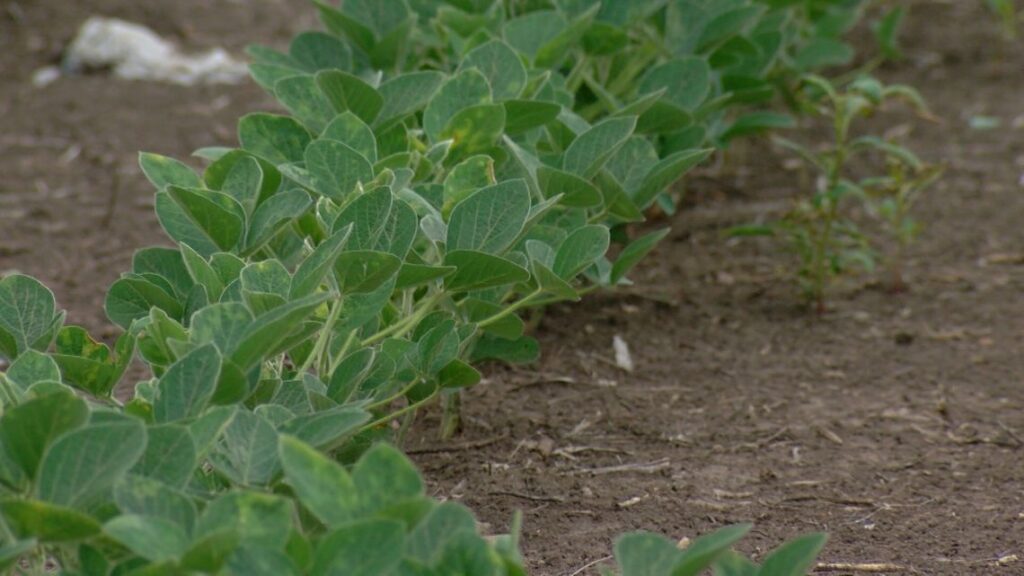
SPRINGFIELD —– Three main factors contribute to the formation of Midwest dust storms: strong winds, dry soil in farm fields and large amounts of loose soil.
That’s according to Andy Taylor, the Science and Operations officer at the National Weather Service’s office in Lincoln. He said these are key ingredients that meteorologists, farmers and experts in the agricultural community have found cause dust storms when they converge.
On May 16, Chicago saw its first major dust storm since the Dust Bowl, which stretched from Texas to New York in the early 1930s and deposited 300 million tons of soil across the nation – 12 million tons of which settled in the Chicago region, according to the Bill of Rights Institute. The storm in May dropped visibility in the city to near zero as wind gusts blew over 60 mph at times, according to the National Weather Service.
Taylor said the atmospheric environment that day was more characteristic of the dry environments in the High Plains or Southwest U.S., not the Midwest. As rain began to fall near Bloomington, it quickly evaporated and cooled the atmosphere, creating strong pockets of wind that began to move North. And as winds sped up, the storm began to pick up and move dry and loose soil from fields it passed over, which created the dust storm.
“The type of dust storm event that we had that affected the Chicago area, I wouldn’t necessarily take that occurrence as saying we’re going to see an increase in those type of events from this point on,” he said. “Although, anytime you see all those ingredients come together, we certainly could see that again.”
Soil conservation funding ‘deprioritized’
While there were no deaths due to the storm in Chicago, a major dust storm that occurred in central Illinois on a portion of I-55 resulted in a multi-car pileup that took the lives of eight people and injured dozens more in May 2023.
That dust storm also dropped visibility to zero on the stretch of the interstate between Farmersville and Divernon, and was again caused by dry, loose soil being picked up and moved by winds.
Although Taylor said dust storms are not new to Illinois – as his office has documented events back to the 80s – most of the storms don’t move across vast expanses of the state. Instead, he said they often occur in more localized areas, like the storm near Divernon in 2023.
“When we’re seeing the right weather-related factors coming together and the ground is fairly dry, which matches up with loose soil so we know we’re going to be more prone to blowing dust, we coordinate with partners in the agricultural community to determine when we might anticipate those blowing dusts events,” Taylor said.
The Association of Illinois Soil and Water Conservation Districts has been lobbying for increased funding for additional district employees. This year’s state budget allows for each district to staff one full-time employee, which AISWCD Executive Director Eliot Clay called “wildly inadequate” as he said each district needs at least two.
“I really, honestly think conservation funding has been deprioritized,” he said.
What do soil and water conservation districts do?
Soil and water conservation districts began to crop up across the U.S. in the late 1930s as a response to the Dust Bowl and Congress’ subsequent declaration of soil and water conservation as a national priority. According to the Association of Illinois Soil and Water Conservation Districts, that declaration prompted then-President Franklin D. Roosevelt to recommend legislation to state lawmakers that would enact districts in every state.
Illinois has 97 districts, or nearly one district for every county in the state. Employees of the districts are responsible for a variety of tasks – including assessing farmland, educating farmers about conservation practices and connecting farmers with grants from the state and federal government. These all play a key role in the association’s mission of protecting Illinois’ natural resources.
“Unlike a group like the Department of Natural Resources or the EPA or even the Department of Agriculture, SWCDs are not a regulatory body,” Clay said. “We are not going out there and enforcing rules and laws on people, we’re just trying to help farmers do better. And that’s the reason why a lot of farmers rely on SWCDs, is because they do not see us as like, the ‘government’ coming in and telling them, ‘this is how you’re going to do your operation.’”
Soil conservation funding stagnates
The fiscal year 2026 budget signed by Gov. JB Pritzker last week allots $7.5 million to the state’s SWCDs – which Clay said is the same amount the association received in the previous fiscal year. However, he said that number was a $1 million cut from the FY24 budget allocation.
Read more: Pritzker signs $55.1B state budget reliant on $700M of new taxes | New taxes on sports bets, nicotine products as Democrats pass $55.2B budget
Of that $7.5 million, $3 million will go to cost-share grants, which act as reimbursements to farmers for the costs of implementing both state and federal conservation policies, such as cover crops. The remaining $4.5 million will go to administrative costs.
Clay said the breakdown of that $4.5 million provides $40,000 to each Soil and Water Conservation district – meaning that every district will have enough funds to pay one full-time employee. He called the salary “wildly inadequate” for the district employees, most of whom have college degrees.
“$40,000 – and that’s supposed to include benefits, so their take-home is less than that – is barely enough, I mean I would say it’s not enough even for one person” Clay said. “And it’s hard to keep people and incentivize people to come to work when there’s not the kind of money there that there should be.”
In addition, Clay said each district needs two full-time employees to be fully-staffed – one to make on-site visits to farms and one to coordinate schedules, receive phone calls and emails, and staff the office.
He said in recent years, the association was told by both the Department of Agriculture and the governor’s office that if they wanted more funding, they would have to advocate for the money to individual lawmakers outside of budget negotiations.
“I don’t know of any other agency or subsect of an agency that has to, on their own, go to the Capitol and get money,” he said. “That’s very peculiar to me and is something I’ve been trying to wrap my head around, and I have not gotten a good explanation from anybody.”
The governor’s office did not respond to a request for comment.
Over the past two years, Clay said the association unsuccessfully lobbied for $10.5 million in annual funding.
“The bigger question I’m left with after being the executive director over the past six months and witnessing it from this angle is, what does the legislature and the administration value?” Clay said. “It really gets to bigger questions about how the state has dealt with conservation funding in general for the last 20-plus years.”
Soil conservation efforts and farming practices
Kevin Brooks, a commercial agriculture educator at the University of Illinois Urbana-Champaign, said the agriculture community has identified practices farmers can use to reduce the amount of dry, loose topsoil in their fields.
“Measuring the humidity level as a cause is not the issue,” Brooks said in an interview with Capitol News Illinois. “I won’t say it’s not 100% not about the weather, but this is primarily about tillage.”
One suggestion he made was for farmers to till their fields less frequently and instead resort to strip-tilling or using no-till strategies whenever possible to reduce the amount of loose topsoil in fields.
Strip-till is a tilling practice where only narrow rows of a field where seeds will be planted are tilled, leaving the rest of the field untouched. While there are many short- and long-term benefits to strip-tilling, no-till practices often don’t seem to benefit farmers right away but do often have long-term advantages, Brooks said.
Rep. Charles Meier, R-Okawville, farms 1,500 acres in southern Illinois with his family, including corn, wheat, beans, hay, and beef cattle. He said most crops are already minimally tilled by farmers.
State Rep. Charlie Meier, R-Okawville, shows clover growing in a field on his Washington County farm in 2022. In 2009, Meier was awarded the State of Illinois Conservation Farm Family of the Year. (Capitol News Illinois file photo by Beth Hundsdorfer)
“I’m 66 years old and we never no-tilled when I was a kid,” he told Capitol News Illinois. “All of our conventional soybeans are no-tilled now, all of our wheat is done by minimal-till, and our corn is all by minimal-till now.”
He said he’s in frequent contact with his SWCD, including a call on Monday with his district’s employee, and criticized Democratic leadership’s funding priorities, such as subsidies for renewable energy.
“They’re not funding the nuts and bolts of Illinois conservation,” Meier said. “I’m not against wind and solar but they don’t pay for themselves and they’re making us taxpayers pay for them.”
Another main practice Brooks recommended farmers employ was planting cover crops, which are crops planted after harvest not for their produce, but for their benefits to the soil. Cover crops can be planted after a fall harvest for a variety of benefits, including to preserve topsoil through the winter, increase organic matter in the soil and dry the field earlier in the spring.
Brooks also attributed recent dust storms to the invention of high-speed discs – a tillage attachment with many more disks than normal tillage attachments, which tills at faster rates. He said these disks have taken tillage speeds from around 4 mph to over 10, and that farmers in Illinois quickly amassed these machines during and after the COVID-19 pandemic, due to the pandemic relief funds they received.
“In theory, they’re supposed to be a kind of conservation because they don’t go into the ground very deep,” Brooks said. “But they literally turn the top several inches of a farm field into powder.”
Dust storm driving tips
Andy Taylor, from the National Weather Service, recommended safety tips for drivers who find themselves caught in a dust storm.
“If you’re caught in dust with extremely low visibility, the advice is to pull completely off the road, turn off your heads and take your foot off the brake,” he said. “Which may sound kind of counterintuitive in a way, but the reason for doing that is because if you have your lights on, people coming into the dust may think you’re moving. They may see your taillights and think ‘Oh look, someone I can follow’ and that may exacerbate accidents and pileups.”
He also advised drivers who know there is risk of a potential dust storm to travel ahead of the storm or to delay travel until later in the day, if possible.
Capitol News Illinois is a nonprofit, nonpartisan news service that distributes state government coverage to hundreds of news outlets statewide. It is funded primarily by the Illinois Press Foundation and the Robert R. McCormick Foundation.
The post Illinois’ soil conservation funding stagnates amid recent high-profile dust storms appeared first on Capitol News Illinois.
Challenges persist for women, minorities breaking into Illinois’ skilled trades
Capitol News Illinois
PEORIA — For 60 years, SkillsUSA Illinois has held workforce development competitions for young people entering the trades. For 60 years, there has never been an all-female team competing in the architecture and construction team competition.
Until now, that is.
This April, students competed at the Peoria Civic Center in a bid to showcase their trades work skills, from barbering and cosmetics to house building and fixing cars. First-place winners in the Illinois competition earned eligibility to travel to Atlanta to compete in the national SkillsUSA Championships this week.
Amid the fanfare and cheer, however, the state competition highlighted some of the persistent challenges facing the Illinois workforce. As employers continue searching for skilled tradespeople to combat national worker shortages, entry into fields like construction remains strikingly low for women and people of color, particularly in higher paying and leadership positions.
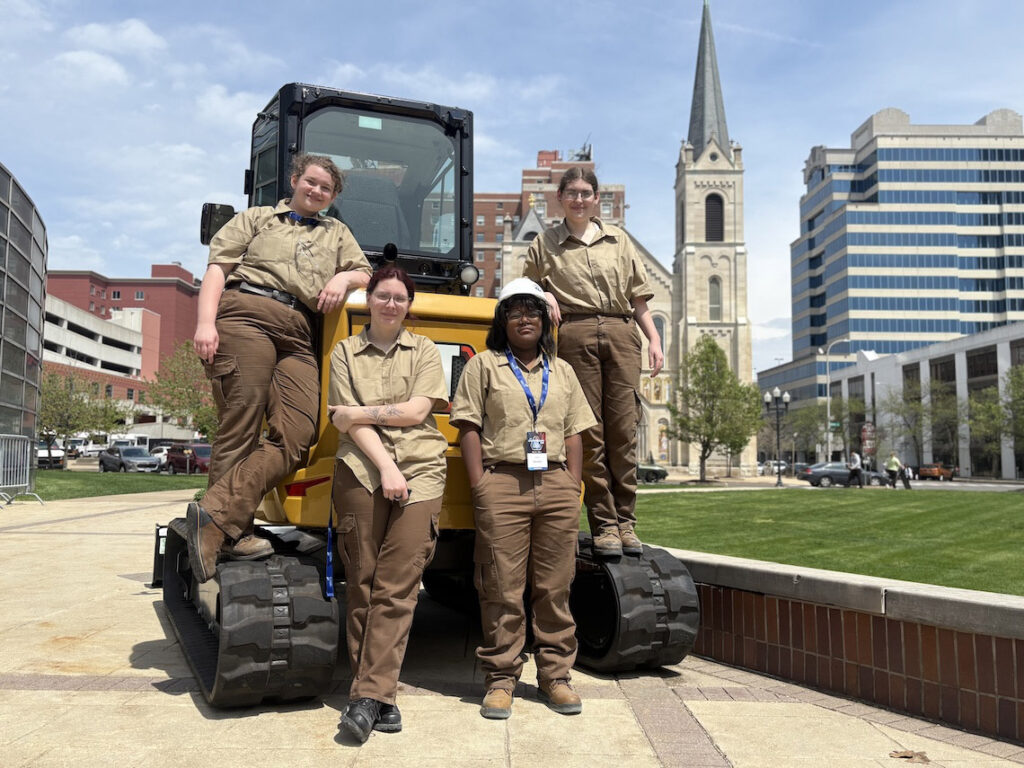
SkillsUSA Illinois’ first all-girls team — Aubrey Levin, Kayhl Miles, Catelin Wesley and team captain Amyla Walls — did not know they were breaking boundaries until after they had finished their competition this spring in Peoria.
The team from the Bloomington Area Career Center reacted to the news with shocked laughter, followed by near immediate dread as they anticipated the heightened expectations and scrutiny of their work this title would bring.
“They’re going to be like, ‘You’re the first all-female team,’ and I’m going to be like, ‘Please don’t look at my electrical,’” Levin said, half laughing.
Although it may seem late for the existence of the first all-female team, it is consistent with the construction industry demographic trends in Illinois. Over the past 10 years, women have held fewer than one in 10 construction jobs. Prior to 2021, fewer than 5% of new construction apprentices in Illinois were women, according to data from the U.S. Department of Labor.
View Chart in New Tab
The problem is a national one. Although 2020 saw the largest number of women working in trades, only one in 20 U.S. construction workers was a woman, according to a report from the Institute for Women’s Policy Research.
Male construction workers were also better compensated than female construction workers in 2024, even for entry-level apprenticeship positions. New male apprentices earned an average wage of $23.76 per hour, 36 cents more than the average pay for their female counterparts.
The discrepancy grew for those who completed their apprenticeships, with an average hourly gender pay gap of $1.41.
Participation rates for workers of color also remained low, with white apprentices accounting for over three quarters of new registered apprenticeships in 2024.
View Chart in New Tab
Apprentices of color earn less on average than white apprentices, both at entry and completion. In 2024, newly registered Black apprentices earned on average 36 cents less in hourly wages than their white counterparts. For those who completed apprenticeships, the gap grew to almost $4 per hour.
As limited as the progress is, much of it has come in the last few years, according to Jayne Vellinga, executive director of the non-profit Chicago Women in Trades.
Vellinga attributes the momentum to “a perfect storm” of an expected construction boom and worker shortage, infrastructure investment and federal leadership on diversity initiatives.
“It did get people to think sort of outside the box in terms of how they were going to recruit a sufficient workforce to meet a large number of projects projected to come to the area and the retirement of experienced workers,” Vellinga said.
Since 2021, the state has invested heavily in the Illinois Works pre-apprenticeship program, which seeks to create a “qualified talent pipeline of diverse candidates in the construction and building trades.” Gov. JB Pritzker’s office announced an additional $19 million funding allocation to the program in April.
However, Vellinga said she is seeing a rollback in progress, pointing to President Donald Trump’s decision to rescind an executive order that had been in place since enacted by President Lyndon B. Johnson in 1965, which prohibited federal contractors from engaging in employment discrimination on the basis of race, color, religion, sex, sexual orientation, gender identity or national origin.
“I don’t know how it’s going to impact opportunities for women, but there is definitely a change in narrative also at the federal level, from ‘we need diversity on publicly funded projects’ to ‘don’t engage in diversity, equity and inclusion activities,’” Vellinga said.
In addition to outright hiring discrimination, Vellinga said many women’s careers are limited by gender stereotypes and harassment on job sites.
“Some women are doing well and are having an opportunity to move up, and other women do face discrimination, are unable to cobble together enough work during the year to make it a viable career, or perhaps the works site is so hostile that they walk away from it,” Vellinga said.
The hostility is something that the team of high schoolers was already familiar with.
House built by the all-girls team during the SkillsUSA Illinois Championships in April. (Medill Illinois News Bureau photo by Maggie Dougherty)
As SkillsUSA Illinois’ first all-girls team spent two days using their carpentry, roofing, electrical and plumbing skills to build a small house, they were subjected to disparaging, gender-based comments, which the team diplomatically referred to as “construction language.”
It is not something unique to this competition, they said. Levin recalled asking women in the construction unions about their advice on entering tradework. They told her she would need to have thick skin.
“Even now?” Levin asked. Especially now, they replied.
The team described their male peers making jokes with double meanings, and then getting irritated if the girls did not laugh.
“You’re like a bad person for not laughing at a really bad joke,” Miles said.
One such joke came at Levin’s expense, while she was standing on a ladder and trying not to cry from pain after being hit in the back by something on site. A team nearby pointed and laughed at her, she said. A teacher walked by and told Levin to let it out if she needed to.
“Not here,” Levin said. “You can’t cry, because then you’re soft.”
On the other hand, if they got mad, Levin said, a male peer would inevitably ask, “What, are you on your period or something?”
The girls said they are held to a higher standard, as any sign of emotion will be used to prove that they are incapable of matching their male peers. If they stop for a second, they will be called lazy or asked whether they broke a nail, the team said. The job requires a strong poker face, Miles added.
And, Walls said, their judgment is constantly called into question. She recounted a male peer repeatedly correcting her and speaking to her like a child, before eventually concluding she was correct all along.
A national survey of women exiting the trades found that the most common reason women left the trades was due to harassment and lack of respect; nearly half of those who left or had strong intentions to leave marked this as their reason for doing so. Over a quarter of women in the study also indicated that they frequently or always saw sexually explicit and racist graffiti; a fifth responded the same for anti-semitic graffiti.
The second most common reason for exiting, selected by over 40% of those with strong intentions to leave, was a lack of prospects for promotion and advancement. The least selected option was that the work was too physically demanding.
Manny Rodriguez looks down the street in front of Revolution Workshop. (Medill Illinois News Bureau photo by Maggie Dougherty)
The perception that women are less competent exacerbates other structural barriers to employment, according to Manny Rodriguez, executive director of the Chicago-based nonprofit Revolution Workshop, which offers workforce development programs targeted at communities of color who have been underrepresented in the trades.
Construction is a tough business for anyone, Rodriguez said. A recent paper by the RAND Corporation found that almost 40% of apprentices drop out of their programs before completion, regardless of race or gender, with almost half of those dropping out in the first six months.
Part of the issue is stability of work, such as making it through the cold season when opportunities for new construction projects dip, according to Rodriguez.
“In the wintertime, you can’t pour concrete. You can’t weld. If the structure is not already up, you pretty much got to wait until spring,” Rodriguez said.
Employer biases mean that women and people of color may be hired for jobs, but not retained for the next one, resulting in more instability for those workers, Rodriguez said. As a result, apprenticeship completion rates for women and people of color are even lower.
In 2023, women accounted for 4.5% of U.S. construction apprentices, but 6% of cancellations, according to U.S. Department of Labor data. A study by The Institute for Construction Employment Research found that over the last two decades, around two-thirds of Black construction apprentices did not complete their programs.
Hispanic workers have maintained a high share of workforce participation in the construction industry, but often in lower paying, physically intensive roles, resulting in higher rates of both fatal and nonfatal injuries on the job.
“Latinos are represented in construction, but where?” Rodriquez asked. “I’m not the electrician, I’m not the plumber, I’m not the heavy equipment operator, I’m not the pipe fitter. So you got no problem breaking my brown body, but you’re not letting me do the other things.”
Many women and people of color who do make it in construction attribute their success, at least in part, to having others who look like them in the field.
A competitor focuses during the SkillsUSA Illinois TeamWorks competition. (Photo courtesy SkillsUSA Illinois)
In the survey of tradeswomen, almost two thirds of respondents identified mentorship from senior tradeswomen as important to their recruitment and advancement. It was something the all-girls team said was valuable as well.
“If we passed a construction site, and they were working, I always got excited when I saw a girl,” said Miles. “I was happy about it, because I’m like, I’m not the only one who actually enjoys this.” Other members of the team agreed.
But Walls, the only Black member of the team, sees fewer women in construction who look like her.
“I don’t see a lot of women, let alone,Black women, doing construction,” Walls said. “I wish I had someone to relate to.”
That is part of the reason why breaking this barrier was important, for the girls on the team and for those who will come after them.
“It doesn’t matter if we win,” Wesley said. “The fact that we have taken a step like this for us, but also for other females in the trades, it’s a huge deal.”
Maggie Dougherty is a graduate student in journalism with Northwestern University’s Medill School of Journalism, Media, Integrated Marketing Communications, and a fellow in its Medill Illinois News Bureau working in partnership with Capitol News Illinois.
Capitol News Illinois is a nonprofit, nonpartisan news service that distributes state government coverage to hundreds of news outlets statewide. It is funded primarily by the Illinois Press Foundation and the Robert R. McCormick Foundation.
The post Challenges persist for women, minorities breaking into Illinois’ skilled trades appeared first on Capitol News Illinois.