Posts Tagged ‘Bills passed 2025’
Pritzker signs bills addressing gun storage, tracing of firearms

Under new laws signed by Gov. JB Pritzker, firearm owners will soon be required to keep their weapons stored securely and out of the hands of minors while law enforcement agencies will be required to trace the ownership of all firearms they recover from crime scenes. (Capitol News Illinois photo by Andrew Campbell)
Illinois adopts tougher gun laws while courts grow increasingly skeptical.
The post Pritzker signs bills addressing gun storage, tracing of firearms appeared first on Capitol News Illinois
Following state rep’s encounter, Pritzker signs ‘squatter bill’ into law
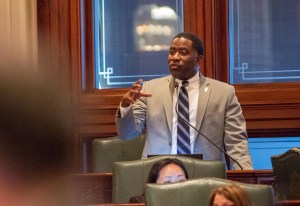
Gov. JB Pritzker signs bill cracking down on squatters after people illegally move in next to state representative.
The post Following state rep’s encounter, Pritzker signs ‘squatter bill’ into law appeared first on Capitol News Illinois
Pritzker signs health care legislation
Capitol News Illinois
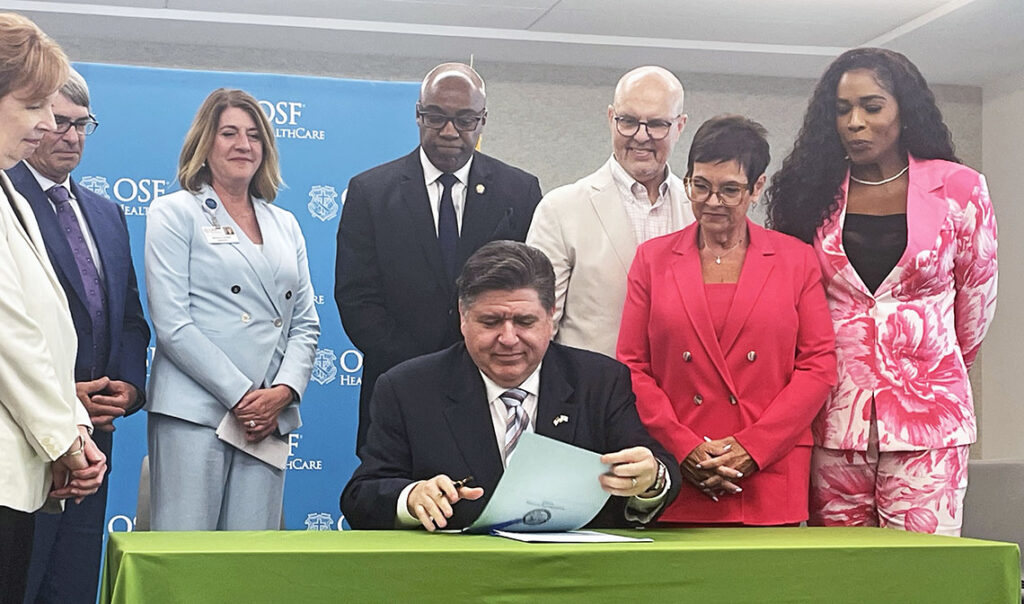
Gov. JB Pritzker signed a pair of health care-related bills Tuesday that he said would put more controls on the pricing of pharmaceutical drugs sold through insurance plans while expanding insurance coverage for certain kinds of hospital costs.
“For too long our health care system has been infected by profit-seeking middlemen and predatory actors looking to make an extra dime at the expense of Illinois patients,” Pritzker said at a bill signing ceremony in Peoria. “Seniors have been forced to pay through the nose for life-saving medications. Families have had to delay or decline medically necessary treatments because they can’t afford it anymore. And family businesses like independent pharmacies have had to shut their doors.”
House Bill 1697, known as the Prescription Drug Affordability Act, will impose new restrictions on practices of pharmacy benefit managers, or PBMs, a powerful but little-understood segment of the pharmaceutical industry.
PBMs are companies that act as a kind of middleman between health insurance plans and pharmaceutical companies by negotiating drug prices and designing drug formularies that are intended to steer patients toward lower-cost medications.
But they have come under intense criticism in recent years for steering patients toward their own affiliated retail chain pharmacies, often to the detriment of smaller independent pharmacies, and for operating pricing systems that are designed to maximize profits for the PBMs rather than producing savings for patients.
Under the legislation, PBMs will be prohibited from steering consumers toward large pharmacies in which they have a financial interest. They will also be prohibited from engaging in “spread pricing” – the practice of charging health plans a higher price for a drug than the PBM pays a pharmacy for dispensing the drug.
The bill also establishes a grant program that will distribute $25 million a year in financial support for independent pharmacies, funded through a tax levied on PBMs operating in Illinois.
David Bagot, an independent pharmacist from Petersburg who is also president of the Illinois Pharmacists Association, called the bill “landmark legislation” that he predicted would be studied and replicated in other states.
“This bill represents the most comprehensive reform of pharmacy benefit managers we have seen in Illinois,” he said. “For far too long, these companies have used our nation’s drug supply chain to benefit shareholders and executives while driving up costs for people who rely on medications and driving pharmacies out of business.”
But the Pharmaceutical Care Management Association, the lobbying organization that represents PBMs, called the bill “misguided legislation” and predicted it would have little or no impact on the prices consumers pay for medications.
“Unfortunately, the legislation does nothing to address the fact that Big Pharma sets the price of the prescription drugs – and the price is the problem when it comes to some Illinoisans facing difficulty affording their prescription drugs,” the group said in a statement. “Lawmakers have passed 20 bills regulating and restricting PBMs since 2016, none of which have led to lower drug prices.”
Insurance coverage expansion
Pritzker also signed House Bill 3019, known as the Healthcare Protection Expansion Act.
Among other things, it prohibits state-regulated health plans from requiring prior authorization for outpatient mental health services. Last year, lawmakers imposed a similar prohibition for inpatient and emergency mental health services.
It also requires insurance plans to cover a patient’s travel-related expenses whenever they have to travel long distances to receive in-network care, a problem often faced by patients who live in rural areas of the state.
“Building on protections that make mental health care accessible for all Illinois residents, this law gives people more opportunities and flexibility to receive necessary services,” state Sen. Laura Fine, D-Glenview, a lead sponsor of the bill, said in a statement.
Capitol News Illinois is a nonprofit, nonpartisan news service that distributes state government coverage to hundreds of news outlets statewide. It is funded primarily by the Illinois Press Foundation and the Robert R. McCormick Foundation.
The post Pritzker signs health care legislation appeared first on Capitol News Illinois.
Illinois to roll out direct admissions program for most state universities
Capitol News Illinois
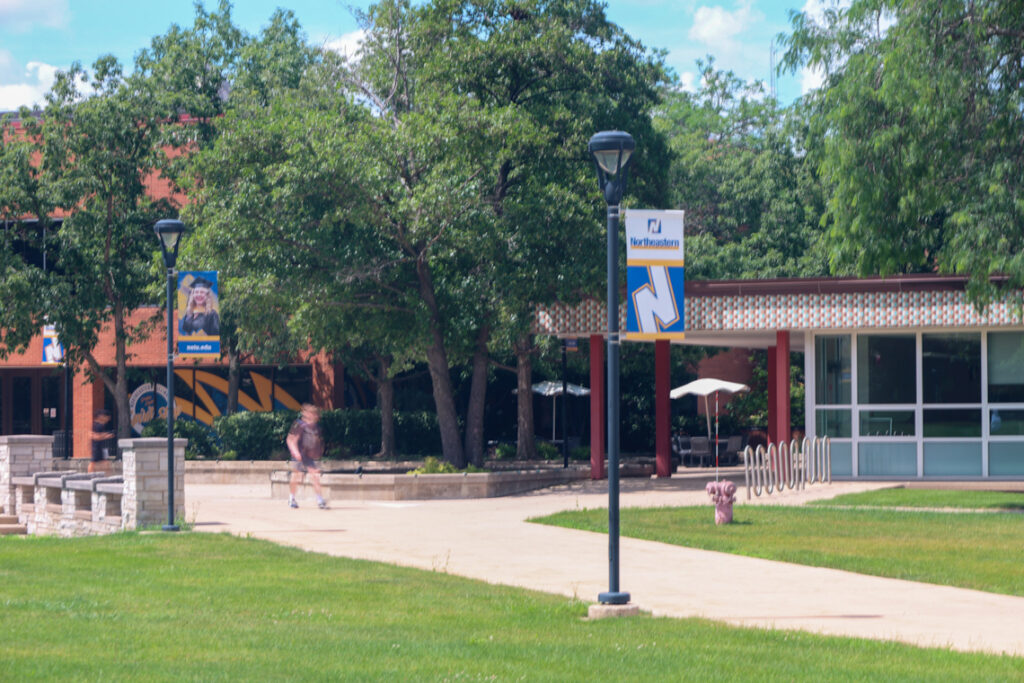
Editor’s note: This story was updated to refer to the correct building on the campus of Northeastern Illinois University in the featured photo caption.
CHICAGO — Illinois students won’t need to fill out applications for most state universities to be admitted — if they have high enough grades.
With his signature, Gov. JB Pritzker on Monday approved a bill creating the direct admissions program. Along with it, he approved bills that implement new state standards for programs offering college credits to high school students, and new requirements for financial aid application assistance.
“These bills streamline the application process for college-bound seniors in Illinois, enhance support for applicants, and open up new horizons for prospective students,” Pritzker said in a statement. “Enacting these laws is what all government work should be about — making life easier for our people.”
Pritzker had said college admissions and higher education accessibility would be a priority of his during this year’s legislative season, which ended May 31. But one of his signature initiatives — allowing community colleges to offer four-year degrees — failed earlier this year.
Direct college admissions
Illinois will implement a direct admissions program so that students hoping to go to a state school will be automatically admitted — if they have a high enough grade point average.
“For eligible seniors and community college transfer students, you will receive offers from the schools that you are admitted to without raising a finger. That’s huge,” Sen. Christopher Belt, D-Swansea, said. “It takes away the anxiety, it takes away the angst of that whole process.”
The bill outlining the direct admissions program, House Bill 3522, passed unanimously in the Senate and with broad bipartisan support in the House in late May.
Read more: House approves new abortion protection, plan to ease college admissions | Senate Democrats champion program to streamline Illinois college applications
The program will begin in the 2027-28 school year, with nine of the state’s 11 public universities participating:
University of Illinois Springfield
Southern Illinois University
Chicago State University
Eastern Illinois University
Governors State University
Illinois State University
Northeastern Illinois University
Northern Illinois University
Western Illinois University
High school students and community college students hoping to transfer to a state school must opt-in to the program to receive offers. Community colleges already admit all students interested in attending but will still participate in the direct admissions program.
The University of Illinois Urbana-Champaign and University of Illinois Chicago will not participate in the direct admission program. The state will, however, provide information about traditional applications to qualifying students through an “access and outreach campaign.”
The criteria for the direct admissions program and outreach campaign will be set by individual schools.
“This new, statewide direct admissions program will make a college degree more accessible for students and will motivate them to continue in their life-changing college journey by ensuring them a spot at their community college or at one of the state’s public universities,” Illinois Board of Higher Education Executive Director Ginger Ostro said in a Monday statement.
Financial aid application assistance
Two more bills signed by Pritzker on Monday, House Bills 3096 and 3097, aim to make it easier for students to navigate the financial aid process.
HB 3096 requires high schools in Illinois to designate at least one staff member as a point-of-contact for information about the Free Application for Federal Student Aid, or FAFSA. HB 3097 requires high schools to offer students time during the school day to fill out FAFSA forms and to receive assistance in doing so.
The new requirements go into effect in the 2025-26 school year.
Information collected through FAFSA is used to determine eligibility for federal loans. Many schools use FAFSA for their own aid programs, and the state offers need-based grants based on information submitted through FAFSA.
“As a father of college students, I just currently went through this fun exercise with my daughter filling out a FAFSA form,” Sen. Javier Cervantes, D-Chicago, said. “I’m being a little sarcastic calling it fun because we had deadlines, we had to make sure we had our documentation together and it wasn’t easy.”
From the 2010 to 2020 school years, an average of 86% of first-time students at four-year schools and 78% of first-time students at two-year schools received federal financial aid, according to data from the U.S. Department of Education.
The Illinois Community College Board offices sits blocks away from the state Capitol. Under a new law, the ICCB and other state agencies are tasked with improving dual credit programs in the state. (Capitol News Illinois photo by Andrew Adams)
Dual credit program
House Bill 2967, another bill approved by Pritzker on Monday, outlines new requirements for high schools and community colleges offering “dual credit” programs, through which students earn high school and college credit for completing a single course.
It requires teachers teaching dual credit classes to have a master’s degree in the subject they’re teaching or a master’s degree and some graduate coursework in the subject. It also requires high schools and community colleges to designate individuals responsible for negotiating what individual dual credit agreements look like.
“HB 2967 reinforces the vital role that strong, robust partnerships between community colleges and high schools play in delivering high quality dual credit programs,” Illinois Community College Board Executive Director Brian Durham said in a statement. “These programs help students get a head start on their college education and a path towards career success.”
The bill also requires schools to consider in-state colleges and universities when setting up dual credit programs over out-of-state institutions.
The bill also creates a committee made up of education officials, representatives from two different statewide teachers’ unions and others to work on improving dual credit programs’ accessibility and quality, as updating a template used by school districts to develop dual credit agreements with community colleges.
Four-year degrees at community college
One key proposal didn’t make the cut this spring — a measure allowing community colleges to offer bachelor’s degrees. Despite being backed by Pritzker in his State of the State address earlier this year, it faced pushback in the General Assembly, which did not pass a bill implementing the policy.
Read more: Pritzker’s community college initiative stalls in House committee
That proposal drew concerns from some lawmakers who worried it could undercut programs to attract local students to state universities. In particular, some lawmakers worried that it could hurt schools like Northeastern Illinois University and Chicago State University, which serve largely minority student populations.
But Pritzker on Monday said he would continue working on a proposal to allow more schools to offer bachelor’s degrees in “very specific, niche areas” like nursing and advanced manufacturing.
“You sometimes have to work two, four, six years, maybe longer to get something done,” Pritzker said.
Capitol News Illinois is a nonprofit, nonpartisan news service that distributes state government coverage to hundreds of news outlets statewide. It is funded primarily by the Illinois Press Foundation and the Robert R. McCormick Foundation.
The post Illinois to roll out direct admissions program for most state universities appeared first on Capitol News Illinois.