Posts by Newspaper Staff
Nesbitt: Time to open federal investigation into Whitmer grant scandal
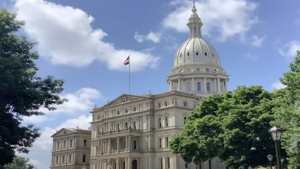
Investigations continue after a Gov. Gretchen Whitmer political appointee and donor was set to recieve $20 million of taxpayer funding for her Oakland County-based nonprofit.
Senate Republican Leader Aric Nesbitt, R-Lawton, is calling for a federal investigation into the matter, sending a letter to U.S. Inspector General Michael E. Horowitz.
“I am writing to request a review by the Office of the Inspector General into the actions of Gov. Gretchen Whitmer, Fay Beydoun and the Michigan Economic Development Corp. regarding a $20 million grant awarded to Beydoun’s nonprofit, Global Link International,” Nesbitt said.
He added that he issued the request due to “serious allegations of misuse of public funds, conflicts of interest and potential national security risks.”
Beydoun has been a long-time political supporter of Whitmer and was serving on the MEDC executive board in 2022 at the time the grant was awarded. She filed paperwork to incorporate Global Link International just days before securing the grant.
The scandal around the grant has been growing for years, with Whitmer consistently stating that there was no favoritism at play. The Center Square first reported on the grant to Global Link International in 2023.
Its funding was meant to help attract international businesses to Michigan, but was canceled in March following allegations of misuse, including a reported $550,000 salary for Beydoun and questionable expenditures such as a $4,500 coffee maker.
According to Nesbitt’s letter, email records show that Beydoun coordinated directly with Whitmer’s office to obtain the grant, including that the “governor personally intervened to ensure its approval.”
Though the governor denies this, it has caused outrage from many.
“Since day one, Gov. Whitmer has denied culpability on this grant, but we now have indisputable confirmation that Whitmer herself was the ultimate architect,” said Zach Rudat, spokesperson for Michigan Forward Network, a nonprofit political organization. “Whitmer wasted millions of taxpayer dollars to line the pockets of a campaign donor and lied to the public about this pay-to-play scheme for years. This new revelation underscores just how corrupt Lansing has become on Whitmer’s watch and the necessity for a top-to-bottom change in the MEDC and governor’s office.”
Michigan Attorney General Dana Nessel has been conducting an investigation into the matter, raiding the MEDC Lansing office June 18 to seize relevant documents.
MEDC’s attorneys filed a lawsuit to seek the return of those documents, arguing they are confidential under attorney-client privilege. A judge subsequently ruled against that lawsuit and MEDC had until today to appeal that decision.
Nesbitt argues a federal investigation is also needed though.
“While Michigan Attorney General Dana Nessel is conducting a state-level investigation into the grant’s misuse, the potential national security implications and the involvement of foreign officials elevate this matter to a federal concern,” his letter stated. “I respectfully urge your office to initiate an inquiry to ensure transparency and safeguard the public interest.”
This is not the only controversy with MEDC grants, with Nesbitt calling for a total overhaul of the system.
“MEDC is Michigan’s USAID,” Nesbitt posted on social media. “It’s time to DOGE it and END the non stop waste, fraud, and abuse.”
Report: Texas leads U.S. in flood deaths, led by Flash Flood Alley
The July 4 Texas Hill Country flash flooding event is the latest to hit the region known as “Flash Flood Alley,” as Texas continues to lead the U.S. in flood-related deaths.
The greatest number of flood deaths in the U.S. have occurred in Texas, according to an analysis conducted by researchers at the University of Texas-San Antonio’s Department of Civil and Environmental Engineering. The analysis evaluated data from 1959 to 2019 in the 48 contiguous states and District of Columbia.
“The last two decades witnessed major flood events, changing the ranking of the top states compared to previous studies, with the exception of Texas, which had significantly higher flood-related fatalities than any other state,” the analysis states.
The 2021 study calculated flood fatalities investigated at the state, National Weather Service Weather Forecast Office (NWS WFO) region, and county levels. Texas reported the most, 1,069, during the 61-year period, followed by Louisiana (693) and California (340).
“Texas is the only state that reported flood fatalities consistently in every year from 1959 to 2019, except for the year 2011 in which the state witnessed a historic drought,” the report states. “All previous studies show Texas as the leading state in flood fatalities but the other leading states were ranked differently in the studies.”
Of the three main types of floods (flash floods, river floods and coastal floods), the majority of fatalities nationwide were caused by flash floods, the report notes.
Over the period analyzed, the New Orleans/Baton Rouge NWS WFO reported the greatest number of fatalities, 861, followed by Texas’ Flash Flood Alley. The Austin/San Antonio NWS WFO and Fort Worth/Dallas NWS WFO reported 381 and 263 fatalities, respectively.
The Flash Flood Alley region includes 27 counties and the cities of Dallas, Austin, and San Antonio. Counties are clustered on the edge of the Balcones Escarpment, which encounters warm and humid air from the south, from the Gulf of America, and cold air from the north, which “occurs right above the escarpment curve causing heavy rains and floods. At the same time, tropical storms from the Gulf are another contributor to heavy rains and floods in the Alley,” the report notes.
Of more the 23,218 counties evaluated, 64 reported the most flood fatalities, 2,572, accounting for 39% of nationwide flood fatalities, the report found. Orleans Parish of Louisiana, devastated by Hurricane Katrina, reported the most of 654.
Four other counties reporting more than 100 flood fatalities included South Dakota’s Pennington County (237), Louisiana’s St. Bernard Parish (154), Colorado’s Larimer County (143) and Texas’ Harris County (101). Three counties reported more than 50 flood deaths, all in Texas’s Flash Flood Alley: Bexar (75), Dallas (69), and Travis (60).
The report also notes that in general, “males are much more likely to be killed in floods than females,” representing 62% of total flood fatalities with known gender information. This is primarily because men are more likely to drive through flood waters, more likely to work as emergency response personnel “and more likely to exhibit other risk-taking behaviors,” the report adds.
“The large percentage of flood fatalities in the age group of under 29 and above 50 may indicate that the elderly are less able to escape from floodwater and young people are more likely to take risks,” it states, noting that children and the elderly are most vulnerable.
The analysis also cites another study that found that “flash floods contributed to the most flood fatalities, identifying 1,185 fatalities caused by 32 flash flood events from 1977 to 1981.” Among them, 42% of reported drowning deaths were vehicle related.
“Purposely driving or walking into floodwaters accounts for more than 86% of total flood fatalities,” the report adds, stating, “the vast majority of flood fatalities are preventable.”
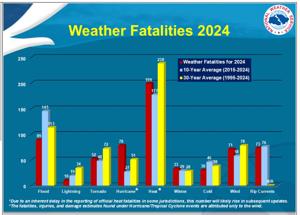
According to NWS data, when analyzing a 10-year average between 2009 and 2018 and 30-year average between 1989–2018, floods caused the second-highest number of weather-related deaths in the US; heat waves ranked first.
Every year, there’s an average of 10,000 thunderstorms, 5,000 floods, 1,300 tornadoes and two Atlantic hurricanes that occur in the U.S., in addition to widespread droughts and wildfires, NOAA explains. Weather, water and climate events cause an average of 650 deaths and $15 billion in damage every year and are responsible for roughly 90% of all presidentially declared disasters, NOAA says. Roughly one-third of the U.S. economy, about $3 trillion, “is sensitive to weather and climate,” it says.
Roughly one in six Texans, or more than five million people, live or work in known flood hazard areas, according to Texas’ first State Flood Plan released last year, The Center Square reported.
Protester appears to fire at ICE agents during Camarillo raid
Federal agents are looking for the man who appeared to pull a gun on U.S. Immigration and Customs Enforcement agents during a raid at a marijuana farm north of Los Angeles, where agents and several hundred protesters clashed.
Dozens of farmworkers were detained.
“FBI has issued a $50,000 award for information leading to the conviction of an Unknown Subject who appeared to fire a pistol at Federal Law Enforcement Officers near Camarillo,” U.S. Attorney Bill Essayli posted on X, with a clip of an ABC7 video of a protester with a gun. Essayli asked anyone with information to call 1-800-CALL-FBI (1-800-225-5324).
The ICE raid was conducted Thursday at Glass House Farms, which is licensed to grow marijuana in Ventura County.
“Federal agents are executing a search warrant at this marijuana farm,” Essayli wrote in another post on X. “Agents have already arrested multiple individuals for impeding this operation and will continue to make arrests. Don’t interfere. You will be arrested and charged with a federal offense.”
Border patrol agents stood in a line to block protesters, according to media reports. Protesters and children were seen in TV stations’ videos running as ICE agents threw canisters of tear gas.
“Kids running from tear gas, crying on the phone because their mother was just taken from the fields,” California Gov. Gavin Newsom posted on X. “Trump calls me ‘Newscum’ — but he’s the real scum.”
But U.S. Customs and Border Patrol Commissioner Rodney Scott had a different take.
“Here’s some breaking news: 10 juveniles were found at this marijuana facility – all illegal aliens, 8 of them unaccompanied,” Scott posted on X. “It’s now under investigation for child labor violations.”
The U.S. Department of Homeland Security also responded to Newsom’s post with this note on X: “Why are there children working at a marijuana facility, Gavin?”
The Center Square reached out Friday to Glass House Farms, but did not get an immediate response.
Another ICE raid took place Thursday farther north at the Glass House Farms site in Carpinteria in Santa Barbara County, according to media reports.
Feds seek nearly 6 years in prison for Madigan confidant Mike McClain

Capitol News Illinois
Article Summary
Longtime Springfield lobbyist Mike McClain, who spent decades as a close friend and advisor to former Illinois House Speaker Michael Madigan, is scheduled for sentencing later this month as part of separate hearings for the “ComEd Four” beginning next week.
McClain and his co-defendants were convicted in 2023 for their roles in bribing Madigan with jobs and contracts for his political allies at electric utility Commonwealth Edison while the company was pushing for legislation in Springfield.
Federal prosecutors are asking a judge to sentence McClain to 70 months in prison, while the ex-lobbyist is asking for probation.
This summary was written by the reporters and editors who worked on this story.
CHICAGO — Federal prosecutors are recommending nearly six years in prison for ex-Springfield lobbyist Mike McClain, the longtime friend and advisor of former Illinois House Speaker Michael Madigan.
McClain was the marquee defendant in the 2023 “ComEd Four” trial, which ended in across-the-board bribery convictions for former lobbyists and executives of electric utility Commonwealth Edison. The four were found guilty orchestrating a yearslong bribery scheme targeted at Madigan, in which the powerful speaker’s allies got jobs and contracts at ComEd while the utility pushed for favorable legislation in Springfield.
Read more: ‘ComEd Four’ found guilty on all counts in bribery trial tied to ex-Speaker Madigan
For more than two years, McClain and his co-defendants have been awaiting sentencing, delayed by concerns of possible impact from a U.S. Supreme Court ruling, the death of the judge who oversaw the ComEd Four case, and Madigan’s own lengthy trial, in which McClain was also a defendant.
But after a jury in February delivered a split verdict in Madigan’s case, including deadlocking on all six corruption counts McClain was also charged with, sentencing hearings for the ComEd Four were scheduled for July. And on Thursday, prosecutors asked a federal judge to give McClain 70 months — nearly six years — in prison.
Read more: Madigan guilty of bribery as split verdict punctuates ex-speaker’s fall
“McClain’s plan was illegal to its core,” prosecutors wrote in their 48-page sentencing memo Thursday. “In securing benefits for both Madigan and ComEd, McClain corrupted the legislative process and the internal control processes of a large, regulated utility.”
The feds also pointed to “McClain’s repeated overstepping of legal lines,” which they characterized as “stunning” and “egregious” — especially when it came to the $1.3 million ComEd paid out in contracts to a handful of Madigan allies who did little to no work for the company. Prosecutors referred to the no-work contractors as the former speaker’s “cronies” and accused McClain of knowing the contracts were a quid pro quo.
But in a competing filing Thursday, McClain’s attorneys asked for probation for the ex-lobbyist, citing his health and warning that a long sentence could mean he’d “die alone in prison.” His lawyers also reiterated their longtime argument that McClain’s efforts to get jobs and contracts for those in Madigan’s orbit was merely “legal and constitutionally protected lobbying.”
“Simply put, over almost a decade, Mr. McClain passed along and advocated for a handful of job recommendations from Madigan because of Madigan’s position both as an influential member of the General Assembly and, in no small measure, because Madigan was Mr. McClain’s old and close friend,” McClain’s attorneys wrote.
Surrounded by media, former Democratic House Speaker Michael Madigan, the longest-serving legislative leader in U.S. history, departs the Dirksen Federal Courthouse on June 13, 2015, after receiving a 7 ½-year prison sentence on corruption charges. He was also fined $2.5 million. (Capitol News Illinois photo by Andrew Adams)
Madigan last month was sentenced to 90 months in prison and a $2.5 million fine for his guilty convictions, the majority of which stemmed from the same ComEd scheme.
Read more: Ex-Speaker Madigan sentenced to 7 ½ years in prison for bribery, corruption
Starting in 2011, ComEd notched several big legislative wins in Springfield, turning the tide of Madigan’s longtime opposition to bills pushed by utility companies. The General Assembly’s actions were worth millions of dollars to ComEd and its parent company Exelon.
During trial, McClain and his other co-defendants pointed to ComEd’s sophisticated — and expensive — multi-year lobbying strategy as the reason for the company’s luck changing in Springfield. But jurors sided with prosecutors’ theory that the company effectively bribed Madigan, showering the powerful speaker with a “stream of benefits” in the form of jobs and contracts, which greased the wheels of the legislative process.
In their filing, the feds characterized McClain as “politically savvy,” glossing through his decades in Springfield, which included 10 years as a Democratic member of the Illinois House, where he first met Madigan in the early 1970s.
“McClain’s tight connection with Madigan translated into McClain, without hesitation, making demand after demand of ComEd to fulfill Madigan’s directives, for which, in return, McClain expected ComEd would get the legislation it wanted,” prosecutors wrote. “McClain dealt with both Madigan and ComEd with eyes wide open and with full knowledge of the mutually beneficial, and wholly illegal, arrangement he helped to bestow on each of them.”
In addition to the no-work contractors, the alleged scheme also included ComEd’s multi-year contract with a law firm co-owned by Democratic fundraiser and Madigan ally Victor Reyes. Madigan also pushed for the appointment of Juan Ochoa to ComEd’s board, and prosecutors outlined several other jobs and internships at the utility that originated from Madigan.
But McClain’s attorneys insisted McClain simply took “into account” the fact that Madigan was an influential public official and treated his requests with more attention than those “from a less influential official.”
“That, too, is not only legal and rational lobbying but is true of any request for a favor anyone gets from anyone: the more important the relationship, the more effort will be spent to try to accommodate the request,” McClain’s lawyers wrote.
Though U.S. District Judge Manish Shah granted a partial retrial in March after throwing out some bribery counts, prosecutors instead asked to forge ahead with sentencing.
Read more: Judge grants retrial on most bribery counts in ‘ComEd 4’ case nearly 2 years post-verdict
The feds earlier this week also recommended a 70-month sentence for former ComEd CEO Anne Pramaggiore, who testified in her own defense at trial. And last week, prosecutors asked that former ComEd exec John Hooker be sentenced to 56 months in prison. Both instead asked for probation. Sentencing recommendations have not yet been filed for ComEd lobbyist Jay Doherty, whose Aug. 5 hearing will be the last of the ComEd Four.
Capitol News Illinois is a nonprofit, nonpartisan news service that distributes state government coverage to hundreds of news outlets statewide. It is funded primarily by the Illinois Press Foundation and the Robert R. McCormick Foundation.
The post Feds seek nearly 6 years in prison for Madigan confidant Mike McClain appeared first on Capitol News Illinois.
From Maine to Texas, federal agents continue to arrest MS-13 gang members

Across the country, federal agents are arresting members of the Mara Salvatrucha (MS-13) U.S.-Salvadoran transnational gang designated as a foreign terrorist organization by the Trump administration.
In January, President Donald Trump issued an executive order directing transnational gangs and cartels to be designated as foreign terrorist organizations. In February, eight were designated as FTOs, including MS-13.
MS-13 is an international criminal gang that originated in Los Angeles in the 1980s to protect Salvadoran illegal foreign nationals, but expanded the scope of its criminal enterprise. MS13 gang members engage in “campaigns of violence and terror in the United States and internationally,” they “are extraordinarily violent, vicious, and similarly threaten the stability of the international order in the Western Hemisphere,” presenting “an unusual and extraordinary threat to the national security, foreign policy, and economy of the United States,” Trump’s order states.
This was after more than 300,000 Salvadorans were reported illegally entering the country under the Biden administration, The Center Square reported.
Federal agents are actively searching for FTO members, including MS-13, to arrest and deport. In the first few months of the Trump administration, more than 2,700 terrorist organization members, including MS-13, were arrested, The Center Square reported.
In Maine, Border Patrol agents arrested two MS-13 members so far this year. They apprehended one Salvadoran in the country illegally during a vehicle stop only to learn he was wanted by Interpol for aggravated murder in El Salvador. In another incident, Border Patrol’s Anti-Smuggling Unit searched for and found an MS-13 member in Portland. Both men were detained to undergo removal proceedings.
“The U.S. Border Patrol is committed to putting dangerous terrorists and violent gang members behind bars,” Border Patrol Houlton Sector Chief Juan Bernal said. “They present a real threat to our nation and to the American people, and as such, they remain a top enforcement priority for the Border Patrol. Members of the MS-13 terrorist organization should know that our agents will find you, we will work to prosecute you, and if you are not legally present in the United States, we will work to remove you from our country.”
Border Patrol agents in Maine have arrested Venezuelan Tren De Aragua terrorist organization and MS-13 members, Border Patrol says.
In Detroit, Border Patrol agents responded to a request for assistance from law enforcement partners in Sterling Heights, who detained two men involved in an altercation at a local motel. Record checks revealed the men were in the country illegally and one admitted to being a member of MS-13 who served 20 years in a Salvadoran prison for murdering a rival gang member.
“This is a major win for the U.S. Border Patrol and the safety of our communities,” Detroit Sector Acting Chief Patrol Agent Javier Geronimo, Jr., said. “This arrest is a clear example of how agents and our law enforcement partners are protecting our towns by removing violent criminals from our country.”
Both men are being processed for removal.
In Dallas, U.S. Immigration and Customs Enforcement officers apprehended Maria Julia Varela, a 36-year-old Salvadoran national, with connections to MS-13 and Barrio 18. She is also wanted in El Salvador for her alleged role in organizing an assassination attempt. She remains in ICE custody pending removal.
“This criminal alien fled El Salvador hoping to evade law enforcement and accountability for an attempt of conspiring to take some one’s life,” Homeland Security Investigations-Dallas Special Agent in Charge Travis Pickard said. “HSI Dallas remains steadfast in ensuring that communities in North Texas are not a refuge for international fugitives. We are dedicated to pursuing those accused of crimes that endanger public safety.”
In Boston, ICE officers working with the FBI apprehended 24-year-old Salvadoran national and MS-13 member, William Alberto Villalobos-Melendez, in Brockton who’d been illegally living in the U.S. for nearly nine years.
He was first apprehended by Border Patrol agents in 2016 after he illegally entered the U.S. near Hidalgo, Texas, as a gotaway, those who illegally enter between ports of entry to evade capture. Border Patrol agents issued him a notice to appear before a federal immigration judge. In 2019, he was ordered to be removed but wasn’t. He was arrested by Massachusetts state police in Middleboro in March on motor vehicle crimes and by ICE in May. He remains in ICE custody pending his removal.
“He is a validated member of a violent transnational street gang and poses a threat to our Massachusetts residents,” ICE ERO Boston acting Field Office Director Patricia Hyde said. “ICE Boston will not tolerate any threat that a member of a nefarious gang poses to our neighbors. We will continue to prioritize public safety by arresting criminal alien threats to our New England communities.”
County Approves School Resource Officer, Multi-Year Planning Requirements
Will County approved hiring an additional sheriff’s deputy for a school resource officer position that will be fully funded by Summit Hill School District 161, while also passing new transparency requirements for long-term transportation and capital projects. The Will County Board Executive Committee on July 10 approved increasing the county’s sheriff enforcement deputies from 233…
Read MoreCounty Addresses Senior Tax Exemption Processing Error
A processing error that cost County Board member Julie Berkowicz $600 in senior tax exemptions has prompted discussions about improving verification systems for property tax breaks. Will County Chief Assessment Officer Dale Butalla acknowledged his office’s responsibility for a mistake that prevented County Board member Julie Berkowicz from receiving her senior tax exemption in 2023,…
Read MoreExecutive Committee Meeting July 10 Meeting Briefs

Liquor License Expansion: The county approved increasing Class C1 liquor licenses from eight to nine to accommodate Lockport Gas and Food LLC at 14747 W. 159th Street in Homer Glen. The C1 license allows off-premises alcohol sales but prohibits consumption on site. HUD Housing Funds: The committee approved accepting the county’s 2025-2029 HUD Consolidated Plan…
Read MoreMeeting Briefs: Frankfort Park District Board for June 10, 2025

The Frankfort Park District Board of Commissioners discussed a legal dispute with the Five Oaks homeowners association over park development rules at its Tuesday meeting. Executive Director Gina Hassett reported that the district’s attorneys are working to remove park land from the HOA’s governing rules. The board also reviewed the successful launch of its summer…
Read MoreTaxpayers will no longer fund illegal aliens’ education
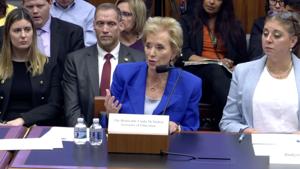
Taxpayers will no longer pay for the education of noncitizens in the U.S. illegally, the U.S. Department of Education said Thursday.
The department said “it will end taxpayer subsidization of illegal aliens in career, technical, and adult education programs.”
A news release said that this change takes place due to an interpretative rule issued Thursday in which “the Department rescinded a Dear Colleague letter from the Clinton Administration that enabled non-qualified illegal aliens to access federal public benefits in contravention of the Personal Responsibility and Work Opportunity Reconciliation Act (PRWORA).”
Title IV of PRWORA “generally limits eligibility for ‘federal public benefits’ to U.S. citizens, permanent residents, and certain categories of ‘qualified aliens,’” the release said.
Federal public benefits include “any retirement, welfare, health, disability, public or assisted housing, postsecondary education, food assistance, unemployment benefits, or any similar benefits for which payments or assistance are provided to an individual, household, or family eligibility unit.”
In 1997, “the Clinton Administration issued a Dear Colleague Letter that erroneously exempted career, technical, and adult education programs from being subject to PRWORA,” the release said.
“In doing so, the Department’s interpretation mischaracterized the law by creating artificial distinctions between federal benefit programs based upon the method of assistance,” the release said. “Congress made no such distinction in PRWORA.”
The department’s release said that Thursday’s interpretive rule “also ensures that postsecondary education programs authorized under the Higher Education Act (HEA), such as Pell Grants and student loans, continue to be inaccessible to illegal immigrants.”
U.S. Secretary of Education Linda McMahon said in the release: “Postsecondary education programs funded by the federal government should benefit American citizens, not illegal aliens.”
“Under President Trump’s leadership, hardworking American taxpayers will no longer foot the bill for illegal aliens to participate in our career, technical, or adult education programs or activities,” McMahon said.
“The Department will ensure that taxpayer funds are reserved for citizens and individuals who have entered our country through legal means who meet federal eligibility criteria,” McMahon said.
Director of Policy Studies Jessica M. Vaughan at the Center for Immigration Studies told The Center Square that “taxpayers should not have to subsidize vocational or other post-secondary education for illegal aliens, who aren’t allowed to work in this country.”
The Center for Immigration Studies is an “independent, non-partisan, non-profit, research organization,” according to its website.
“Illegal workers displace American workers and cause their wages to go down, Vaughan said.
The department’s release explained that “interpretive rules cannot have effective dates and are not binding on the public or the Department.”
Additionally, Thursday’s interpretive rule “represents the Department’s current position on the issue and may be referenced when enforcing or monitoring grantee and subgrantee compliance with PRWORA.”
When reached, the Department of Education referred The Center Square to its news release, as well as its March decision to revoke waivers to California and Oregon colleges and universities that used “federal funds to provide services to illegal aliens.”
The department’s action is in response to Trump’s February executive order “Ending Taxpayer Subsidization of Open Borders,” the release said.
The U.S. Departments of Housing and Urban Development and Homeland Security announced in March that they were ending taxpayer-funding house for illegal aliens, The Center Square reported.
The executive order “directed federal agencies to stop funding public benefits for foreign nationals living illegally in the U.S.,” as The Center Square reported.