Posts by Newspaper Staff
Illinois ag director says Trump trade policies are ‘crushing’ farmers
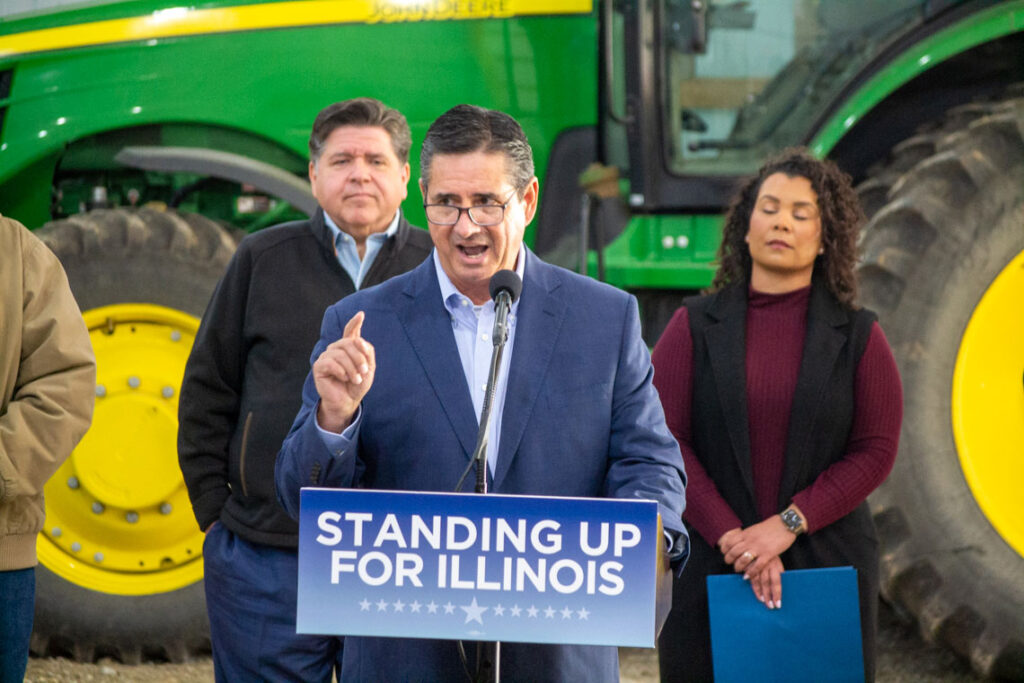
The aid package is about half the size of one offered in the first Trump administration.
Read MoreAppeals court won’t release detained immigrants amid warrantless arrest scrutiny
Split opinion allows consent decree to continue but says lower judge erred.
Read MoreWATCH: California co-leads suit over $100,000 H-1B visa fee
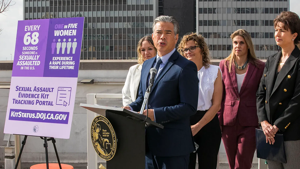
Democratic attorneys general from California and 18 other states sued the Trump administration Friday over its new $100,000 fee on H-1B visas.
President Donald Trump imposed the rule Sept. 19 for new petitions for the nonimmigrant visas, which allow U.S. employers to hire temporary, foreign workers in response to labor shortages among physicians, surgeons, researchers, educators, nurses and other vital workers.
The new fee will make it more difficult for health care centers, schools, universities and others to hire workers, California Attorney General Rob Bonta said during a news conference Friday morning in San Francisco. He said it will make current labor shortages worse.
Bonta and Massachusetts Attorney General Andrea Joy Campbell are co-leading the coalition of states in the suit, which is California’s 49th one this year against the Trump administration.
Bonta said the new fee violates the U.S. Constitution and the Administrative Procedure Act’s notice-and-comment process.
The Center Square Friday reached out to the White House, which commented on the lawsuit.
“President Trump promised to put American workers first, and his commonsense action on H-1B visas does just that by discouraging companies from spamming the system and driving down American wages, while providing certainty to employers who need to bring the best talent from overseas,” White House spokeswoman Taylor Rogers told The Center Square in an email. “The Administration’s actions are lawful and are a necessary, initial, incremental step towards necessary reforms to the H-1B program.”
The Center Square also reached out to the U.S. departments of Homeland Security and Labor, but did not hear back before press time.
Bonta noted the visas allow employers such as schools, hospitals, universities and research institutions to hire highly skilled workers.
“California, like every other state, needs more teachers, more nurses, more doctors,” the California attorney general said. “There is a shortage of supply in those professions.”
Bonta’s office said employers filing H-1B petitions typically pay between $960 and $7,595 in regulatory and statutory fees.
Bonta said the $100,000 far exceeds processing costs and call the new fee an “unnecessary obstacle” to hiring the workers America needs.
“The consequences for California would be devastating,” Bonta said. “We’re already facing a nationwide teacher shortage. Last year 74% of U.S. school districts struggled to fill open positions, especially in areas such as special education, foreign language and STEM [science, technology, engineering and math] fields. Nearly 30,000 educators nationwide hold H-1B visas.
“And hundreds of colleges and universities rely on them to support instruction and support research,” he said.
“Public schools, many of which operate on very tight budgets, can’t absorb an extra $100,000 for hire,” Bonta said.
“The health care sector is equally at risk,” he said, noting rural communities would be especially hit by the loss of workers. He said patients would see “longer wait times, reduced access to care, growing health disparities.”
Bonta said Congress didn’t authorize Trump to impose the new $100,000 fee.
“No presidential administration can rewrite immigration law,” the attorney general said. “No president can destabilize our schools, our hospitals, our universities on a whim. And no president can ignore the co-equal branch of government, the Congress; the Constitution or ignore the law.”
Besides California, states filing the lawsuit are Arizona, Colorado, Connecticut, Delaware, Hawaii, Illinois, Maryland, Michigan, Minnesota, North Carolina, New Jersey, New York, Oregon, Rhode Island, Vermont, Washington and Wisconsin.
In other litigation news, Democratic attorneys general praised this week’s federal ruling that blocked the Trump administration’s attempt to close a Federal Emergency Management Agency program designed to protect communities from natural disasters before they strike.
Democrats won their suit to protect FEMA’s Building Resilient Infrastructure and Communities program. Those filing the suit included attorneys general from Arizona and California.
“We’re winning case after case as we protect Arizonans from harm and rising prices that the Trump administration continues to illegally pursue,” Arizona Attorney General Kris Mayes said in a news release. “Arizonans will notice this victory the next time a wildfire or flood hits – thanks to the work of those in my office, our state will be prepared.”
Entrepreneur’s supporters say case law may result in release
Arizonans think a situation involving Kilmar Armando Abrego Garcia should result in the release of a Phoenix area business owner facing deportation.
Garcia is the Maryland man who the Trump administration has argued is in the U.S. illegally and needs to be deported.
A federal judge Thursday ordered Garcia to be released for reasons including Zadvydas v. Davis, a 2001 U.S. Supreme Court case that established limits on indefinite immigration detention.
It is that same case that Democrat Brent Peak of Arizona has pointed to in his efforts to have Kelly Yu, a restaurateur in the Phoenix suburb of Peoria, released after being in detention for months. Yu is an illegal immigrant but has received bipartisan support from Arizonans who say she’s a responsible business owner and a respected member of the community.
Yu is being detained at the U.S. Immigration and Customs Enforcement detention center in Eloy, Arizona.
“The court determined that if someone is being held, but there is no record and their deportation is not foreseeable, like, there’s no foreseeable resolution to completing the deportation, then they must be released,” Peak told The Center Square. “She has no record. She has 20 years of upstanding conduct and residency in the U.S, so, at this point, from what I understand it would simply take a filing, filing a habeas petition, and a judge would order her release awaiting deportation.”
A habeas petition is a legal request that someone in custody files to ask a court to rule their imprisonment is unlawful.
Yu has been in detention for six months.
Republican Lisa Everett has been partnering with Peak to try to help Yu. Like Peak, Everett is optimistic that the Garcia situation will benefit Yu.
“Kelly Yu should be released because she has not violated any laws,” Everett told The Center Square. “She pays her taxes. She is a business owner and employs Americans. She is who we want in an immigrant.”
In August, when The Center Square first reported about Peak and Everett’s efforts to keep Yu from being deported, the U.S. Department of Homeland Security said Kelly Yu, aka Lai Kuen Yu, is “an illegal alien from Hong Kong, one that has had a final deportation order from a judge since 2005.” U.S. Homeland Security Assistant Secretary Tricia McLaughlin also told The Center Square in an email that Yu “was arrested illegally crossing the border by U.S. Border Patrol in Arizona on February 4, 2004.”
Yu was released into the country days later.
“On November 14, 2013, the Board of Immigration Appeals dismissed her appeal and upheld her final order of removal,” McLaughlin told The Center Square. “On August 23, 2016, the U.S. Court of Appeals for the Ninth Circuit denied her appeal. On June 12, the Board of Immigration Appeals granted her a temporary stay of removal while they consider her motion to reopen. She will remain in ICE custody pending her removal proceedings.”
According to Peak, the reason Yu has not been deported is because China has not responded to the U.S. to finalize the passport.
“That normally is done in a few weeks,” said Peak. “That’s why we thought all along that deportation was imminent because we were just waiting on the China side of whatever needs to be done for the passport, and I don’t know the details of that, of how that works.”
China isn’t doing anything, which leaves Yu stuck in prison, Peak said.
Yu’s husband, Aldo Urquiza, is an American citizen. He runs the two restaurants he has with his wife. Meanwhile, Yu’s daughter, Zita Yu, is in college and works at the restaurants.
Peak and Everett have been in touch with Urquiza on a regular basis.
“At this point, the family has given up,” said Peak. “My hope is that some other organization or perhaps even I would love to see Kris Mayes, our attorney general [in Arizona], file on her behalf to get a judge to order her released as she awaits deportation.”
Pointing again to Zadvydas v. Davis, Peak said “it is illegal to continue to imprison her for an indefinite time frame when the U.S. cannot determine how long they need to hold her” in custody.
“They do not know when her deportation will happen because they cannot get the answers that they need and the follow up that they need from China,” said Peak.
The Center Square has tried multiple times since August to get interviews from Arizonans in the U.S. House of Representatives and the U.S. Senate.
No one has responded.
“Sadly, I have not gotten a response from any of these officials with the exception of one returned phone call from Mark Kelly‘s office back in August I believe,” said Everett. “I have reached out to most of these offices repeatedly.”
The Center Square also reported on Yu’s situation in October and November.
GOP lawmakers silent on Trump’s EO punishing state AI guardrails
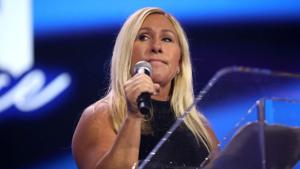
Frustrated with Congress failing to enact national artificial intelligence regulations, President Donald Trump took matters into his own hands Thursday night and signed an executive order strong-arming states into setting industry-friendly regulations only.
Republicans have spoken out against Big Tech and the potential dangers of uncontrolled AI expansion. Yet as of Friday afternoon, not a single AI-cautious Republican member of Congress has condemned the order, with only one commenting on the action at all.
“President Trump is right: we need federal standards to protect kids, creators, consumers, and conservatives across the entire country,” Sen. Marsha Blackburn, R-Tenn., posted on X on Friday. “I look forward to continuing to work with the President to draft the federal framework he has called on Congress to pass.”
While not a moratorium on state-level AI regulations – something U.S. lawmakers voted overwhelmingly to strip out of two major bills this year – the executive order cracks down on states with more restrictive laws.
Under the order, states with AI laws that the Trump administration says “harm innovation” would lose access to crucial broadband funds and could even face lawsuits from the U.S. Attorney General’s newly established AI Litigation Task Force.
The order also directs Congress to “ensure that there is a minimally burdensome national standard” for AI and requires that whatever congressional framework emerges “forbid State laws that conflict with the policy set forth in this order.”
The ultimate goal, the White House says, is to “protect American AI innovation from an inconsistent and costly compliance regime resulting from varying State laws.”
David Sacks, who advises the White House on AI and Cryptocurrency policy, said the executive order “is not that framework itself, or an amnesty or moratorium, but rather a statement of principles and a set of tools for the Administration to push back on the most onerous and excessive State AI laws.”
He added that the order “does not mean the Administration will challenge every State AI law.”
“The focus is on excessive and onerous State laws,” Sacks said. “We look forward to working with Congress to enact a stable and enduring framework that reduces unnecessary regulation, enables innovation, protects core values, and helps America win the AI race.”
Democrats quickly condemned the order, with Sen. Amy Klobuchar, D-Minn., calling it “dangerous, and most likely illegal” and Sen. Ed Markey, D-Mass., dubbing it “an irresponsible power grab.”
Conspicuously silent on the order are the Republicans who spoke out the most against an AI moratorium, including Sens. Josh Hawley, R-Mo., and Ron Johnson, R-Wis., as well as Reps. Chip Roy, R-Texas, and Thomas Massie, R-Ky.
Rep. Majorie Taylor Greene, R-Ga., who previously argued that states “must retain the right to regulate and make laws on AI and anything else for the benefit of their state,” also remained mum as of Friday afternoon.
According to Co-Chair of Congressional Artificial Intelligence Caucus Don Beyer, D-Va., however, “members in both chambers and both parties” are “actively exploring legislative options” in response to the order, which he says violates the 10th amendment.
“This is a terrible idea,” Beyer said in a statement. “Congress has been slow to respond to the AI revolution and in the absence of a strong federal response, states are wisely taking the lead to create guardrails and protect the public. Trump’s attempt to undo this progress without providing any federal regulatory protections would be extremely harmful.”
The executive order will likely draw lawsuits from both Republican and Democrat-led states.
Pritzker signs ‘medical aid in dying’ bill amid religious opposition
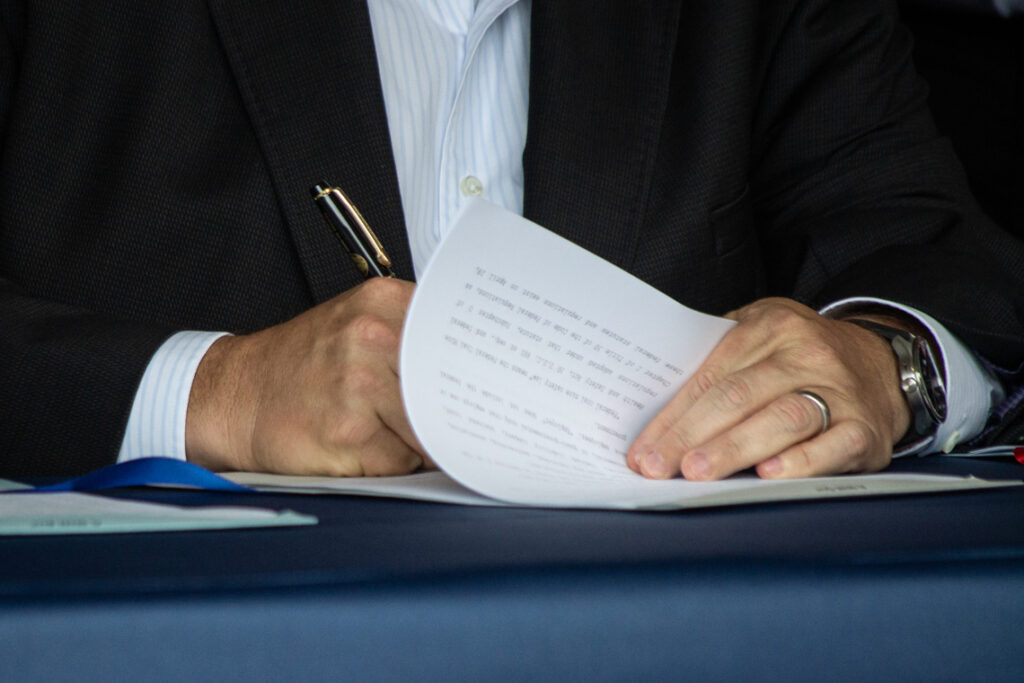
Gov. JB Pritzker signed legislation Friday legalizing end-of-life care for terminally ill adults in Illinois.
Read MoreGabbard: 2,000 Afghan refugees in U.S. have ties to terrorism

An estimated 2,000 Afghan nationals admitted to the United States following the deadly 2021 pullout of American forces from Afghanistan have ties to terrorism, according to the Director of National Intelligence Tulsi Gabbard.
Gabbard made the astonishing revelation during an interview on Fox News Friday morning, following a tense House Homeland Security Committee hearing Thursday, when Homeland Security Secretary Kristi Noem highlighted national security risks to the homeland.
The Center Square previously reported that the U.S. Department of Defense Inspector General released a report in January 2022 that admitted thousands of Afghan evacuees who entered the U.S. following the American military evacuation in August 2021 were not properly vetted.
“[The DoD] found that Afghan evacuees were not vetted by the National Counter-Terrorism Center (NCTC) using all DoD data prior to arriving in CONUS,” the report said.
The report also noted, during an “analytic review, NGIC personnel identified Afghans with derogatory information in the DoD ABIS database who were believed to be in the United States.”
The 2022 report affirms Gabbard’s concerns that some individuals admitted to the U.S. under the Biden administration may pose a national security risk.
“The vast majority of them were not properly vetted. They certainly were not vetted at anywhere near the standard that we require under this administration of allowing people into our country. And of that number, we know that there are at least 2,000 who are here who have ties to or are known or suspected terrorists,” Gabbard told Fox News.
During the Biden administration, nearly 200,000 Afghan nationals were admitted to the U.S., including Rahmanullah Lakanwal, who is accused of shooting two National Guard members, killing one just blocks from the White House on the eve of Thanksgiving.
While there have been no formal terrorism charges brought against Lakanwal as of yet, the attack is being investigated for alleged terrorism. It has been described as a terror attack by high-ranking officials such as Gabbard and Noem.
During the interview, Gabbard stated that, through the National Counterterrorism Center, in partnership with the Department of Homeland Security and the FBI, the agencies will work together to re-vet “every single” Afghan individual admitted during the Biden administration, underscoring the threat to national security.
“We’ve got to realize what’s happening here within the context of the greater threat that we face. We know that al Qaeda and ISIS continue to actively plot attacks against our homeland. And so when you look at the spread of the radical Islamist ideology and the propagation of it, you look at active plots, and they’re looking for people who can carry out those plots,” said Gabbard.
In July, The Center Square asked border czar Tom Homan about the report and whether the Trump administration would investigate the individuals who had not been vetted.
Homan vowed the Trump administration would thoroughly vet Afghan refugees and would be doing things the “right way” by revisiting the vetting process.
“We’re going to re-vet them because we don’t think the last administration properly vetted them…This administration will do things the right way, we’ll make sure everyone is vetted properly,” said Homan.
After last month’s shooting in Washington, D.C., President Donald Trump vowed to pause migration from certain countries, including Afghanistan.
Op-Ed: No more CDL mills: Trump’s DOT puts safety back in the driver’s seat

As families prepare for the holidays, America’s truck drivers are doing what they always do – keeping promises to working people by delivering the goods that make this season possible. They are the backbone of our economy and the lifeline of Main Street. Yet, lurking behind this essential workforce are fraudsters and fly-by-night operators who cut corners and put lives at risk. Thanks to the Trump administration, that ends now.
Last week, U.S. Transportation Secretary Sean Duffy delivered one of the most sweeping enforcement actions in recent memory – removing nearly 3,000 fraudulent commercial driver’s license (CDL) training providers from the federal registry and putting another 4,000 on notice. These so-called “CDL mills” have churned out undertrained drivers for years, endangering families on the road and eroding trust in a profession built on skill and responsibility.
Training for an 80,000-pound truck isn’t a box to check – it’s a promise to every family sharing the road that safety comes first. Yet, for too long, shady operators looking to make quick buck have gamed the system for profit, while the Biden Administration looked the other way. With this crackdown, the Trump Administration is drawing a hard line: America’s highways belong to trained professionals – not to fraudsters selling shortcuts.
It’s a victory for millions of honest truckers who do things the right way. Chris Spear, president and CEO of the American Trucking Associations (ATA), representing thousands of patriotic trucking companies across the nation, put it bluntly: “If you’re issuing certificates to anyone who can fog a mirror, you’re on notice.” ATA has long demanded tougher enforcement to shut down sham training outfits that gamble with safety for profit. Now, those demands are being met.
And this isn’t a one-off. This crackdown builds on a clear record of decisive action by the Trump administration. Earlier this year, Secretary Duffy pushed states to purge thousands of illegal drivers from their rolls. That included more than 17,000 illegals in California alone – legions of people who should never have been behind the wheel of a big rig. No legal right to even be here, no obligation to follow the rules, and no business operating heavy machinery on American highways.
Trucking isn’t just a job – it’s a calling answered by millions of skilled Americans who keep our economy humming, our store shelves stocked, and our communities supplied. That’s why this profession must be protected from threats both inside and out. Internally, bad actors and fraudulent CDL mills undermine safety and tarnish the reputation of every honest driver. Externally, trial lawyers circle like vultures, turning accidents into jackpot justice schemes that bleed family-owned trucking companies dry and increase costs for everyone. If we allow these dual forces to erode standards and exploit tragedy, we don’t just endanger truckers – we endanger the entire supply chain that powers this country.
President Trump and Secretary Duffy deserve credit for taking bold action where previous administrations failed. This crackdown is a victory for highway safety, for American workers, and for every family who expects to travel our roads without fear. The message is clear: we’re taking back our roads and taking back our country.
Hochul weighs AI regulations as Trump sets federal rules
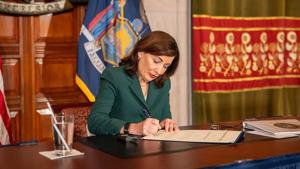
New York Gov. Kathy Hochul is weighing plans to regulate the state’s artificial intelligence sector, even as President Donald Trump seeks to restrict states from regulating the industry.
Hochul is reviewing a proposal approved by the state Legislature, called the Responsible AI Safety and Education Act, which would impose new safety regulations on major AI companies and require disclosure within 72 hours if a company believes harm may be imminent from one of their platforms.
Recent reports have suggested that Hochul is considering a complete rewrite of the bill to match a measure passed by California earlier this year. That law is considered more favorable to the industry.
On Thursday, Hochul signed legislation that her administration called the nation’s first AI regulations designed to both protect consumers and increase transparency in the film industry.
The measure requires anyone producing or creating an ad to provide a disclosure if it includes AI-generated synthetic performers. Another related bill signed by Hochul requires written consent from heirs or executors if a person wants to use the name, image, or likeness of an individual for commercial purposes after their death.
“By mandating transparency and securing consent, New York has drawn a bright line that puts human creativity, integrity and trust first,” Hochul, a Democrat, said in remarks Thursday. “This is smart, forward-looking legislation that will have national impact.”
But New York’s efforts to regulate the industry set the state up for an inevitable clash with the federal government, which is moving to scuttle state regulations it claims would cripple the burgeoning industry.
Trump signed an executive order Thursday seeking to limit states’ ability to regulate artificial intelligence and upend existing laws. Trump wielded his executive powers after Congress failed to pass a bill with similar regulations last month.
The order directs Attorney General Pam Bondi to create an “AI Litigation Task Force” to root out state laws that clash with the Trump administration’s “light touch” plans for regulating the industry.
Trump administration officials say they want to prevent a hodgepodge of regulations by states that could make it difficult for big AI companies to compete nationwide.
“We have over a thousand bills going through state legislatures right now to regulate AI, over a hundred of them have already passed, 25% of them are in California, New York and Illinois,” David Sacks, the White House’s AI and crypto czar, said in remarks Thursday.
Democratic California Gov. Gavin Newsom blasted the president’s order in a social media post accusing him of “running a con” by seeking to block states from setting regulations for the industry.
“President Trump continued his ongoing grift in the White House, attempting to enrich himself and his associates, with a new executive order seeking to preempt state laws protecting Americans from unregulated AI technology,” Newsom said.
EXCLUSIVE: First Nation police chiefs want to participate in border security efforts

First Nation tribal police chiefs in Canada say want to participate in border security efforts. Many already are on the front lines, living at the U.S.-Canada border, they told The Center Square.
“National security doesn’t exist without First Nation policing at the border,” Dwayne Zacharie, president of First Nations Chiefs of Police Association, told The Center Square in an exclusive interview while participating in border security operations with Texas Operation Lone Star sheriffs. Zacharie also serves as Chief Peacekeeper of Kahnawake Peacekeepers located near Montreal.
One of the biggest problems First Nation communities face is a lack of funding and the Canadian government refusing to designate policing as essential services, he argues.
“We’re not regarded as essential service,” but considered “as an enhancement to” the Royal Canadian Mounted Police (RCMP) and other provincial police services, he said.
There are more than 630 indigenous communities in Canada and only 36 self-administered policing services, he says. The 35 serve roughly 150 indigenous communities; the RCMP and provincial police are supposed to serve the rest, he said. First Nation police receive roughly 40 percent less salaries than federal and provincial police organizations that “don’t share information with us, don’t provide us with opportunities for advanced training or resourcing commensurate with our needs,” he said.
As a result, he said he’s looking for help outside of Canada, including from U.S. federal, state and local partners to help him and First Nation police fight crime, including border crime.
“We’re going to find the partners that we need to have,” he said. He’s hoping new partnerships will help “because we do see the impacts in our communities as police officers. We see MS-13, the Sinaloa Cartel, Hell’s Angels and organized crime entities that come into our communities because in their minds, the picking is ripe because we don’t have the resources, we’re understaffed.”
President Donald Trump “has a different reality about the way he looks at things,” including telling Canadian authorities to improve border security, he said. Canada’s $1.3 billion border plan claims to surge resources to law enforcement but “First Nation policing didn’t see any influx of resources, didn’t see any upgrades in training,” Zacharie told The Center Square.
First Nation challenges are compounded by systemic underfunding and policies that led to multiple lawsuits. They’re using expired bullet proof vests, don’t have enough vehicles and safety equipment to perform their jobs, and can’t hire or retain personnel due to lack of resources, they say. Their working conditions “would never be accepted by the provincial police or the Montreal police or any other police department,” Shawn Dulude, president of the Quebec Association of First Nation and Inuit Police Directors, told City News.
In Quebec, 22 First Nation police officers filed a complaint against Public Safety Canada with the Canadian Human Rights Commission alleging “persistent underfunding of Indigenous police forces,” which has created serious security risks. This is after Pekuakamiulnuatsh First Nation sued Quebec officials arguing they underfunded their police for years. Canada’s Supreme Court ruled in their favor last year.
In British Colombia, the Heiltsuik Tribal Council also sued, arguing the RCMP aren’t protecting residents from organized crime, including drug trafficking and sexual violence. The region is dealing with cartel and CCP-related crime, The Center Square reported.
These problems are compounded by “a stigma attached to policing because of the old concepts and the way that the RCMP enforced the Indian Act, which created residential schools, which was a way to indigenous people and take their culture and their language and basically eradicate native people from the land,” Zacharie told The Center Square.
The 1876 Indian Act defined Indian status, created the reservation system and kept several colonial-era laws designed to “eliminate First Nations culture in favour of assimilation into Euro-Canadian society.” It “enabled trauma, human rights violations and social and cultural disruption for generations,” the Canadian Encyclopedia states.
Canadian police enforced a pass system regulating indigenous travel, a permit system regulating the sale of goods and farm equipment prohibitions on reservations.
From 1831 to 1996, more than 130 government-sponsored residential schools sought to “westernize” indigenous children. They were “overcrowded, underfunded, and rife with disease, leading to the deaths of many children, who were often buried in unmarked graves,” IndoCanada Professional explains. An estimated 150,000 children attended them; an estimated 6,000 died at them, the encyclopedia states.
In 1951, the Indian Act was amended to authorize the forcible removal of indigenous children. Now referred to as the “Sixties Scoop,” under the guise of “child welfare,” Canadian police accompanied “social workers” to forcibly take children from their parents, place them in non-indigenous foster care and adopt them out worldwide.
By the early 1980s, investigations were conducted; the Provincial Court of Manitoba detailed examples of “cultural genocide.” A class action lawsuit was filed by survivors, including those still searching for family members. In 2018, a settlement was approved.
The Indian Act also created an unequal legal status for women based on marital status. It was amended in 1985 to address the issue, which critics argue is still discriminatory.
Indigenous women were also forcibly sterilized in two provinces from 1928 to 1972.
Similar to the United States, thousands of indigenous women and girls suffer from violent crime and are missing, prompting national inquiries.
First Nation challenges are ongoing. In 2023, more than 100 First Nations sued the government for failing to provide housing and running water on reservations.
Zacharie is hoping with the help of Americans there’s a “chance for us to build a partnership … and educate people about the realities we are facing.”