Posts by Newspaper Staff
Federal Reserve holds rates steady, but could cut them later this year

Federal Reserve officials agreed to hold interest rates steady on Wednesday but suggested they could cut them later this year.
“Despite elevated uncertainty, the economy is in a solid position,” Federal Reserve Chairman Jerome Powell said.
Earlier in the day, President Donald Trump again called Powell “not a smart person” and said Powell was “too late” to cut interest rates. The president also said he was looking forward to the end of Powell’s tenure at the Federal Reserve.
“Now we have a man who just refuses to lower the Fed rate – just refuses to do it,” Trump said Wednesday morning before Powell’s news conference. “And he’s not a smart person. I don’t even think he’s that political, I think he hates me, but that’s OK. He should. I call him every name in the book trying to get him to do something.”
Trump said he wanted rate cuts to make it easier for the U.S. Treasury to issue less expensive long-term debt.
The Federal Open Markets Committee kept the central bank’s federal funds rate at a target of 4.25% and 4.5%.
“For the time being, we’re well positioned to wait to learn more about the likely course of the economy,” Powell said during the news conference.
Trump has repeatedly called on the Federal Reserve to lower interest rates, but the president has limited authority over the independent agency.
Social Security, Medicare to run out of money earlier than expected
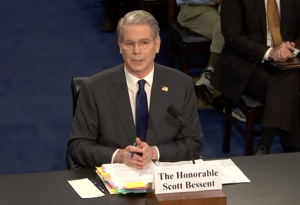
The Social Security program is nine years away from insolvency, the Social Security Board of Trustees said Wednesday.
This forecast moved up one year since 2024’s annual report, which projected the program to deplete its funding by 2035. Now that projection date is set at 2034.
Medicare’s hospital trust fund will fall short in 2033, when it will only be able to cover 89% of scheduled benefits. This date moved up three years since last year’s report, according to the Medicare Board of Trustees.
“As in prior years, we found that the Social Security and Medicare programs both continue to face significant financing issues,” the Treasury Department said Wednesday.
Tens of millions of Americans who rely on Social Security due to retirement or disabilities would see cuts to their monthly benefits.
If no changes are made, beneficiaries will only receive 81% of their benefits in nine years, the trustees’ report says.
“This data underscores the need for lawmakers to take action to support the long-term viability of these programs,” Treasury Secretary Scott Bessent said. “Under President Trump’s whole-of-government initiative, the administration will continue to root out waste, fraud and abuse across federal agencies to ensure quality service for beneficiaries and responsible stewardship of taxpayer funds.”
The Social Security trustees cited a recent law upping support for beneficiaries as the culprit for the insolvency drop from 2035 to 2034.
The bipartisan Social Security Fairness Act, which was signed into law earlier this year, added benefits for almost three million public sector employees, including teachers and firefighters.
The Committee for a Responsible Federal Budget, a D.C.-based think tank, responded to Wednesday’s Social Security and Medicare reports.
“Where is the sense of urgency?” President Maya MacGuineas said. “We are running out of time to phase in changes gradually and avoid harsh cuts, sharp tax increases or unacceptable borrowing.”
Legislation would codify more TCJA tax write-offs for American businesses

As Republican leaders in Congress work to renew key portions of the 2017 Tax Cuts and Jobs Act via the budget reconciliation process, two lawmakers have introduced a bill of their own to resurrect certain tax deductions for businesses.
The CREATE JOBS Act, sponsored in the House by Rep. Glenn Grothman, R-Wis., and in the Senate by Sen. Ted Cruz, R-Texas, would codify the TCJA’s 100% bonus depreciation, which allowed businesses to completely write off the cost of certain property – including manufacturing equipment and heavy machinery – acquired between 2017 and the end of 2022.
The bill would also make permanent a 2022 TCJA provision that required businesses that choose to fully deduct research and development costs from their taxable income do so over a period of five years, rather than annually.
Additionally, the CREATE Jobs Act would implement neutral cost recovery, which adjusts business tax deductions for rental units and commercial structures to prevent depreciation.
“As Congress considers extending immediate deductions for research and equipment, it’s long past time to give structures similar treatment. The 2017 tax cuts were a leap forward for investment, but they left buildings behind,” Cato Institute’s Adam Michel, who supports the bill, said Tuesday.
“By fixing that omission, the CREATE JOBS Act levels the playing field for all types of investment and unlocks capital for American manufacturing,” he added.
Wisconsin Manufacturers & Commerce, a business and manufacturers association, also expressed support for the bill, calling it a “common-sense policy that is positively pro-business and promotes job creation.”
According to the Tax Foundation, the bill could create over one million jobs and eventually increase GDP by 5.1%.
But if scored using the Congressional Budget Office’s method, which assumes that extending tax cuts costs the federal government money, the provisions could add to the federal debt and deficit in the long run as well, though economic growth might cancel that out.
FBI settles legal challenge over Covenant shooter’s manifesto

The FBI has settled litigation with a Tennessee newspaper over its previous refusal to release the manifesto written by the perpetrator of the March 2023 shooting at Covenant School.
The Tennessee Star and others sued the FBI for the release of Audrey Elizabeth Hale’s manifesto after the agency denied it during the Biden administration. Hale, a female who identified as a male, killed three children and three staff members in the shooting at the Nashville school before being shot and killed by responding officers.
Settlement negotiations over the release began after FBI Director Kash Patel took over the agency, according to the Wisconsin Institute of Law and Liberty.
The FBI released 120 pages of Hale’s writing in April. As part of the lawsuit settlement, the agency will pay $86,000 in legal fees to the law firm.
“Journalists everywhere should be willing to go to the mat to hold their government accountable, regardless of the story or who is in charge at the nation’s capital,” said Michael Patrick Leahy, CEO, editor-in-chief, and majority owner of Star News Digital Media. “We appreciate WILL for taking our case and fighting back against the Biden administration’s reckless and dangerous record retention policies.”
Matt Kittle, an investigative reporter with The Federalist, was also a plaintiff in the law firm’s suit.
“This settlement is a win for government transparency and efforts by real journalists to keep their government open and accountable,” said Dan Lennington, deputy counsel for the law firm.
Arrested Milwaukee County judge’s trial delayed

Judge Hannah Dugan will not go on trial in her immigration collusion case next month after the federal judge handling the case delayed the trial Wednesday.
Judge Lynn Adleman told the court he wants to make sure the case is “done right.”
Dugan is facing two federal charges, one of them a felony, after prosecutors say she helped sneak an illegal Mexican immigrant out of the side door of her courtroom in May.
Video shows Dugan leave the bench to speak with ICE agents outside of her courtroom. It also shows her return to court, then order the suspect through the jury room, and eventually into a side hallway.
Dugan’s legal team is claiming judicial immunity.
This week they filed another brief that said the case should be dismissed because all judges have wide latitude in managing their courtrooms.
Dugan’s lawyers have said from the beginning that she cannot be held accountable.
The U.S. Attorney’s Office in Milwaukee essentially has said Dugan overstepped her authority when she allowed the immigrant to use the non-public section of her courtroom to try and evade immigration authorities.
Dugan was indicted on May 13. She was originally set for trial July 21.
Adleman did not set a new trial date, instead he said “I don’t think this is going to get lost.”
Dugan is on paid leave from her job as a Milwaukee County circuit court judge. She has raised more than $130,000 for her defense through an online legal defense fund, though she has not publicly said who has donated, or how much.
She has pleaded not guilty.
If convicted, Dugan is looking at six years in prison and a $350,000 fine.
WATCH: Judiciary explores accountability options over Biden decline ‘coverup’

No obvious solutions emerged during a congressional hearing Wednesday on how to hold those accountable for the alleged cover-up of President Joe Biden’s mental and cognitive decline, but witnesses had some suggestions for how to prevent similar situations in the future.
Republicans have been adamant for some time that Democratic lawmakers, the prior administration, the legacy media and those closest to Biden conspired to hide the former president’s mental and cognitive decline from the American people. More recently, allegations have surfaced that some of Biden’s staff or potentially others may have used an autopen – a machine that can replicate signatures – to sign official documents for Biden without his knowledge or consent.
Wednesday’s witnesses agreed that further investigation needs to be done into these questions. Republicans also explored what can be done after the fact and how to prevent similar events from happening in the future. The Senate Judiciary Committee’s hearing into those questions Wednesday’s boycotted by all but one Democrat.
Republicans didn’t miss the opportunity to call them out for it. U.S. Sen. Eric Schmitt, R-MO, said Democrats’ absence and their failure to call any witnesses to testify was “deeply disappointing” but “not surprising.”
“Their absence speaks volumes – an implicit admission that the truth is too inconvenient to face,” Schmitt said. “This de facto boycott is not just a refusal to participate. It’s a refusal to serve the American people who deserve answers about who was truly leading their government.”
Much of the hearing’s discussion revolved around proper uses of the autopen, which witnesses testified can only be rightfully used when the president specifically delegates its use to the user. The committee also discussed Section 4 of the 25th Amendment to the Constitution, which talks about succession in the case of a president becoming unfit or unable to fulfill the role. The amendment authorizes the vice president and a majority of the president’s cabinet to declare the president unfit, though that declaration has to be validated by a vote from Congress in order to have any effect.
What’s missing, however, is a clear manner of recourse for lawmakers or the public if those around the president fail to act despite plain signs he is incapable of holding office. Republicans wanted to know what they could do to prevent the alleged conspiracy from simply fading into history without consequences for any involved.
“As a government, it is imperative that we have clear contingency plans when emergency strikes, and yes, it is an emergency when we have a sitting president who is unable to discharge the duties of that office,” said U.S. Sen. John Cornyn, R-TX.
He asked witness Theo Wold, a visiting fellow for law and technology policy with The Heritage Foundation and who worked in the previous Trump administration, if any criminal statutes could be applied to those who are found to have participated in the alleged cover-up.
“In this case, some have suggested that there may be potential crimes committed by members of the Cabinet for failing to act basically, suborning perjury, forging, forging government documents, impersonating a federal officer, making false statements, conspiracy to defraud the United States, obstruction of justice, wire or mail fraud… Do you think there’s any application of any of those criminal statutes to the circumstances of the Biden presidency?” Cornyn asked.
“There very well could be,” Wold said, but he added that it would be “a question for a prosecutor to take up in their discretion.”
While witnesses agreed that anyone participating in a cover-up should be held accountable, the solutions for doing so weren’t as clear as recommendations for how to prevent similar situations in the future.
John Harrison, James Madison Distinguished Professor of Law at the University of Virginia, didn’t see an obvious method of redress for what already happened but suggested that Congress perhaps require greater documentation of presidential actions going forward.
Wold provided additional suggestions, such as a revival of discussion around “other guardrails” that can be imposed on the 25th Amendment. There was lively debate toward the end of Ronald Reagan’s presidency about adding a mental health professional to the White House medical team or “whether the surgeon general should oversee the inclusion of medical reporting as part of… the 25th Amendment,” according to Wold. But he said there hadn’t been serious discussion since on how to improve the amendment. He also agreed with Sen. Katie Britt, R-AL, that some of the terms in the amendment, like “unable,” should be more clearly defined.
Treasury hits CJNG leaders with new counterterrorism sanctions

The U.S. Treasury hit top Cartel de Jalisco Nueva Generacion leaders with fresh sanctions on Wednesday as the Trump administration cracks down on illicit fentanyl trafficking.
“CJNG’s reign of terror across Mexico and its trafficking of fentanyl into the United States has destroyed countless innocent lives,” Treasury Secretary Scott Bessent said. “The United States remains strongly committed to leveraging all available tools to degrade the capacity of CJNG and other cartels to flood our streets with dangerous drugs and perpetrate heinous acts of violence against civilians.”
Treasury’s Office of Foreign Assets Control sanctioned five of CJNG’s Mexico-based leaders. OFAC said CJNG is a violent cartel responsible for “a significant share of fentanyl and other illicit drugs entering the United States.”
“It uses murder as a tactic to intimidate rivals, including sending messages to other cartels through the targeted killings of women,” according to OFAC. “The recent discovery of a CJNG recruitment camp, Izaguirre ranch – which was reportedly used to execute recruits that defy instructions – underscores the cartel’s brutal methods.”
OFAC designated CJNG leader Ruben Oseguera Cervantes (known as “El Mencho”), along with three other top cartel members. OFAC also sanctioned a CJNG commander, linked to El Mencho, who has been identified as the prime suspect in the recent murder of Mexican influencer Valeria Marquez during a live social media broadcast.
CJNG runs clandestine laboratories in Mexico to produce fentanyl, methamphetamine, cocaine, and other illicit drugs. The cartel effectively controls the deep-water port of Manzanillo in the Mexican State of Colima and runs fentanyl precursor procurement and other drug trafficking operations through the port.
“CJNG’s ruthless ambition to expand its operations has led the organization to deploy kidnappings, torture, bombings, and executions of civilians, Mexican politicians, and military and law enforcement officers,” OFAC noted.
It’s not the first time the cartel has faced sanctions. In 2015, OFAC designated CJNG pursuant to the Foreign Narcotics Kingpin Designation Act for the cartel’s role in international narcotics trafficking. In 2021, OFAC also designated CJNG pursuant to an executive order. In February, the U.S. Department of State designated CJNG as a Foreign Terrorist Organization and a Specially Designated Global Terrorist.
The sanctions essentially cut of cartel members and businesses controlled by them from the U.S. financial system.
Group: End tax dollars going to hospitals that promote DEI, minor transgender surgeries

An organization is calling for the end of federal funding to what it calls “woke” hospitals in the U.S. that use taxpayer dollars for diversity, equity and inclusion initiatives, gender surgeries on children, and climate activities instead of focusing on their mission to “provide high-quality care at affordable costs.”
In Consumers’ Research’s Consumer Warning report, five such hospitals are listed along with their so-called woke initiatives, the hospitals being Cleveland Clinic, Vanderbilt University Medical Center, Henry Ford Health, Memorial Hermann Health System, and Johns Hopkins All Children’s Hospital.
Consumers’ Research is an independent educational nonprofit as stated on its website.
The report says that “instead of lowering costs and passing savings onto patients, hospitals have spent considerable money, time and manpower pursuing a partisan agenda pertaining to Diversity, Equity, and Inclusion (DEI), radical gender ideology, and climate activism.”
Each of the five hospitals listed in the Consumers’ Research report “receive millions of dollars in federal funding, government-mandated savings programs, and tax exemptions,” meaning that taxpayers are often the ones paying for “various forms of progressive activism.”
Consumers’ Research executive director Will Hild told The Center Square that “hospitals should be focused on providing high-quality care at affordable costs, not peddling a woke agenda, which takes away vital resources that should be going to patient care.”
“The reason hospitals receive benefits like tax-exempt status is because they are supposed to be serving the community,” Hild said.
“Promoting discriminatory policies and performing sex-change procedures on kids does not enhance the communities hospitals are supposed to be helping,” Hild said. “Every hospital CEO should read this Consumer Warning and promptly end woke policies in their organizations and refocus on their core mission, which is providing the best quality patient care at affordable prices.
“Until then, their federal funding should be investigated to ensure taxpayers are not footing the bill for a political agenda,” Hild said.
The political agenda is evident at Cleveland Clinic in its commitment to embedding diversity and inclusion into every process and practice, pledge of over $7 million annually in 2016 toward “greening initiatives,” and its previous performance of hundreds of “irreversible” transgender treatments and procedures on minors, even lobbying against a 2023 Ohio bill prohibiting such procedures, according to the report.
Cleveland Clinic told The Center Square: “We are in full compliance with all state and federal laws and strongly refute the false and misleading assertions made in this report. The report intentionally shares information that is outdated.”
“For more than a century, Cleveland Clinic’s mission has been to care for life, research for health, and educate those who serve,” the hospital said. “Cleveland Clinic is a nonpartisan organization, and we neither have nor promote any political agenda.”
Vanderbilt University Medical Center is also involved in DEI initiatives and climate activism, according to the report, and provided “big money maker” gender transition surgeries to minors before Tennessee outlawed it.
According to the report, Henry Ford Health has “implemented extensive DEI training programs for its health system leaders” and still offers gender-affirming care to minors as of March 2025.
A Henry Ford Health spokesman told The Center Square that “Henry Ford Health respects and fully complies with all state and federal anti-discrimination laws.”
“For more than a century, Henry Ford Health has been fully committed to serving Michigan’s richly diverse communities, providing health care services and employment opportunities to everyone,” the spokesman said. “Our commitment to non-discrimination remains steadfast.”
Memorial Hermann Health System puts a large emphasis on the equity portion of its DEI initiatives and “maintains that ‘health equity’ is paramount,” according to Consumers’ Research.
Additionally, Memorial Hermann has “performed 15 sex-change surgeries on minors and prescribed puberty blockers or hormone therapy to three children.”
Meanwhile, Johns Hopkins All Children’s Hospital “considers ‘diversity and inclusion’ to be part of its founding value,” and prescribes to minors puberty blockers and hormone therapy, according to the report.
John Hopkins, Memorial Hermann and Vanderbilt Memorial Hermann did not respond to The Center Square before publication.
The report additionally states that these five hospital systems are “non-compliant” with “federal price transparency rules” – non-compliance meaning that a hospital actively refuses “to show patients full prices.”
Initiatives taken up by Consumers’ Research to combat woke ideology in hospitals include a letter to President Donald Trump, a letter to Congress, letters to the governors where the five hospitals in question are, and mobile billboards calling for the end of the funding of woke hospitals.
In a statement obtained by The Center Square, Hild said that “it is time to stop funding woke hospitals.”
“Until every hospital in America stops pushing discriminatory DEI policies, mutilating kids’ bodies, and promoting climate politics, their federal funding streams and other government benefits like tax-exemptions should be investigated to ensure taxpayers are not supporting any hospital’s reckless ideological activism,” Hild said.
Here’s how Senate committees changed Trump’s ‘one big, beautiful bill’

The last U.S. Senate committees have submitted revisions to the House-passed One Big Beautiful Bill Act, shoring up funding for big-ticket items while making further changes to Medicaid, SNAP, student loan options and more.
House committees worked for months to assemble the multitrillion-dollar budget reconciliation package implementing President Donald Trump’s tax, border, energy and defense priorities.
Senate committees have now put their stamp on the bill, most notably by raising the debt ceiling by $5 trillion rather than $4 trillion and by making key provisions from the expiring 2017 Tax Cuts and Jobs Act permanent, versus extending them for 10 years only.
As reported by The Center Square, that includes the boosted maximum standard deduction and across-the-board tax cuts; the 20% Qualified Business Income deduction; and $2,000 child tax credit, though the Senate Finance Committee reduced the House’s four-year $500 boost to $200.
Although the Finance committee keeps the House’s temporary nixing of taxes on tips and overtime, it caps deductions for tips at $25,000 and deductions for overtime at $12,500 for single filers.
The committee also expands the House’s charity deductions for un-itemized filers and the temporary tax cut for eligible seniors, boosting the senior $4,000 deduction to $6,000. As with the child tax credit, however, taxpayers would need a social security number to claim it.
Three key business tax credits would become permanent as well – full reimbursement for new capital investments like machinery and equipment, an expanded deduction for corporation’s interest on debt, and immediate deductions for companies’ research costs.
The cost of permanently extending the tax cuts will raise the OBBBA’s already enormous price tag, according to budget watchdogs. So Senate committees found even deeper savings than the House’s $1.7 trillion by further overhauling Medicaid and the Supplemental Nutrition Assistance Program.
Under the Senate plan, the amount states can tax Medicaid providers will cap at 3.5% by 2031, down from the House’s version of 6%. It softens the House’s new Medicaid work requirements, however, by exempting enrollees with dependents under the age of 14.
The Senate’s SNAP reforms expand on the House’s, which require states to cover 50% of administrative costs and 5% of their SNAP benefit cost share. But the Senate Committee on Agriculture, Nutrition and Forestry hikes the state administrative cost burden to 75%.
Additionally, under the House plan, states’ benefit cost contributions would increase the higher their payment error rates, with states having an average error rate of 10% paying 25% of SNAP benefit costs. The Senate version would exempt states with an error rate below 6% from this requirement and lower the 25% cost share cap to 15%
Financial aid and student loan repayment changes made by the House to extract more savings would see some edits as well. The Senate Health, Education, Labor, and Pensions Committee section keeps current Pell Grant eligibility standards in place, rather than keeping the House’s proposed restrictions, and proposes more limitations on graduate student borrowing.
It also keeps Subsidized Stafford loans — repealed in the House version — and scraps House changes to Income-Based Repayment for current borrowers.
Funding for homeland security and border initiatives remains disputed in the Senate’s version of the bill. The Homeland Security and Governmental Affairs committee, chaired by known fiscal hawk Sen. Rand Paul, R-Ky., allocates $39 billion in spending.
Dissatisfied with that amount, the Senate Budget Committee intervened, releasing its own border security funding package that allocates over $127 billion for border security activities.
Other changes Senate committees made include slowing phase outs of Inflation Reduction Act subsidies for energy projects, killing the House’s hard-fought quadrupling of the $10,000 SALT deduction cap, axing a proposed excise tax on private foundations, lowering a proposed 21% tax on university endowments to 8%, and relaxing licensing and registration requirements for certain guns and suppressors.
However, many House and Senate provisions could be stripped by the Senate parliamentarian in the coming weeks if they don’t meet the Senate’s Byrd rules, which limit budget reconciliation bills to fiscal matters.
Coalition warns cuts would be ‘devastating’ to food assistance

Colorado Gov. Jared Polis, a Democrat, is leading a coalition urging Congress to not cut federal funding for the Supplemental Nutrition Assistance Program.
The program provides food assistance to more than one in 10 low-income Coloradans.
“SNAP is a longstanding lifeline providing basic food assistance for the most vulnerable Americans and supporting our agricultural producers, and the proposals included in H.R. 1 would both erode the fundamental infrastructure of our food safety net and transfer an unanticipated and severe financial burden to states at a time of extreme budgetary constraints,” the coalition said in a statement.
The cuts are a part of the Republican-proposed One Big Beautiful Bill Act, the budget reconciliation measure already passed by the House. As it currently stands, Colorado could lose between $200 million and $360 million annually in federal funding for SNAP.
The coalition, which includes farming, local government, state agencies and hunger groups, said the cuts would have a “severe impact.” That impact could even mean cuts for those currently enrolled in SNAP.
“As Governor Polis noted, these proposed SNAP cuts would be nothing short of devastating for communities across Colorado, especially in rural areas,” said Joël McClurg, executive director of systems for the Colorado Blueprint to End Hunger. “Already operating on shoestring budgets, many of our counties would be forced to choose between absorbing new crushing costs or slashing critical services — and either path disproportionately punishes the very people who need support the most.”
The act includes a number of significant SNAP reforms targeted at saving the federal government money, with estimates that it could save up to $239 billion.
Under the reforms, states would be required to pay for more of its administrative costs and benefit payments, upward of a 20% match for Colorado.
“Since its inception, SNAP benefits have been covered 100% by the federal government, with states only paying for benefits administration,” said a report from the Colorado Fiscal Institute. “But for the first time in history, the proposal would have states pay for a share of SNAP benefits.”
Monthly, approximately 617,000 Coloradans receive at least $120 million in SNAP benefits. In 2024, almost one million individual Coloradans received SNAP.
According to the coalition, SNAP also has economic benefits. It injects over $486 million into the economy in wages, supports 21,500 grocery stores that accept it, and generates $70 million in state tax revenue from enhanced local economic activity.
“Not only is SNAP a valuable program for our communities, both rural and urban, it also provides a vital market for many of our farmers and ranchers,” said Chad Franke, president of Rocky Mountain Farmers Union. “The family farmers and ranchers we represent know the value of providing local food to local communities.”
Advocates for the cuts argue they will help fix a bloated government assistance program, especially as it adds a work requirement for able-bodied adults and bans all illegal immigrants from receiving SNAP.
According to a report from the Center on Budget and Policy Priorities, only 46% of Colorado SNAP recipients are from “working families.”
“States are taking advantage of loopholes that allow millions of people to receive SNAP,” said Sonny Perdue, a former U.S. secretary of agriculture, in 2019. “It is my job to ensure the people who truly need food stamps receive what they’re entitled to – but the waste must stop.”
Republicans continue to be motivated by those same sentiments.
While the U.S. Senate’s version of the One Big Beautiful Bill Act does not cut SNAP as much as the U.S. House’s version, it is likely the final version will shift some portion of SNAP’s financial burden to the states.