Posts by Newspaper Staff
New grant enables children to learn U.S. history, study founding documents

In honor of the nation’s 250th birthday, the U.S. Department of Education will enable students to learn American history through a new grant program.
“This new program will fund seminars that equip educators and students with the knowledge and civic values needed to uphold the freedoms we enjoy,” Acting Assistant Secretary for the Office of Elementary and Secondary Education Hayley Sanon said in a Department of Education news release.
“As our nation’s 250th birthday approaches, the Department of Education is providing grantees with an opportunity to celebrate the roots of our constitutional republic and teach students about America’s Founding principles and the responsibilities of citizenship,” Sanon said.
The purpose of this discretionary grant program – the American History and Civics Seminars grant – “is to promote new and existing evidence-based strategies to encourage innovative American history, civics and government, and geography instruction,” according to a Federal Register notice on the subject.
The Department of Education’s release said that seminars receiving the grant “must study the American political tradition (ideas, traditions, institutions, and texts essential to American constitutional government and American history) with a focus on the first principles of the Founding, their inclusion in the Declaration of Independence, the U.S. Constitution, and the Bill of Rights.”
“Applicants must design and implement evidence-based approaches to seminars for educators or students specifically focused on American history and civics that directly commemorate the 250th anniversary of the Founding of the United States,” the release said.
According to the release, “the Department’s Office of Elementary and Secondary Education (OESE) intends to conduct informational webinars to provide technical assistance to interested applicants for grants under the AHC-Seminars program.”
“Priority will be given to applicants from institutions of higher education that have established independent academic units dedicated to civic thought, constitutional studies, American history, political leadership, and free market economics,” the release explained.
When asked for comment, the Department of Education referred The Center Square to its press release as well as a Federal Register notice.
Other 250th celebrations that have taken place in the nation include an army parade and firework show, as The Center Square reported.
In honor of the 250th anniversary of the United States Army, thousands gathered in Washington D.C. for a day “dedicated to honoring the service and sacrifices of the brave men and women whose calling is to defend the nation,” The Center Square reported.
Future plans to celebrate the nation’s 250th birthday include remarks by President Donald Trump at Iowa’s State Fair, a creative contest for those in third through twelfth grade, and more – with not all events yet announced.
Policy group offers Trump another path forward on tariffs

A nonprofit group wants an appeals court to consider another trade statute as it evaluates legal challenges to President Donald Trump’s sweeping “Liberation Day” tariffs.
The America First Policy Institute wrote in a friend-of-the-court brief on Tuesday that a key law wasn’t considered in a previous court decision that found Trump didn’t have unilateral authority to impose tariffs.
“The stakes of this case are enormous,” attorneys for the group wrote. “If allowed to stand, the ruling below threatens to eviscerate the foreign policy of the President of the United States and to deprive America of hundreds of billions of dollars in revenue. Before the judiciary renders a decision so consequential, it is surely essential that all relevant law be fully considered. That did not happen here.”
Attorney Jed Rubenfeld, on behalf of America First, said “the single most relevant federal statute was not considered at all.” He said the Tariff Act of 1930 expressly authorizes Trump’s tariffs.
Rubenfeld wrote that Section 338 of the Tariff Act of 1930 gives the president the power to impose tariffs on any country in any amount up to 50%, when “the president shall find as a fact that any foreign country places any burden or disadvantage” on United States commerce. The attorney said no prior investigation or action by any agency is required.
Trump announced reciprocal tariffs on nearly all U.S. trading partners on April 2, which he dubbed “Liberation Day,” for American trade. Seven days later, Trump suspended those higher rates for 90 days to give his trade team time to cut deals.
States and small businesses have challenged those tariffs in court. The three-judge panel on the U.S. Court of International Trade unanimously ruled that Congress did not give the president tariff authority under the International Emergency Economic Powers Act of 1977. The ruling voided Trump’s “Liberation Day” tariffs and struck down other tariffs Trump issued under the IEEPA.
An appeals court ruled earlier this month that the “Liberation Day” tariffs can remain in place while the legal challenge over his authority to impose import taxes continues. The Federal Circuit Court of Appeals set oral arguments for 10 a.m. on July 31.
The businesses, represented by the Liberty Justice Center, said their livelihood is on the line. The businesses included VOS Selections, a New York-based wine and spirit importer.
“An eventual refund is of little comfort to the VOS Plaintiffs, who face imminent irreparable harm, including existential threats of bankruptcy and permanent damage to their business, whether by reputational damage, loss of goodwill, or harm to relationships with suppliers and customers,” Liberty Justice Center attorneys wrote. “What good is a refund of the tariffs paid to a business that is bankrupt and no longer exists?”
The Liberty Justice Center attorneys said, “Small businesses are particularly vulnerable, as they are less equipped to absorb these extra costs. Close to two-thirds of small businesses have reported that tariffs and other trade issues would hurt their businesses.”
Economists, businesses and some publicly traded companies have warned that tariffs could raise prices on a wide range of consumer products.
Trump has said he wants to use tariffs to restore manufacturing jobs lost to lower-wage countries in decades past, shift the tax burden away from American families, and pay down the national debt.
A tariff is a tax on imported goods paid by the person or company that imports them. The importer can absorb the cost of the tariffs or try to pass the cost on to consumers through higher prices.
Trump’s tariffs give U.S.-produced goods a price advantage over imported goods, and they generate revenue for the federal government.
House Democrats, Republicans spar over implementing DOGE cuts
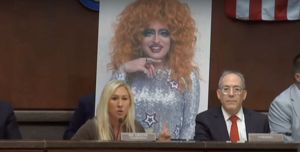
House Republicans and Democrats sparred on Tuesday over codifying cuts proposed by the Department of Government Efficiency.
U.S. Rep. Marjorie Taylor Greene, R-Ga., said Congress needs to “lock in” DOGE’s $180 billion in cuts across the federal government at a House Oversight and Government Reform’s DOGE subcommittee.
“We need to make sure we lock in those savings, it should be the first installment we pay on our nation’s $37 trillion debt,” Greene said.
Greene also pointed to a $9 billion recessions package passed in the House that would make cuts to several international organizations, nongovernmental organizations as well as public media including NPR and PBS.
“Nine billion is just the tip of the iceberg of the waste DOGE has identified and of the spending that the administration has paused or shut off,” Greene added.
Witnesses before the panel highlighted some of DOGE’s cuts and said Congress needs to take control in order to make the DOGE cuts permanent.
Matthew Dickerson, a witness before the committee and director of budget policy at the Economic Policy Innovation Center, called for Congress to enact a 10% reduction across the federal workforce. He said this reduction would reduce discretionary spending on salaries by as much as $608 billion.
“The most straightforward way to control waste, fraud and abuse is by controlling agency budgets in the annual appropriations process,” Dickerson said.
David Burton, a senior fellow in economic policy at the Heritage Foundation, affirmed the importance of the appropriations process.
“Most of the personnel reductions, grant reductions and other reforms initiated by DOGE will not result in actual savings unless Congress takes action through appropriations bills,” Burton said.
Democrats on the committee disagreed with the sentiment of cementing DOGE cuts and pointed to several errors the agency has made in the past few months.
“While we came to the table at the beginning of the whole process in good faith, with real ideas, bipartisan ideas that folks have actually been working on for years and desire to actually fix and modernize the federal government, what we’ve seen from DOGE is the exact opposite,” Rep. Melanie Stansbury, D-N.M., said.
Democrats cited proposed cuts to healthcare services for veterans within the Department of Veterans Affairs. Rep. Jasmine Crockett, D-Texas, called for a subpoena of Elon Musk to investigate DOGE’s actions, which failed to pass.
Greene reaffirmed a commitment to implementing cuts proposed by DOGE and compared the government to “an overgrown, out of control animal.”
“We as lawmakers should pass new DOGE cuts every single day and make cutting waste, fraud and abuse our top priority,” Greene said.
“Instead of growing the government, we should be slashing the government. The government is far too big, it’s like an overgrown, out of control animal, and the American people are beginning to hate it,” she added.
Challenges persist for women, minorities breaking into Illinois’ skilled trades

Capitol News Illinois
PEORIA — For 60 years, SkillsUSA Illinois has held workforce development competitions for young people entering the trades. For 60 years, there has never been an all-female team competing in the architecture and construction team competition.
Until now, that is.
This April, students competed at the Peoria Civic Center in a bid to showcase their trades work skills, from barbering and cosmetics to house building and fixing cars. First-place winners in the Illinois competition earned eligibility to travel to Atlanta to compete in the national SkillsUSA Championships this week.
Amid the fanfare and cheer, however, the state competition highlighted some of the persistent challenges facing the Illinois workforce. As employers continue searching for skilled tradespeople to combat national worker shortages, entry into fields like construction remains strikingly low for women and people of color, particularly in higher paying and leadership positions.
SkillsUSA Illinois’ first all-girls team — Aubrey Levin, Kayhl Miles, Catelin Wesley and team captain Amyla Walls — did not know they were breaking boundaries until after they had finished their competition this spring in Peoria.
The team from the Bloomington Area Career Center reacted to the news with shocked laughter, followed by near immediate dread as they anticipated the heightened expectations and scrutiny of their work this title would bring.
“They’re going to be like, ‘You’re the first all-female team,’ and I’m going to be like, ‘Please don’t look at my electrical,’” Levin said, half laughing.
Although it may seem late for the existence of the first all-female team, it is consistent with the construction industry demographic trends in Illinois. Over the past 10 years, women have held fewer than one in 10 construction jobs. Prior to 2021, fewer than 5% of new construction apprentices in Illinois were women, according to data from the U.S. Department of Labor.
View Chart in New Tab
The problem is a national one. Although 2020 saw the largest number of women working in trades, only one in 20 U.S. construction workers was a woman, according to a report from the Institute for Women’s Policy Research.
Male construction workers were also better compensated than female construction workers in 2024, even for entry-level apprenticeship positions. New male apprentices earned an average wage of $23.76 per hour, 36 cents more than the average pay for their female counterparts.
The discrepancy grew for those who completed their apprenticeships, with an average hourly gender pay gap of $1.41.
Participation rates for workers of color also remained low, with white apprentices accounting for over three quarters of new registered apprenticeships in 2024.
View Chart in New Tab
Apprentices of color earn less on average than white apprentices, both at entry and completion. In 2024, newly registered Black apprentices earned on average 36 cents less in hourly wages than their white counterparts. For those who completed apprenticeships, the gap grew to almost $4 per hour.
As limited as the progress is, much of it has come in the last few years, according to Jayne Vellinga, executive director of the non-profit Chicago Women in Trades.
Vellinga attributes the momentum to “a perfect storm” of an expected construction boom and worker shortage, infrastructure investment and federal leadership on diversity initiatives.
“It did get people to think sort of outside the box in terms of how they were going to recruit a sufficient workforce to meet a large number of projects projected to come to the area and the retirement of experienced workers,” Vellinga said.
Since 2021, the state has invested heavily in the Illinois Works pre-apprenticeship program, which seeks to create a “qualified talent pipeline of diverse candidates in the construction and building trades.” Gov. JB Pritzker’s office announced an additional $19 million funding allocation to the program in April.
However, Vellinga said she is seeing a rollback in progress, pointing to President Donald Trump’s decision to rescind an executive order that had been in place since enacted by President Lyndon B. Johnson in 1965, which prohibited federal contractors from engaging in employment discrimination on the basis of race, color, religion, sex, sexual orientation, gender identity or national origin.
“I don’t know how it’s going to impact opportunities for women, but there is definitely a change in narrative also at the federal level, from ‘we need diversity on publicly funded projects’ to ‘don’t engage in diversity, equity and inclusion activities,’” Vellinga said.
In addition to outright hiring discrimination, Vellinga said many women’s careers are limited by gender stereotypes and harassment on job sites.
“Some women are doing well and are having an opportunity to move up, and other women do face discrimination, are unable to cobble together enough work during the year to make it a viable career, or perhaps the works site is so hostile that they walk away from it,” Vellinga said.
The hostility is something that the team of high schoolers was already familiar with.
House built by the all-girls team during the SkillsUSA Illinois Championships in April. (Medill Illinois News Bureau photo by Maggie Dougherty)
As SkillsUSA Illinois’ first all-girls team spent two days using their carpentry, roofing, electrical and plumbing skills to build a small house, they were subjected to disparaging, gender-based comments, which the team diplomatically referred to as “construction language.”
It is not something unique to this competition, they said. Levin recalled asking women in the construction unions about their advice on entering tradework. They told her she would need to have thick skin.
“Even now?” Levin asked. Especially now, they replied.
The team described their male peers making jokes with double meanings, and then getting irritated if the girls did not laugh.
“You’re like a bad person for not laughing at a really bad joke,” Miles said.
One such joke came at Levin’s expense, while she was standing on a ladder and trying not to cry from pain after being hit in the back by something on site. A team nearby pointed and laughed at her, she said. A teacher walked by and told Levin to let it out if she needed to.
“Not here,” Levin said. “You can’t cry, because then you’re soft.”
On the other hand, if they got mad, Levin said, a male peer would inevitably ask, “What, are you on your period or something?”
The girls said they are held to a higher standard, as any sign of emotion will be used to prove that they are incapable of matching their male peers. If they stop for a second, they will be called lazy or asked whether they broke a nail, the team said. The job requires a strong poker face, Miles added.
And, Walls said, their judgment is constantly called into question. She recounted a male peer repeatedly correcting her and speaking to her like a child, before eventually concluding she was correct all along.
A national survey of women exiting the trades found that the most common reason women left the trades was due to harassment and lack of respect; nearly half of those who left or had strong intentions to leave marked this as their reason for doing so. Over a quarter of women in the study also indicated that they frequently or always saw sexually explicit and racist graffiti; a fifth responded the same for anti-semitic graffiti.
The second most common reason for exiting, selected by over 40% of those with strong intentions to leave, was a lack of prospects for promotion and advancement. The least selected option was that the work was too physically demanding.
Manny Rodriguez looks down the street in front of Revolution Workshop. (Medill Illinois News Bureau photo by Maggie Dougherty)
The perception that women are less competent exacerbates other structural barriers to employment, according to Manny Rodriguez, executive director of the Chicago-based nonprofit Revolution Workshop, which offers workforce development programs targeted at communities of color who have been underrepresented in the trades.
Construction is a tough business for anyone, Rodriguez said. A recent paper by the RAND Corporation found that almost 40% of apprentices drop out of their programs before completion, regardless of race or gender, with almost half of those dropping out in the first six months.
Part of the issue is stability of work, such as making it through the cold season when opportunities for new construction projects dip, according to Rodriguez.
“In the wintertime, you can’t pour concrete. You can’t weld. If the structure is not already up, you pretty much got to wait until spring,” Rodriguez said.
Employer biases mean that women and people of color may be hired for jobs, but not retained for the next one, resulting in more instability for those workers, Rodriguez said. As a result, apprenticeship completion rates for women and people of color are even lower.
In 2023, women accounted for 4.5% of U.S. construction apprentices, but 6% of cancellations, according to U.S. Department of Labor data. A study by The Institute for Construction Employment Research found that over the last two decades, around two-thirds of Black construction apprentices did not complete their programs.
Hispanic workers have maintained a high share of workforce participation in the construction industry, but often in lower paying, physically intensive roles, resulting in higher rates of both fatal and nonfatal injuries on the job.
“Latinos are represented in construction, but where?” Rodriquez asked. “I’m not the electrician, I’m not the plumber, I’m not the heavy equipment operator, I’m not the pipe fitter. So you got no problem breaking my brown body, but you’re not letting me do the other things.”
Many women and people of color who do make it in construction attribute their success, at least in part, to having others who look like them in the field.
A competitor focuses during the SkillsUSA Illinois TeamWorks competition. (Photo courtesy SkillsUSA Illinois)
In the survey of tradeswomen, almost two thirds of respondents identified mentorship from senior tradeswomen as important to their recruitment and advancement. It was something the all-girls team said was valuable as well.
“If we passed a construction site, and they were working, I always got excited when I saw a girl,” said Miles. “I was happy about it, because I’m like, I’m not the only one who actually enjoys this.” Other members of the team agreed.
But Walls, the only Black member of the team, sees fewer women in construction who look like her.
“I don’t see a lot of women, let alone,Black women, doing construction,” Walls said. “I wish I had someone to relate to.”
That is part of the reason why breaking this barrier was important, for the girls on the team and for those who will come after them.
“It doesn’t matter if we win,” Wesley said. “The fact that we have taken a step like this for us, but also for other females in the trades, it’s a huge deal.”
Maggie Dougherty is a graduate student in journalism with Northwestern University’s Medill School of Journalism, Media, Integrated Marketing Communications, and a fellow in its Medill Illinois News Bureau working in partnership with Capitol News Illinois.
Capitol News Illinois is a nonprofit, nonpartisan news service that distributes state government coverage to hundreds of news outlets statewide. It is funded primarily by the Illinois Press Foundation and the Robert R. McCormick Foundation.
The post Challenges persist for women, minorities breaking into Illinois’ skilled trades appeared first on Capitol News Illinois.
Trump: Ceasefire reached between Israel, Iran
Hours after Iran launched retaliatory strikes against the U.S. for striking its three key nuclear facilities, President Donald Trump announced a ceasefire deal has been reached between Israel and Iran.
The president is touting the deal as a “complete and total ceasefire” in a Truth Social post Monday afternoon.
Trump spent the afternoon with his national security team; it is unclear if the meeting was used to iron out the ceasefire details.
“CONGRATULATIONS TO EVERYONE! It has been fully agreed by and between Israel and Iran that there will be a Complete and Total CEASEFIRE (in approximately 6 hours from now, when Israel and Iran have wound down and completed their in progress, final missions!), for 12 hours, at which point the War will be considered, ENDED! Officially, Iran will start the CEASEFIRE and, upon the 12th Hour, Israel will start the CEASEFIRE and, upon the 24th Hour, an Official END to THE 12 DAY WAR will be saluted by the World,” Trump explained.
“During each CEASEFIRE, the other side will remain PEACEFUL and RESPECTFUL. On the assumption that everything works as it should, which it will, I would like to congratulate both Countries, Israel and Iran, on having the Stamina, Courage, and Intelligence to end, what should be called, ‘THE 12 DAY WAR.’ This is a War that could have gone on for years, and destroyed the entire Middle East, but it didn’t, and never will! God bless Israel! God bless Iran, God bless the Middle East, God bless the United States of America, and GOD BLESS THE WORLD!” Trump concluded.
As the president mentioned in his post, the conflict, or war, began June 12 after Iran rejected negotiations to cease its enrichment of weapons-grade nuclear material. Israel launched targeted attacks on the Islamic Republic.
Israel and the U.S. maintained that Iran was merely weeks from building nuclear weapons, thus endangering Israel and the Middle East.
The two countries exchanged a barrage of missiles, with Israel eventually gaining air superiority over Iran.
A turning point in the conflict came Saturday night when the U.S. launched strikes, called Operation Midnight Hammer. The strikes “obliterated” — in Trump’s words — Iran’s top three nuclear facilities, including Fordow, Natanz and Isfahan.
B-2 stealth bombers out of Whiteman Airforce Base in Missouri were used to drop several 30,000 bunker busters to destroy Fordow and Natanz. At the same time, dozens of Tomahawk missiles fired from a submarine were used to destroy Isfahan.
On Monday, Iran launched over a dozen missiles targeting the U.S. Al Udeid Air Base in Qatar. The attack was thwarted, and no injuries were reported. In a social media post following the strike, the president brushed off the attack, claiming Iran needed to blow off steam. He indicated the U.S. received prior notice of the attack, allowing them to prepare.
The ceasefire comes less than a week after the president claimed he wasn’t negotiating a ceasefire between the two countries.
What to watch for from NATO 2025 summit
President Donald Trump will head to the 2025 North Atlantic Treaty Organization summit at The Hague on Tuesday. Here’s what to expect from this year’s summit.
Defense spending targets
Formed by the United States, the United Kingdom, and 10 other western nations in 1949 to counter the expansion of Soviet influence throughout Europe, NATO today has 32 member nations.
In 2014, NATO member countries agreed on a minimum defense spending target of 2% of their national GDPs. Members were to aim to reach that target by 2024. Not all of the members had reached the 2% benchmark as of last year.
Trump has repeatedly complained about member countries not meeting defense spending targets, while the U.S. has never devoted less than 3% of its GDP to defense spending. During his first term, Trump threatened to withdraw the U.S. from the organization because of this imbalance, often implying that NATO members benefit much more from America’s membership than the other way around.
While withdrawal never happened, that appeal has become even more relevant because of the ongoing war between Russia and Ukraine. In 2025, Trump has repeatedly urged member countries to raise their defense spending to 5% of their national GDP, insinuating that the U.S. is footing the bill for their security by contributing more to Ukraine’s defense.
Higher spending targets likely
Former Netherlands Prime Minister and NATO Secretary General Mark Rutte on Monday made it sound like the group is going to commit to the 5% spending target Trump has stressed.
“As the world becomes more dangerous, Allied leaders will take bold decisions to strengthen our collective defense, making NATO a stronger, a fairer and a more lethal Alliance,” Rutte said.
“This will include a major new defense investment plan, ranging the benchmark for defense investment to 5% of GDP, a concerted effort to ramp up defense industry across the Alliance, bringing not only greater security, but also more jobs and a continued focus on support for Ukraine, alongside the pursuit of a just and lasting end to Russia’s war of aggression. All of this is essential to keeping our 1 billion citizens safe.”
Negotiables
One of the details that may emerge from the summit is a deadline for reaching the 5% target. There has been discussion of a 2035 or even a 2032 deadline.
Rutte has also suggested that the 5% target be broken down into two categories: 3.5% for “core defense capabilities” and 1.5% as more discretionary defense spending. An as yet unanswered question is whether members will agree that aid to Ukraine can count toward that 1.5% target.
The Russia Ukraine war
Trump has made it clear that he simply wants to see an end to the Russia Ukraine war and that American aid to Ukraine’s efforts is going to flow less freely than it did under the Biden administration. Some European leaders have stood firmly with Ukrainian President Volodymyr Zelenskyy in emphasizing that any type of agreed to ceasefire must include strong commitments from Russia to a lasting peace. Trump has shown less interest in those kinds of preconditions and it’s not expected that the U.S. will budge during the summit.
Pritzker OKs changes to Prisoner Review Board following years of controversy
Capitol News Illinois
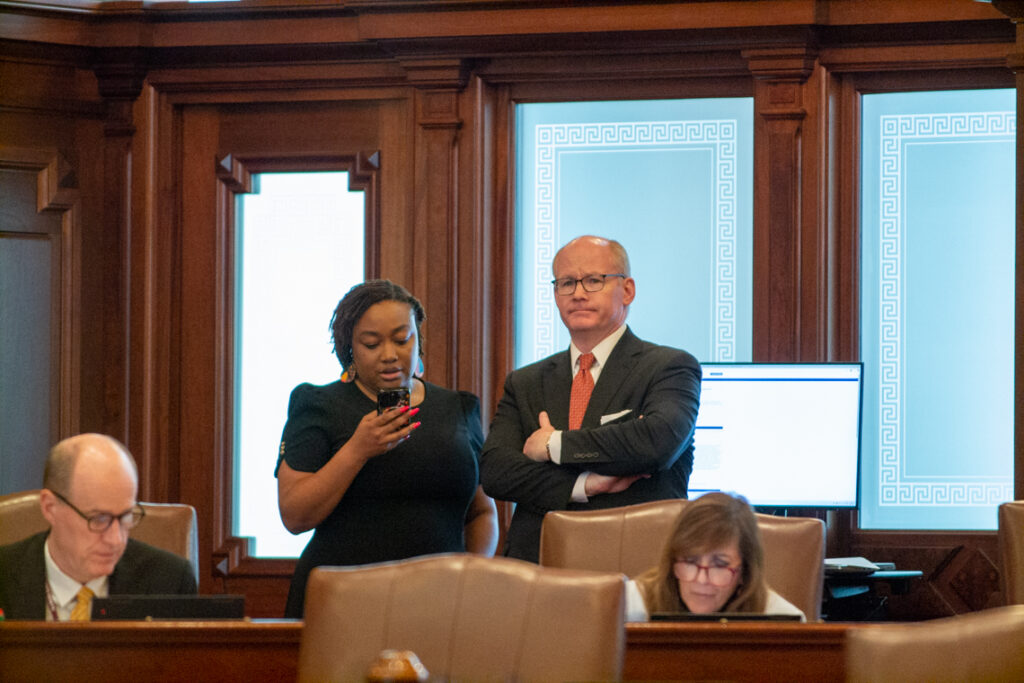
Gov. JB Pritzker signed a new law Friday to make a series of changes to the Prisoner Review Board after it released a man who would go on to commit murder, leading to intense scrutiny in Springfield.
Pritzker signed Senate Bill 19, which contains changes designed to include victims’ participation in Prisoner Review Board decisions and ensure more board members have relevant law enforcement or judicial experience.
The law gives victims the right to file impact statements ahead of hearings, provides them with additional notice when their offender is granted early release, and allows them to seek an order of protection against an offender who is incarcerated.
It also creates the Office of the Director of Victim and Witness Services within the PRB, which would ensure the board complies with victims’ rights. The measure also mandates the board provide victims with contact information for the State Victim Assistance Hotline.
“The bulk of this bill is focused on … making sure that victims, survivors, are more engaged in the process at PRB because unfortunately, too often, we’ve heard from victims and family members that they simply haven’t been given a voice in this process,” bill sponsor Rep. Will Guzzardi, D-Chicago, said when the bill passed the House last month.
Read more: Prisoner Review Board reform bill clears Senate
The bill was approved by the Senate in April on a 33-22 vote, with some Democrats opposing it. The House voted 74-37 along party lines to send the bill to Pritzker’s desk in May. Republicans, who had for months been calling for broader reforms, criticized the bill.
Pritzker’s signature comes just two weeks after a man released by the PRB was found guilty of murdering 11-year-old Jayden Perkins at his Chicago home in March 2024.
Crosetti Brand was released from prison in 2023 after serving a sentence for a domestic violence conviction. After his release, Brand began threatening a former partner, Laterria Smith, and showed up to her home in February 2024, according to the Chicago Sun-Times. Brand was sent back to prison for violating the conditions of his release, and Smith filed for an order of protection. But a Cook County judge denied the order because Brand was behind bars.
On March 12, 2024, the PRB voted to release Brand citing a lack of evidence to keep him behind bars, the Sun-Times reported. The next day, Brand confronted Smith at her home and stabbed her and her son, Perkins, multiple times. Smith survived but Perkins did not. Brand was found guilty of first-degree murder and 16 other counts earlier this month.
Two board members, including the chair, resigned after Perkins’ death. Smith sued the board for negligence in March.
Read more: Prisoner Review Board sued for negligence a year after released prisoner killed Chicago boy
The case put even more scrutiny on the board, which was already in the spotlight over other controversial decisions to release people from prison.
In May 2024, the Senate unanimously passed a bill that would have made a series of reforms to the board, including requiring that certain meetings be livestreamed and board members receive additional training. The bill appeared ready to pass the House with 76 members signing on as cosponsors. But the bill was never called for a vote in the final hours of session after Pritzker had concerns about the feasibility of the livestreaming requirements and lack of funding for the board.
Read more: Stalled bills: ‘Dignity in Pay Act,’ Prisoner Review Board changes fail to move
Instead, lawmakers moved forward with the legislation signed by Pritzker on Friday, which Republicans opposed saying it doesn’t go far enough to meaningfully reform the board.
“After the Governor ignored our consistent and clear warnings, a horrible murder was triggered by a terrible decision by the Prisoner Review Board,” Sens. Jason Plummer, R-Edwardsville, and Steve McClure, R-Springfield, said in a statement. “Now, instead of listening to a bipartisan coalition at the capitol, he and his far-left allies pushed through a bill that makes it more difficult for the PRB to keep violent criminals off the streets.”
The new law also attempts to make the board more professional, Senate President Don Harmon, D-Oak Park, the Senate sponsor of the bill, said in April. It gives board members eight-year terms instead of six so they can be more focused on their decisions rather than their reappointment, he said. It also changes qualifications for board members, requiring seven out of the 15 board members have at least five years of experience as a law enforcement officer, parole officer, prosecutor, criminal defense attorney or judge.
Republicans opposed creating longer terms for board members, saying it reduces Senate oversight of the board and fails to hold board members accountable for decisions. The Senate is responsible for confirming the governor’s appointments to the board.
Capitol News Illinois is a nonprofit, nonpartisan news service that distributes state government coverage to hundreds of news outlets statewide. It is funded primarily by the Illinois Press Foundation and the Robert R. McCormick Foundation.
The post Pritzker OKs changes to Prisoner Review Board following years of controversy appeared first on Capitol News Illinois.
U.S. Iranian strikes draw support, criticism from Congress
The U.S. strikes on Iranian nuclear sites is drawing cheers and jeers from Congressional Democrats and Republicans.
President Donald Trump announced that the U.S. military had “successfully” carried out strikes on three of Iran’s major nuclear sites, including Fordow. The strikes mark the first time the U.S. have carried out an attack inside Iran.
Multiple reports indicated six B-2 stealth bombers based out of Whiteman Air Force Base in Missouri were used to carry out attacks on Fordow, while 30 Tomahawk missiles were fired from nuclear submarines.
Senate Majority Leader Sen. John Thune, R-S.D., led support for the military strikes, underscoring Iran’s threat on the West.
“The regime in Tehran, which has committed itself to bringing ‘death to America’ and wiping Israel off the map, has rejected all diplomatic pathways to peace. The mullahs’ misguided pursuit of nuclear weapons must be stopped. As we take action tonight to ensure a nuclear weapon remains out of reach for Iran, I stand with President Trump and pray for the American troops and personnel in harm’s way,” Thune posted to X.
Sen. Tim Kaine, D-Va., who introduced legislation to reign in the president’s power in carrying out such attack, sounded off on the strikes.
“The American public is overwhelmingly opposed to the U.S. waging war on Iran. And the Israeli Foreign Minister admitted [Friday] that Israeli bombing had set the Irania nuclear program back ‘at least 2 or 3 years.’ So what made Trump recklessly decide to rush and bomb today? Horrible judgment. I will push for all Senators to vote on whether they are for this third idiotic Middle East war,” Kaine posted on X.
House Speaker Rep. Mike Johnson, R-La., posted a lengthy statement in support of the president.
“The military operations in Iran should serve as a clear reminder to our adversaries and allies that President Trump means what he says. The President gave Iran’s leader every opportunity to make a deal, but Iran refused to commit to a nuclear disarmament agreement.
“President Trump has been consistent and clear that a nuclear-armed Iran will not be tolerated. That posture has now been enforced with strength, precision, and clarity. The President’s decisive action prevents the world’s state sponsor of terrorism, which chants ‘Death to America,’ from obtaining the most lethal weapon on the planet. This is America First policy in action. God bless our brave men and women in uniform — the most lethal fighting force on the planet — as we pray for their safe return home. May God bless America,” Johnson posted to X.
Rep. Thomas Massie, R-Ky., was one of the few Republicans to call out the president, declaring the strikes are “not Constitutional.”
Sen. John Fetterman, D-Pa., has bucked his party by showing staunch support for Israel and the president.
“As I’ve long maintained, this was the correct move by POTUS. Iran is the world’s leading sponsor of terrorism and cannot have nuclear capabilities. I’m grateful for and salute the finest military in the world,” Fetterman posted on X.
Minority Leader Rep. Hakeem Jeffries, D-N.Y., released a statement on the strikes, criticizing the president for failing to get congressional approval prior to the strikes.
“Donald Trump promised to bring peace to the Middle East. He has failed to deliver on that promise. The risk of war has now dramatically increased, and I pray for the safety of our troops in the region who have been put in harm’s way.
“President Trump misled the country about his intentions, failed to seek congressional authorization for the use of military force and risks American entanglement in a potentially disastrous war in the Middle East.
“First, the Trump administration bears the heavy burden of explaining to the American people why this military action was undertaken. Second, Congress must be fully and immediately briefed in a classified setting. Third, Donald Trump shoulders complete and total responsibility for any adverse consequences that flow from his unilateral military action,” Jeffries said in a statement.
SPD investigating attack on journalist during Antifa protests
Seattle Police are investigating an attack on an independent conservative journalist last weekend during anti-Trump and anti-ICE rallies in Seattle.
Cam Higby says he was assaulted by Antifa members as he attended the sometimes violent “No Kings Day” protests in Seattle at a Department of Homeland Security Building on June 14.
Separately, independent journalist Brandi Kruse says she also was assaulted by Antifa members in Tukwila, just south of Seattle. Both attacks were captured on video posted to social media.
“It was out of nowhere, completely out of nowhere that they got violent,” said Higby, whose attack was captured on vide and posted to X. The attack left him bloodied, bruised and with a concussion that is still causing headaches, vision impairment and memory issues nearly a week later, he said.
Lawson allegedly brutally assaulted independent journalist Cam Higby as he was reporting on an Antifa anti-ICE direct action near the federal building in Seattle on June 14, video evidence shows. pic.twitter.com/rorgkpacF5— Katie Daviscourt 📸 (@KatieDaviscourt) June 16, 2025
In a Friday interview, Higby told The Center Square he had been covering the protests in Seattle all day and took a seat on the ground near the federal building by himself when the assailants came out of nowhere.
“They took over the streets, they lit fires to cars, they shot fireworks at cars. Then it’s out of nowhere where this guy yells, ‘Hey Cam, it’s time for you to leave,’ and they charged me and I knew one of them and I’d identified him earlier in the night because he threatened to kill me three weeks earlier,” Higby told The Center Square
The attacker he was referring threatened to kill Higby in an Instagram post, he said, which was reported to police.
“They crossed the street to get to me and charged me and before I could stand up, I was pinned up against the wall,” said Higby. “They were grabbing at my gas mask and my helmet and just keeping me in place and one of them picked me up and choked me out from the rear. And then he released me, punched me twice in the head with SAP gloves which were filled with steal or lead shot. I turned around and somebody pulled him back and he kicked me in the face. I pulled out pepper spray and I nailed him in the face, and then I retreated and called 911 and then the police never showed up.”
Higby said he waited for police for about 45 minutes but they never came.
Video journalist Jonathan Cho, who was also covering protests, picked him up and took him back to his car across town, according to Higby.
Higby said he went to urgent care the next morning and then to the emergency room when his symptoms related to the concussion were getting worse.
“They said if I had a brain bleed, I’d already be dead. I think it’s very likely that if I wasn’t wearing a helmet, that I would have been either killed or critical,” Higby said.
Kruse, host of the unDivided video podcast, told The Center Square she had only been at the Tukwila protest scene for 30 seconds when she was attacked.
“I didn’t even get a chance to cover it. Within 30 seconds of walking up, I heard a couple of people shout, ‘that’s Brandi Kruse.’ And then they started to form around me, and initially it was they were blocking my camera with their umbrellas because they don’t want you to document their criminal conduct. And then they started spraying water at me, and then they got a little more aggressive,” Kruse said. “They were dumping full bottles of water and hurling bottles of water and it hit me a couple of times from behind.”
Kruse said she tried to walk away but was followed with protesters pushing signs into her face and continuing to hurl things at her.
“But the thing is they won’t let you walk away, and they don’t want you to walk away. I’m just sort of looking over my shoulder and then I see this individual coming from behind me to the right who had something that they were starting to spray. And you know, your mind goes in a million different places, and you don’t know what it could be, but as soon as it hit my eyes and I got the smell, I knew it was some sort of bug spray because it had that distinctive smell. We found out later it was this hornet and wasp killer that can spray like up to 20 feet,” said Kruse, who posted to social media video of the attack and security escort pouring water into her eyes to flush out the spray which she shared burned painfully for days.
In the assault on Higby, police say they know who the assailant is but have yet to make an arrest. Higby said he’s “10 thousand percent sure” it’s the same person who threatened him weeks before.
Higby told The Center Square he’s been informed that despite the seriousness of the assault, prosecutors may not be inclined to pursue charges.
Seattle Police responded to an email from The Center Square on Friday requesting details on the case and received the following response: “This case is an open and active investigation assigned to SPD’s homicide & Assault Unit. SPD policy prevents me from releasing suspect details or ‘leads,’” wrote Eric Munoz, detective in SPD media and public affairs.
Seattle Police Guild President Mike Solan told The Center Square in a Friday interview that he was skeptical as to whether prosecutors would pursue charges, despite the serious nature of the attack on Higby. He also condemned the lack of coverage in the mainstream media of the assaults on journalists.
“I think the bigger conversation here is why isn’t corporate media drawing attention to this political violence as they’re watching journalists get assaulted and it doesn’t appear to be covered by corporate media at all. My question is why, and the fact that that’s not happening is a major problem with what’s unfolding in our nation,” said Solan.
Kruse said she was also disappointed that members of the mainstream media have ignored the attack.
“I was getting text messages from former colleagues in television news in Seattle asking if I was OK, saying they saw the video, but then never reporting on it. So it’s not as if they’re oblivious … if these were the proud boys, or if these were right-wing extremists and they assaulted journalists, there’s no way that it wouldn’t be covered,” said Kruse.
Kruse said she’s been in contact with officials in the Trump administration who are paying attention to the case, but has also filed a police report with the Tukwila Police Department.
Advocates await action on bill protecting rights of immigrant students in Illinois
Capitol News Illinois
SPRINGFIELD — Immigration rights advocates in Illinois are anxiously awaiting the governor’s signature on legislation aimed at protecting K-12 students who may be in the country without legal authorization from being denied access to a free public education.
House Bill 3247, known as the “Safe Schools for All Act,” passed both chambers of the General Assembly in the final days of the spring session. It would prohibit schools from denying any child access to a free public education based on their actual or perceived immigration status, or that of their parents.
It would also prohibit schools from disclosing, or threatening to disclose, information about a student’s immigration status or the status of a person associated with the child. And it would require schools to develop procedures for reviewing and authorizing requests from law enforcement agents attempting to enter a school or school facility.
The bill is intended to buffer K-12 students in Illinois from efforts by the Trump administration to launch mass deportations of noncitizens living in the United States without legal authorization.
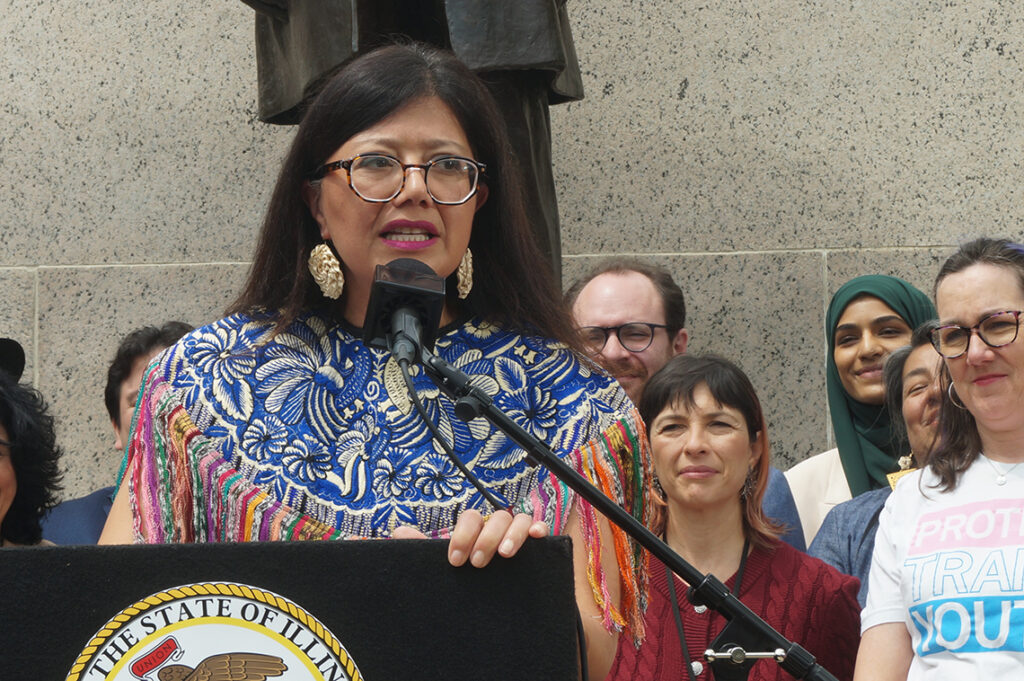
Speaking at a May 7 rally outside the Statehouse, where Democratic lawmakers and immigration rights advocates protested an appearance in Springfield that day of Homeland Security Secretary Kristi Noem, state Sen. Karina Villa, D-West Chicago, the chief Senate sponsor of the bill, vowed that Illinois would remain defiant of Trump’s political agenda.
“We are also going to protect our children,” she told the crowd gathered around a statue of Abraham Lincoln. “We’re going to make them feel safe in our schools by passing HB 3247. We are going to unite and we are going to get that done.”
On Jan. 20, the first day of the new administration, the Department of Homeland Security rescinded a Biden-era policy that prevented federal agents from conducting immigration enforcement actions in certain “sensitive” areas, including schools, churches and hospitals.
Immigrant rights advocates demonstrate outside the Illinois Statehouse for legislation protecting rights of noncitizens, including a bill meant to ensure the right of a free public K-12 education, regardless of a child’s immigration status. (Capitol News Illinois photo by Peter Hancock)
Fred Tsao, an attorney for the Illinois Coalition for Immigrant and Refugee Rights, said during an interview that the policy change has had a chilling effect on the immigrant community, making many afraid to even show up in school.
“We have seen a decline in student participation, particularly among heavily Latino schools after this inauguration,” he said. “So we want to make sure that schools are prepared in the events that federal agents, or for that matter other law enforcement, come to their door in a nonemergency situation.”
Tsao said advocates have also been concerned about possible changes in other legal protections for immigrant students that so far have only been expressed in judicial opinions.
In 1982, the U.S. Supreme Court struck down a Texas statute that authorized local school districts to either deny enrollment to children who had not been “legally admitted” to the United States, or to charge them tuition, holding the law violated the Equal Protection Clause of the 14th amendment.
Tsao, however, said there have been attempts in other state legislatures, including earlier this year in Tennessee, to pass legislation that would challenge that 43-year-old ruling. And while the effort in the Tennessee legislature fell short this year, he said advocates in Illinois wanted to act now to make sure the rights of immigrant students are protected in state law, should the Supreme Court precedent ever be overturned.
“Fortunately, our counterparts in Tennessee, the immigrant advocacy organizations and community leaders, bombarded the General Assembly with advocacy work and were able to persuade a number of legislators to vote against this legislation when it came down to it,” he said. “But you know, that’s not to say that folks in Tennessee or folks in other states won’t try again.”
As of Wednesday, June 18, HB 3247 had not yet been sent to Gov. JB Pritzker.
Capitol News Illinois is a nonprofit, nonpartisan news service that distributes state government coverage to hundreds of news outlets statewide. It is funded primarily by the Illinois Press Foundation and the Robert R. McCormick Foundation.
The post Advocates await action on bill protecting rights of immigrant students in Illinois appeared first on Capitol News Illinois.